


Meta posted a record quarter, and investors are buying today's results. Shares rose after hours by approx. 3.5% to around $720. Revenue grew by 26% YoY to $64.6 billion, clearly beating expectations. Financial guidance for Q4 also came in above consensus. Behind the main numbers, however, lies a story rarely seen at Meta in recent times. Capital expenditures in Q3 reached nearly $35 billion, and free cash flow dropped into negative territory at -$2.1 billion. In what may prove crucial regarding development financing, management also announced a new non-voting share class and explicitly stated it is intended to help raise capital for AI, among other things. For now, the market is paying for growth and not worrying about the bill. However, Meta is no longer funding the AI race solely from its own profits.
Key Data (Q3 2026)
- Revenue: $64.60 billion vs. $63.33 billion expected (+26% YoY)
- Advertising Revenue: $63.06 billion vs. $61.85 billion expected (+26% YoY)
- Family of Apps, Revenue: $64.16 billion vs. $62.75 billion expected
- Reality Labs, Revenue: $443 million vs. $517.7 million expected (-6% YoY)
- EPS (GAAP): $3.83 vs. $3.56 expected; $7.40 excluding legal write-off
- Operating Income (GAAP): $12.99 billion (-37% YoY), margin 20% vs. 40% a year ago
- Operating Income ex-legal write-off: $22.88 billion vs. $20.85 billion expected, margin approx. 35%
- Reality Labs Operating Loss: $4.13 billion vs. $5.13 billion expected
- Write-off for settlement with state attorneys general: $9.89 billion
- Capex (incl. finance leases): $34.91 billion (+80% YoY)
- Free Cash Flow: -$2.12 billion vs. +$10.6 billion a year earlier
- Q4 Revenue Guidance: $73–$76 billion vs. consensus of approx. $73.6 billion
- Full-Year 2026 Capex Guidance: $135–$145 billion (previously $130–$145 billion)
- Daily Active People (DAP): 3.64 billion (+3% YoY)
- Headcount: 66,775 employees (-15% YoY)
- Market Reaction: approx. +3.5% after hours, to around $720 (close: $697.52)
Family of Apps: Advertising in Its Best Shape in Years
Meta's core business remains the backbone and is very strong. Advertising revenue grew 26% YoY, even when excluding foreign exchange impacts. At this scale, that is an exceptional result. The source of growth is important: ad impressions grew 10% YoY, while the average price per ad increased 14% YoY. Prices are rising despite a much higher ad supply because advertisers are getting better results and can afford to pay more. Management attributes this to AI: more relevant content recommendations, higher engagement, and better ad targeting. Naturally, in the context of Poland, Meta's actions might seem controversial, but even despite various blocks in other markets, the company continues to earn more and more from ads (including misleading ones).
The user base is losing momentum, but is still growing slightly (DAP +3% YoY to 3.64 billion). Thus, growth is driven primarily by monetization rather than new users. This underpins Meta's current investment narrative: AI in advertising is generating real earnings.
Operating income for the segment reached $17.12 billion, which is understated because the entire legal write-off went to Family of Apps. Without it, the result would have reached around $27 billion at a margin of approx. 42%. This remains a very high level, though lower than last year. Costs are growing faster than revenues:
- cost of revenue: +45% YoY
- R&D: +32% YoY, reaching $20 billion in a single quarter
- depreciation & amortization: +44% YoY, a direct consequence of building data centers
Reality Labs: Smaller Losses, Lower Ambitions
Reality Labs, the metaverse, VR, and smart glasses division, lost $4.13 billion in the quarter. That is $1 billion less than the market expected. However, segment revenues fell by 6% YoY to just $443 million. The business didn't suddenly start performing better; rather, priorities are shifting: Meta is reallocating funds from the metaverse to AI.
Segment losses are projected at $18–$19 billion in 2026 and around $15 billion in 2027. This is good news for investors, as the segment was seen for years as a cash burn pit. However, it is hard to speak of actual savings when the spared cash is redirected into an even more capital-intensive endeavor.
What to Watch For in Meta's Report?
Capex and Cash Flows. This is the central theme of the report. Operating cash flows reached a solid $32.8 billion, but capital expenditures absorbed $34.9 billion. As a result, free cash flow dipped into negative territory. Nine months into the year, FCF stands at $11 billion compared to $29.5 billion a year ago.
The capex forecast for 2026 is $135–$145 billion. The midpoint aligns with consensus (approx. $139.7 billion), and the upper limit remained unchanged. The market reacted with relief to the lack of a negative surprise. Simple math, however, reveals the scale of spending. After three quarters, Meta has spent approx. $85.8 billion. That leaves $49–$59 billion for Q4, up to 70% more than in Q3. Consequently, negative FCF could repeat. The company provided no guidance for 2027, stating only that it will continue investing "aggressively."
Balance Sheet. Cash and marketable securities total $82.45 billion. Long-term debt increased since the start of the year from $58.7 to $80.9 billion, as the company issued $24.9 billion in bonds in 2026. Net cash has therefore dropped to nearly zero. In 2026, Meta did not repurchase a single share, whereas in the same period last year it spent $26.2 billion on buybacks. Funds previously dedicated to share buybacks are now flowing into data centers.
New Class C Shares. Starting January 19, 2027, Meta will introduce publicly traded Class C non-voting shares. Each shareholder will receive one Class C share for every Class A or Class B share held. Economically, this acts as a 2-for-1 stock split, which is how the market initially interpreted it. However, the objective behind it is key. Management explicitly lists capital raising, employee compensation, and acquisitions as primary motives. Meta gains a currency it can issue without diluting Mark Zuckerberg's control, similar to Google's move in 2014. The message is clear: the scale of AI investments exceeds funding capacity from profits alone, making share issuances a realistic option.
Legal Matters. The $9.89 billion write-off relates to a settlement with 52 state attorneys general regarding social media's impact on teen mental health. The total value of the settlement is up to approx. $18.6 billion. Shortly before the results were published, a court in New Mexico ordered Meta to pay $25 billion in a lawsuit concerning misleading users about data privacy. The company itself warns of further lawsuits involving young users. Legal risk is becoming a permanent line item in operational costs.
AI and Muse. The Muse assistant surpassed 10 million downloads, and Meta's stock gained nearly 20% in the month following its release. The company also unveiled Muse Wonder, its first frontier-class model, and announced a business line offering AI tools for enterprise clients. However, Meta itself admits that investments in Meta Superintelligence Labs will yield returns more slowly than those in the core business. Subscriptions at $20 and $100 per month represent a promising start, but for now Muse is building adoption rather than financial results.
Summary
The market is rewarding Meta for what it sees here and now. Advertising revenue grew 26% YoY, ad prices rose by double digits, Reality Labs lost less, Q4 guidance beat expectations, and capex brought no fresh negative surprises. On top of that comes a stock split, which always sells well. The ~3.5% after-hours gain fits into the trend of recent weeks, as the stock has gained nearly 20% since the release of Muse.
However, this report also highlights the cost of an "all-in on AI" strategy. Capex is up 80% YoY, free cash flow turned negative, net cash disappeared, share buybacks are paused, and a new share class is designed to assist in funding upcoming investments. Furthermore, the reported profit reflects heavy legal liabilities.
Investors received two signals at once. First: AI is already tangibly improving ad monetization, and for some time now, the company has proven that AI can generate revenue. Second: the bill for the next stage of the race is so high that even one of the world's most profitable companies is preparing an additional capital source. Today's market reaction indicates that investors continue to give Zuckerberg the benefit of the doubt. How long that lasts will depend on Muse and Superintelligence Labs—specifically, whether they begin generating profits before patience with negative FCF runs out.
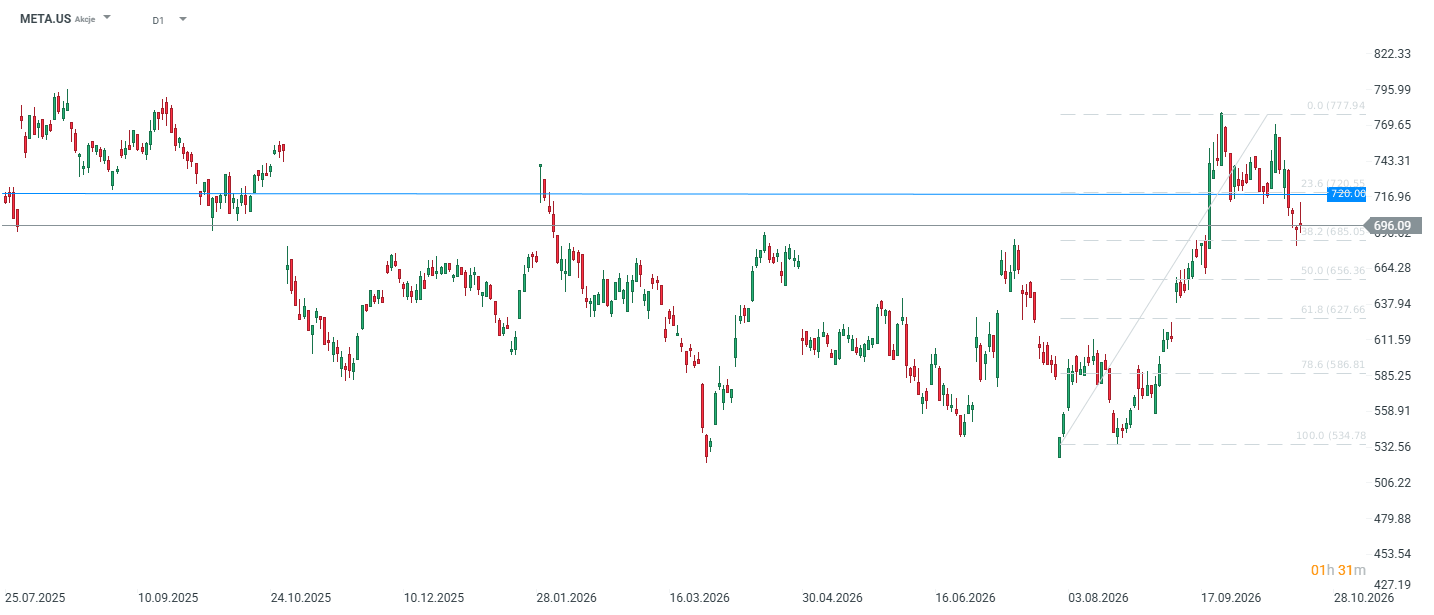 Looking back at recent weeks, Meta's stock chart looks spectacular: approx. 30% gain from the August low. The stock paused at a key support level stemming partly from the 38.2% Fibonacci retracement. On the other hand, year-to-date growth stands at around 6%. The company is significantly underperforming sectors such as energy.
Michał Stajniak, CFA
Head of Research at XTB


Tesla was supposed to burn $5 billion, but posted a positive result. Will Tesla still be a car company in a year?


Daily Summary: SpaceX and the tech sector drive Wall Street, oil retreats sharply below $97


US OPEN: Preparations for Tesla's mega-merger with SpaceX. Diplomatic stalemate with Iran cools Wall Street's enthusiasm

Tesla Preview: Will Robotaxis Save Earnings?
The content of this report has been created by XTB S.A., with its registered office in Warsaw, at Prosta 67, 00-838 Warsaw, Poland, (KRS number 0000217580) and supervised by Polish Supervision Authority ( No. DDM-M-4021-57-1/2005). This material is a marketing communication within the meaning of Art. 24 (3) of Directive 2014/65/EU of the European Parliament and of the Council of 15 May 2014 on markets in financial instruments and amending Directive 2002/92/EC and Directive 2011/61/EU (MiFID II). Marketing communication is not an investment recommendation or information recommending or suggesting an investment strategy within the meaning of Regulation (EU) No 596/2014 of the European Parliament and of the Council of 16 April 2014 on market abuse (market abuse regulation) and repealing Directive 2003/6/EC of the European Parliament and of the Council and Commission Directives 2003/124/EC, 2003/125/EC and 2004/72/EC and Commission Delegated Regulation (EU) 2016/958 of 9 March 2016 supplementing Regulation (EU) No 596/2014 of the European Parliament and of the Council with regard to regulatory technical standards for the technical arrangements for objective presentation of investment recommendations or other information recommending or suggesting an investment strategy and for disclosure of particular interests or indications of conflicts of interest or any other advice, including in the area of investment advisory, within the meaning of the Trading in Financial Instruments Act of 29 July 2005 (i.e. Journal of Laws 2019, item 875, as amended). The marketing communication is prepared with the highest diligence, objectivity, presents the facts known to the author on the date of preparation and is devoid of any evaluation elements. The marketing communication is prepared without considering the client’s needs, his individual financial situation and does not present any investment strategy in any way. The marketing communication does not constitute an offer of sale, offering, subscription, invitation to purchase, advertisement or promotion of any financial instruments. XTB S.A. is not liable for any client’s actions or omissions, in particular for the acquisition or disposal of financial instruments, undertaken on the basis of the information contained in this marketing communication. In the event that the marketing communication contains any information about any results regarding the financial instruments indicated therein, these do not constitute any guarantee or forecast regarding the future results.