



One of the less exciting, yet moderately important U.S. companies reporting earnings today was Ross Stores.
Ross Stores operates several discount retail chains, meaning stores aimed at less affluent customers. Ross Stores’ stated and target customer group is “middle income,” but looking at the U.S. retail landscape, the USD 80,000 to 90,000 annual income bracket that dominates among Ross Stores customers is hard to describe as “middle income” in the current environment.
Earnings
The headline financial figures were good, though meaningfully distorted.
- Revenue rose to USD 6.3 billion, slightly above the consensus of about USD 6.15 billion.
- Comparable sales (like for like) increased by 10%. The report indicates this growth was a mix of higher engagement from existing customers and an influx of new ones.
- EPS (GAAP) came in at USD 2.66 versus the USD 1.94 consensus. Crucially, USD 0.60 of that total came from a refund of customs duties. After adjusting for this, EPS beat consensus by 6%, not 37%.
- Despite the significant impact from tariffs, operating margin improved organically by 205 basis points, so the company showed a real, not merely on paper, improvement in operating efficiency.
Investors reacted most positively to the clear upward revision of growth forecasts for the coming quarters. This reflects noticeably higher traffic in the company’s stores.
Ross Stores price chart (D1)
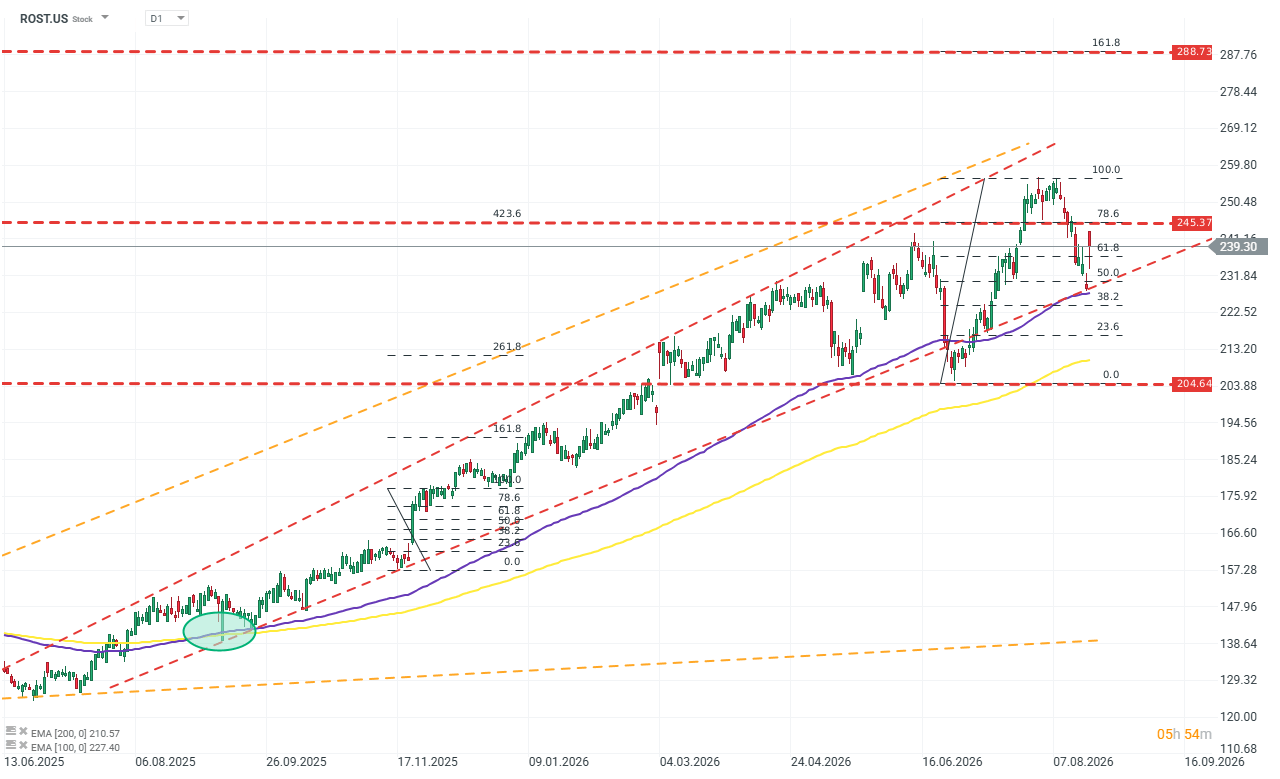
In the context of Ross’s own rally and potential positioning for a “recession,” a retailer with “only” a decent growth pace and a P/E of around 33 suggests that a meaningful premium tied to a weakening consumer is already priced in. Source: xStation5
Macroeconomic implications
More interesting than the results themselves are the macroeconomic observations suggested by the latest quarter’s results from retailers and consumer companies. Two important trends are visible, and they closely mirror what is happening in the broader economy.
Budget retailers such as Ross and Target handled earnings well. Mid to upper mid priced brands also did well, such as Estée Lauder. Meanwhile, previous market leaders like Walmart and Costco fell sharply after earnings. Why?
In July, U.S. retail sales declined by 0.6% month over month, the first drop in nine months. At the same time, they were 5% higher than a year earlier. Earlier data pointed to continued growth in real consumption, but also a decline in the savings rate to 2.7%. This means demand remains resilient, although households’ financial buffer is shrinking.
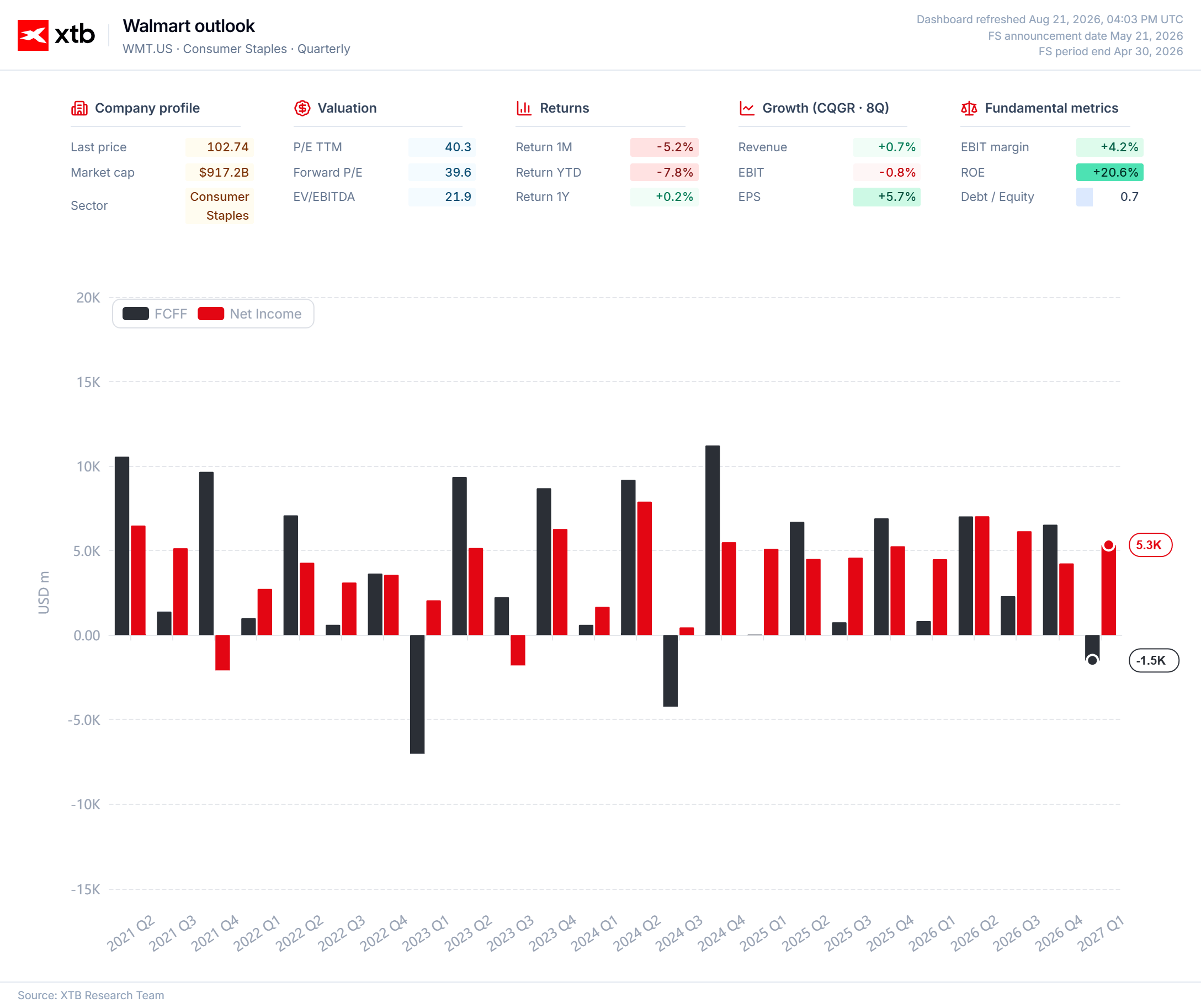
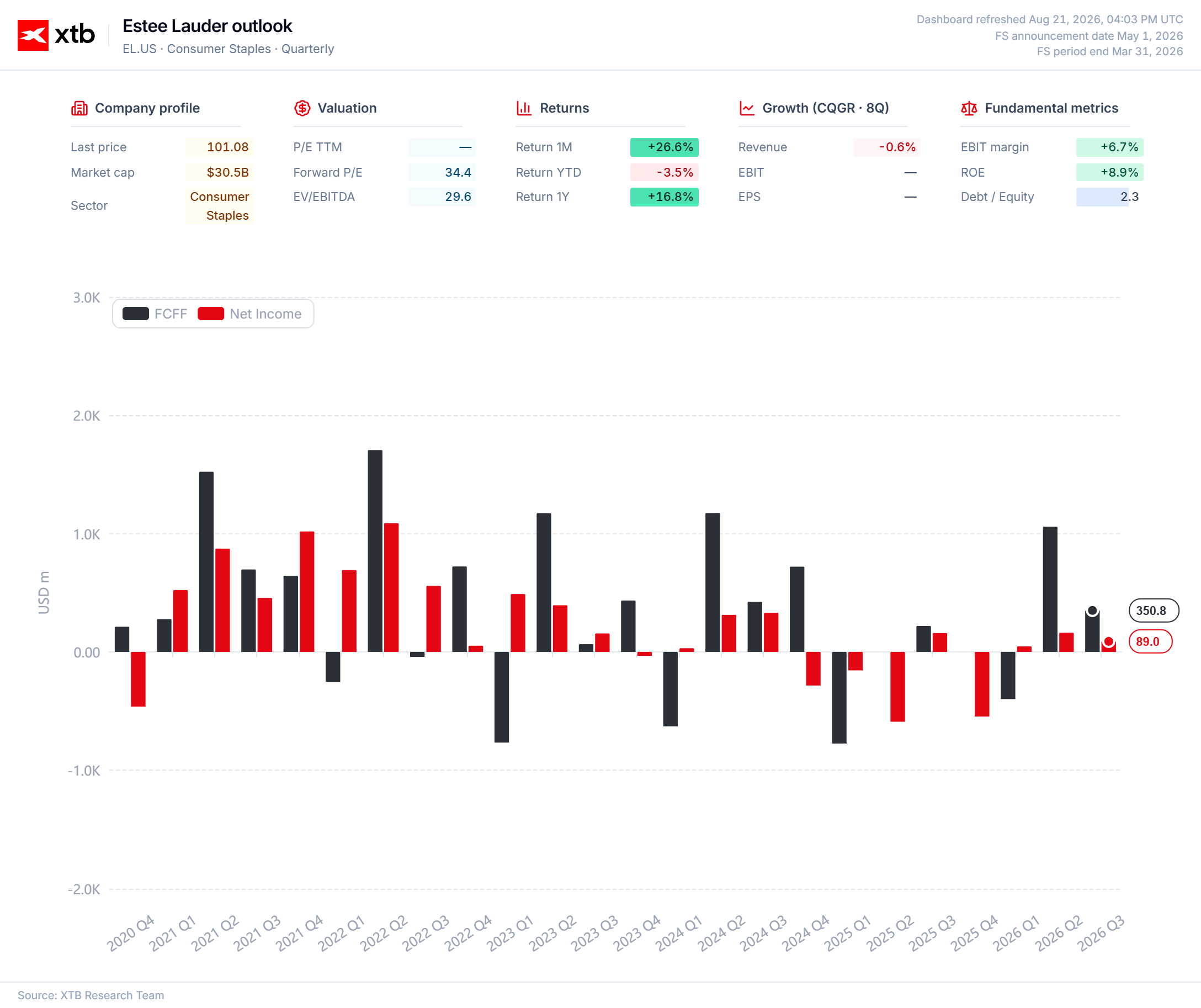
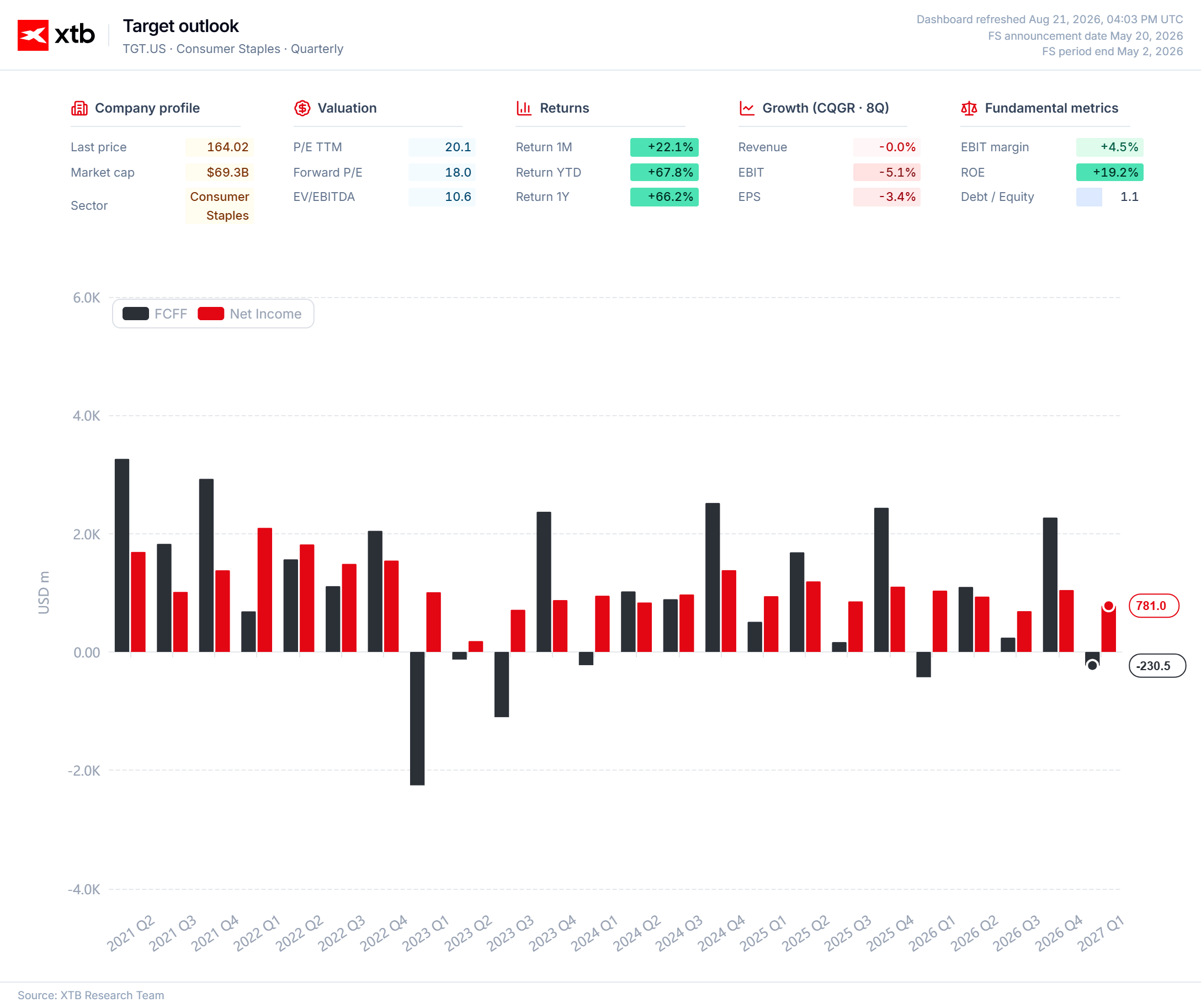
In such a situation, companies that offer households the best price to quality ratio benefit, as do “aspirational” brands focused on customers who are not yet under financial pressure.
As with retailers’ earnings, everything suggests that consumption growth is becoming lower quality and more fragile. Cost pressure from expensive gasoline, which affects consumers as well as distributors and producers, will only reinforce the current trends.



Three markets to watch next week (23.10.2026)



Daily Summary: Oil at five-month highs, indices under pressure (23.10.2026)

US Open: Further declines on Wall Street, Brent above 111 USD, AI correction continues (14.10.2026)

Chart of the Day: Is USDJPY running out of road? Inflation forces the BoJ to act, but the Fed could spoil the Yen’s rally
The content of this report has been created by XTB S.A., with its registered office in Warsaw, at Prosta 67, 00-838 Warsaw, Poland, (KRS number 0000217580) and supervised by Polish Supervision Authority ( No. DDM-M-4021-57-1/2005). This material is a marketing communication within the meaning of Art. 24 (3) of Directive 2014/65/EU of the European Parliament and of the Council of 15 May 2014 on markets in financial instruments and amending Directive 2002/92/EC and Directive 2011/61/EU (MiFID II). Marketing communication is not an investment recommendation or information recommending or suggesting an investment strategy within the meaning of Regulation (EU) No 596/2014 of the European Parliament and of the Council of 16 April 2014 on market abuse (market abuse regulation) and repealing Directive 2003/6/EC of the European Parliament and of the Council and Commission Directives 2003/124/EC, 2003/125/EC and 2004/72/EC and Commission Delegated Regulation (EU) 2016/958 of 9 March 2016 supplementing Regulation (EU) No 596/2014 of the European Parliament and of the Council with regard to regulatory technical standards for the technical arrangements for objective presentation of investment recommendations or other information recommending or suggesting an investment strategy and for disclosure of particular interests or indications of conflicts of interest or any other advice, including in the area of investment advisory, within the meaning of the Trading in Financial Instruments Act of 29 July 2005 (i.e. Journal of Laws 2019, item 875, as amended). The marketing communication is prepared with the highest diligence, objectivity, presents the facts known to the author on the date of preparation and is devoid of any evaluation elements. The marketing communication is prepared without considering the client’s needs, his individual financial situation and does not present any investment strategy in any way. The marketing communication does not constitute an offer of sale, offering, subscription, invitation to purchase, advertisement or promotion of any financial instruments. XTB S.A. is not liable for any client’s actions or omissions, in particular for the acquisition or disposal of financial instruments, undertaken on the basis of the information contained in this marketing communication. In the event that the marketing communication contains any information about any results regarding the financial instruments indicated therein, these do not constitute any guarantee or forecast regarding the future results.