

- The Bank of Russia sold 6.2 tonnes of gold in September, marking 10 consecutive months of sell-offs.
- Sales aim to finance a growing federal budget deficit driven largely by defense spending.
- Russia remains the sixth largest holder of global gold reserves despite recent reductions.

- The Bank of Russia sold 6.2 tonnes of gold in September, marking 10 consecutive months of sell-offs.
- Sales aim to finance a growing federal budget deficit driven largely by defense spending.
- Russia remains the sixth largest holder of global gold reserves despite recent reductions.
Scale and pace of sales
In September, the Bank of Russia sold 6.2 tonnes of gold (200,000 ounces), bringing official gold reserves down to 2,264–2,282 tonnes, the lowest level since late 2019. This marks the tenth consecutive month of uninterrupted sell-offs, during which Russia has shed a total of approximately 62 tonnes of bullion since December 2025. This is the largest continuous sell-off of Russian gold reserves since the 1998 financial crisis, when the central bank sold 118 tonnes in just three months amid a rouble collapse and default. It is precisely against such risks that gold remains one of the key reserve assets for central banks worldwide. However, in Russia's case, the situation is somewhat different from the late 1990s.
Why is Russia doing this?
The answer is simple and confirmed by Central Bank Governor Elvira Nabiullina herself: it is a matter of budget financing, not panic or a currency crisis. Specifically:
- The Russian budget deficit is heading towards 7.3 trillion roubles in 2026, double original projections.
- Defense and security spending is expected to absorb 38% of the entire federal budget in 2026, after a fourfold increase since 2021.
- Gold sales are conducted primarily through the Ministry of Finance and the National Wealth Fund (NWF), rather than directly by the central bank as a currency intervention. Nabiullina stresses that this is a normal liquidity operation of the reserve fund, not a sign of crisis. It is worth noting that gold owned by the NWF is included in the broad basket of central bank reserves.
- Following the invasion of Ukraine in 2022 and the freezing of Russian dollar and euro assets by the West, gold became one of the few available, liquid reserve assets for the NWF, and the fund itself shrank from 555 tonnes in May 2022 to around 160 tonnes by the end of 2025.
Can a central bank finance the budget?
It is worth clarifying the mechanism, as it is sometimes confused with a standard transfer of central bank profits to the budget (a routine practice performed at year-end by institutions like the Fed or other central banks, passing operational surpluses as a "dividend" to the state).
Returning to the main topic, what Russia is doing is entirely different. The gold formally belongs to the National Wealth Fund (NWF), a Russian sovereign wealth fund historically fueled by oil and gas revenues and treated by the Ministry of Finance as a rainy-day buffer. The central bank merely administers these assets and operationally executes sales transactions; it is neither their owner nor beneficiary.
How does this work in practice? The NWF/Ministry of Finance sells gold, and the proceeds go directly to the budget to cover the deficit. The central bank earns nothing as an institution; it acts as an intermediary. This is why Nabiullina emphasizes that "the decline in reserves reflects operations of the Ministry of Finance and the NWF," defending the central bank's independence and distancing it from the impression that the institution is simply funding government spending.
Formally, this is not classic "monetary deficit financing"—a situation where a central bank directly buys government debt or prints money to cover spending, which is prohibited in most legal regimes due to the risk of hyperinflation and loss of currency credibility. Theoretically, state actions operate within established legal frameworks. Ultimately, selling gold is a transfer of already existing, previously accumulated wealth. It is more comparable to selling state enterprise shares than to printing money.
However, the line can be blurry: if gold is sold on the domestic market for roubles that subsequently fund the budget, the functional effect approaches an increase in money supply. If it is exported for hard currency (hence growing sales to China), it is a cleaner asset exchange without money creation. This ambiguity feeds analyst questions regarding how much operational independence the Bank of Russia retains versus acting as a fiscal tool supporting the war budget.
To whom is Russia selling gold?
The Bank of Russia does not disclose full transaction details, but it is known that gold is sold primarily on the domestic market, both to obtain budget liquidity and to meet growing retail demand from Russians buying gold to safeguard savings (in 2024, Russian consumers bought 75.6 tonnes of gold, about 25% of annual domestic production). Although inflation remains relatively low by Russian standards at slightly above 6%, the artificial rouble exchange rate and restrictions on capital transfers make gold a popular asset among the public.
The export channel is also significant: Russian precious metal exports to China are rising, partly driven by strongly increasing retail demand in that country.
What does this mean in the context of Russia?
Analysts studying the Russian economy agree that this is not a signal of an impending financial crash, but rather a structural, long-term concerning trend:
- Economist Elina Ribakova (Peterson Institute) points out that selling gold indicates Russia lacks other liquid assets to meet rising expenditures. Even high oil prices are unable to plug the gap, alongside issues related to reduced fuel export capacity in recent months.
- At the current pace of sales, exhausting total reserves would take Russia around two decades. Utilizing reserves is a deliberate practice among less stable states, as seen in Turkey (particularly in March).
- Oil and gas revenues remain the key buffer, supported by elevated commodity prices related to the conflict involving Iran: these revenues, not gold, remain the "real constraint" on Moscow's ability to fund war in the long term.
- The real risk is not a sudden crisis, but accumulating economic distortion. A growing divide exists between a government aiming to maintain the current wartime trajectory and economists warning that the present model is unsustainable if the economy is to return to a normal path post-conflict.
Russia remains one of the largest gold holders globally
Despite ten months of sell-offs, Russia remains the sixth largest holder of gold reserves in the world, with bullion representing approximately 41% of the country's total international reserves. Historically, prior to 2022, Russia was the fifth largest holder (~2,300 tonnes), on par with France and Italy and behind the United States and Germany. Crucially, Russia is also the second largest gold producer globally (after China), with annual production exceeding 300 tonnes, meaning it can rebuild reserves relatively quickly by purchasing from domestic producers when budget conditions improve.
Marginal impact on the global gold market
Russian sales do not threaten the overall central bank demand structure for gold. World Gold Council data for August 2026:
- Total global net central bank purchases in August reached 39 tonnes (WGC data) and potentially up to 79 tonnes in September according to Goldman Sachs estimates based on trade data.
- The leading buyer remains Poland, the largest net purchaser year-to-date (98 tonnes), targeting 700 tonnes in reserves (currently at 648 tonnes). In August, NBP bought an additional 8 tonnes.
- China has been buying continuously for 22 months. In August, it officially added 20 tonnes (Goldman Sachs estimates actual purchases at 25 tonnes), bringing reserves to 2,387 tonnes (9% of total reserves).
- Other significant buyers: Uzbekistan (+8t in August, gold making up 90% of its reserves), Kazakhstan (+7t), Czech Republic (42nd consecutive month of purchases).
- The only notable net sellers in 2026 are: Turkey (-82t YoY, mainly Q1), Russia (-56t YoY), alongside smaller net sales from Azerbaijan, Germany, and Egypt.
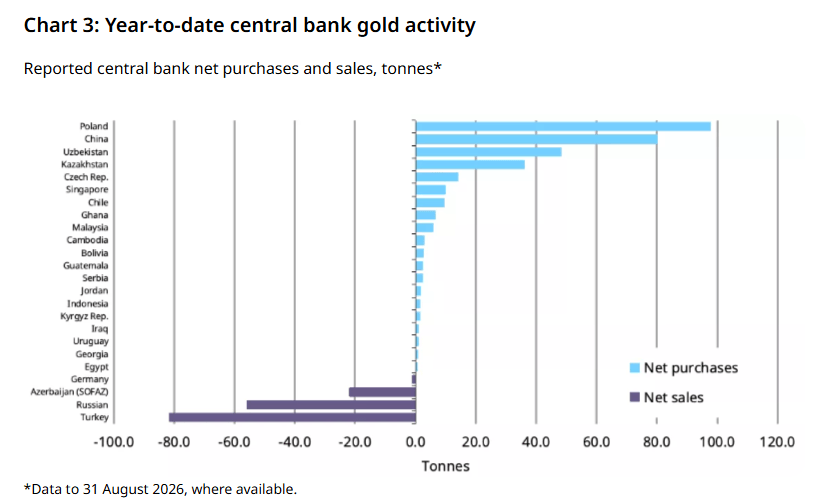 Poland leads purchases this year based on the latest full data, while Turkey is selling the most. Source: WGC
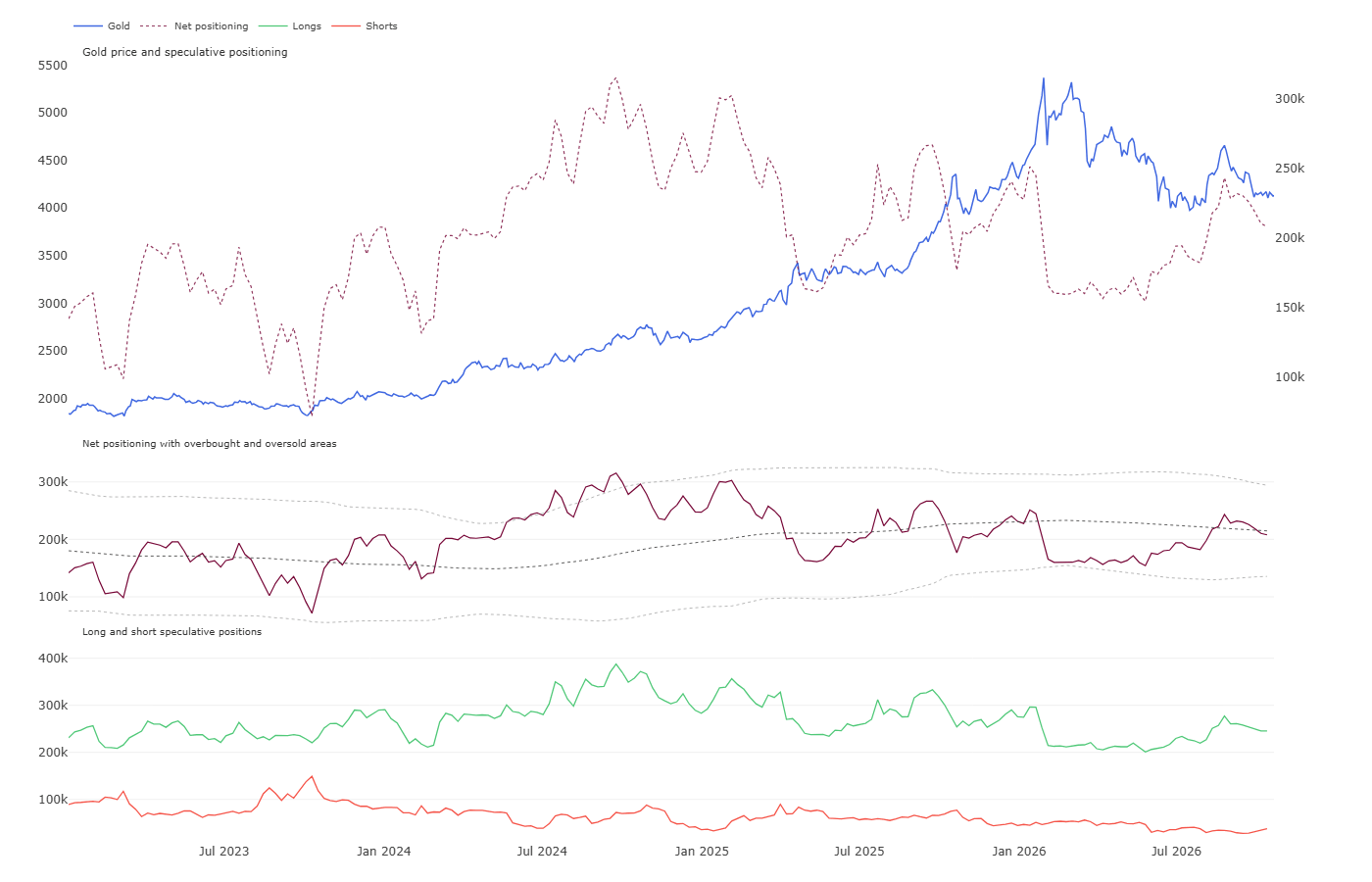
Comparing these figures: Russia's sales of 6.2 tonnes per month represent a fraction of global net central bank monthly purchases (39–79 tonnes). Even combining Russia and Turkey as the main sellers, the official sector net balance remains distinctly positive: central banks as a group continue accumulating gold at a rate that structurally supports prices. Goldman Sachs explicitly refers to this demand as "structural support" for the market, less price-sensitive than investment or speculative flows, which helps absorb corrections triggered by ETF sales or speculative position unwinds. This indicates that central bank buying could lead gold prices to resume stronger growth over a longer time horizon. In the short term, the picture is mixed: ETFs are purchasing gold, albeit slower than a few weeks ago, while speculative funds in the US and China have noticeably trimmed net long positions on futures.



Daily Summary: Buyers Refuse to Give In



📈Morning Brefieng: AI sector rebound collides with still-expensive oil (20.10.2026)


Chart of the Day: What’s next for tech stocks after the deepest sell-off since April 2025? (19.10.2026)

Morning Wrap: Nasdaq rebounds ahead of Mag7 earnings, bonds regain favour, oil falls from peak (19.10.2026)
The content of this report has been created by XTB S.A., with its registered office in Warsaw, at Prosta 67, 00-838 Warsaw, Poland, (KRS number 0000217580) and supervised by Polish Supervision Authority ( No. DDM-M-4021-57-1/2005). This material is a marketing communication within the meaning of Art. 24 (3) of Directive 2014/65/EU of the European Parliament and of the Council of 15 May 2014 on markets in financial instruments and amending Directive 2002/92/EC and Directive 2011/61/EU (MiFID II). Marketing communication is not an investment recommendation or information recommending or suggesting an investment strategy within the meaning of Regulation (EU) No 596/2014 of the European Parliament and of the Council of 16 April 2014 on market abuse (market abuse regulation) and repealing Directive 2003/6/EC of the European Parliament and of the Council and Commission Directives 2003/124/EC, 2003/125/EC and 2004/72/EC and Commission Delegated Regulation (EU) 2016/958 of 9 March 2016 supplementing Regulation (EU) No 596/2014 of the European Parliament and of the Council with regard to regulatory technical standards for the technical arrangements for objective presentation of investment recommendations or other information recommending or suggesting an investment strategy and for disclosure of particular interests or indications of conflicts of interest or any other advice, including in the area of investment advisory, within the meaning of the Trading in Financial Instruments Act of 29 July 2005 (i.e. Journal of Laws 2019, item 875, as amended). The marketing communication is prepared with the highest diligence, objectivity, presents the facts known to the author on the date of preparation and is devoid of any evaluation elements. The marketing communication is prepared without considering the client’s needs, his individual financial situation and does not present any investment strategy in any way. The marketing communication does not constitute an offer of sale, offering, subscription, invitation to purchase, advertisement or promotion of any financial instruments. XTB S.A. is not liable for any client’s actions or omissions, in particular for the acquisition or disposal of financial instruments, undertaken on the basis of the information contained in this marketing communication. In the event that the marketing communication contains any information about any results regarding the financial instruments indicated therein, these do not constitute any guarantee or forecast regarding the future results.