



Ryanair Holdings (RYAAY.US) shares have already fallen more than 10% from recent highs and are declining slightly in pre-market trading in the United States, alongside other stocks from the travel and hospitality sector.
Firstly, the market is pricing in the risk of weaker demand for the company’s routes during the summer season amid concerns about the security situation and the potential loss of routes in the Middle East and Turkey. The outlook for travel to Cyprus, Turkey, Egypt, or even the Greek islands (Aegan Sea; East-Mediterranean Sea) has also become more uncertain. A potentially weaker tourism season in 2026 - combined with pressure from rising jet fuel prices and a more cautious consumer (possibly preferring shorter holiday trips) is weighing on sentiment, despite the company’s recently reported very solid results.
Is a strong start to the year not enough?
February confirmed that demand for Ryanair’s services at the beginning of the year remained exceptionally strong. The airline carried 13.3 million passengers, representing 6% year-over-year growth and a clear acceleration compared with 12.7 million passengers in January. This is an important signal, as Ryanair is not only expanding year over year but is also maintaining a very strong start to 2026.
- Importantly, the increase in traffic did not come at the expense of aircraft utilization. The load factor remained at a high level of 92%, stable year over year and improving sequentially from 91% in January. In practice, this reflects a very healthy operating mix: more passengers, more flights, and aircraft that remain almost fully booked.
- Ryanair is expanding its operations in a controlled and economically rational manner. In February, the airline operated more than 75,000 flights, compared with 73,000 in January, confirming increased capacity and readiness to absorb strong demand. In Ryanair’s model, this is particularly important because the company’s advantage comes not only from low ticket prices but also from the ability to quickly deploy additional capacity where demand and profitability are strongest.
- Ryanair’s business model continues to benefit from a fundamental cost advantage that competitors in Europe find difficult to replicate. In the fiscal year ending in March 2025, the airline carried 200.2 million passengers, growing 9% year over year and becoming the first airline in Europe to exceed 200 million passengers in a single year. This is not merely a function of scale — it demonstrates that the ultra-low-cost model continues to work even in a demanding cost and competitive environment.
- From a strategic perspective, Ryanair remains the benchmark for low-cost aviation in Europe. As the company is now the largest low-fare airline in the world by passenger traffic, investors increasingly view it not as a traditional airline but as a mass mobility operator across Europe. Such a position provides significant negotiating leverage with airports, service providers, and indirectly with competitors.
- Data for the first nine months of fiscal 2026 remain consistent with this narrative. Passenger traffic increased 4% year over year to 166.5 million, indicating that the growth is not the result of a single strong month but rather part of a broader trend. Ryanair continues to deliver scale, which in its business model typically translates into strong operating leverage.
- Another positive signal for the market was the upgrade of the traffic outlook for fiscal 2026. The company now expects 208 million passengers, compared with the previous forecast of 207 million, implying 4% annual growth. While the scale of the revision itself is modest, investors are now concerned that the war in Iran could significantly disrupt this target in the coming months.
- Another key element of the Ryanair story is Boeing. Improved availability of aircraft deliveries from Boeing allows the airline to launch additional capacity more quickly and monetize strong demand during peak travel periods. For Ryanair, the fleet is not merely an asset — it is a strategic tool for gaining market share.
Ryanair continues to execute its business model almost textbook-perfectly. Passenger traffic is growing, load factors remain very high, the number of flights is increasing, scale is reaching record levels, and the full-year outlook has been raised. The company remains one of the strongest operators in European aviation, although the Middle East conflict introduces new sources of risk.
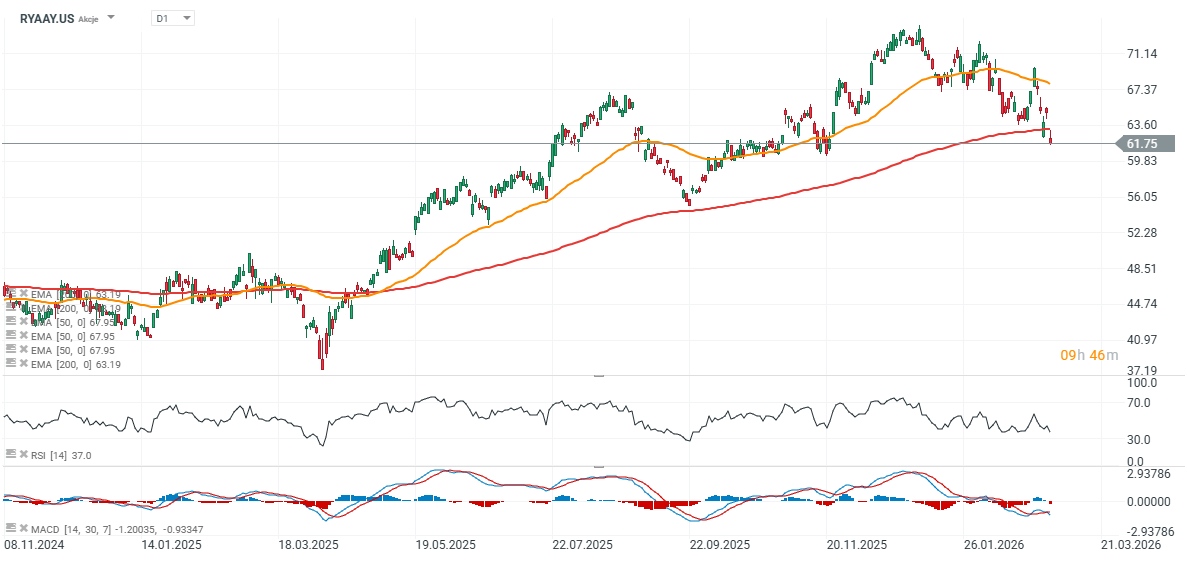
Ryanair Holdings (D1 chart)
Ryanair shares are experiencing a strong decline and have fallen below the long-term EMA200 moving average (red line). The last time the stock dropped below this level was in April 2025, when the correction eventually reached nearly 30% relative to the moving average. Key support levels now appear to be around USD 60 per share, followed by USD 55, where previous price reactions occurred.
Source: xStation5



The US100 gets back on track and gains 1%📈



Market Wrap: Renewed confidence in AI drives stock market recovery (27.10.2026)


US OPEN: Anthropic filing and Iran talks support the market

Anthropic files prospectus ahead of IPO with "ANT" ticker on Nasdaq. The launch date and price remain a mystery
The content of this report has been created by XTB S.A., with its registered office in Warsaw, at Prosta 67, 00-838 Warsaw, Poland, (KRS number 0000217580) and supervised by Polish Supervision Authority ( No. DDM-M-4021-57-1/2005). This material is a marketing communication within the meaning of Art. 24 (3) of Directive 2014/65/EU of the European Parliament and of the Council of 15 May 2014 on markets in financial instruments and amending Directive 2002/92/EC and Directive 2011/61/EU (MiFID II). Marketing communication is not an investment recommendation or information recommending or suggesting an investment strategy within the meaning of Regulation (EU) No 596/2014 of the European Parliament and of the Council of 16 April 2014 on market abuse (market abuse regulation) and repealing Directive 2003/6/EC of the European Parliament and of the Council and Commission Directives 2003/124/EC, 2003/125/EC and 2004/72/EC and Commission Delegated Regulation (EU) 2016/958 of 9 March 2016 supplementing Regulation (EU) No 596/2014 of the European Parliament and of the Council with regard to regulatory technical standards for the technical arrangements for objective presentation of investment recommendations or other information recommending or suggesting an investment strategy and for disclosure of particular interests or indications of conflicts of interest or any other advice, including in the area of investment advisory, within the meaning of the Trading in Financial Instruments Act of 29 July 2005 (i.e. Journal of Laws 2019, item 875, as amended). The marketing communication is prepared with the highest diligence, objectivity, presents the facts known to the author on the date of preparation and is devoid of any evaluation elements. The marketing communication is prepared without considering the client’s needs, his individual financial situation and does not present any investment strategy in any way. The marketing communication does not constitute an offer of sale, offering, subscription, invitation to purchase, advertisement or promotion of any financial instruments. XTB S.A. is not liable for any client’s actions or omissions, in particular for the acquisition or disposal of financial instruments, undertaken on the basis of the information contained in this marketing communication. In the event that the marketing communication contains any information about any results regarding the financial instruments indicated therein, these do not constitute any guarantee or forecast regarding the future results.