



SpaceX posted a very strong Q3 2026 on paper. However, as is often the case with Elon Musk’s companies, the company’s situation and outlook are more complex than the headline financial release suggests.
Earnings
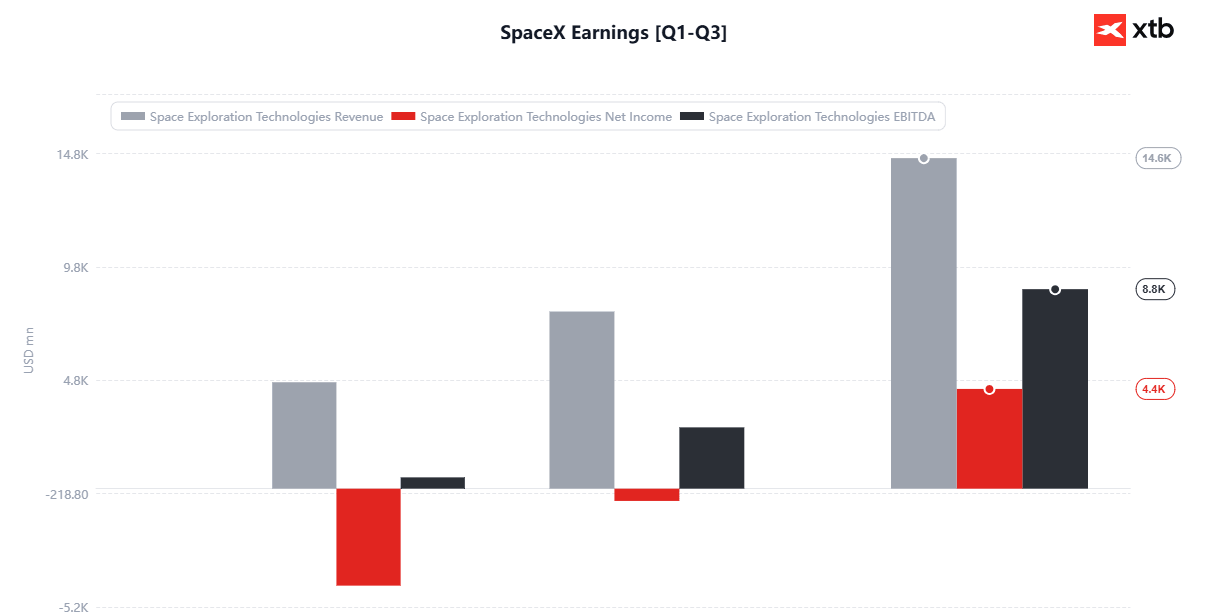
- Financially, SpaceX beat even optimistic earnings scenarios by a wide margin, which translated into an approximately 3–4% rise in after-hours trading.
- Revenue: USD 14.58bn vs. market consensus of USD 12.7–12.8bn
- The “star” of the call was profit, which reached USD 4.4bn, more than 2x the consensus of around USD 1.5bn
- Adjusted EBITDA rose to USD 8.8bn vs. market expectations of around USD 6.4bn
- Starlink subscribers also surprised to the upside, increasing to 13.6m vs. market expectations of 12–12.2m
- CAPEX also came in above expectations, totaling USD 19.6bn by quarter-end
Could this profit be misleading?
For most companies, a profit number this far above consensus raises questions, and SpaceX is no exception. The answer is found deeper in the financial statements and SEC filings.
Of the more than USD 4bn, only USD 2.79bn is actual operating profit. The remaining amount includes USD 1.025bn of unexplained “other,” roughly USD 200m in interest income, and USD 390m in net tax benefits. This means the company is showing a real improvement in operating efficiency, but the organic result is materially lower quality than the reported headline figure.
A no-longer-space company?
A segment breakdown shows an increasingly complex picture.
- Starlink generated USD 5.2bn in revenue and as much as USD 2.4bn in profit. Most importantly, the company not only meaningfully exceeded the market’s expectations for Starlink subscribers, but also increased profit per user from USD 66 to USD 69. It is fair to say this is the most positive part of the release, as it shows both quantitative and qualitative growth in SpaceX’s key business line.
- Questions arise around the “SuperIntelligence” segment, whose revenue surpassed Starlink and reached USD 7.6bn, with operating profit of USD 431m. Notably, USD 16.4bn out of USD 19bn in company CAPEX was allocated to AI. In short: SpaceX’s AI business absorbs over 85% of total investment, generates about 50% of revenue, and delivers less than 10% of profit.
- It is also hard to be optimistic about the “Space” segment, which generated operating losses, with revenue of about USD 1.8bn, up a modest 6% y/y. Starship remains in its early stages, yet it is still not as capital-intensive as the company’s AI investments. The number of rocket launches remains in a narrow range of around 35 per quarter, with cumulative payload of roughly 500 tons over the same period. More than half of all launches are still for “internal” needs.A significant success in this segment is the first profitable Starship configuration, capable of placing as many as 26 Starlink V3 satellites into orbit at once.
Starlink Mobile
A major event for shareholders was SpaceX’s purchase of 800 MHz spectrum, which could enable the company to build its own (partly) satellite-based mobile network. The company also reported FCC approval for a constellation of 15,000 mobile satellites using around 2 GHz spectrum, which may, but does not have to, be tied to another ambitious project. However, there is still a lack of concrete financial, technical, or even marketing information about the next steps for this initiative.
Conclusion
- Given the state of the company’s outline, which raised concerns not only due to unambitious philosophical arguments but also due to accounting practices that evoke memories of Enron’s best years, the Q3 results show a new quality in the company’s reporting.
- Starlink performed exceptionally well and exceeded expectations across all key metrics.
- The space segment continues to struggle with growth and monetization, though a small consolation for shareholders is that Starship’s performance remains consistent, even if its growth pace is disappointing.
- AI remains a major question mark. It is difficult to extrapolate where and how the company earns money from AI, how durable the margin is, and what the monetization outlook looks like. These questions are critical in the context of massive CAPEX, which may become a problem over time.


CoreWeave: Record Demand Collides with Crushing Costs



Chart of the Day: US100 (Nasdaq 100). Rebound in AI trade vs. weakening technical picture



Macro Calendar - UK Labor Market, ZEW Sentiment, and Wall Street Giants' Reports

Chart of the Day: What’s next for tech stocks after the deepest sell-off since April 2025? (19.10.2026)
The content of this report has been created by XTB S.A., with its registered office in Warsaw, at Prosta 67, 00-838 Warsaw, Poland, (KRS number 0000217580) and supervised by Polish Supervision Authority ( No. DDM-M-4021-57-1/2005). This material is a marketing communication within the meaning of Art. 24 (3) of Directive 2014/65/EU of the European Parliament and of the Council of 15 May 2014 on markets in financial instruments and amending Directive 2002/92/EC and Directive 2011/61/EU (MiFID II). Marketing communication is not an investment recommendation or information recommending or suggesting an investment strategy within the meaning of Regulation (EU) No 596/2014 of the European Parliament and of the Council of 16 April 2014 on market abuse (market abuse regulation) and repealing Directive 2003/6/EC of the European Parliament and of the Council and Commission Directives 2003/124/EC, 2003/125/EC and 2004/72/EC and Commission Delegated Regulation (EU) 2016/958 of 9 March 2016 supplementing Regulation (EU) No 596/2014 of the European Parliament and of the Council with regard to regulatory technical standards for the technical arrangements for objective presentation of investment recommendations or other information recommending or suggesting an investment strategy and for disclosure of particular interests or indications of conflicts of interest or any other advice, including in the area of investment advisory, within the meaning of the Trading in Financial Instruments Act of 29 July 2005 (i.e. Journal of Laws 2019, item 875, as amended). The marketing communication is prepared with the highest diligence, objectivity, presents the facts known to the author on the date of preparation and is devoid of any evaluation elements. The marketing communication is prepared without considering the client’s needs, his individual financial situation and does not present any investment strategy in any way. The marketing communication does not constitute an offer of sale, offering, subscription, invitation to purchase, advertisement or promotion of any financial instruments. XTB S.A. is not liable for any client’s actions or omissions, in particular for the acquisition or disposal of financial instruments, undertaken on the basis of the information contained in this marketing communication. In the event that the marketing communication contains any information about any results regarding the financial instruments indicated therein, these do not constitute any guarantee or forecast regarding the future results.