



As expected by the market, the Swiss National Bank (SNB) left its policy rate unchanged at 0%, while Sweden’s Riksbank also made no move, keeping rates at 1.75%. The SNB’s statement looked very cautious and slightly dovish, while the Riksbank much more clearly signaled the possibility of a rate hike.
SNB decision and a softer tone?
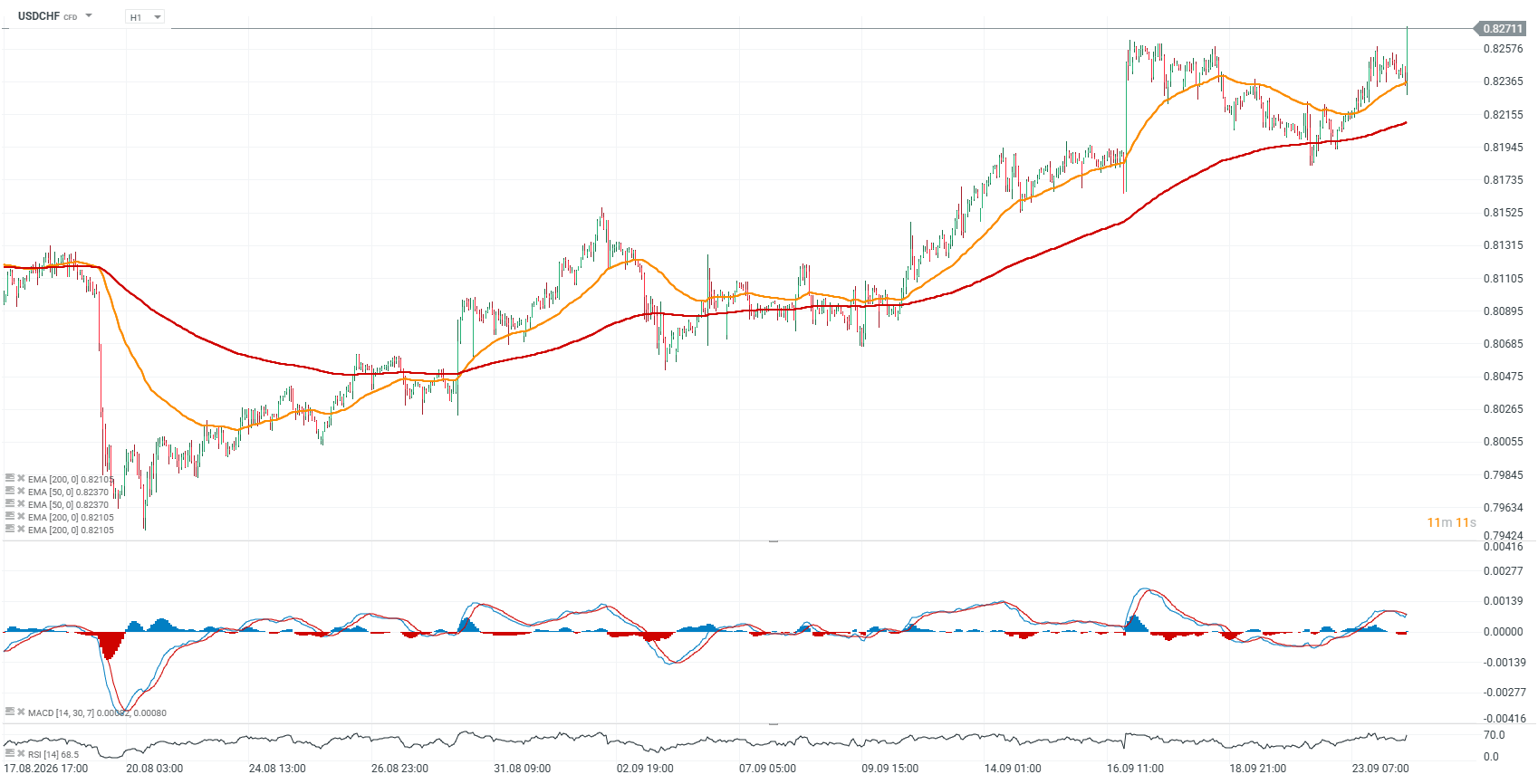
The SNB softened its language regarding potential interventions aimed at weakening the franc and raised its inflation forecasts. The bank is increasingly acknowledging that a weaker franc and more expensive imports could once again add to price pressures, which over time may reduce the scope for maintaining an ultra-loose policy stance. Despite this, the franc weakened after the decision, clearly reflected in the jump in USDCHF.
- The SNB kept its key policy rate unchanged at 0% for a fifth consecutive quarter.
- The bank removed its previous wording about an “increased willingness” to sell the franc, which may suggest a lower propensity to intervene in the FX market.
- The SNB assessed that medium-term inflationary pressures had increased, although only slightly.
- Swiss inflation stood at 0.8% in August and remains within the 0–2% range that the bank considers consistent with price stability.
- The franc weakened to its lowest level in 17 months against the euro and its lowest since June against the U.S. dollar, increasing import costs and potentially adding to inflation.
- Such a setup could gradually lay the groundwork for a future rate hike, although most economists do not expect one before 2028.
- An alternative to rate hikes could be FX-market action, such as selling foreign assets to strengthen the franc and limit imported inflation.
- The SNB had already highlighted rising inflation risks, while August price growth was the fastest in nearly two years.
USDCHF chart (H1 timeframe)
 Source: xStation5
Riksbank signals a possible hike this year
The Riksbank kept its key policy rate unchanged at 1.75%, but at the same time signaled that a hike may be needed later this year if the economic recovery continues to strengthen. The bank said the outlook for inflation and economic activity had not changed significantly, although price pressures remain elevated.
- The Riksbank left its policy rate unchanged at 1.75%, the lowest level in the European Union.
- The decision was in line with expectations from all 18 economists surveyed by Bloomberg.
- The bank indicated that rates could be raised later this year if inflation stabilizes around 2% and the economy continues to recover.
- The Riksbank emphasized that the outlook for inflation and economic activity remains broadly unchanged compared with its previous assessment.
- In August, the bank estimated the probability of a 25 bp rate hike in 2026 at around 50%.
- Sweden’s economy returned to growth in Q2, supported by tax cuts on food and fuel as well as an improvement in household consumption.
- Earlier rate cuts also supported demand, although concerns are rising over the impact of the war with Iran and higher energy prices on inflation.
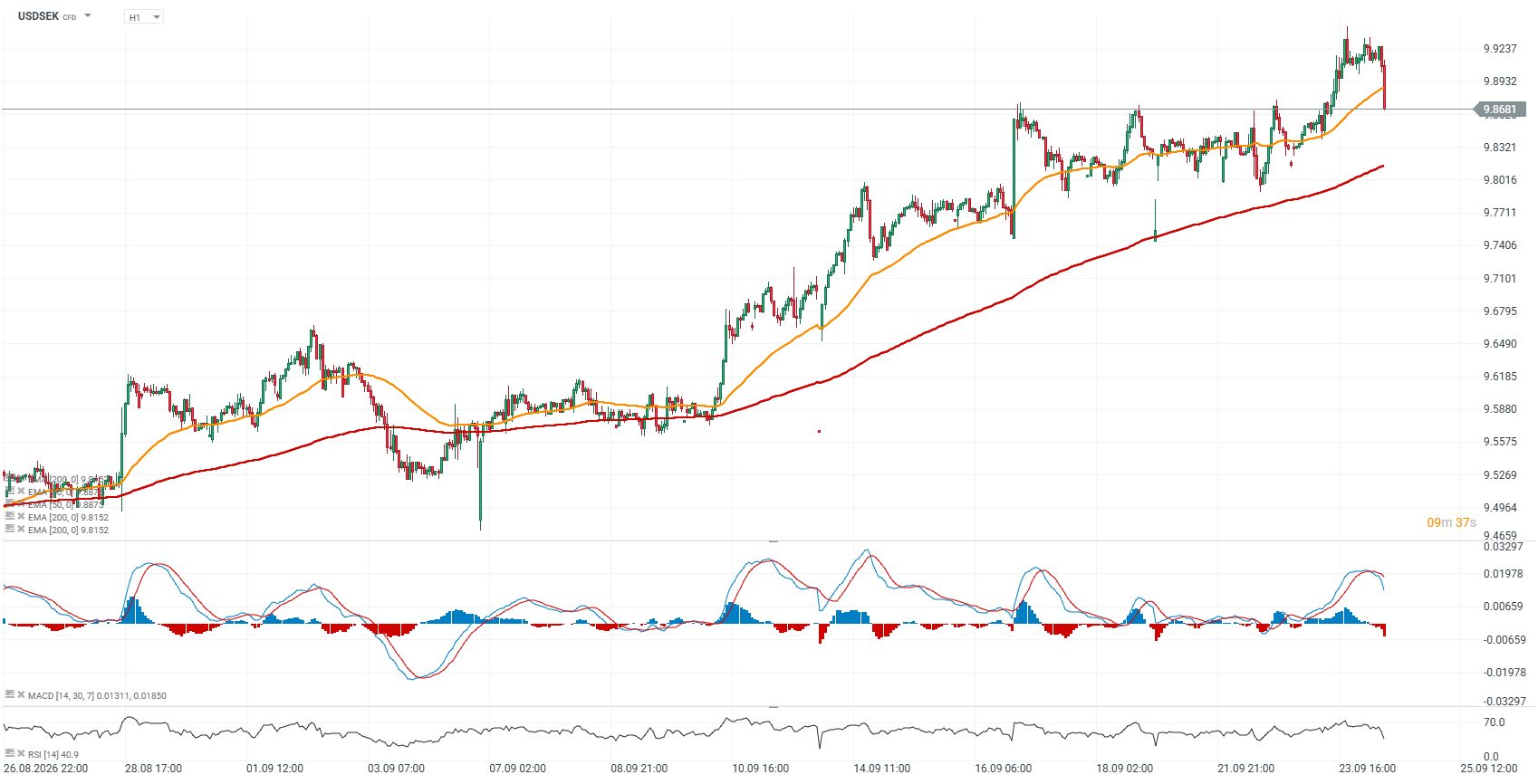
- The Riksbank’s decision fits into the broader trend of tighter monetary policy following recent moves by both the ECB and the Fed. The Swedish krona is strengthening after the decision.
USDSEK chart (H1 timeframe)
 Source: xStation5


US inflation concerns rise

US CPI above expectations!🔥📈


Dollar in Limbo Ahead of CPI 🚨
Chart of the Day 📈 EURUSD attempts to rebound ahead of US inflation data (14.10.2026)
The content of this report has been created by XTB S.A., with its registered office in Warsaw, at Prosta 67, 00-838 Warsaw, Poland, (KRS number 0000217580) and supervised by Polish Supervision Authority ( No. DDM-M-4021-57-1/2005). This material is a marketing communication within the meaning of Art. 24 (3) of Directive 2014/65/EU of the European Parliament and of the Council of 15 May 2014 on markets in financial instruments and amending Directive 2002/92/EC and Directive 2011/61/EU (MiFID II). Marketing communication is not an investment recommendation or information recommending or suggesting an investment strategy within the meaning of Regulation (EU) No 596/2014 of the European Parliament and of the Council of 16 April 2014 on market abuse (market abuse regulation) and repealing Directive 2003/6/EC of the European Parliament and of the Council and Commission Directives 2003/124/EC, 2003/125/EC and 2004/72/EC and Commission Delegated Regulation (EU) 2016/958 of 9 March 2016 supplementing Regulation (EU) No 596/2014 of the European Parliament and of the Council with regard to regulatory technical standards for the technical arrangements for objective presentation of investment recommendations or other information recommending or suggesting an investment strategy and for disclosure of particular interests or indications of conflicts of interest or any other advice, including in the area of investment advisory, within the meaning of the Trading in Financial Instruments Act of 29 July 2005 (i.e. Journal of Laws 2019, item 875, as amended). The marketing communication is prepared with the highest diligence, objectivity, presents the facts known to the author on the date of preparation and is devoid of any evaluation elements. The marketing communication is prepared without considering the client’s needs, his individual financial situation and does not present any investment strategy in any way. The marketing communication does not constitute an offer of sale, offering, subscription, invitation to purchase, advertisement or promotion of any financial instruments. XTB S.A. is not liable for any client’s actions or omissions, in particular for the acquisition or disposal of financial instruments, undertaken on the basis of the information contained in this marketing communication. In the event that the marketing communication contains any information about any results regarding the financial instruments indicated therein, these do not constitute any guarantee or forecast regarding the future results.