


- TSMC posted a net profit of 763.1 billion TWD, beating market expectations by a wide margin.
- Advanced technologies accounted for 79% of wafer revenue, driven by strong demand for AI infrastructure.
- The company raised its full-year revenue growth guidance and projects record capital expenditures of 64 billion USD.

- TSMC posted a net profit of 763.1 billion TWD, beating market expectations by a wide margin.
- Advanced technologies accounted for 79% of wafer revenue, driven by strong demand for AI infrastructure.
- The company raised its full-year revenue growth guidance and projects record capital expenditures of 64 billion USD.
Taiwanese chipmaker TSMC published its third-quarter results on Thursday, which once again exceeded market expectations and marked the sixth consecutive record quarter in terms of net profit.
- The company generated 763.1 billion TWD in net profit (~$23.8 billion), representing an increase of 68.7% YoY and clearly beating Bloomberg's consensus of 739.5 billion TWD.
- Revenue reached 1.49 trillion TWD ($46.7 billion), growing by 50.9% YoY (compared to a forecast of 1.46 trillion TWD).
- Operating profit stood at 876.4 billion TWD with an operating margin of 58.7%, while the gross margin settled at 66.4% — slightly below the 67.7% recorded in the previous quarter, which the company attributes to ramp-up costs for its newest 2nm technology node.
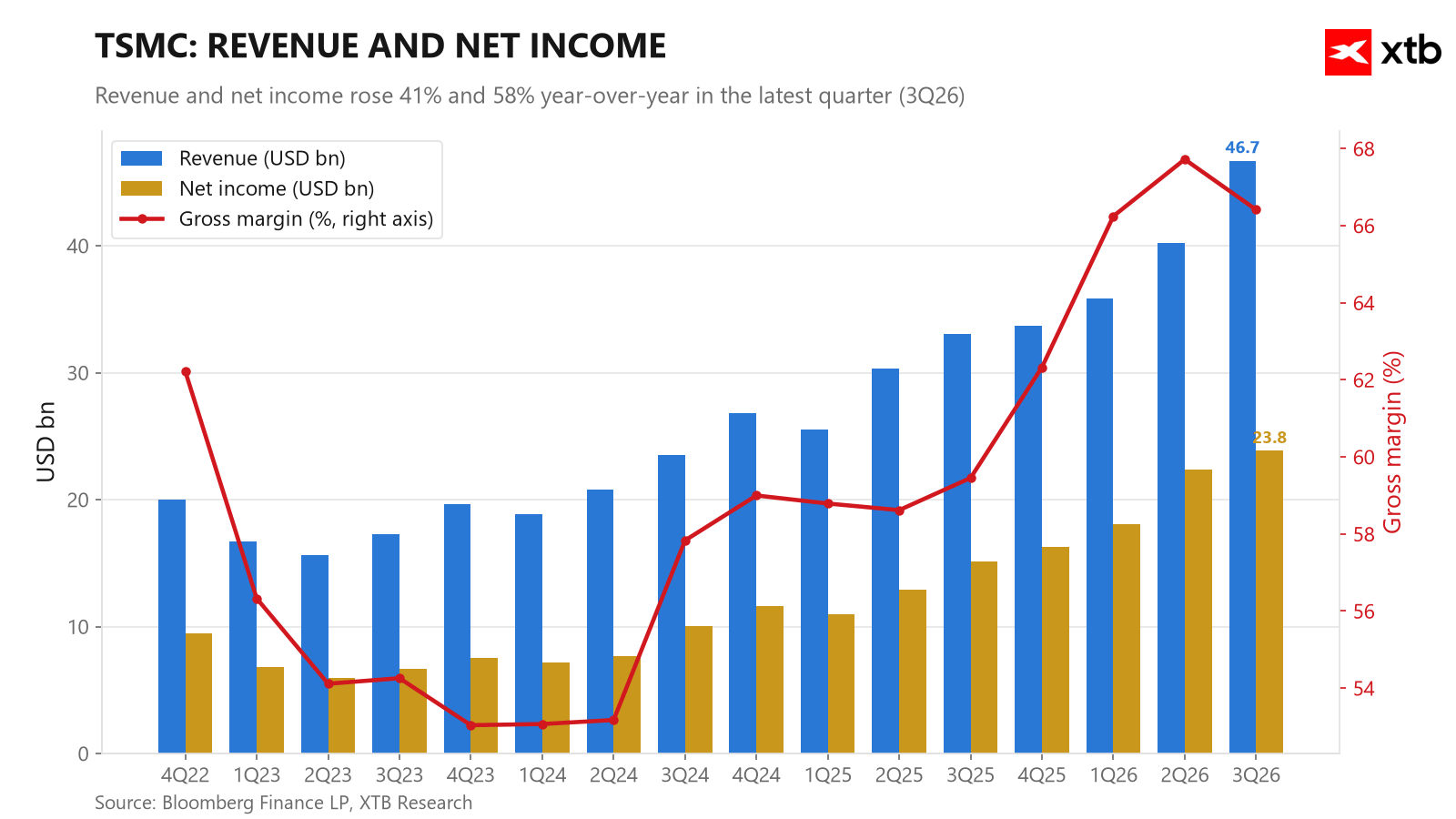
The scale of the positive surprise was also evident on a per-share basis: earnings per share (EPS for ADRs listed in New York) came in at $4.60 compared to the expected $4.45 (+57.5% YoY). Revenue expressed in USD ($46.72 billion) beat market estimates by 2.4% and grew by 41.2% compared to the same period last year.
What is driving these spectacular results?
Insatiable demand for artificial intelligence infrastructure remains the main growth driver. Advanced technologies (7nm chips and newer) accounted for as much as 79% of wafer revenue, with the 3nm node alone contributing 33%. Production in the breakthrough 2nm technology, launched only this year, has already brought in 8% of revenue, demonstrating the impressive pace of adoption of the latest processes by key customers. As the exclusive supplier of the most advanced chips for Nvidia and Apple, TSMC's results are widely treated as a reliable barometer of actual demand for AI computing power.
Importantly, TSMC's report arrived amid growing doubts regarding the profitability of global AI spending, fueled by the recent sell-off in shares of cloud provider CoreWeave. However, TSMC presented a strong counterargument: demand for flagship integrated circuits is not weakening, regardless of market nervousness around end-application companies.
Forecasts and Capital Expenditures (CapEx)
The company has once again raised its full-year revenue growth guidance for 2026 (currently "slightly above 40%" in USD terms), and the presented results suggest that these estimates may still prove to be conservative. This year's capital expenditures are projected to reach a record level of $64 billion.
Market attention, however, is shifting to 2027: while the Bloomberg consensus predicts capital spending at $75 billion, Goldman Sachs and UBS have raised their forecasts to $85 billion and $90 billion, respectively. Such significant increases indicate that the market may still be underestimating the scale of the company's global expansion.
TSMC is expanding its manufacturing network at an unprecedented pace, currently building around 20 facilities simultaneously (compared to the standard 4-5). After committing an additional $100 billion in investments in Arizona in July (totaling $265 billion in US commitments), the company is currently analyzing the construction of another manufacturing complex in Texas to meet the growing demand from US data centers.
Market Reaction and Valuation
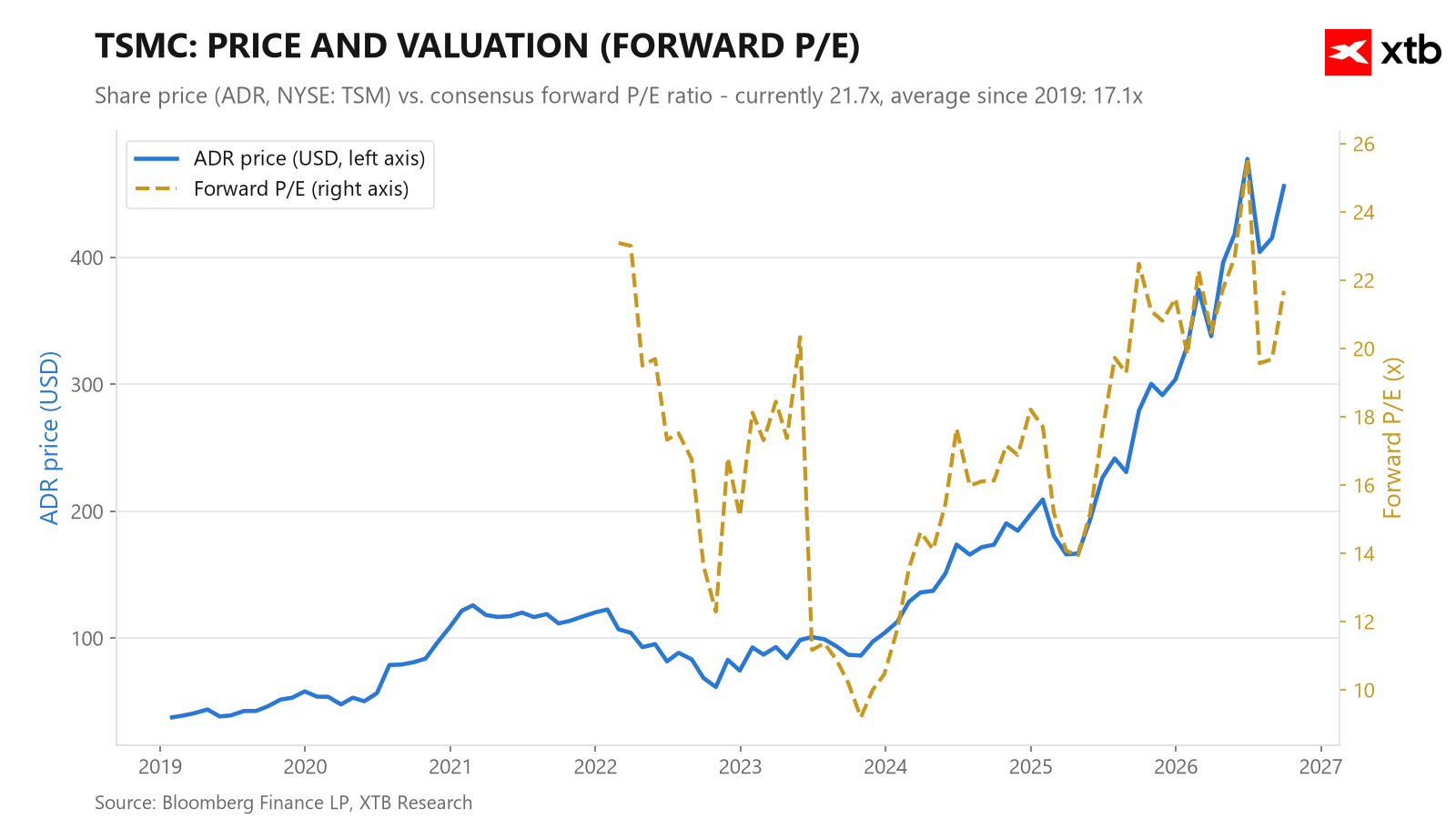
TSMC shares have gained nearly 60% this year, and the company was among the first in the semiconductor sector to reach new all-time highs following the July pullback in the tech sector. Despite recent downside pressure resulting from general profit-taking across AI stocks, the company's valuation remains reasonable. The Forward Price-to-Earnings (Forward P/E) ratio currently stands at around 21.7x, above its seven-year average (17.1x), but noticeably below the June peak of 26x (when the stock price exceeded $477) and below the levels seen in 2022, when the stock traded at less than a quarter of its current price.



Daily Summary: Rising inflation weighs on markets, semiconductors suffer most (14.10.2026)


US Open: CPI reading weighs on American indices (14.10.2026)

POET: A “meme stock” in photonics, is there still hope?


US Open: Earnings season kicks off on a high note (13.10.2026)
The content of this report has been created by XTB S.A., with its registered office in Warsaw, at Prosta 67, 00-838 Warsaw, Poland, (KRS number 0000217580) and supervised by Polish Supervision Authority ( No. DDM-M-4021-57-1/2005). This material is a marketing communication within the meaning of Art. 24 (3) of Directive 2014/65/EU of the European Parliament and of the Council of 15 May 2014 on markets in financial instruments and amending Directive 2002/92/EC and Directive 2011/61/EU (MiFID II). Marketing communication is not an investment recommendation or information recommending or suggesting an investment strategy within the meaning of Regulation (EU) No 596/2014 of the European Parliament and of the Council of 16 April 2014 on market abuse (market abuse regulation) and repealing Directive 2003/6/EC of the European Parliament and of the Council and Commission Directives 2003/124/EC, 2003/125/EC and 2004/72/EC and Commission Delegated Regulation (EU) 2016/958 of 9 March 2016 supplementing Regulation (EU) No 596/2014 of the European Parliament and of the Council with regard to regulatory technical standards for the technical arrangements for objective presentation of investment recommendations or other information recommending or suggesting an investment strategy and for disclosure of particular interests or indications of conflicts of interest or any other advice, including in the area of investment advisory, within the meaning of the Trading in Financial Instruments Act of 29 July 2005 (i.e. Journal of Laws 2019, item 875, as amended). The marketing communication is prepared with the highest diligence, objectivity, presents the facts known to the author on the date of preparation and is devoid of any evaluation elements. The marketing communication is prepared without considering the client’s needs, his individual financial situation and does not present any investment strategy in any way. The marketing communication does not constitute an offer of sale, offering, subscription, invitation to purchase, advertisement or promotion of any financial instruments. XTB S.A. is not liable for any client’s actions or omissions, in particular for the acquisition or disposal of financial instruments, undertaken on the basis of the information contained in this marketing communication. In the event that the marketing communication contains any information about any results regarding the financial instruments indicated therein, these do not constitute any guarantee or forecast regarding the future results.