



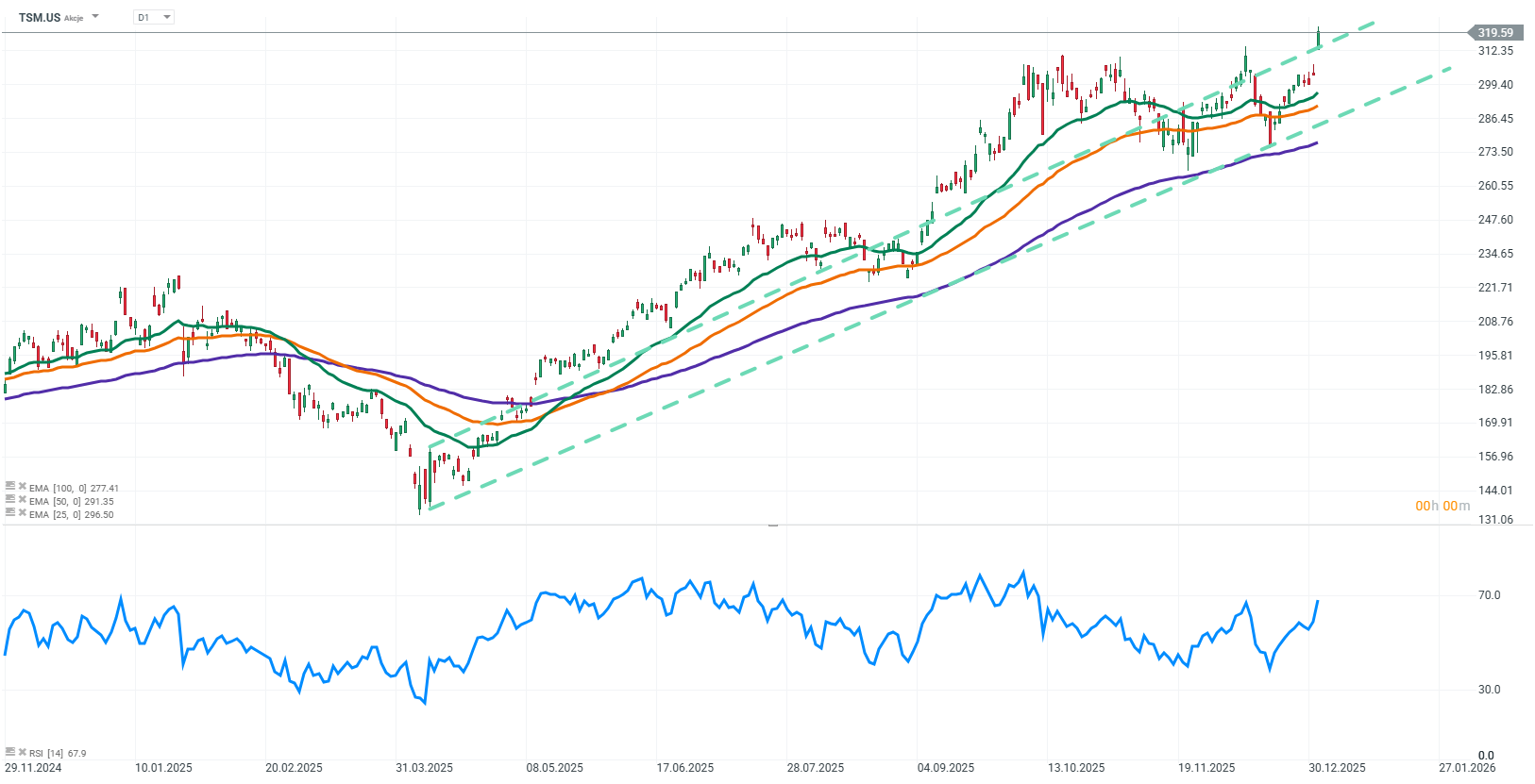
Shares of Taiwan Semiconductor Manufacturing Co. (TSMC) are reaching new all-time highs. In recent days, the stock on the Taipei Exchange rose by as much as 7%, representing approximately a 50% increase since the beginning of 2025, and the company’s market capitalization has surpassed one trillion dollars. One of the key drivers of this strong growth is the recent decision by Goldman Sachs to raise its price target for the stock, highlighting analysts’ strong confidence in the company’s continued development.
AI as a Growth Engine and Valuation Driver
Goldman Sachs’ decision alone does not tell the whole story. In recent years, artificial intelligence has become a central engine for TSMC’s growth, with demand for AI chips so high that limited production capacity in the most advanced 3 nm and 5 nm technologies ensures the company maintains its market edge for years to come. Forecasts indicate that revenue growth in US dollars could reach 30% in 2026 and 28% in 2027. The announced investment plan exceeding 150 billion dollars through 2028 demonstrates that the company is focused on sustainable growth in AI and data center sectors rather than short-term gains.
2 nm Technology – Another Milestone
TSMC’s introduction of 2 nm technology marks a true breakthrough. Mass production now utilizes Gate-All-Around transistors, delivering higher performance and significantly improved energy efficiency compared with previous 3 nm processes. Production capacity for this node is already largely reserved by key clients, including Apple and NVIDIA, ensuring stable revenues for the coming years. In the mobile chip segment, 2 nm technology will form the foundation for top-tier processors, providing a clear performance and efficiency advantage.
Market Dominance and Competition
TSMC maintains a clear lead over competitors, including Samsung, which is developing its own 2 nm processes but remains technologically behind. While some clients explore alternative manufacturing sources to increase supply chain flexibility, TSMC continues to be the preferred partner for the most demanding AI, data center, and high-end mobile chip projects.
Market Sentiment and Investor Expectations
The strong upward movement of TSMC’s stock means the market increasingly values the company as strategic infrastructure for the global data-driven economy rather than a traditional chipmaker. High valuations translate into low tolerance for any disappointments. Any surprise in financial results or delays in the production of the most advanced nodes could trigger significant market reactions.
Positive factors include record stock levels, fully utilized production capacity, aggressive investment strategy, and technological leadership in 2 nm processes. Risks stem from high market expectations, cost pressure from investments in cutting-edge technology, and potential competitive pressures or order dispersion due to multi-sourcing strategies.
Source: xStation5
Conclusion
TSMC enters 2026 with tremendous momentum. Stock prices are at record levels, analysts are raising price targets, and the narrative of a sustained AI boom supports positive investor sentiment. Mass production of 2 nm processes, expanding production capacity, and strategic partnerships with leaders in mobile and data center markets make TSMC a key player in the global semiconductor industry. The company is no longer just a chip manufacturer; it has become the foundation of the era of artificial intelligence, high-performance computing, and next-generation mobile technologies.


Netflix Preview. It needs to prove it can still surprise


Chart of the Day: US100 (Nasdaq 100). Rebound in AI trade vs. weakening technical picture


Macro Calendar - UK Labor Market, ZEW Sentiment, and Wall Street Giants' Reports



Market Wrap: Rebound in China and Falling Oil Prices, France Leads EU Declines
The content of this report has been created by XTB S.A., with its registered office in Warsaw, at Prosta 67, 00-838 Warsaw, Poland, (KRS number 0000217580) and supervised by Polish Supervision Authority ( No. DDM-M-4021-57-1/2005). This material is a marketing communication within the meaning of Art. 24 (3) of Directive 2014/65/EU of the European Parliament and of the Council of 15 May 2014 on markets in financial instruments and amending Directive 2002/92/EC and Directive 2011/61/EU (MiFID II). Marketing communication is not an investment recommendation or information recommending or suggesting an investment strategy within the meaning of Regulation (EU) No 596/2014 of the European Parliament and of the Council of 16 April 2014 on market abuse (market abuse regulation) and repealing Directive 2003/6/EC of the European Parliament and of the Council and Commission Directives 2003/124/EC, 2003/125/EC and 2004/72/EC and Commission Delegated Regulation (EU) 2016/958 of 9 March 2016 supplementing Regulation (EU) No 596/2014 of the European Parliament and of the Council with regard to regulatory technical standards for the technical arrangements for objective presentation of investment recommendations or other information recommending or suggesting an investment strategy and for disclosure of particular interests or indications of conflicts of interest or any other advice, including in the area of investment advisory, within the meaning of the Trading in Financial Instruments Act of 29 July 2005 (i.e. Journal of Laws 2019, item 875, as amended). The marketing communication is prepared with the highest diligence, objectivity, presents the facts known to the author on the date of preparation and is devoid of any evaluation elements. The marketing communication is prepared without considering the client’s needs, his individual financial situation and does not present any investment strategy in any way. The marketing communication does not constitute an offer of sale, offering, subscription, invitation to purchase, advertisement or promotion of any financial instruments. XTB S.A. is not liable for any client’s actions or omissions, in particular for the acquisition or disposal of financial instruments, undertaken on the basis of the information contained in this marketing communication. In the event that the marketing communication contains any information about any results regarding the financial instruments indicated therein, these do not constitute any guarantee or forecast regarding the future results.