



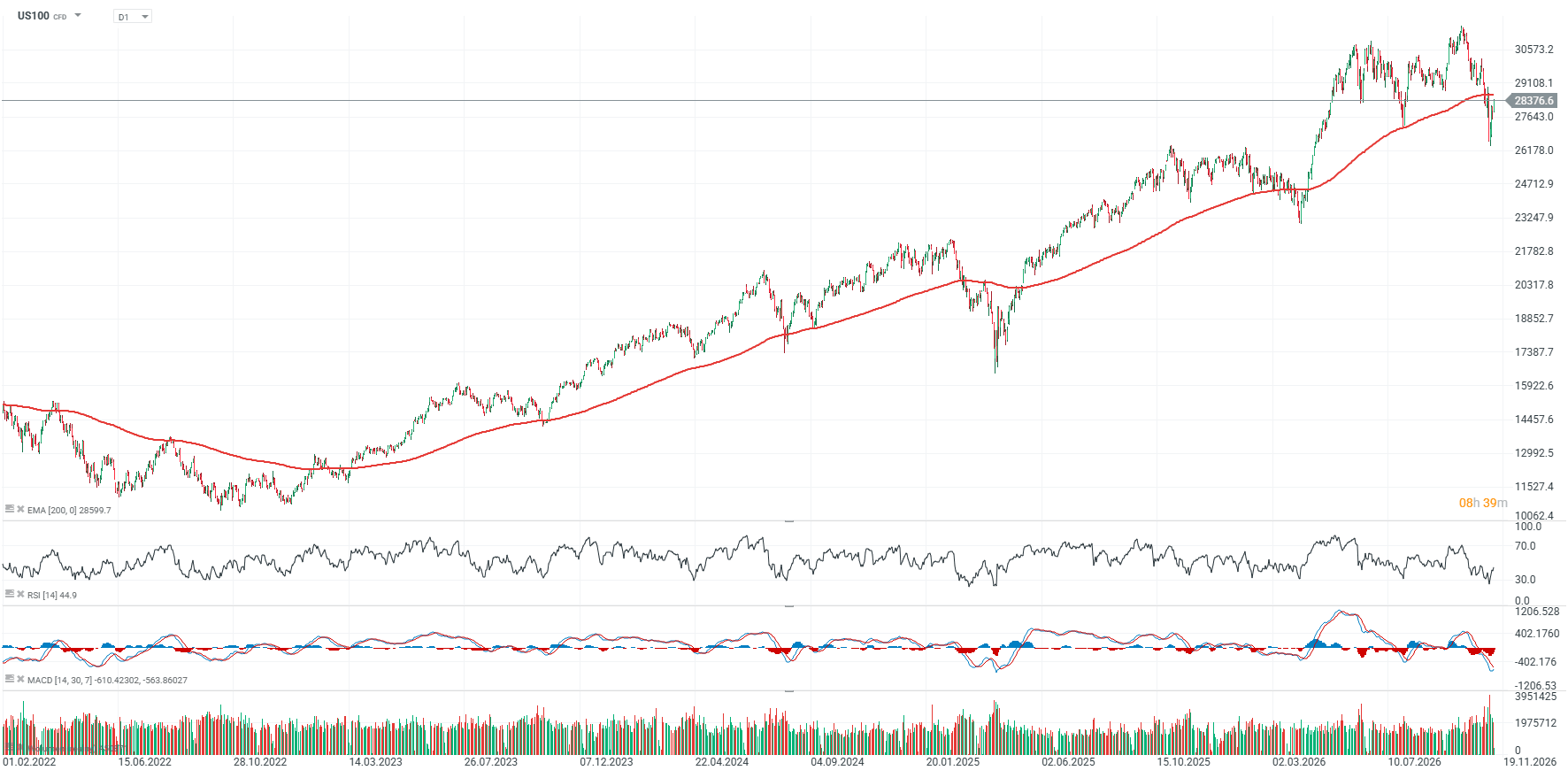
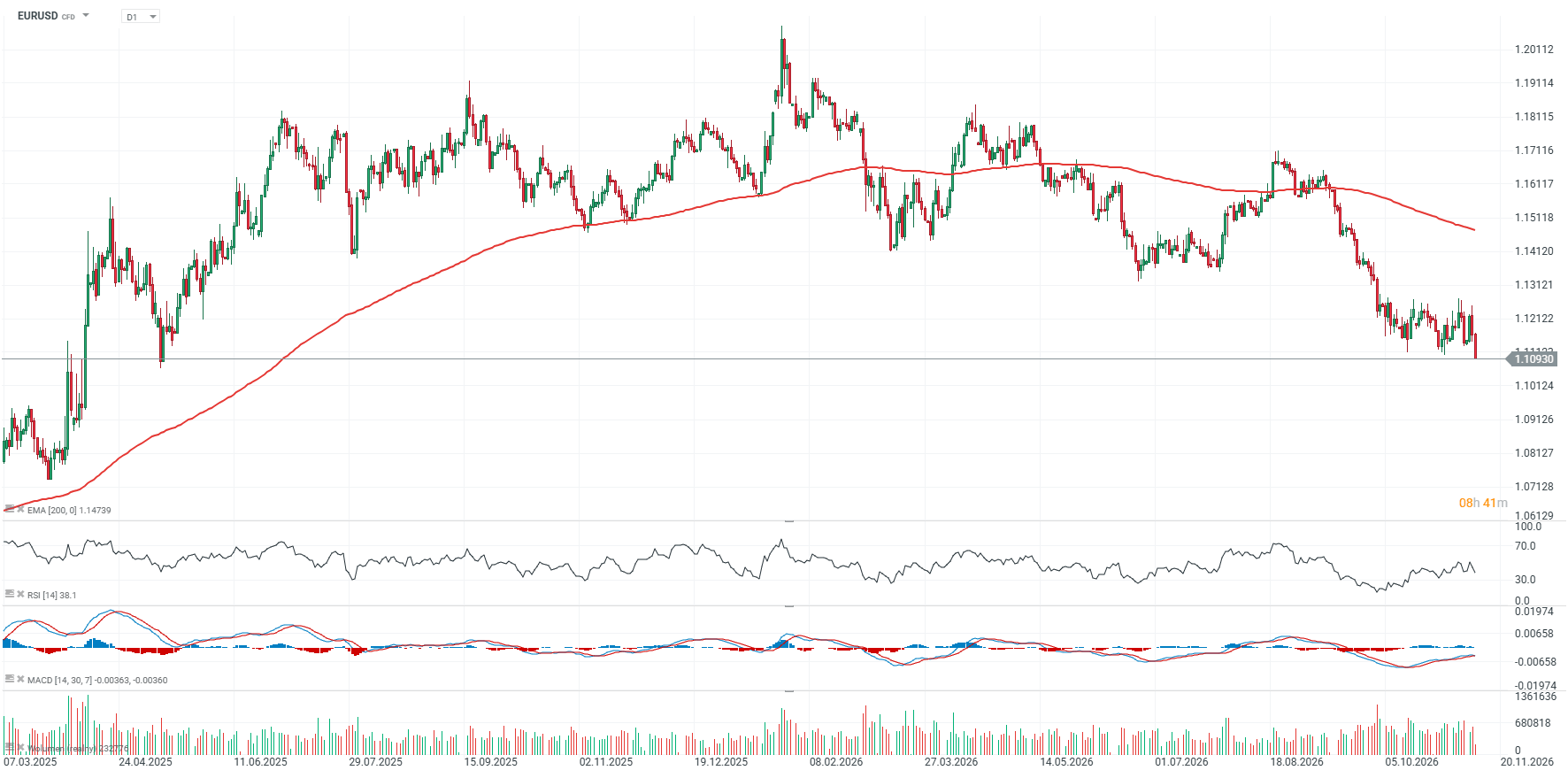
US index futures are trading higher on Wednesday, supported by a strong rally in CoreWeave and a rebound in Nvidia following two consecutive down sessions for the chipmaker. The Nasdaq 100 opened nearly 2% higher, while the S&P 500 is gaining 1%. Dow Jones Industrial Average futures are up 0.3%, despite a stronger US dollar and a rise in yields of more than 5%.
-
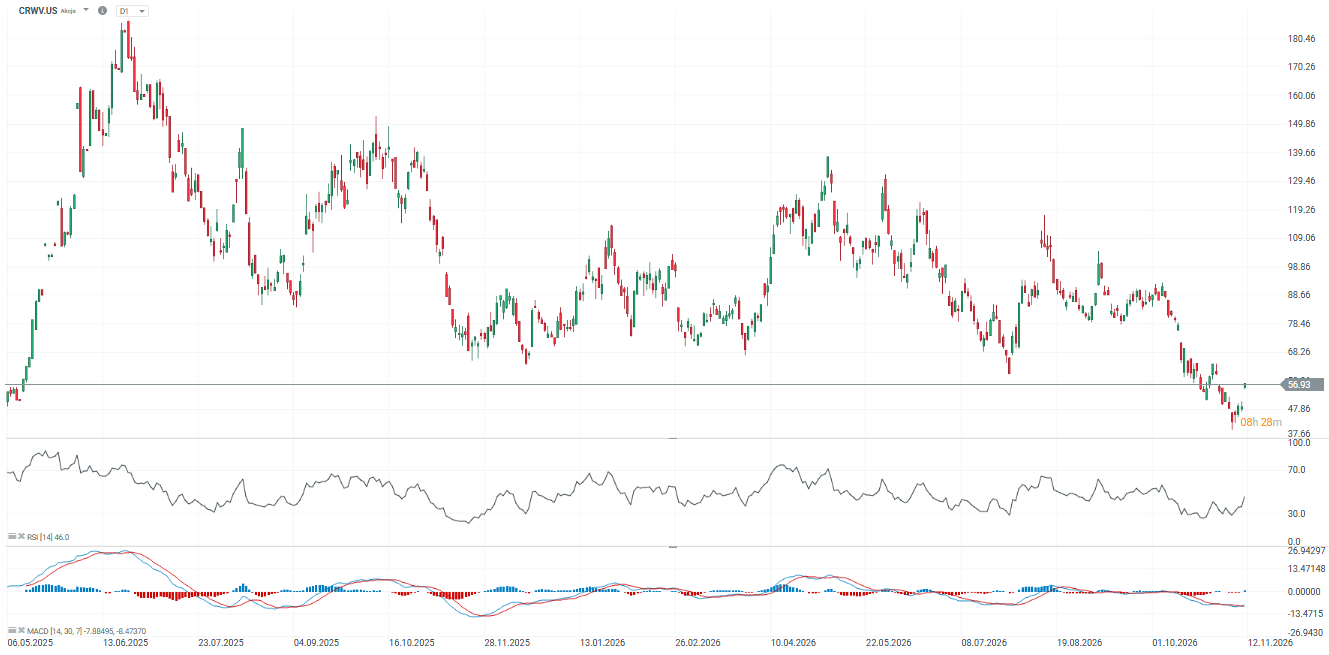
Shares of neocloud company CoreWeave are up more than 10% after the company reported third-quarter revenue above analysts’ expectations. CoreWeave also raised its 2026 revenue and operating income guidance.
-
Nvidia is rebounding more than 5% after losing nearly 10% since the start of the week following CEO Jensen Huang’s confirmation of an affair with a woman suspected of ties to Chinese intelligence. Nvidia’s decline weighed on the broader market on Tuesday, when the main US indices ended the session lower.
-
CoreWeave’s results also supported the Asian technology sector. South Korea’s Kospi ended the session 2.6% higher, with SK Hynix gaining 5.36% and Samsung Electronics rising 3.57%. Gains also spread to European technology stocks, with Infineon up 6.3%, ASMI 5.5%, STMicroelectronics 4%, and ASML around 3%.
-
Iran’s Security Council chief Rezaei warned that in the event of a US attack, Tehran would target not only nearby US military bases but also more distant facilities, including bases in Europe if aircraft used to strike Iran were launched from them.
-
The escalation in rhetoric is supporting oil prices, with Brent rebounding to around $93 per barrel from roughly $90 yesterday. Rezaei also said that Vladimir Putin had emphasized in talks with the US that Iran is not a country that can be easily overthrown. He added that Iran is working on nuclear-powered ships and submarines and therefore needs enriched nuclear material.
US100 chart (D1 interval)
 Source: XTB
CoreWeave after earnings: record backlog and strong AI demand, but debt remains the key risk
CoreWeave reported third-quarter 2026 results that clearly confirmed continued very strong demand for AI infrastructure, while the company also raised its full-year guidance and partly reassured investors over the financing of further expansion. Revenue surged 168% YoY to $3.66 billion, versus roughly $3.55 billion expected by analysts, while backlog increased to $132.5 billion. CoreWeave shares were up around 15–17% ahead of the Wall Street open, with the positive reaction also spreading to other neocloud companies.
Key Q3 2026 figures
-
Q3 revenue: $3.66 billion, +168% YoY, versus roughly $3.55 billion consensus and the company’s previous Q3 guidance of $3.45–3.60 billion. This represents a beat of around 3% versus market expectations and a result slightly above the upper end of CoreWeave’s own forecast.
-
Net loss: $709 million, compared with a $626 million loss in Q2 and a $110 million loss a year earlier.
-
Loss per share: $1.27, versus roughly $1.55 loss expected by the market; a year earlier, the loss stood at $0.22 per share. EPS was therefore clearly better than consensus despite the deeper YoY net loss.
-
Backlog: $132.5 billion, +138% YoY, versus $104 billion at the end of Q2. In addition, after Q2 CoreWeave said it had already signed more than $25 billion of new customer commitments at the beginning of Q3 that were not yet included in the previous backlog figure.
-
FY2026 revenue guidance: raised to $13.0–13.3 billion from $12.4–13.2 billion previously. The midpoint increased from $12.8 billion to $13.15 billion.
-
FY2026 adjusted operating income guidance: raised to $1.275–1.375 billion from $960 million–$1.15 billion previously. The midpoint increased by around 26%, in line with the company’s own calculation.
-
FY2026 CAPEX: now expected at $37–39 billion versus $35–39 billion previously. The upper end was maintained, while the lower end was raised by $2 billion as CoreWeave aims to deploy contracted infrastructure more quickly for customers.
-
Exit ARR / annualized run-rate revenue: raised to $20–21 billion from $18.5–19.5 billion previously. The midpoint increased from $19.0 billion to $20.5 billion, or by around 7.9%.
-
Q4 interest expense: new guidance stands at $1.05–1.15 billion; previous Q3 guidance was $860–940 million, highlighting a continued sharp increase in financing costs.
Demand for computing power remains far stronger than supply
The most important element of the report is not revenue growth itself, but the scale of contracted future business. Revenue backlog has already reached around $132.5 billion, showing that major AI labs, hyperscalers and enterprises are continuing to aggressively reserve access to GPUs and data-center infrastructure. CoreWeave increased active power capacity to more than 1.7 GW, twice the level seen at the beginning of the year, while contracted power capacity has exceeded 4.6 GW.
The company also emphasized that it is signing new computing-capacity contracts at increasingly higher prices. CoreWeave had previously said that short-term contracts signed in Q3 were reaching annual revenue values of around $40 million per megawatt of power, suggesting very high economic value for the most advanced AI clusters. Demand therefore remains strong enough that CoreWeave’s main growth constraint is currently not customer acquisition, but the pace at which infrastructure can be built and brought online.
CoreWeave is trying to address the market’s biggest concern: financing
The financing structure was the main reason behind CoreWeave shares falling more than 40% over the past month. The business model requires enormous spending on GPUs, data centers, power infrastructure and lease agreements, while the company remains loss-making on a net-income basis and faces very high interest costs. In Q3 alone, interest expense reached $846 million, nearly three times higher than a year earlier.
However, the company is trying to reduce its dependence on expensive unsecured debt. CoreWeave expects around $9 billion in customer prepayments and deposits over the next three months and does not plan to issue additional unsecured debt at the parent-company level through the end of 2027 at current yields. Financing is expected to rely more heavily on structures secured by customer contracts, assets such as GPUs and direct customer prepayments.
This part of the report is likely responsible for a large share of today’s stock-price rebound. The market received a signal that further growth does not necessarily have to be financed solely through increasingly expensive high-yield debt, where yields have risen above 15% in recent weeks.
Interest costs remain enormous
There is, however, a clear limit to the optimism. CoreWeave expects interest expense of $1.05–1.15 billion in Q4 alone, which could amount to nearly one-third of quarterly revenue. At the same time, the company raised the lower end of its annual capital expenditure guidance to $37 billion as it aims to accelerate infrastructure deployment for customers.
This illustrates CoreWeave’s fundamental dilemma. The company has enormous demand, rapidly growing revenue and one of the largest backlogs in the entire AI sector, but it must continuously invest tens of billions of dollars before its infrastructure begins generating full revenue. Debt and the cost of capital therefore remain just as important to the company’s valuation as the pace of sales growth.
CoreWeave lifts the entire neocloud sector
The report was also interpreted by the market as a positive signal for CoreWeave’s competitors. In premarket trading, shares of Nebius were up around 11–15%, Applied Digital around 7–10%, and IREN nearly 8%, as CoreWeave’s strong backlog reduced concerns that the AI investment boom is beginning to fade sharply. Nvidia, which is both a supplier to and a major shareholder in CoreWeave, was also up around 4%.
For the broader sector, the key signal is that the main problem facing neoclouds does not currently appear to be a lack of customers, but rather the cost of financing the enormous infrastructure needed to serve those customers. CoreWeave’s results therefore show that AI demand remains exceptionally strong, but investors are likely to focus increasingly not only on revenue growth, but also on debt structures, cash flows and the economics of new data centers.
Source: XTB
Goldman and UBS expect another Fed hike in March after a December move
Goldman Sachs now expects the Federal Reserve to raise interest rates not only in December, but also in March. Higher-than-expected October CPI inflation, which increased by 0.4% MoM versus the 0.3% expected, strengthened market conviction that the Fed may need to maintain a more restrictive stance for longer.
-
Under Goldman’s scenario, a hike as early as January is also possible, although March remains the more likely timing. The bank assumes inflation data for November and December could be somewhat softer, but renewed cost pressures at the beginning of 2027 could push inflation higher again and prompt the Fed to deliver another 25 bp hike.
-
UBS also expects 25 bp hikes in December and March, but sees limited support within the FOMC for a 50 bp move. At the same time, the latest data have increased the risk of faster or more aggressive monetary tightening if inflation does not begin to slow more clearly.
Despite some technical uncertainty, inflation remaining above desired levels should keep the Fed dissatisfied with the pace of progress in bringing price pressures under control, which is why a December increase in the federal funds rate remains both our and the market’s base-case scenario. Comments from Fed Governor Christopher Waller also strengthened market expectations for a 25 bp move. The US bond market will remain closed on Wednesday for Veterans Day.
 Source: XTB


Siemens Energy gains 9% after earnings 📈 European earnings season in focus


Nvidia shares suffer their biggest drop since 2025 🚩 What’s next for the AI giant?


📈 US500 continues its rebound


Economic calendar: European earnings season in focus amid light macro calendar (11.11.2026)
The content of this report has been created by XTB S.A., with its registered office in Warsaw, at Prosta 67, 00-838 Warsaw, Poland, (KRS number 0000217580) and supervised by Polish Supervision Authority ( No. DDM-M-4021-57-1/2005). This material is a marketing communication within the meaning of Art. 24 (3) of Directive 2014/65/EU of the European Parliament and of the Council of 15 May 2014 on markets in financial instruments and amending Directive 2002/92/EC and Directive 2011/61/EU (MiFID II). Marketing communication is not an investment recommendation or information recommending or suggesting an investment strategy within the meaning of Regulation (EU) No 596/2014 of the European Parliament and of the Council of 16 April 2014 on market abuse (market abuse regulation) and repealing Directive 2003/6/EC of the European Parliament and of the Council and Commission Directives 2003/124/EC, 2003/125/EC and 2004/72/EC and Commission Delegated Regulation (EU) 2016/958 of 9 March 2016 supplementing Regulation (EU) No 596/2014 of the European Parliament and of the Council with regard to regulatory technical standards for the technical arrangements for objective presentation of investment recommendations or other information recommending or suggesting an investment strategy and for disclosure of particular interests or indications of conflicts of interest or any other advice, including in the area of investment advisory, within the meaning of the Trading in Financial Instruments Act of 29 July 2005 (i.e. Journal of Laws 2019, item 875, as amended). The marketing communication is prepared with the highest diligence, objectivity, presents the facts known to the author on the date of preparation and is devoid of any evaluation elements. The marketing communication is prepared without considering the client’s needs, his individual financial situation and does not present any investment strategy in any way. The marketing communication does not constitute an offer of sale, offering, subscription, invitation to purchase, advertisement or promotion of any financial instruments. XTB S.A. is not liable for any client’s actions or omissions, in particular for the acquisition or disposal of financial instruments, undertaken on the basis of the information contained in this marketing communication. In the event that the marketing communication contains any information about any results regarding the financial instruments indicated therein, these do not constitute any guarantee or forecast regarding the future results.