



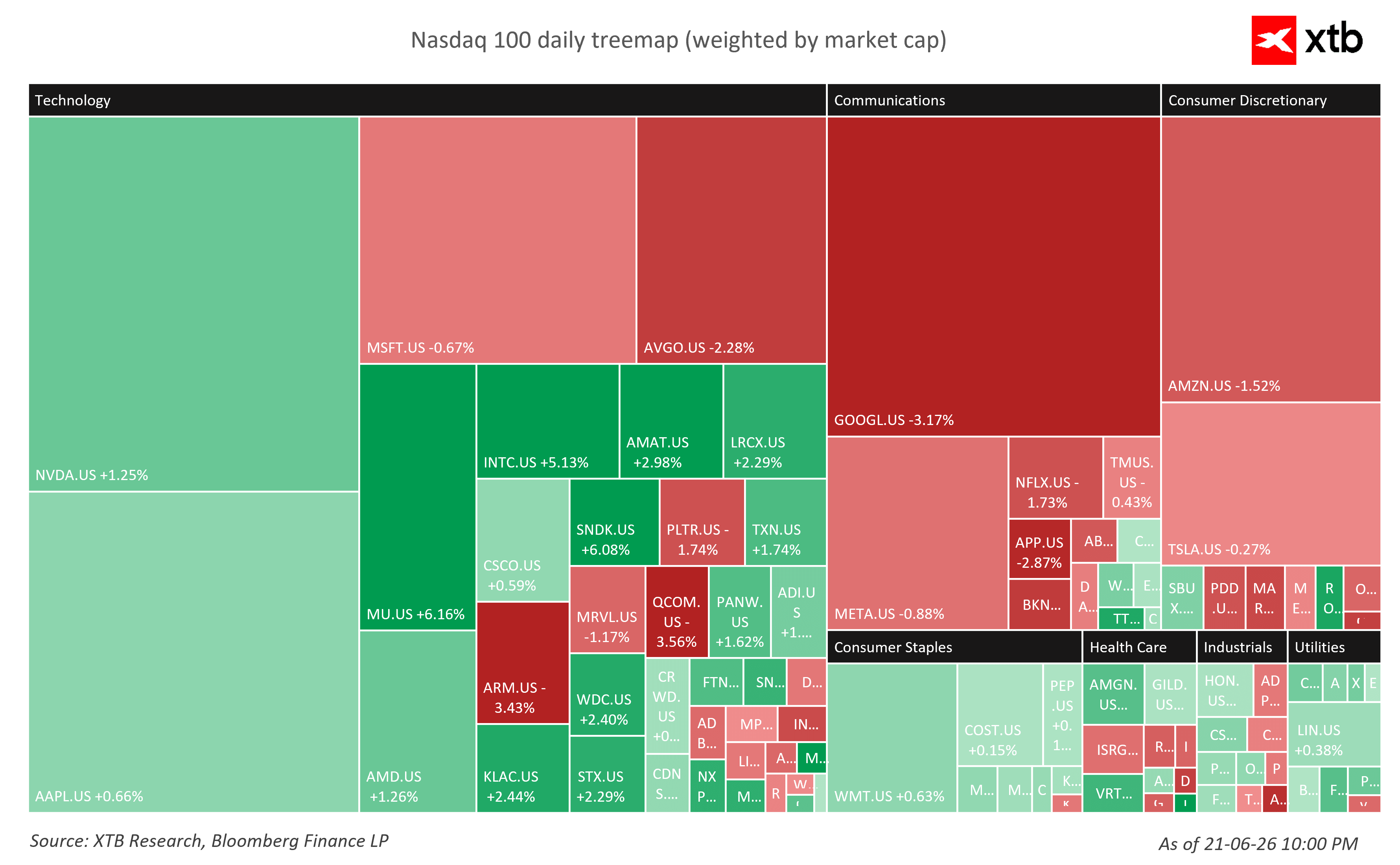
Wall Street started the week on a positive note, although investor sentiment remains far from euphoric. Following the long weekend, market attention is focused primarily on developments in the Middle East. The situation surrounding Iran and the Persian Gulf remains highly uncertain, with recent days bringing renewed tensions and exchanges of threats between the parties involved. At the same time, signs of progress in diplomatic negotiations have helped sustain hopes for de-escalation, encouraging investors to cautiously return to risk assets.
Despite elevated geopolitical risks, major U.S. equity indices are posting modest gains. Markets appear to be increasingly pricing out the worst-case scenario for the Middle East conflict. While the tensions have already disrupted global trade flows and commodity transportation, investors are now shifting their focus toward the prospect of a gradual normalization of conditions. Expectations of de-escalation and the eventual restoration of smooth transit through the Strait of Hormuz are supporting sentiment, although market participants recognize that repairing disrupted supply chains and reversing the economic impact of recent events will take time.
Investor confidence has also been supported by reports of progress in negotiations between Washington and Tehran. U.S. Vice President J.D. Vance described the latest round of talks as having achieved "significant progress," a development that markets interpreted as increasing the likelihood of further de-escalation across the region. While the situation remains fluid, investors are increasingly focused on the possibility of a lasting agreement rather than scenarios involving a broader regional conflict.
The economic calendar remains relatively light at the start of the week, prompting investors to look ahead to several key events scheduled for the coming days. Thursday’s release of the PCE inflation report, the Federal Reserve’s preferred inflation gauge, will be closely watched for clues regarding the future path of U.S. interest rates. With Fed officials recently signaling a cautious approach toward further monetary easing, any indication of persistent inflationary pressures could have a meaningful impact on market expectations.
Micron’s upcoming quarterly earnings report is also drawing considerable attention and may prove to be one of the most important events of the week for the semiconductor sector. Investors are looking for confirmation that strong demand tied to artificial intelligence infrastructure, data centers, and advanced memory solutions remains intact. Solid results could provide another catalyst for the technology sector, which has been one of the market’s strongest performers in recent months.
For now, investors are opting for cautious optimism, betting on further geopolitical de-escalation while maintaining confidence in the resilience of corporate earnings. The start of the week suggests that markets remain focused on a gradual normalization of conditions in the Middle East, although a more meaningful test of sentiment may arrive later this week with key macroeconomic releases and corporate earnings.
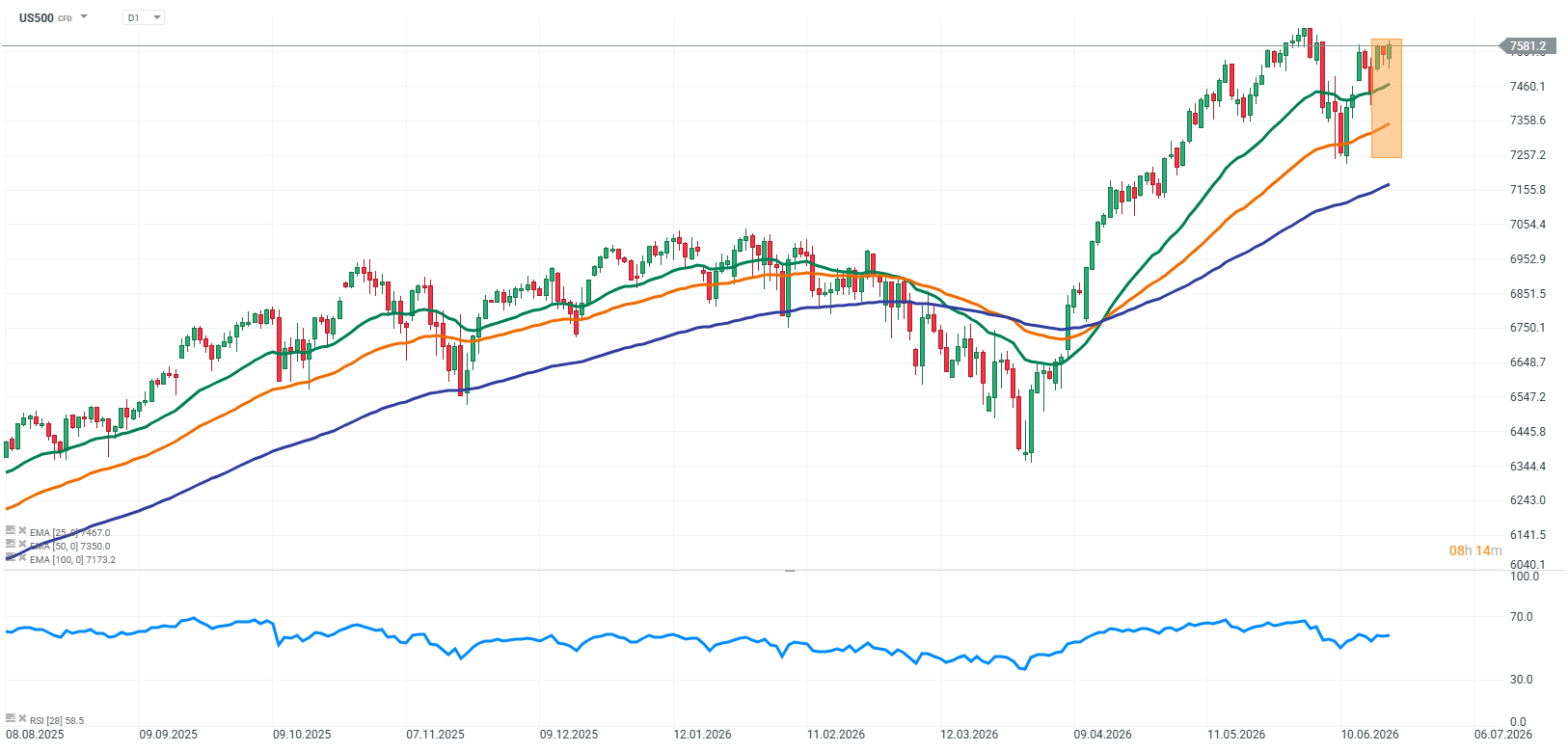
S&P 500 (US500) futures are moving higher as investors increasingly embrace the prospect of a lasting de-escalation in the Middle East. Reports of progress in U.S.-Iran negotiations and growing expectations that a formal agreement could be reached are supporting global risk appetite. Markets are betting that a potential truce would pave the way for a gradual normalization of conditions across the region, including the restoration of unrestricted shipping through the Strait of Hormuz, one of the world's most important energy trade routes.
Source: xStation5
Company News
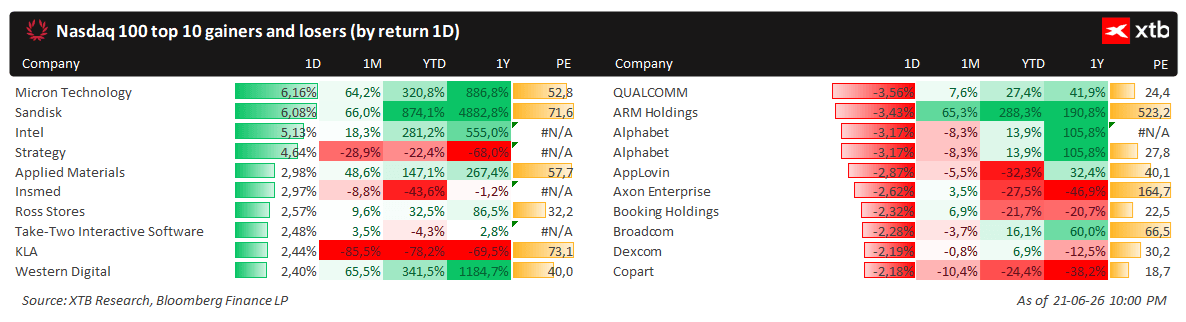
Micron (MU.US) is gaining ahead of its quarterly earnings release, which is expected to be one of the key events this week for the semiconductor industry. Investors are looking for further evidence of improving conditions in the memory market, where strong demand continues to outpace supply growth. The ongoing expansion of artificial intelligence infrastructure remains an important tailwind, driving demand for advanced memory solutions used in data centers. The results could serve as a key indicator of the broader health of the AI ecosystem.
SpaceX (SPCX.US) shares remain under pressure following the announcement of the company’s inaugural corporate bond offering. The move comes after a strong post-IPO rally and is being viewed by some investors as an opportunity to lock in profits. At the same time, the additional capital could support future expansion initiatives and strategic investments, which remain central to the company’s long-term growth plans.
Super Micro Computer (SMCI.US) is trading higher as investors adopt a more constructive view of the company’s outlook. Concerns surrounding shareholder dilution appear to be fading, while attention shifts back toward strong demand for AI-focused server infrastructure. Expectations for continued growth in orders related to high-performance computing and artificial intelligence remain a key driver of sentiment toward the stock.
Cerebras Systems (CBRS.US) remains in focus ahead of its upcoming earnings release. Investors are closely watching the company’s ability to execute on its growth strategy and maintain strong business momentum. Confidence in the company’s outlook has been supported by major strategic partnerships announced in recent months, helping to alleviate concerns about future demand for its AI computing solutions.



Three markets to watch next week (23.10.2026)



Daily Summary: Oil at five-month highs, indices under pressure (23.10.2026)

US Open: Further declines on Wall Street, Brent above 111 USD, AI correction continues (14.10.2026)

Chart of the Day: Is USDJPY running out of road? Inflation forces the BoJ to act, but the Fed could spoil the Yen’s rally
The content of this report has been created by XTB S.A., with its registered office in Warsaw, at Prosta 67, 00-838 Warsaw, Poland, (KRS number 0000217580) and supervised by Polish Supervision Authority ( No. DDM-M-4021-57-1/2005). This material is a marketing communication within the meaning of Art. 24 (3) of Directive 2014/65/EU of the European Parliament and of the Council of 15 May 2014 on markets in financial instruments and amending Directive 2002/92/EC and Directive 2011/61/EU (MiFID II). Marketing communication is not an investment recommendation or information recommending or suggesting an investment strategy within the meaning of Regulation (EU) No 596/2014 of the European Parliament and of the Council of 16 April 2014 on market abuse (market abuse regulation) and repealing Directive 2003/6/EC of the European Parliament and of the Council and Commission Directives 2003/124/EC, 2003/125/EC and 2004/72/EC and Commission Delegated Regulation (EU) 2016/958 of 9 March 2016 supplementing Regulation (EU) No 596/2014 of the European Parliament and of the Council with regard to regulatory technical standards for the technical arrangements for objective presentation of investment recommendations or other information recommending or suggesting an investment strategy and for disclosure of particular interests or indications of conflicts of interest or any other advice, including in the area of investment advisory, within the meaning of the Trading in Financial Instruments Act of 29 July 2005 (i.e. Journal of Laws 2019, item 875, as amended). The marketing communication is prepared with the highest diligence, objectivity, presents the facts known to the author on the date of preparation and is devoid of any evaluation elements. The marketing communication is prepared without considering the client’s needs, his individual financial situation and does not present any investment strategy in any way. The marketing communication does not constitute an offer of sale, offering, subscription, invitation to purchase, advertisement or promotion of any financial instruments. XTB S.A. is not liable for any client’s actions or omissions, in particular for the acquisition or disposal of financial instruments, undertaken on the basis of the information contained in this marketing communication. In the event that the marketing communication contains any information about any results regarding the financial instruments indicated therein, these do not constitute any guarantee or forecast regarding the future results.