



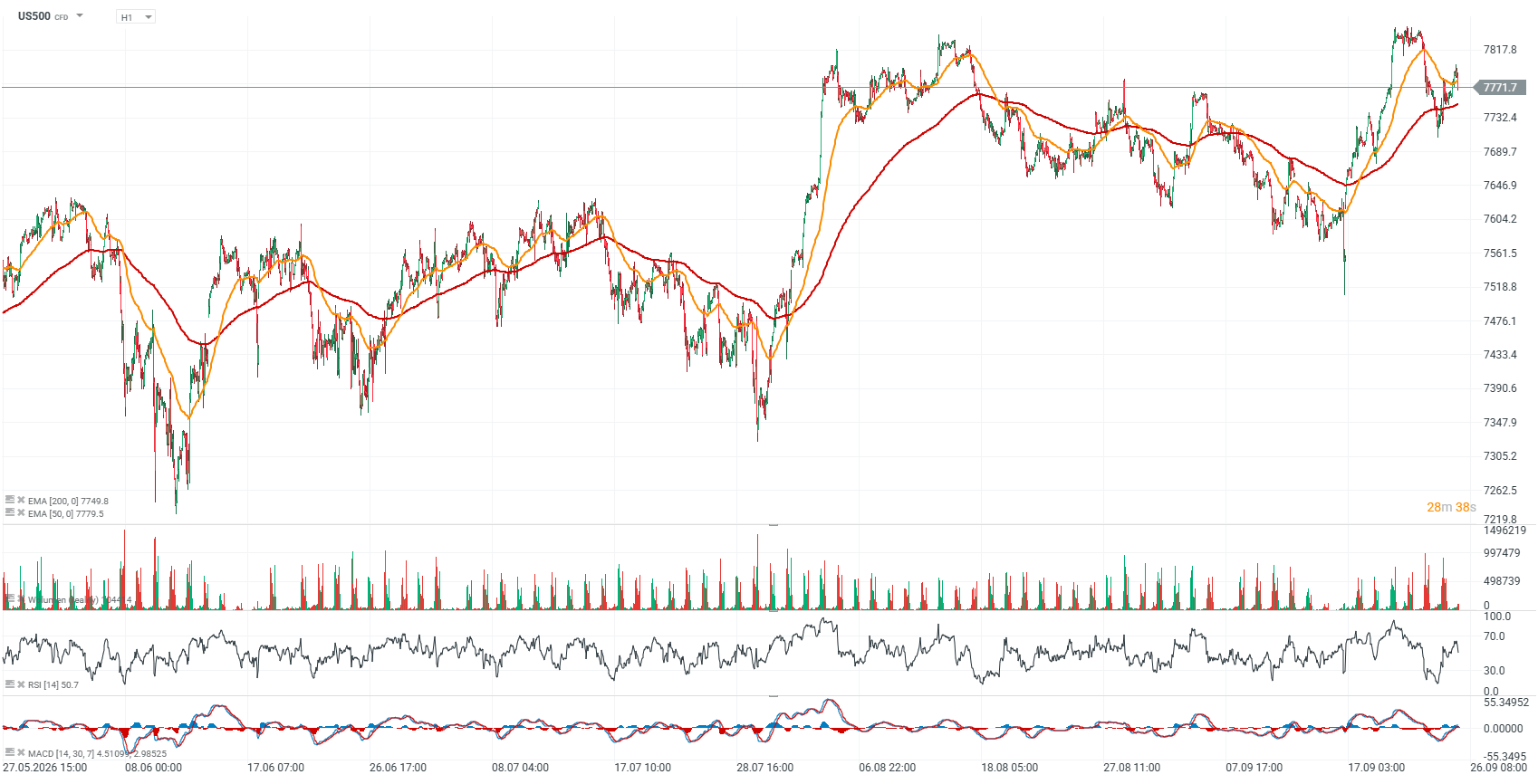
U.S. index futures are trading higher on Friday as Wall Street heads toward the end of a highly volatile week dominated by a sharp rise in Treasury yields. Sentiment has improved slightly amid lower oil prices and hopes for diplomatic progress surrounding Iran and the Strait of Hormuz. Nevertheless, elevated yields, rising financing costs and a higher probability of another Fed rate hike remain the main sources of risk for the market.
-
At the open, the S&P 500 is up 0.2%, the Nasdaq 100 is gaining 0.2%, while futures tied to the Dow Jones Industrial Average (DJIA) are higher by around 130 points, or 0.15%. The DJIA is heading for its fourth consecutive weekly decline and was down 0.6% through Thursday’s close. The S&P 500 is up around 0.7% for the week, while the Nasdaq has gained approximately 1.5%.
-
Shares of internet infrastructure giant Akamai Technologies are up more than 19% after the company announced a multi-year agreement with Anthropic. Fastly and Synopsys shares are also trading higher.
-
Oil prices are falling amid hopes for a potential diplomatic resolution to the conflict with Iran. According to Reuters, U.S. and Iranian negotiators in New York are exploring the possibility of a phased agreement that could lead toward an end to the conflict in the Middle East.
-
WTI crude futures are down almost 2%, while Brent is losing around 1% and trading near $99 per barrel.
-
Pressure remains visible in the bond market. The yield on the 10-year U.S. Treasury rose on Thursday to its highest level since 2007, while the 30-year yield reached its highest level since 2004. They currently stand at around 5.18% and 5.48%, respectively.
-
The rise in yields was driven by hawkish comments from Fed Governor Michael Barr, persistently high energy prices linked to the war in Iran, and a strong PMI report.
-
Fed funds futures are pricing in around a 66% probability of a rate hike in October.
-
The average rate on 30-year U.S. mortgages has risen to 7.45%, the highest level since 2024, increasing the risk of further pressure on household financing costs. Morgan Stanley expects higher borrowing costs to weigh on consumption, particularly spending on goods.
-
Treasury Secretary Scott Bessent said earlier that the U.S. and China had agreed to extend their trade truce by another two months, while investors are also closely following Xi Jinping’s visit to the United States. U.S. Trade Representative Jamieson Greer said additional details on U.S.-China trade negotiations are expected to be released on Monday.
US500 chart, D1 interval
 Source: xStation5
Company news
-
Scholastic – Shares of the children’s book publisher are down more than 10% following the release of its fiscal first-quarter results. The company reported an adjusted loss of $3.63 per share, compared with a loss of $2.52 per share a year earlier, while revenue declined 4% year over year to $216.8 million.
-
Synopsys – Shares are up more than 3% after HSBC upgraded the stock from “Hold” to “Buy.” Analyst Frank Lee said the company’s new business model could position Synopsys as one of the beneficiaries of the rapid expansion of the AI market.
Synopsys receives the highest price target on Wall Street. HSBC sees shares reaching $700
HSBC upgraded Synopsys from “Hold” to “Buy” while raising its price target from $490 to $700, currently the highest target on Wall Street. With the shares trading at around $425, this would imply upside of roughly 65%, although such an aggressive valuation requires equally ambitious earnings assumptions to materialize.
The key change concerns HSBC’s view of the company’s future profitability. The bank rolled its valuation framework forward from fiscal 2026 to fiscal 2027 and applied a price-to-earnings multiple of 35x to its projected EPS of $20.01. Importantly, HSBC’s earnings forecast is around 13% above consensus and the highest among Wall Street estimates. As a result, the $700 price target is based primarily on the assumption that Synopsys will grow earnings faster than the broader market currently expects.
Another important part of HSBC’s thesis is Synopsys’ shift toward a business model with a greater contribution from royalty-based revenue, which could improve scalability and increase the share of high-margin, recurring revenue. At the same time, the development of agentic artificial intelligence could increase demand for EDA tools used to design increasingly complex semiconductor chips. The combination of structural semiconductor growth and potentially improving revenue quality is therefore central to HSBC’s more optimistic valuation framework.
Results confirm improving momentum, but Synopsys’ valuation leaves little room for error
The fundamental arguments behind the growing analyst optimism have been partly confirmed by the company’s latest results. In fiscal Q3 2026, Synopsys reported adjusted EPS of $3.91 versus expectations of $3.67, while revenue reached $2.48 billion compared with the $2.44 billion consensus. The company also raised its full-year outlook, reinforcing expectations for faster earnings growth in 2027.
Positive sentiment is not limited to HSBC. Baird recently upgraded Synopsys to “Outperform” and raised its price target to $560, while Morgan Stanley upgraded the stock to “Overweight,” citing greater confidence in the Ansys integration and a recovery in the Design IP segment. Benchmark, meanwhile, maintained its “Buy” rating. Additional support comes from very high gross margins of around 83% and upward revisions to earnings forecasts from a number of analysts.
Valuation remains the main risk. At the current share price, Synopsys trades at elevated multiples, meaning further upside will increasingly depend not only on the expansion of the AI and EDA markets, but also on whether that growth translates into faster EPS growth and stronger momentum in the Design IP segment. In practice, the market is increasingly valuing Synopsys not simply as a stable software supplier to the semiconductor industry, but as one of the potential structural beneficiaries of the next stage of the AI boom. That increases both the upside potential and the stock’s sensitivity to any earnings disappointment.
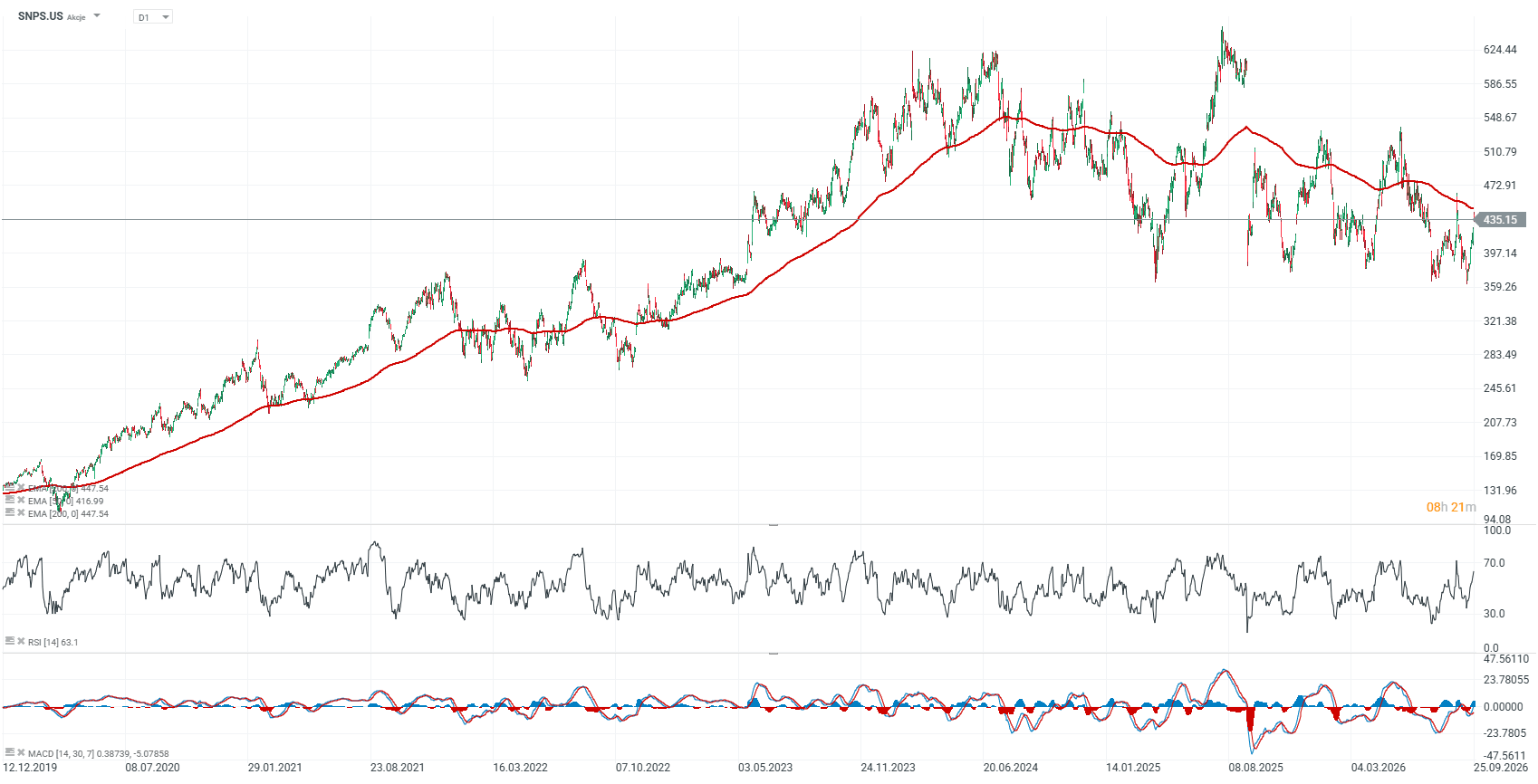
Synopsys shares chart (SNPS.US), D1 interval
Despite analysts’ optimism, the shares are still trading below the EMA200, shown by the red line, although today’s breakout has brought the stock back toward this key resistance level. The historical high is located near $630 per share, meaning the stock would need to rise by around 50% from current levels to reach a new all-time high.
Source: xStation5



Daily Summary: Friday offers no relief; the US100 drops 2%🚨


Three Markets to Watch Next Week (October 16, 2026)


Market wrap: European indices rebound 🔼 Defence stocks on the rise


TSMC in Talks with Elon Musk Over Terafab
The content of this report has been created by XTB S.A., with its registered office in Warsaw, at Prosta 67, 00-838 Warsaw, Poland, (KRS number 0000217580) and supervised by Polish Supervision Authority ( No. DDM-M-4021-57-1/2005). This material is a marketing communication within the meaning of Art. 24 (3) of Directive 2014/65/EU of the European Parliament and of the Council of 15 May 2014 on markets in financial instruments and amending Directive 2002/92/EC and Directive 2011/61/EU (MiFID II). Marketing communication is not an investment recommendation or information recommending or suggesting an investment strategy within the meaning of Regulation (EU) No 596/2014 of the European Parliament and of the Council of 16 April 2014 on market abuse (market abuse regulation) and repealing Directive 2003/6/EC of the European Parliament and of the Council and Commission Directives 2003/124/EC, 2003/125/EC and 2004/72/EC and Commission Delegated Regulation (EU) 2016/958 of 9 March 2016 supplementing Regulation (EU) No 596/2014 of the European Parliament and of the Council with regard to regulatory technical standards for the technical arrangements for objective presentation of investment recommendations or other information recommending or suggesting an investment strategy and for disclosure of particular interests or indications of conflicts of interest or any other advice, including in the area of investment advisory, within the meaning of the Trading in Financial Instruments Act of 29 July 2005 (i.e. Journal of Laws 2019, item 875, as amended). The marketing communication is prepared with the highest diligence, objectivity, presents the facts known to the author on the date of preparation and is devoid of any evaluation elements. The marketing communication is prepared without considering the client’s needs, his individual financial situation and does not present any investment strategy in any way. The marketing communication does not constitute an offer of sale, offering, subscription, invitation to purchase, advertisement or promotion of any financial instruments. XTB S.A. is not liable for any client’s actions or omissions, in particular for the acquisition or disposal of financial instruments, undertaken on the basis of the information contained in this marketing communication. In the event that the marketing communication contains any information about any results regarding the financial instruments indicated therein, these do not constitute any guarantee or forecast regarding the future results.