


The U.S. tech sector found itself at the epicenter of an unprecedented corporate upheaval that forced institutional investors to sharply reassess risk premiums on Wall Street. The alleged proposal to vote on removing Jensen Huang as Nvidia’s CEO—a fallout from an escalating romantic scandal—has struck at the very foundation of the AI bull market. By mid-2026, Nvidia had supplied the lion’s share of global AI computing power (nearly 18 million H100 chip equivalents out of just under 27 million installed worldwide), leaving Google, AMD, and Amazon in the dust. To the financial markets, Huang is not merely a CEO—he is the architect of an ecosystem on which the trillion-dollar capital expenditure (CapEx) budgets of hyperscalers depend. The prospect of a leadership vacuum in Santa Clara triggered an immediate wave of position reductions in semiconductor stocks, dragging down the entire Nasdaq 100 index.
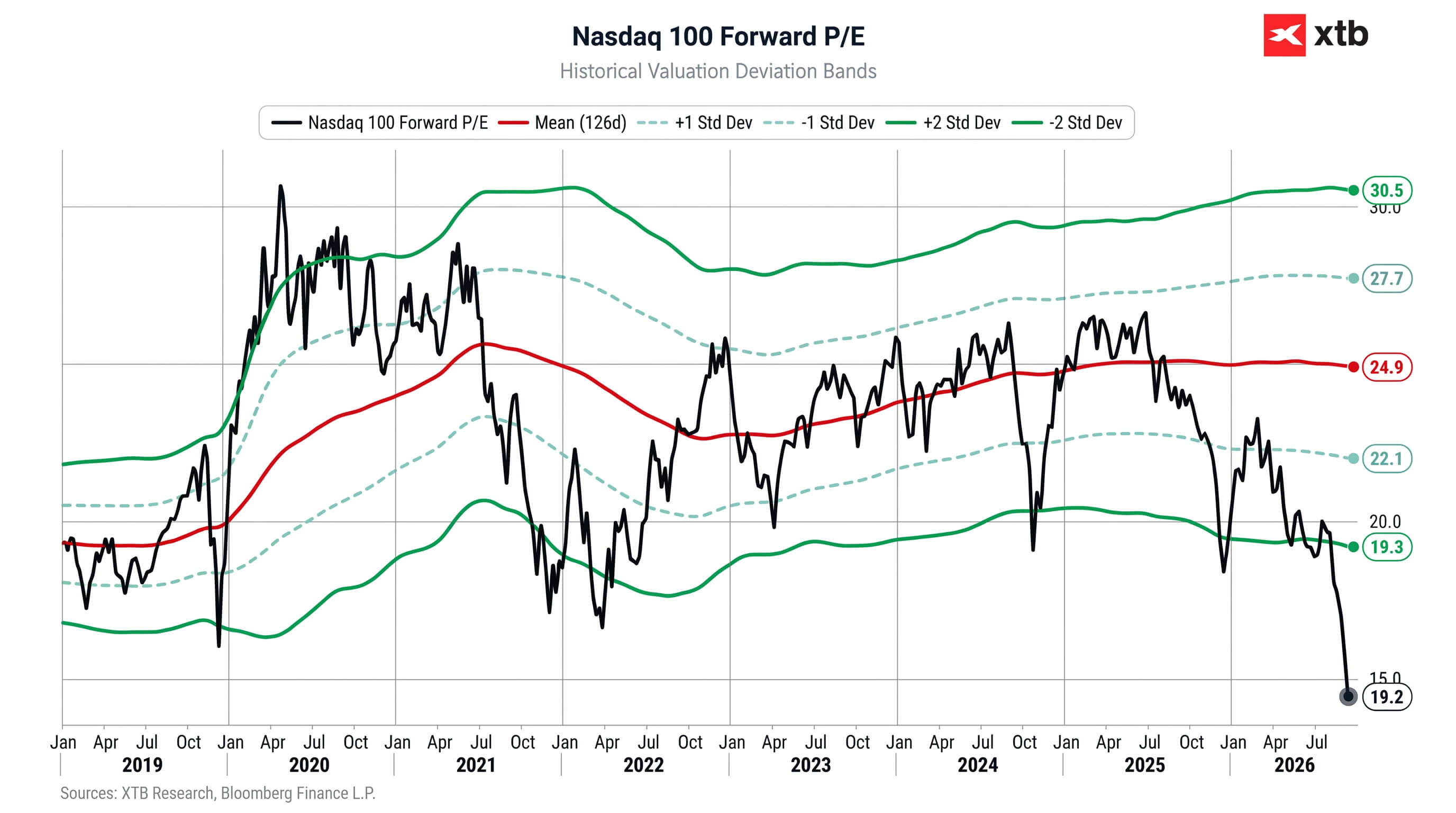
However, the scale of the market crash is particularly evident in the index’s fundamentals and multiples. The price-to-forward-earnings ratio plummeted in November 2026 to 19.2x. This represents a break below the lower band of two standard deviations ( -2 Std Dev at 19.3x) relative to the long-term average for 2019–2026 of 24.9x. From a historical perspective, such a deep valuation discount was last seen only during the pandemic crash in March 2020 and at the bottom of the bear market in the fall of 2022. The market has, in effect, already priced in the scenario of decision-making paralysis at Nvidia, driving the valuations of leading tech companies down to levels that are oversold in terms of price-to-earnings multiples and relative valuations. Source: XTB Research, Bloomberg Financial LP
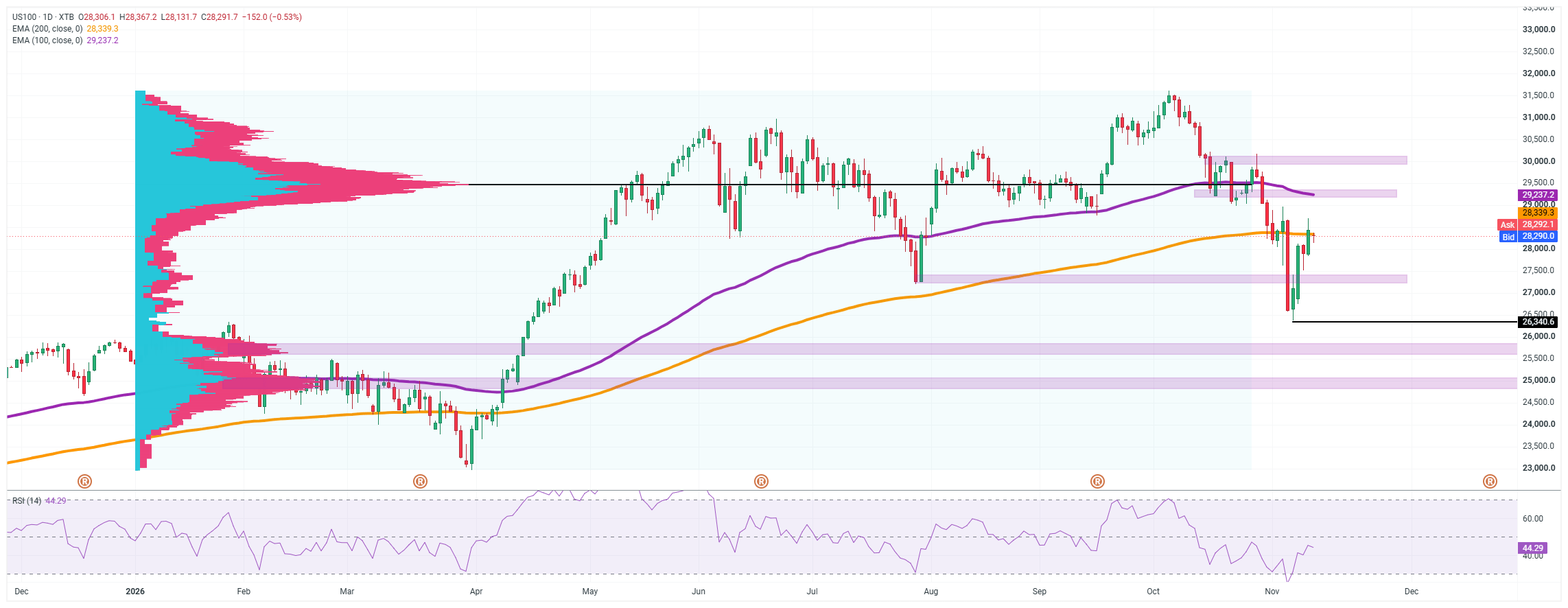
From a technical analysis perspective on the daily timeframe (US100, D1), the November panic led to a break below the uptrend line and a decline in prices all the way to a local low of 26,340.6 points. The sell-off only slowed after the RSI (14) indicator fell into oversold territory, from which demand triggered a rapid V-shaped rebound, pulling the contract back toward the 28,291-point level (currently, the RSI is rebounding to 44.29). The key battle is now taking place at the 200-day EMA (28,339.3 points) , which the bulls may attempt to reclaim. A sustained break above this barrier could pave the way for a test of the resistance convergence zone at 29,237–29,500 points, where the 100-period EMA (29,237.2 points) and the main node of the volume profile (Point of Control – POC). Conversely, a rejection of the price from below the 200-period EMA following a negative outcome of the Nvidia vote would hypothetically threaten a return to the support zone at 27,300 points, and in an extreme, possible scenario—a retest of the low at 26,340 points.


Morning Wrap: Nvidia sell-off weighs on indices - how many more Huang's affairs must the market price-in? (12.11.2026)


📊Daily Summary: Tech sector drives Wall Street rebound, DAX leads in Europe


US Open: Nasdaq 100 rises nearly 2% as CoreWeave and Nvidia rebound 📈 EURUSD hits its lowest level since May 12, 2026


Market wrap: Siemens Energy gains 9% after earnings 📈 European earnings season in focus
The content of this report has been created by XTB S.A., with its registered office in Warsaw, at Prosta 67, 00-838 Warsaw, Poland, (KRS number 0000217580) and supervised by Polish Supervision Authority ( No. DDM-M-4021-57-1/2005). This material is a marketing communication within the meaning of Art. 24 (3) of Directive 2014/65/EU of the European Parliament and of the Council of 15 May 2014 on markets in financial instruments and amending Directive 2002/92/EC and Directive 2011/61/EU (MiFID II). Marketing communication is not an investment recommendation or information recommending or suggesting an investment strategy within the meaning of Regulation (EU) No 596/2014 of the European Parliament and of the Council of 16 April 2014 on market abuse (market abuse regulation) and repealing Directive 2003/6/EC of the European Parliament and of the Council and Commission Directives 2003/124/EC, 2003/125/EC and 2004/72/EC and Commission Delegated Regulation (EU) 2016/958 of 9 March 2016 supplementing Regulation (EU) No 596/2014 of the European Parliament and of the Council with regard to regulatory technical standards for the technical arrangements for objective presentation of investment recommendations or other information recommending or suggesting an investment strategy and for disclosure of particular interests or indications of conflicts of interest or any other advice, including in the area of investment advisory, within the meaning of the Trading in Financial Instruments Act of 29 July 2005 (i.e. Journal of Laws 2019, item 875, as amended). The marketing communication is prepared with the highest diligence, objectivity, presents the facts known to the author on the date of preparation and is devoid of any evaluation elements. The marketing communication is prepared without considering the client’s needs, his individual financial situation and does not present any investment strategy in any way. The marketing communication does not constitute an offer of sale, offering, subscription, invitation to purchase, advertisement or promotion of any financial instruments. XTB S.A. is not liable for any client’s actions or omissions, in particular for the acquisition or disposal of financial instruments, undertaken on the basis of the information contained in this marketing communication. In the event that the marketing communication contains any information about any results regarding the financial instruments indicated therein, these do not constitute any guarantee or forecast regarding the future results.