



US index futures are trading higher today, although US stock exchanges remain closed for Thanksgiving. Investors will therefore have to wait until Friday's shortened session to see how the equity market responds to the latest developments. Wall Street recovered most of its sharp losses yesterday, but major technology stocks remained under pressure. The Nasdaq 100 finished above 26,000 points, while the Dow Jones and Russell 2000 posted gains, suggesting a partial rotation away from the artificial intelligence sector. Investors are now focusing on new reports of Nvidia-related export restrictions, persistent US inflation and the prospect of another Federal Reserve rate hike.
-
The S&P 500 ended Wednesday's session down 0.25% at 7,182.78 points, while the Nasdaq 100 fell 0.64% to 26,046.90 points. The Dow Jones gained 0.33%, and the Russell 2000 advanced 0.71%, highlighting the relative strength of smaller US companies.
-
Wall Street recovered most of its losses following a sharp sell-off earlier in Wednesday's session. The S&P 500 had fallen as much as 3.2% before buyers regained control. However, the VIX rose 7.3% to 28.29 points, indicating that market volatility remained elevated.
-
US PCE inflation reached 3.8% YoY in October, while core PCE inflation accelerated to 3.3%, above the 3.2% consensus. Meanwhile, third-quarter US GDP growth was revised upward to an annualized 4.3%. These figures increase the likelihood that interest rates will remain elevated in 2027.
-
Nvidia is facing renewed scrutiny following reports of tighter US export restrictions. According to the Financial Times, the company instructed its partners to suspend AI server shipments to Malaysia, Singapore, Thailand and Indonesia. Nvidia has not independently confirmed these reports.
-
The NYSE and Nasdaq are closed on Thursday, November 26, while Friday's trading session will end at 1:00 PM ET (7:00 PM Polish time), three hours earlier than usual. Reduced trading activity during the holiday period could amplify price fluctuations.
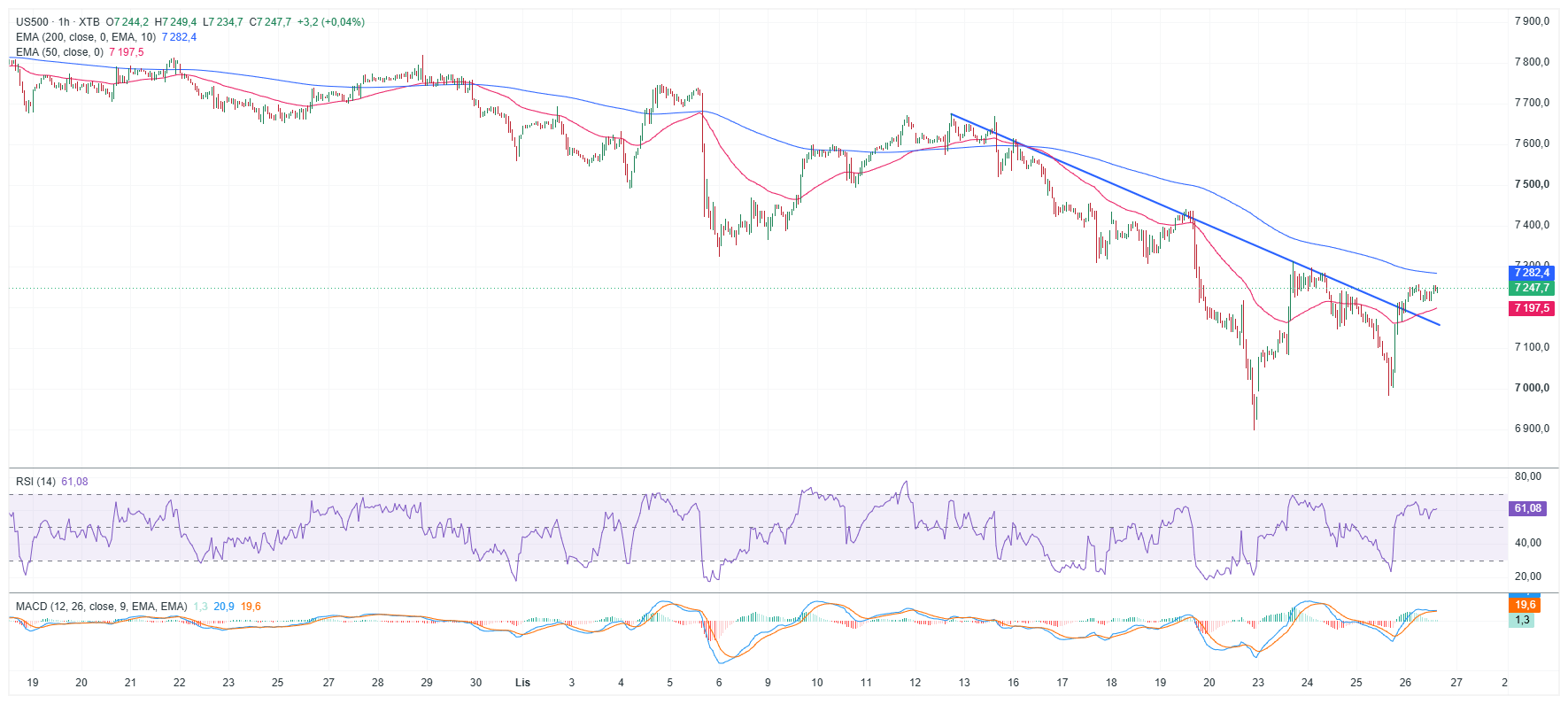
US500 Chart (Hourly Timeframe)
In the near term, a key objective for buyers will be a recovery towards 7,300 points (a key short-term resistance zone) and a sustained breakout above this level. Such a move could confirm a potential double-bottom formation around 7,000 points, which now is the major support.
 Source: XTB
Indices Defends Key Support Levels. Is the Correction Coming to an End?
Wednesday's session provided one of the clearest examples of how quickly investor sentiment can shift in an increasingly volatile market. Despite an aggressive sell-off during the first part of the session, buying interest returned before the close. The S&P 500 recovered most of its earlier losses, which had reached 3.2% at the session low, while the Nasdaq 100 climbed back above the psychologically important 26,000-point level. The sharp recovery suggests that some investors are taking advantage of lower valuations, although it does not yet confirm a sustained reversal of the broader correction.
Importantly, the rebound was not evenly distributed across the market. The Dow Jones and Russell 2000 finished in positive territory, while the Nasdaq remained under pressure. The relative strength of smaller companies and selected cyclical sectors may indicate that investors are seeking alternatives to the largest technology stocks. Such a rotation could improve overall market resilience by reducing the dependence of major indices on a handful of mega-cap companies.
At the same time, core PCE inflation of 3.3% and annualized US economic growth of 4.3% increase the likelihood that the Federal Reserve will maintain restrictive monetary policy. Elevated interest rates can weigh particularly heavily on technology valuations, especially when a substantial share of a company's expected cash flows lies several years in the future.
Nvidia and the AI Sector: Investors Are Becoming More Selective
The current correction has been particularly painful for companies exposed to artificial intelligence infrastructure. On Wednesday, Nvidia fell 3.91%, Oracle lost 5.13%, Micron declined 4.53%, and Sandisk dropped 5.57%. Meanwhile, HP surged 11.49%, and Analog Devices gained 6.44%. These considerable differences suggest that investors are becoming less willing to value the AI sector as a single investment theme. Actual earnings performance, profitability and the ability to generate sustainable free cash flow are increasingly important.
For Nvidia, additional uncertainty stems from new export restrictions affecting Southeast Asia. According to the Financial Times, the suspension of server shipments is connected to US regulations requiring additional export licenses for advanced AI chips. Crucially, these restrictions could extend beyond direct chip sales to fully assembled server systems supplied by partners such as Dell Technologies and Super Micro Computer. It remains unclear whether the restrictions will be temporary or how much of the existing order pipeline could be affected.
For investors, these developments introduce another layer of risk into valuations across the AI infrastructure industry. Even strong demand for computing capacity does not guarantee that all anticipated revenue will materialize if customers encounter regulatory barriers. At the same time, companies financing large, multiyear infrastructure projects through debt remain vulnerable to elevated borrowing costs. The market may increasingly distinguish between businesses already generating substantial earnings from artificial intelligence and those whose valuations depend primarily on expected future benefits.
Wall Street Stocks to Watch on Friday
- Nvidia (NVDA.US) – New export restrictions could put further pressure on the stock. According to Thursday's Financial Times report, Nvidia instructed its partners to suspend AI server shipments to Malaysia, Singapore, Thailand and Indonesia following tighter US export regulations. Nvidia shares fell 3.9% on Wednesday, before these reports emerged, making Friday's session the first opportunity to assess the market's reaction to the latest developments. Investors will focus on whether the restrictions represent a temporary disruption or a more lasting threat to future revenue.
- Dell Technologies (DELL.US) and Super Micro Computer (SMCI.US) – AI server manufacturers face a potential test of investor confidence. Both companies could come under pressure following Financial Times reports of restrictions affecting shipments of completed server systems powered by Nvidia processors to four Southeast Asian countries. Potential delays in fulfilling orders could raise uncertainty surrounding the pace of AI infrastructure expansion. Friday's trading will offer an indication of whether investors begin pricing in revenue risks for Nvidia's partners, although the financial impact remains unknown.
- HP (HPQ.US) – Can the stock sustain its rally of more than 11% following earnings? Wednesday's 11.5% surge stood out against the broader weakness among major technology companies. The PC manufacturer issued adjusted EPS guidance of $3.15–$3.45 for fiscal 2027, compared with a consensus estimate of approximately $3.28. However, part of the positive earnings surprise resulted from tariff-related refunds, which may be nonrecurring. Friday's session will test whether investors are willing to maintain the stock's higher valuation despite uncertainty surrounding future profit margins.
- Analog Devices (ADI.US) – A test of semiconductor strength beyond Nvidia. Shares gained 6.4% on Wednesday, outperforming Nvidia, Micron and other AI infrastructure companies. Investor sentiment has been supported by record financial results, including quarterly revenue of $4.37 billion and annual free cash flow of $5.5 billion. Further gains on Friday could indicate that investors remain interested in selected semiconductor manufacturers, particularly those demonstrating a strong ability to convert revenue into cash flow.
- Deere & Company (DE.US) – Will improving industrial expectations sustain the stock's recovery? Shares of the agricultural and construction equipment manufacturer gained approximately 4.4% on Wednesday following its fourth-quarter earnings release. The company reported revenue of $12.12 billion and earnings of $3.89 per share, highlighting signs of stabilization in agricultural equipment demand. Investors will be watching whether an improving economic outlook supports further capital inflows into industrial stocks. Deere could also serve as an important indicator of investment rotation from technology into more traditional sectors of the economy.
- Vertex Pharmaceuticals (VRTX.US) – Potential for a sharp reaction following the FDA decision delay. Shares of the biotechnology company fell more than 7% in Wednesday's after-hours trading following news that the FDA had extended its review of povetacicept, an experimental treatment for IgA nephropathy. The agency moved the decision deadline from November 30, 2026, to February 28, 2027. Friday will be the first regular trading session following the announcement, allowing investors to assess the potential implications for the drug's commercialization timeline. The extension itself does not mean the regulator has rejected the treatment.
What Comes Next for US market? Black Friday and the Fed in Focus
The next Wall Street session will take place on Friday, November 27, although US stock exchanges will close early at 1:00 PM ET (7:00 PM Polish time). Reduced liquidity during the shortened session could lead to sharper price movements, particularly among companies affected by recent regulatory or corporate developments.
Investors will primarily assess the sustainability of Wednesday's rebound. Maintaining the Nasdaq 100 above 26,000 points and the S&P 500 above 7,000 points could support market stabilization, but a broader recovery extending beyond mega-cap technology stocks would be a more convincing signal. Wednesday's relative outperformance by the Dow Jones and Russell 2000 suggested that capital was not leaving the entire US equity market but was instead shifting between different segments.
The Federal Reserve's December meeting remains the most important upcoming macroeconomic event. Core PCE inflation of 3.3% and strong GDP growth increase the risk of further monetary tightening. Under these conditions, the biggest challenge for AI companies may not be revenue growth itself, but their ability to justify elevated valuations while the cost of capital remains high.
From a broader market perspective, the direction of sector rotation remains the key factor to watch. If investors continue increasing exposure to industrials, financials and smaller companies, the market recovery could continue despite weakness in Nvidia. However, if renewed selling pressure across major AI infrastructure companies spreads to the wider market, Wednesday's rebound may prove to have been only a temporary interruption in November's correction.
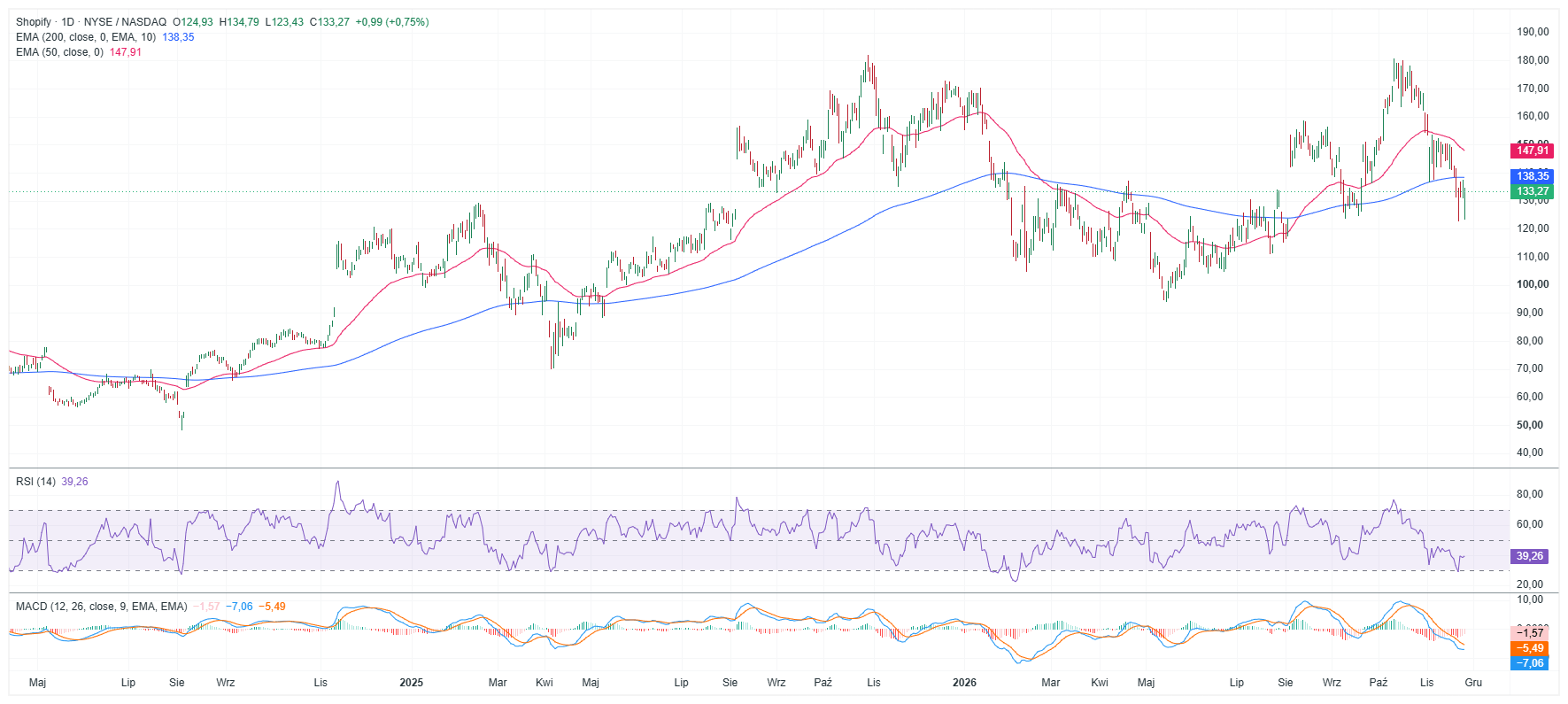
Shopify Stock Price Chart (Daily Timeframe)
 Source: XTB


Market Wrap: European Indices Rise 📈


🚨Imperial Brands up 12% following reports of a possible acquisition by Japan Tobacco


Black Friday 2026 Analysis 🔼 These 6 Stocks Could Benefit From the Shopping Boom


📈 Gains across global stock markets
The content of this report has been created by XTB S.A., with its registered office in Warsaw, at Prosta 67, 00-838 Warsaw, Poland, (KRS number 0000217580) and supervised by Polish Supervision Authority ( No. DDM-M-4021-57-1/2005). This material is a marketing communication within the meaning of Art. 24 (3) of Directive 2014/65/EU of the European Parliament and of the Council of 15 May 2014 on markets in financial instruments and amending Directive 2002/92/EC and Directive 2011/61/EU (MiFID II). Marketing communication is not an investment recommendation or information recommending or suggesting an investment strategy within the meaning of Regulation (EU) No 596/2014 of the European Parliament and of the Council of 16 April 2014 on market abuse (market abuse regulation) and repealing Directive 2003/6/EC of the European Parliament and of the Council and Commission Directives 2003/124/EC, 2003/125/EC and 2004/72/EC and Commission Delegated Regulation (EU) 2016/958 of 9 March 2016 supplementing Regulation (EU) No 596/2014 of the European Parliament and of the Council with regard to regulatory technical standards for the technical arrangements for objective presentation of investment recommendations or other information recommending or suggesting an investment strategy and for disclosure of particular interests or indications of conflicts of interest or any other advice, including in the area of investment advisory, within the meaning of the Trading in Financial Instruments Act of 29 July 2005 (i.e. Journal of Laws 2019, item 875, as amended). The marketing communication is prepared with the highest diligence, objectivity, presents the facts known to the author on the date of preparation and is devoid of any evaluation elements. The marketing communication is prepared without considering the client’s needs, his individual financial situation and does not present any investment strategy in any way. The marketing communication does not constitute an offer of sale, offering, subscription, invitation to purchase, advertisement or promotion of any financial instruments. XTB S.A. is not liable for any client’s actions or omissions, in particular for the acquisition or disposal of financial instruments, undertaken on the basis of the information contained in this marketing communication. In the event that the marketing communication contains any information about any results regarding the financial instruments indicated therein, these do not constitute any guarantee or forecast regarding the future results.