



In light of the latest escalation in the Middle East, many investors still remember the years 2022–2023 and the persistent fears of rising fuel prices, especially in Europe. It is no coincidence that many market participants and observers see a scenario of another wave of fuel shortages and a rise in inflation that would bury hopes of a continued recovery in the economies of the European Union.
However, the Europe entering 2026 is not the same Europe as in 2020 or 2022. The economies and markets of developed countries have learned a painful lesson about import dependence. That lesson has not been absorbed in full, but it has been absorbed to a large extent.
The situation of each country in Europe is different, yet despite significant market destabilization, none of them is currently in a situation that could be described as difficult.
The Middle East is associated by most people with crude oil; however, oil from the Arabian Peninsula goes mainly to Asia rather than to Europe. Europe remains critically dependent on hydrocarbon imports, but it meets a large share of its energy needs through supplies from Norway and the United States.
The Middle East itself has not remained passive, waiting for an inevitable U.S. war with Iran. The “East–West” pipeline currently runs across the Arabian Desert and is capable of pumping between 5 and as much as 7 million barrels of oil per day to ports on the Red Sea, completely bypassing the Strait of Hormuz. Meanwhile, along the Tigris River in Iraq runs the “Al Haditha–Rumalia” pipeline, which then connects to the “Kirkuk–Ceyhan” pipeline, through which an additional 1.5 million barrels per day can be delivered to Turkey.
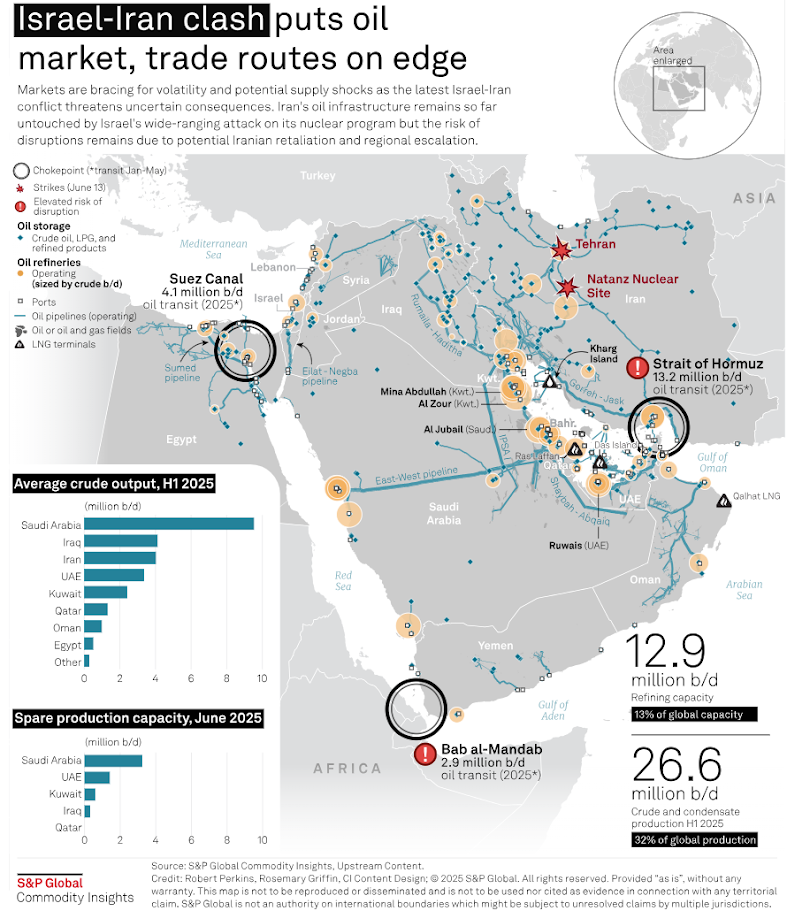
Source: S&P Global
The situation looks worse when it comes to LNG gas, where import dependence is greater, more concentrated, and offers no easy way to bypass the currently “hot” Strait of Hormuz. Still, this is not a reason to panic. Foremost, it is worth looking at the calendar: peak demand for LNG occurs in winter and summer, when heating and cooling are necessary. But it is early March, winter is over, and the arrival of summer heat is at least two months away.
Those two months matter because, regardless of one’s views on the conflict, there is currently no scenario in which Iran emerges victorious from the present confrontation; its defeat, collapse of state structures, or near-total erosion of its ability to continue fighting is now a matter of weeks rather than months. This time “buffer” is reinforced by the fact that after the outbreak of the war in Ukraine, Europe undertook the construction and filling of countless natural gas storage facilities.
The military operations currently underway in the Middle East are a challenge for markets, traders, economies, and central banks to the same extent as for command staffs. However, they are nothing on the scale of what Europe and the world have had to deal with over the past few years.
Yet despite these facts, there are gaps in supply chains that cannot be patched either easily or quickly. That gap is jet fuel. Europe is closing or converting a large portion of its refineries, while demand for passenger flights is hitting record highs. If Europe does not quickly find a way to diversify in this narrow segment of the hydrocarbon market, the consequences for the valuations of European airlines could be dramatic.
LHA.DE (D1)
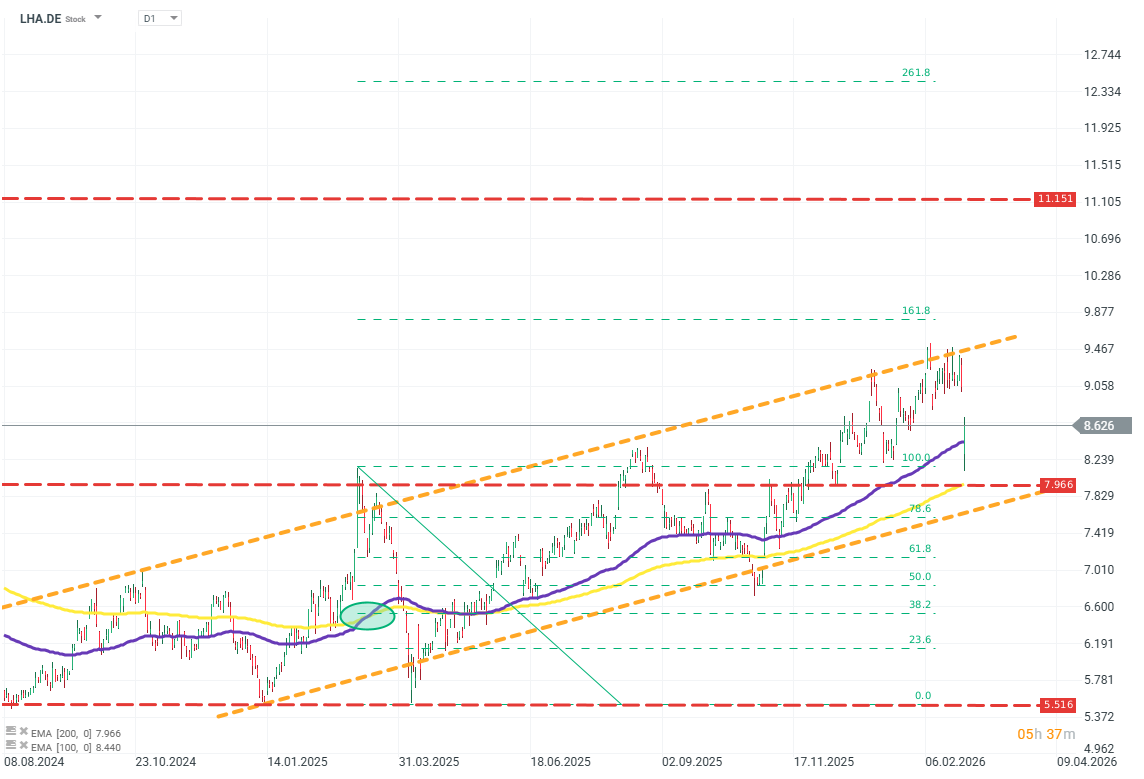
Source: xStation5
Lufthansa's valuations reflect the combination of strong demand in the passenger flight segment and a number of challenges facing the European economy, such as rising fuel and labor costs. A shortage of aviation fuel could prove fatal for many companies without renewed government intervention.

Chart of the Day 📈 EURUSD attempts to rebound ahead of US inflation data (14.10.2026)


ASML disappoints on revenue but delivers stronger profits and raises guidance 🍳 What’s next for the AI sector?


Daily Summary: Earnings Season Kicks Off on Wall Street Amid Mixed Sentiment


SpaceX Wants to Fly Starship Almost Every Day. Musk’s Business Empire Is Betting on It
The content of this report has been created by XTB S.A., with its registered office in Warsaw, at Prosta 67, 00-838 Warsaw, Poland, (KRS number 0000217580) and supervised by Polish Supervision Authority ( No. DDM-M-4021-57-1/2005). This material is a marketing communication within the meaning of Art. 24 (3) of Directive 2014/65/EU of the European Parliament and of the Council of 15 May 2014 on markets in financial instruments and amending Directive 2002/92/EC and Directive 2011/61/EU (MiFID II). Marketing communication is not an investment recommendation or information recommending or suggesting an investment strategy within the meaning of Regulation (EU) No 596/2014 of the European Parliament and of the Council of 16 April 2014 on market abuse (market abuse regulation) and repealing Directive 2003/6/EC of the European Parliament and of the Council and Commission Directives 2003/124/EC, 2003/125/EC and 2004/72/EC and Commission Delegated Regulation (EU) 2016/958 of 9 March 2016 supplementing Regulation (EU) No 596/2014 of the European Parliament and of the Council with regard to regulatory technical standards for the technical arrangements for objective presentation of investment recommendations or other information recommending or suggesting an investment strategy and for disclosure of particular interests or indications of conflicts of interest or any other advice, including in the area of investment advisory, within the meaning of the Trading in Financial Instruments Act of 29 July 2005 (i.e. Journal of Laws 2019, item 875, as amended). The marketing communication is prepared with the highest diligence, objectivity, presents the facts known to the author on the date of preparation and is devoid of any evaluation elements. The marketing communication is prepared without considering the client’s needs, his individual financial situation and does not present any investment strategy in any way. The marketing communication does not constitute an offer of sale, offering, subscription, invitation to purchase, advertisement or promotion of any financial instruments. XTB S.A. is not liable for any client’s actions or omissions, in particular for the acquisition or disposal of financial instruments, undertaken on the basis of the information contained in this marketing communication. In the event that the marketing communication contains any information about any results regarding the financial instruments indicated therein, these do not constitute any guarantee or forecast regarding the future results.