



The semiconductor sector has come under significant pressure, with recent trading sessions showing just how quickly investors can change their sentiment toward companies tied to the artificial intelligence boom. Intel’s weaker-than-expected guidance has added to concerns about the industry’s health, but the underlying issue is broader. The market is increasingly focused on whether massive investments in AI infrastructure will actually translate into revenue and profits, rather than simply generating more promises of rising demand.
Against this backdrop, AMD has an opportunity to reverse the negative trend and restore investor confidence in the sector’s growth potential. However, this will not be an easy task. Expectations for the company are high, its shares have already posted a substantial rally, and much of the bullish scenario appears to be priced in. Simply beating estimates may therefore not be enough. Investors will primarily be looking for evidence that growth momentum can be sustained over the coming quarters.
Key Market Expectations
AMD is scheduled to report its third-quarter results after Tuesday’s Wall Street session. The company’s previous guidance and analyst consensus point to very strong revenue growth.
-
Revenue: approximately $13.1 billion, up more than 40% year over year.
-
Adjusted earnings per share: approximately $1.95.
-
Non-GAAP gross margin: around 56%, based on the company’s previous guidance.
-
Data Center segment: the key area to watch, following more than a doubling of revenue in the second quarter.
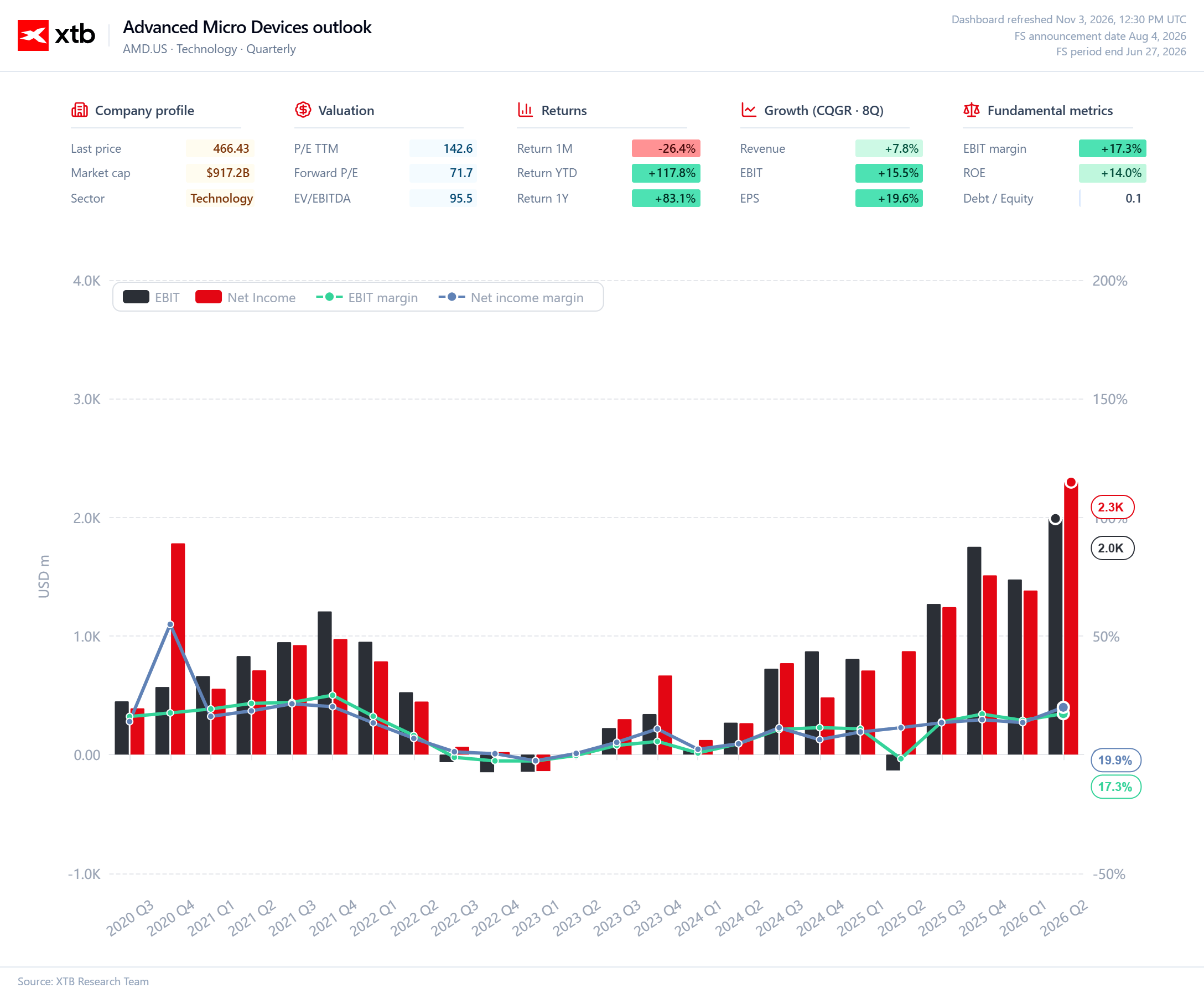
Data Center Must Maintain Its Momentum
Data centers have become the most important part of AMD’s investment story. In the second quarter, revenue in this segment increased by 107% year over year, driven by demand for EPYC server processors and Instinct accelerators. Lisa Su signaled accelerating interest in EPYC processors and growing adoption of Instinct products. The third quarter should show whether this trend is becoming sustainable.
Orders from the largest cloud service providers and enterprise customers will be particularly important. The market wants to know whether the expansion of AI infrastructure is still translating into higher purchases of AMD chips and whether the company can continue securing major contracts. Any slowdown in Data Center would be difficult for investors to accept, as a significant part of AMD’s current valuation rests on the assumption that demand for computing power will continue growing over the coming years.
Instinct and the Battle for the AI Market
Instinct accelerators remain another key part of the story. AMD is gradually strengthening its position in chips used to train and run artificial intelligence models, although the gap with Nvidia remains significant. Investors will want to see whether new deployments are translating into meaningful revenue and whether the company can secure major projects rather than remain merely an alternative supplier for the largest customers.
Partnerships with major technology companies also matter. The expansion of AMD’s partnership with Meta in late October in the area of AI infrastructure strengthened the company’s position, as did the development of its Helios platform, designed for large-scale AI deployments. For the market, however, the most important factors will be the pace of execution and when these projects begin making a meaningful contribution to financial results.
EPYC Could Be Just as Important as Accelerators
Discussions about AMD often focus almost entirely on graphics processors. However, the expansion of data centers is also increasing demand for CPUs, which handle workload management, communication and other computing tasks. This is an area where AMD has been steadily gaining market share through its EPYC processor family.
A healthy server market could therefore provide the company with an additional source of growth, independent of AI accelerator sales. Supply constraints at competitors could create an opportunity for AMD to capture further orders, but the company must also have sufficient production capacity to take advantage of it. Demand alone will not be enough if AMD cannot deliver the required number of chips.
Intel Highlights the Risks Across the Industry
Intel’s latest results reminded investors that strong demand for computing infrastructure does not automatically translate into positive results for every semiconductor manufacturer. Weaker guidance for the next quarter and availability issues affecting some server products triggered a strong market reaction. AMD is in a different position and has considerably greater exposure to the growing data center market, but broader pressure across the sector cannot be ignored.
A weaker personal computer market could also become an additional headwind. Higher component prices and more cautious corporate spending are weighing on demand, potentially affecting the client segment. AMD is less dependent on this market than Intel, but weaker PC sales could partially offset growth generated by Data Center. Investors will therefore be assessing not only the performance of the company’s most promising business but also the condition of its remaining segments.
Next-Quarter Guidance Could Determine the Stock’s Reaction
The most important part of the earnings report may not be the results for the past quarter, but rather the outlook for the end of the year and management’s comments regarding 2027. AMD had previously guided for revenue of approximately $13 billion in the third quarter, so the market will be looking for a clear signal that growth is not losing momentum. Strong guidance for the next period would confirm that demand for server processors and AI accelerators remains durable and that current orders are not simply the result of a temporary investment wave.
Gross margin will also be important. The company’s previous assumptions pointed to a level of approximately 56% in the third quarter. Combining rapid revenue growth with improving profitability would signal that AMD is benefiting from a more favorable sales mix and increasingly monetizing rising demand. However, if revenue grows faster than earnings, investors may begin questioning the quality of that growth.
AMD Must Convince the Market That the Best Is Yet to Come
Today’s report will be more than just another quarterly test for AMD. The company has an opportunity to demonstrate that challenges facing other manufacturers and deteriorating sentiment across the sector do not signal the end of semiconductor industry growth. At the same time, expectations are running high. Following the stock’s strong rally and amid elevated expectations for its AI business, even solid results could be viewed as insufficient.
AMD therefore needs strong earnings, but above all, a convincing outlook for the coming quarters. Investors will be looking for growing orders, further expansion in the Data Center segment, progress in Instinct sales and continued momentum in EPYC. If Lisa Su delivers guidance confirming that growth could accelerate further in 2027, AMD could become the company that once again improves sentiment across the semiconductor sector. Without such a signal, the market may conclude that much of the bullish scenario is already priced in.
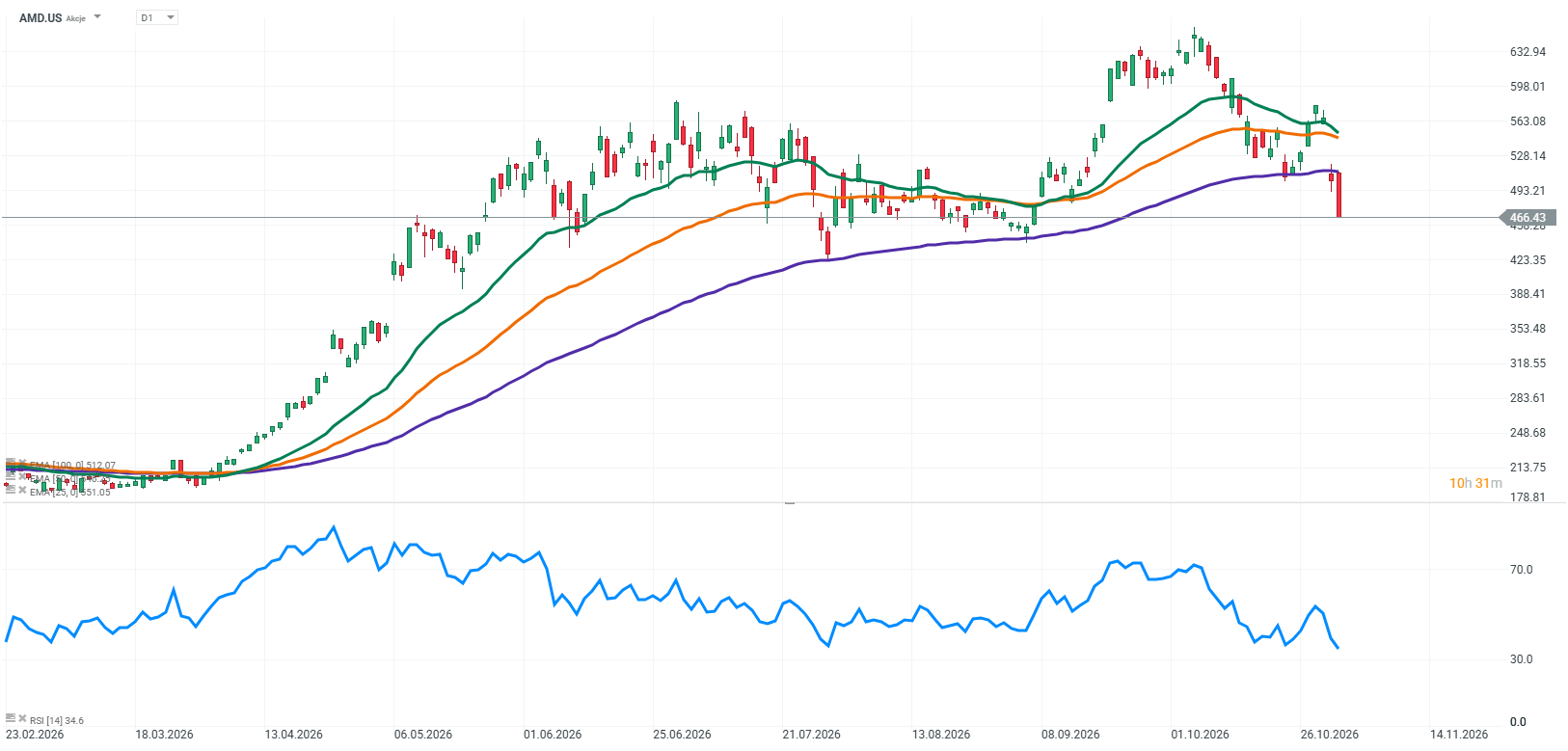
Source: XTB Research


Pfizer Reports Earnings 📈 Shares Near Multi-Year Highs


Palantir Nearly Doubles Revenue 📈 Shares Edge Higher Following Strong Earnings


Apple beats Wall Street estimates 🔼 iPhone and Mac drive earnings, China disappoints



Daily Summary: A Rollercoaster Ride in the Commodities Market🚨Oil Drops 7%; Gold Rallies Over 2%💥
The content of this report has been created by XTB S.A., with its registered office in Warsaw, at Prosta 67, 00-838 Warsaw, Poland, (KRS number 0000217580) and supervised by Polish Supervision Authority ( No. DDM-M-4021-57-1/2005). This material is a marketing communication within the meaning of Art. 24 (3) of Directive 2014/65/EU of the European Parliament and of the Council of 15 May 2014 on markets in financial instruments and amending Directive 2002/92/EC and Directive 2011/61/EU (MiFID II). Marketing communication is not an investment recommendation or information recommending or suggesting an investment strategy within the meaning of Regulation (EU) No 596/2014 of the European Parliament and of the Council of 16 April 2014 on market abuse (market abuse regulation) and repealing Directive 2003/6/EC of the European Parliament and of the Council and Commission Directives 2003/124/EC, 2003/125/EC and 2004/72/EC and Commission Delegated Regulation (EU) 2016/958 of 9 March 2016 supplementing Regulation (EU) No 596/2014 of the European Parliament and of the Council with regard to regulatory technical standards for the technical arrangements for objective presentation of investment recommendations or other information recommending or suggesting an investment strategy and for disclosure of particular interests or indications of conflicts of interest or any other advice, including in the area of investment advisory, within the meaning of the Trading in Financial Instruments Act of 29 July 2005 (i.e. Journal of Laws 2019, item 875, as amended). The marketing communication is prepared with the highest diligence, objectivity, presents the facts known to the author on the date of preparation and is devoid of any evaluation elements. The marketing communication is prepared without considering the client’s needs, his individual financial situation and does not present any investment strategy in any way. The marketing communication does not constitute an offer of sale, offering, subscription, invitation to purchase, advertisement or promotion of any financial instruments. XTB S.A. is not liable for any client’s actions or omissions, in particular for the acquisition or disposal of financial instruments, undertaken on the basis of the information contained in this marketing communication. In the event that the marketing communication contains any information about any results regarding the financial instruments indicated therein, these do not constitute any guarantee or forecast regarding the future results.