



“If you don’t know what it’s about, it’s about money” is a saying that fits reality more often than not.
One could paraphrase it as: “If you don’t know why it’s falling, it’s the Fed.”
The current sell-off in financial markets, in terms of momentum, resembles a typical episode of market panic or a bursting speculative bubble. Given the gains driven by the “race” or “revolution” in AI, leaning toward the second explanation is tempting, but the available data does not allow a rational justification for the scale of the move. Valuation metrics, forecasts, and market fundamentals do not point to a “bubble” episode, only to a period of moderately above-average multiples and valuations, which in the vast majority of cases are supported by improved results. So where does a retreat with such strong momentum come from?
Markets are starting to signal that the cost of further fighting inflation may rise faster than the current consensus among Fed members suggests. The real effectiveness of Fed policy in combating inflation also leaves much to be desired. However, the Fed’s current policy stance and the currently priced-in path of rate hikes for the coming quarters are not new information. So what changed in the market to so quickly justify such large declines?
AI capital expenditures are enormous and without precedent. This is a challenge for companies and the market that investors have been well aware of for over a year. Spending measured in trillions is not something you can announce or withdraw from overnight. Fed policy, however, is beginning to undermine the foundations of the AI boom more than any doubts about adoption or commercialization ever could.
The challenge of financing AI infrastructure was significant from the very beginning. The war in Iran, which pushed inflation expectations higher, made that challenge even harder, but it still was not impossible. Executing AI investments under restrictive Fed policy relied on the decisions of one man: Jensen Huang.
Will the “AI trade” survive without Jensen?
Jensen Huang practiced a controversial policy of financing counterparties and providing guarantees for key entities and projects. He was the architect, the executor, and the biggest supporter of this policy. The mechanism was cited as a critical threat to the market by, among others, Michael Burry. Huang, in effect, single-handedly lowered real funding rates and the level of risk discounted by the market for the entire sector. The weak point of the mechanism turned out not to be market forces, but Jensen’s absence.
Colette Kress, Nvidia’s former CFO, has been appointed in Jensen Huang’s place. Assessing Ms. Kress’s management style is somewhat subjective, but what matters here is market perception: Kress is seen as far more cautious in deploying capital. She was named interim CEO because her calm, conservative approach was expected to provide stability. This happened at the very moment when the AI industry needed Huang’s characteristic aggressiveness and access to Nvidia’s vast cash reserves.
This is not merely perception, because Kress has a track record of clashing with Jensen on key financing issues. Reuters reports that Kress and her team argued with Huang and the sales department over risky transactions involving OpenAI and Lambda. It also describes a reduction of proposed support for OpenAI’s data center project from USD 250 billion to USD 120 billion. This is not a definitive preview of Kress’s policy as CEO, but the market does not currently have time to wait and see.
A hard-to-quantify reduction in Nvidia’s involvement implies a meaningful increase in risk and in the return investors require. This is the direct catalyst for the declines that have cut valuations of key sector companies by dozens of percent despite improving results.
Chart: IG spread vs NASDAQ 100
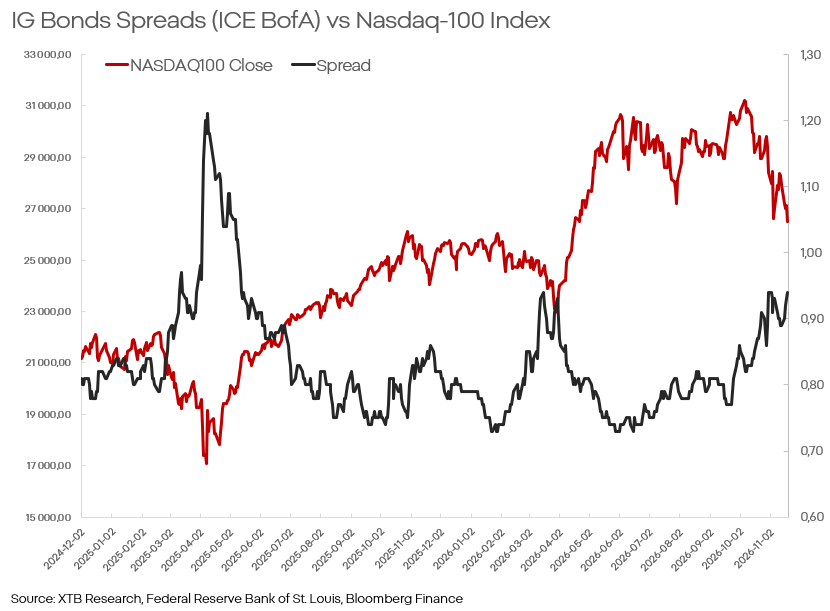
The black line represents the additional compensation investors expect for lending money to high-credit-quality companies instead of the US government. An increase in the line therefore means greater risk aversion and less favorable financing conditions for companies. On the chart, it is often accompanied by falling stock prices, including recently.
The earnings have not changed. Risk has changed, and it must be paid for with lower valuations.
What next?
Declines driven by such an extreme and hard-to-value scenario do not have a clearly defined bottom or limit.
They may continue until a specific, numerical translation of Nvidia’s reduced involvement can be incorporated into valuation models for AI-sector companies.
There are also other catalysts that could (though do not have to) calm markets:
- End of the war in Iran: A quick and lasting end to the war in Iran is currently an extremely unlikely scenario, though not impossible. Speculating about how it might happen is not very productive, but a rapid removal of inflation pressure from oil, fuel, and gas could be a strong enough impulse to change inflation and Fed expectations overnight, giving companies breathing room.
- Jensen’s return or the return of his policy: A second scenario for calming markets is Jensen returning to Nvidia, or a clear and explicit declaration by the current CEO or a future CEO that Jensen’s policy and “philosophy” will be continued in a way that markets believe.
- A Fed pivot: The Fed could, for various reasons, change its narrative on interest rates. A significant shift in rhetoric and/or policy could also lower expectations for debt and investment costs enough to calm markets.
Kamil Szczepański
Financial Markets Analyst, XTB



US OPEN: Selling pressure eases, Anthropic gives back post-IPO gains



Market Wrap: Global stocks post 7th consecutive session of losses, Anthropic failed to reassure the market (20.11.2026)

Market Wrap: Anthropic Lifts Sentiment, but a Hawkish Fed Keeps the Dollar High


Palo Alto Earnings: Another Record Riding the Cybersecurity Crisis Wave
The content of this report has been created by XTB S.A., with its registered office in Warsaw, at Prosta 67, 00-838 Warsaw, Poland, (KRS number 0000217580) and supervised by Polish Supervision Authority ( No. DDM-M-4021-57-1/2005). This material is a marketing communication within the meaning of Art. 24 (3) of Directive 2014/65/EU of the European Parliament and of the Council of 15 May 2014 on markets in financial instruments and amending Directive 2002/92/EC and Directive 2011/61/EU (MiFID II). Marketing communication is not an investment recommendation or information recommending or suggesting an investment strategy within the meaning of Regulation (EU) No 596/2014 of the European Parliament and of the Council of 16 April 2014 on market abuse (market abuse regulation) and repealing Directive 2003/6/EC of the European Parliament and of the Council and Commission Directives 2003/124/EC, 2003/125/EC and 2004/72/EC and Commission Delegated Regulation (EU) 2016/958 of 9 March 2016 supplementing Regulation (EU) No 596/2014 of the European Parliament and of the Council with regard to regulatory technical standards for the technical arrangements for objective presentation of investment recommendations or other information recommending or suggesting an investment strategy and for disclosure of particular interests or indications of conflicts of interest or any other advice, including in the area of investment advisory, within the meaning of the Trading in Financial Instruments Act of 29 July 2005 (i.e. Journal of Laws 2019, item 875, as amended). The marketing communication is prepared with the highest diligence, objectivity, presents the facts known to the author on the date of preparation and is devoid of any evaluation elements. The marketing communication is prepared without considering the client’s needs, his individual financial situation and does not present any investment strategy in any way. The marketing communication does not constitute an offer of sale, offering, subscription, invitation to purchase, advertisement or promotion of any financial instruments. XTB S.A. is not liable for any client’s actions or omissions, in particular for the acquisition or disposal of financial instruments, undertaken on the basis of the information contained in this marketing communication. In the event that the marketing communication contains any information about any results regarding the financial instruments indicated therein, these do not constitute any guarantee or forecast regarding the future results.