


Apple Inc. is entering its Q2 2026 earnings at a point where the market no longer values the company purely as a stable hardware-and-services business, but increasingly views it as a lagging participant in the global artificial intelligence cycle. This fundamentally changes how results are interpreted, as the focus shifts from the question of “is Apple delivering” to whether “Apple is returning to a phase of innovation-driven growth.”
At the same time, this quarter is also transitional from a product and strategic cycle perspective. Apple is operating between its traditional model built around the iPhone and services, and a new growth architecture that is gradually being built around AI, refreshed hardware, and potential new device categories.
Key market expectations for Q2 2026
-
Revenue around 109.7 billion USD
-
EPS around 1.96 USD
-
iPhone around 57 billion USD
-
Mac around 8.1 billion USD, supported by a new product cycle
-
Services around 30.4 billion USD, a stable high-margin segment
-
China around 18.9 billion USD, a key demand-sensitive region
-
Margins supported by product mix, but under pressure from memory costs
-
CapEx moderate, but gradually increasing due to AI and hardware investment
Market expectations and positioning
The market is pricing in another solid quarter of growth driven by a new product cycle, where the key contributors are the iPhone 17e, refreshed Mac lineup, and new iPads. The MacBook Neo is particularly important as it pushes Apple further into a more mass-market price segment and may expand volumes beyond the traditional premium core.
At the same time, investors assume the company remains partially exposed to memory cost pressures, which could limit margin expansion despite a favorable product mix.
Against this backdrop, the market is no longer evaluating Apple purely on a beat-or-miss basis, but increasingly on the quality and durability of its product cycle.
AI as the missing element of the growth narrative
Artificial intelligence remains a central but still incomplete part of Apple’s story. The company is gradually introducing AI features into iOS and its broader ecosystem, but the market still views these developments as incremental improvements rather than a fundamental shift in how the company operates.
In practice, AI is currently seen as a potential driver of higher device upgrades, a factor that strengthens ecosystem stickiness, and a foundation for future product categories such as wearables, smart home devices, and fully AI-driven hardware. However, there is still no clear evidence that AI is directly generating a new layer of revenue monetization.
Memory costs and margin pressure
A key short-term factor remains pressure in the supply chain, particularly in memory components. Unlike in previous cycles, this is no longer a secondary issue, as it is beginning to affect both product pricing and production capacity.
This means that even with stable demand, Apple may face limitations in further expanding gross margins, which increases the importance of product mix and the Services segment as a stabilizing profit buffer.
Services as a stabilizer, not the main re-rating driver
The Services segment remains one of the most important components of Apple’s business model, generating high-margin and recurring cash flows. However, its role in the current cycle is more stabilizing than growth-driving.
Unlike in previous years, Services is no longer the primary driver of valuation re-rating. Instead, the key factors now are the hardware cycle, artificial intelligence, and potential entry into new product categories.
Management transformation and strategic regime shift
An additional key element is the change in leadership structure, with John Ternus taking over as CEO while Tim Cook transitions to the role of chairman.
John Ternus is viewed as a more product- and engineering-focused leader, which the market interprets as a potential shift toward faster product decisions and a higher willingness to take technological risks. Tim Cook, meanwhile, remains a stabilizing force in operational and geopolitical areas, reducing the risk of abrupt strategic shifts.
High expectations and limited room for error
Apple is currently one of the most fully priced companies among large-cap technology stocks, meaning the market is no longer pricing in stability alone, but rather a renewed acceleration in growth.
As a result, even solid earnings may fail to generate a lasting positive reaction unless they are supported by a clear shift in the forward-looking narrative. The key areas of market sensitivity include the durability of the iPhone and Mac cycle, the impact of memory costs on margins, and the pace of AI integration and monetization.
Key takeaways
-
Apple is in a phase where maintaining growth is no longer sufficient, and a re-acceleration is required
-
The product cycle, including iPhone 17e and MacBook Neo, supports results but does not yet reshape the long-term growth structure
-
Artificial intelligence remains the most important missing element of the investment narrative
-
Memory cost pressure limits further margin expansion
-
The market expects Apple not only to remain stable, but to re-establish its ability to deliver high-quality growth rather than just steady performance
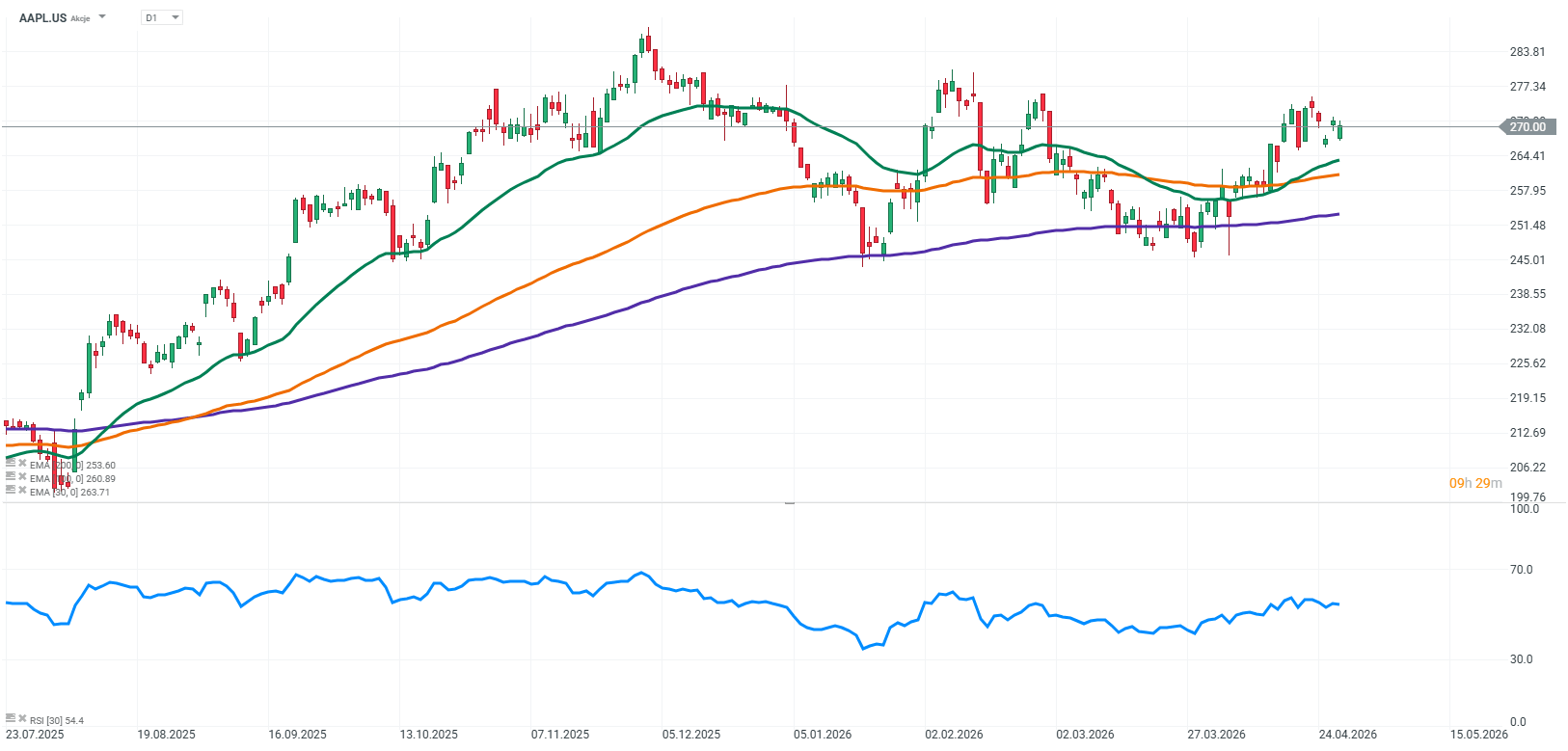
Source: xStation5


Daily summary 📈 Precious metals and stock indices rebound as Treasury yields fall


US Open: Nasdaq 100 extends losses 🚩 AI stocks under pressure, CoreWeave falls 8%



Market Wrap: Tech Sell-Off Hits Europe, Gold Shines Again


TSMC breaks records once again driven by the AI boom
The content of this report has been created by XTB S.A., with its registered office in Warsaw, at Prosta 67, 00-838 Warsaw, Poland, (KRS number 0000217580) and supervised by Polish Supervision Authority ( No. DDM-M-4021-57-1/2005). This material is a marketing communication within the meaning of Art. 24 (3) of Directive 2014/65/EU of the European Parliament and of the Council of 15 May 2014 on markets in financial instruments and amending Directive 2002/92/EC and Directive 2011/61/EU (MiFID II). Marketing communication is not an investment recommendation or information recommending or suggesting an investment strategy within the meaning of Regulation (EU) No 596/2014 of the European Parliament and of the Council of 16 April 2014 on market abuse (market abuse regulation) and repealing Directive 2003/6/EC of the European Parliament and of the Council and Commission Directives 2003/124/EC, 2003/125/EC and 2004/72/EC and Commission Delegated Regulation (EU) 2016/958 of 9 March 2016 supplementing Regulation (EU) No 596/2014 of the European Parliament and of the Council with regard to regulatory technical standards for the technical arrangements for objective presentation of investment recommendations or other information recommending or suggesting an investment strategy and for disclosure of particular interests or indications of conflicts of interest or any other advice, including in the area of investment advisory, within the meaning of the Trading in Financial Instruments Act of 29 July 2005 (i.e. Journal of Laws 2019, item 875, as amended). The marketing communication is prepared with the highest diligence, objectivity, presents the facts known to the author on the date of preparation and is devoid of any evaluation elements. The marketing communication is prepared without considering the client’s needs, his individual financial situation and does not present any investment strategy in any way. The marketing communication does not constitute an offer of sale, offering, subscription, invitation to purchase, advertisement or promotion of any financial instruments. XTB S.A. is not liable for any client’s actions or omissions, in particular for the acquisition or disposal of financial instruments, undertaken on the basis of the information contained in this marketing communication. In the event that the marketing communication contains any information about any results regarding the financial instruments indicated therein, these do not constitute any guarantee or forecast regarding the future results.