



This was the kind of report that left the market with very little to question.
Arista Networks not only significantly exceeded analysts’ expectations, but also provided guidance for the next quarter that once again came in well above the market consensus. In pre-market trading, the company’s shares are up more than 12%.
The key financial data from the second-quarter 2026 report highlights the scale of Arista’s current business growth:
-
Revenue: $3.04 billion, representing a 37.7% year-over-year increase and a 12.1% sequential increase. The company surpassed the $3 billion quarterly revenue mark for the first time in its history.
-
Adjusted earnings per share (EPS): $1.02 compared with approximately $0.89 expected by analysts. The result represents around 40% year-over-year growth and a significant beat versus consensus estimates.
-
Adjusted operating margin: 49.9% compared with 48.8% a year earlier. Despite rapid revenue growth, Arista continues to maintain exceptionally high profitability.
-
Gross margin: approximately 65%, highlighting the strength of the company’s business model and its ability to sustain strong financial efficiency.
-
Projected third-quarter 2026 revenue: approximately $3.3 billion, clearly above previous market expectations.
-
Projected adjusted EPS for the third quarter: $1.06–$1.08, also above analyst consensus.
-
Projected operating margin: 48–49%, suggesting that continued revenue growth should not come at the expense of a significant deterioration in profitability.
-
Full-year outlook: management expects approximately $12.6 billion in revenue in 2026, representing roughly 40% year-over-year growth.
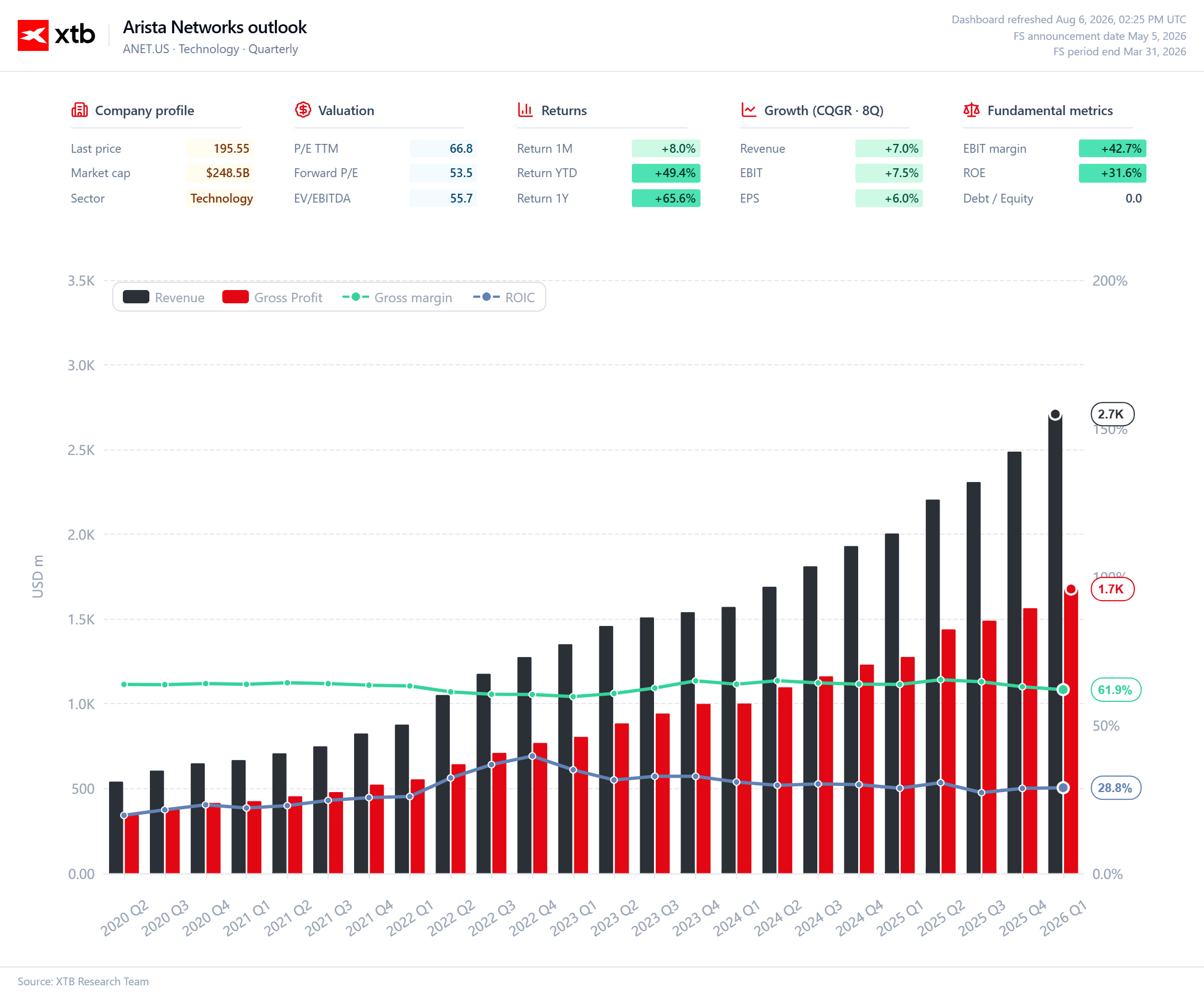
This set of numbers highlights the most important part of Arista’s current story: the company is not only growing rapidly thanks to investments in AI infrastructure, but it also remains one of the most profitable companies in the broader technology infrastructure sector.
The market received exactly what it expected from one of the most important companies involved in the development of AI infrastructure. Strong revenue growth, a clear earnings beat, very high profitability, and the prospect of further acceleration in the coming quarters. Equally important, the report confirms that AI-related demand remains exceptionally strong and is not limited only to semiconductor manufacturers.
Arista ended the second quarter with revenue of $3.04 billion, surpassing the $3 billion quarterly sales milestone for the first time in its history. The result represents 37.7% year-over-year growth and a 12.1% increase compared with the previous quarter. Revenue also exceeded market expectations by approximately $210 million.
Adjusted earnings per share came in at $1.02, compared with around $0.89 expected by analysts. This represents nearly 40% year-over-year growth and one of the strongest positive surprises in the report.
However, Arista’s story is not only about beating forecasts. The quality of growth is equally important. The company is increasing revenue at a pace close to 40%, while maintaining an adjusted operating margin of nearly 50%. This combination of rapid expansion and exceptional profitability remains one of the biggest strengths of its business model.
The adjusted operating margin reached 49.9%, compared with 48.8% a year earlier. Arista is not only scaling its operations, but also preserving high financial efficiency. With increasing revenue and a larger business footprint, the company continues to generate substantial profits, clearly distinguishing itself from many companies growing at AI-sector rates but with much lower profitability.
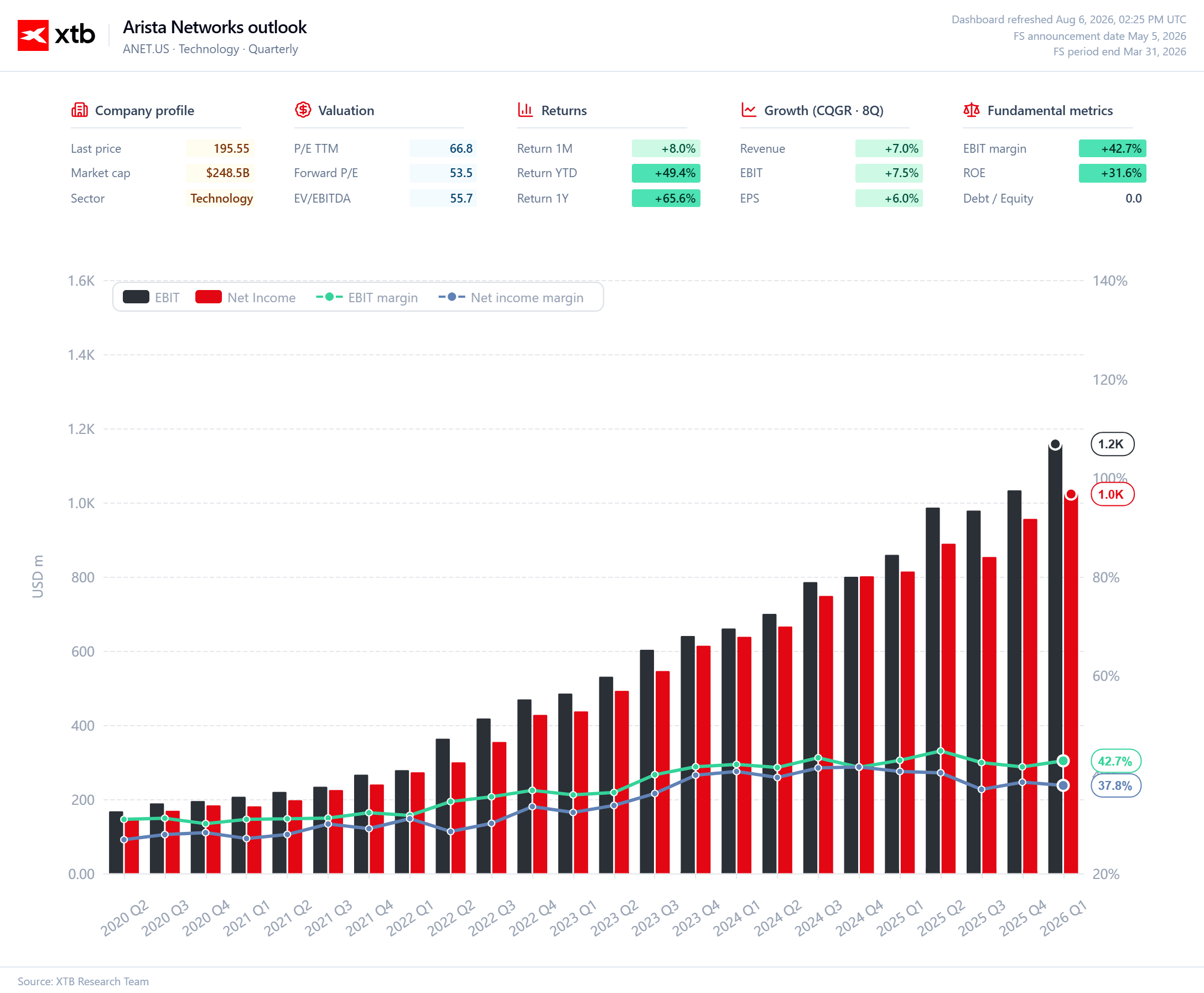
The most important part of the story, however, lies in the growing demand for networking infrastructure powering data centers. As artificial intelligence models continue to scale, demand is increasing not only for AI processors and chips, but also for the systems that connect thousands of these components and allow them to exchange data efficiently.
This is where Arista fits into the current AI boom.
The company provides networking switches and solutions responsible for communication inside large-scale data centers. As AI clusters become more complex, networking is no longer just a supporting element. It has become one of the critical components of the entire infrastructure, because system performance depends not only on the computing power of individual chips but also on the speed and efficiency of data transfer between them.
The larger AI clusters become, the more important network capacity, low latency, and the ability to handle an increasing number of connections become. Arista benefits from the same trend driving semiconductor companies’ results, but captures value from a different part of the technology supply chain.
The latest report shows that demand for networking solutions remains extremely strong. Arista benefits both from rising investments by the largest technology companies and from increasing demand among enterprise customers. Growth is no longer driven exclusively by a handful of major cloud providers, which further strengthens the quality of the company’s expansion.
Another very important element of the report is the third-quarter outlook. Arista expects revenue of approximately $3.3 billion. This figure is significantly above previous market expectations and indicates that the company continues to see very strong demand for its solutions.
At the same time, adjusted earnings per share guidance of $1.06–$1.08 also came in above market expectations. Management expects adjusted operating margins to remain between 48% and 49%, showing that further revenue growth should not come at the cost of meaningful margin compression.
In practice, investors received not only very strong second-quarter results, but also confirmation that the current momentum can continue in the coming months.
This is particularly important in the broader artificial intelligence investment narrative. In recent quarters, investors have increasingly questioned whether record capital spending by the largest technology companies on data centers would continue and whether AI infrastructure demand would remain strong enough to justify the scale of these investments.
Arista’s results provide another argument that the current AI investment cycle remains intact.
AI demand does not end with the purchase of chips. Building large-scale data centers requires the expansion of the entire supporting infrastructure ecosystem, and networking has become one of the most important elements enabling the efficient use of increasingly powerful computing clusters. Arista’s rising revenue demonstrates that investment in this area remains highly active.
Of course, this does not mean all risks have disappeared. Arista’s shares are priced with high expectations for continued growth, and the company remains dependent on spending levels from major cloud customers. At its current valuation, the market will continue to demand strong growth and sustained profitability.
However, today’s report shows that Arista continues to meet those expectations.
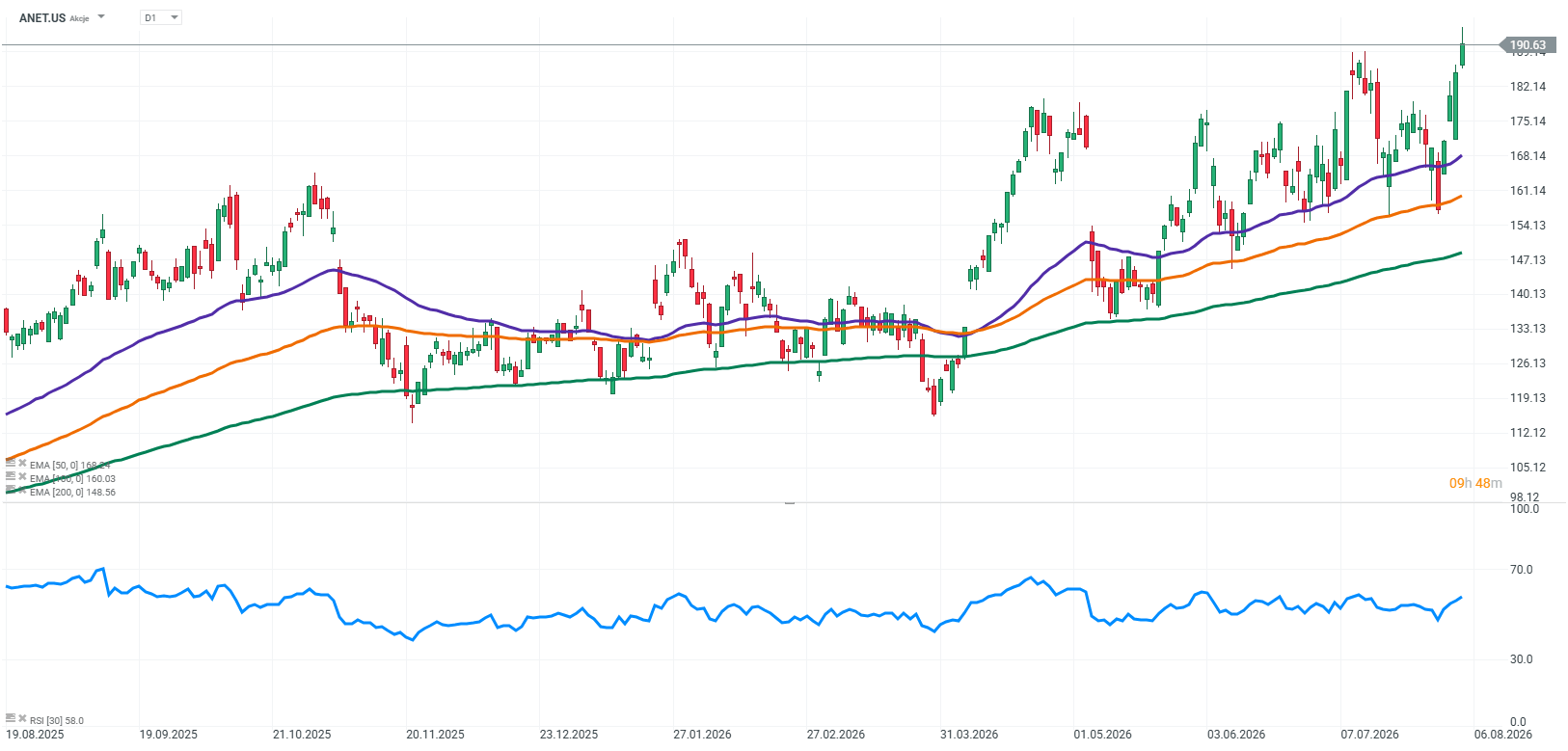
Source: xStation5


🚩 Caterpillar shares extend decline, down 30% from record high


Webull shares down 20% amid fears over potential China ties



US Open: Wall Street in the Red 🚩 Nasdaq Falls 1% From Record Highs, Constellation Brands Back at March 2020 Level



Market Wrap: Oil rises again, French fiscal concerns weigh on euro (07.10.2026)
The content of this report has been created by XTB S.A., with its registered office in Warsaw, at Prosta 67, 00-838 Warsaw, Poland, (KRS number 0000217580) and supervised by Polish Supervision Authority ( No. DDM-M-4021-57-1/2005). This material is a marketing communication within the meaning of Art. 24 (3) of Directive 2014/65/EU of the European Parliament and of the Council of 15 May 2014 on markets in financial instruments and amending Directive 2002/92/EC and Directive 2011/61/EU (MiFID II). Marketing communication is not an investment recommendation or information recommending or suggesting an investment strategy within the meaning of Regulation (EU) No 596/2014 of the European Parliament and of the Council of 16 April 2014 on market abuse (market abuse regulation) and repealing Directive 2003/6/EC of the European Parliament and of the Council and Commission Directives 2003/124/EC, 2003/125/EC and 2004/72/EC and Commission Delegated Regulation (EU) 2016/958 of 9 March 2016 supplementing Regulation (EU) No 596/2014 of the European Parliament and of the Council with regard to regulatory technical standards for the technical arrangements for objective presentation of investment recommendations or other information recommending or suggesting an investment strategy and for disclosure of particular interests or indications of conflicts of interest or any other advice, including in the area of investment advisory, within the meaning of the Trading in Financial Instruments Act of 29 July 2005 (i.e. Journal of Laws 2019, item 875, as amended). The marketing communication is prepared with the highest diligence, objectivity, presents the facts known to the author on the date of preparation and is devoid of any evaluation elements. The marketing communication is prepared without considering the client’s needs, his individual financial situation and does not present any investment strategy in any way. The marketing communication does not constitute an offer of sale, offering, subscription, invitation to purchase, advertisement or promotion of any financial instruments. XTB S.A. is not liable for any client’s actions or omissions, in particular for the acquisition or disposal of financial instruments, undertaken on the basis of the information contained in this marketing communication. In the event that the marketing communication contains any information about any results regarding the financial instruments indicated therein, these do not constitute any guarantee or forecast regarding the future results.