


The information shared by ARM Holdings CEO Rene Haas clearly indicates that the company has reached a pivotal turning point in its history. The firm is no longer perceived solely as an architecture designer for integrated circuits, but is instead becoming a fully fledged participant in the artificial intelligence chip market. The declaration that the target of reaching $15 billion in revenue from its own chips will be achieved much earlier than anticipated completely rewrites the current market narrative. It demonstrates that investors may have significantly underestimated the pace of this transformation until now. Massive demand driven by the artificial intelligence revolution is rapidly accelerating the commercialization of this new business segment, translating into tangible and highly optimistic expectations for future margins and cash flows.
The foundation of this market story lies not only in the success of the new product business, but above all in the unprecedented scale of ARM architecture adoption across the world's largest data centers. The largest global cloud computing providers, including AWS with its Graviton processors, Microsoft Azure deploying the Cobalt chip, Google Cloud with the Axion solution, as well as Oracle and Alibaba Cloud, are already building their core infrastructure on British technology. This means that these solutions have ceased to be merely an interesting alternative to traditional x86 architecture and have become a strategic element in the plans of tech giants. In mid-2026, these corporations are investing hundreds of billions of dollars in artificial intelligence infrastructure, and a significant portion of these massive budgets is indirectly flowing through licensing fees and the ecosystem tied to ARM.
The market introduction of a new central processor called the AGI CPU represents the second, critical piece of this puzzle. For the first time in its 35-year history, the company has decided to launch production of its own, finished chip instead of limiting itself exclusively to selling intellectual property rights. Meta has become the first major customer for this innovative processor, and other entities have quickly joined the ranks of early business partners. This selection of counterparties proves that ARM does not intend to operate in isolation, but is instead consistently building a powerful technological alliance around its new product. The AGI CPU itself was designed specifically for AI agents, meaning systems capable of operating fully independently as virtual assistants that execute complex tasks without continuous human intervention.
Official specifications show that the new chip offers more than 2-fold higher performance per server rack compared to x86 solutions, which directly translates into lower internal costs and a significantly higher compute density in modern data centers. This drastic energy advantage is becoming a key argument at a time when data centers are grappling with astronomical power bills and transmission capacity limits. When cloud providers are forced to buy tens of thousands of processors for their servers, higher energy efficiency generates savings reaching tens of millions of dollars annually. This makes ARM technology simply impossible for modern businesses to ignore.
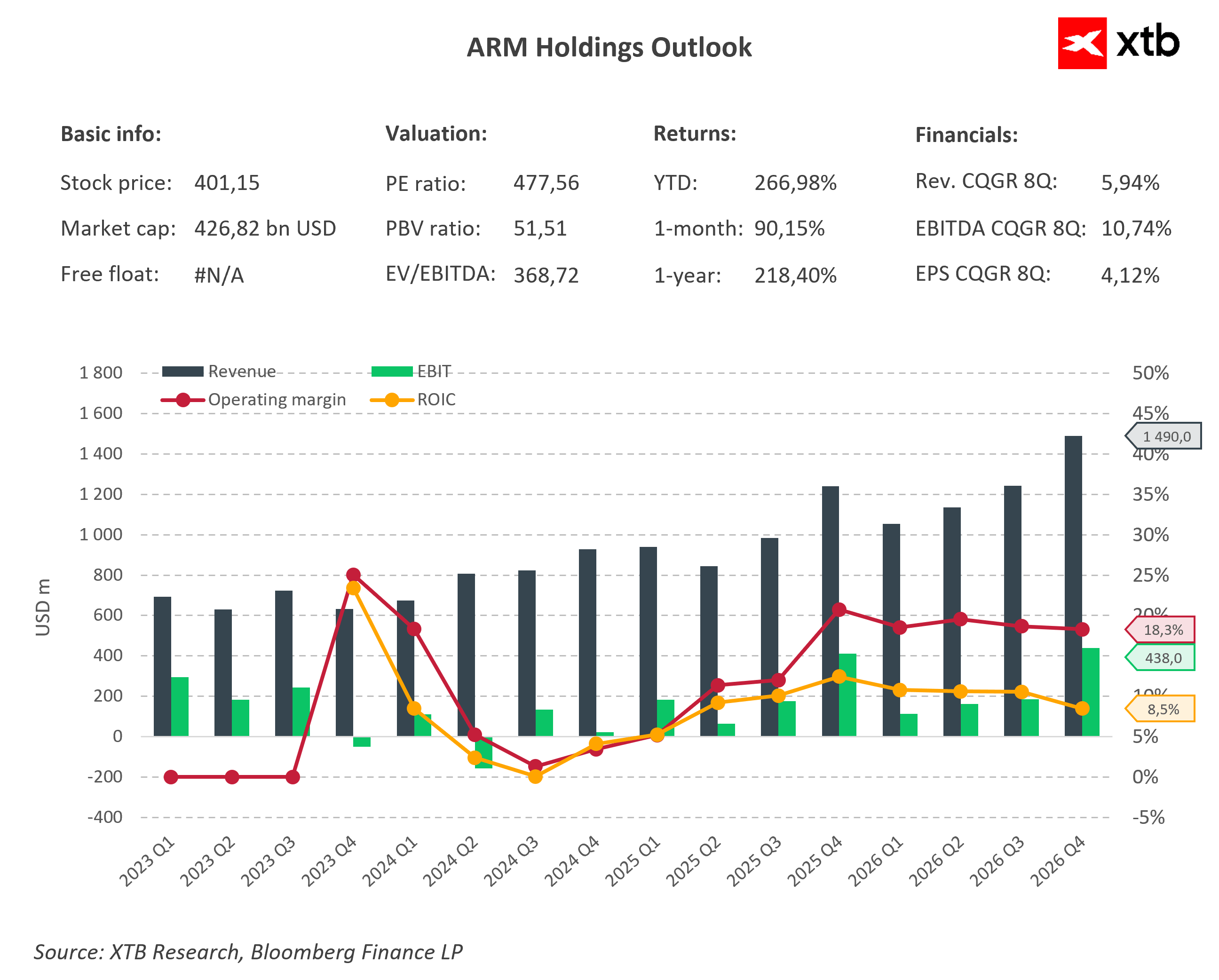
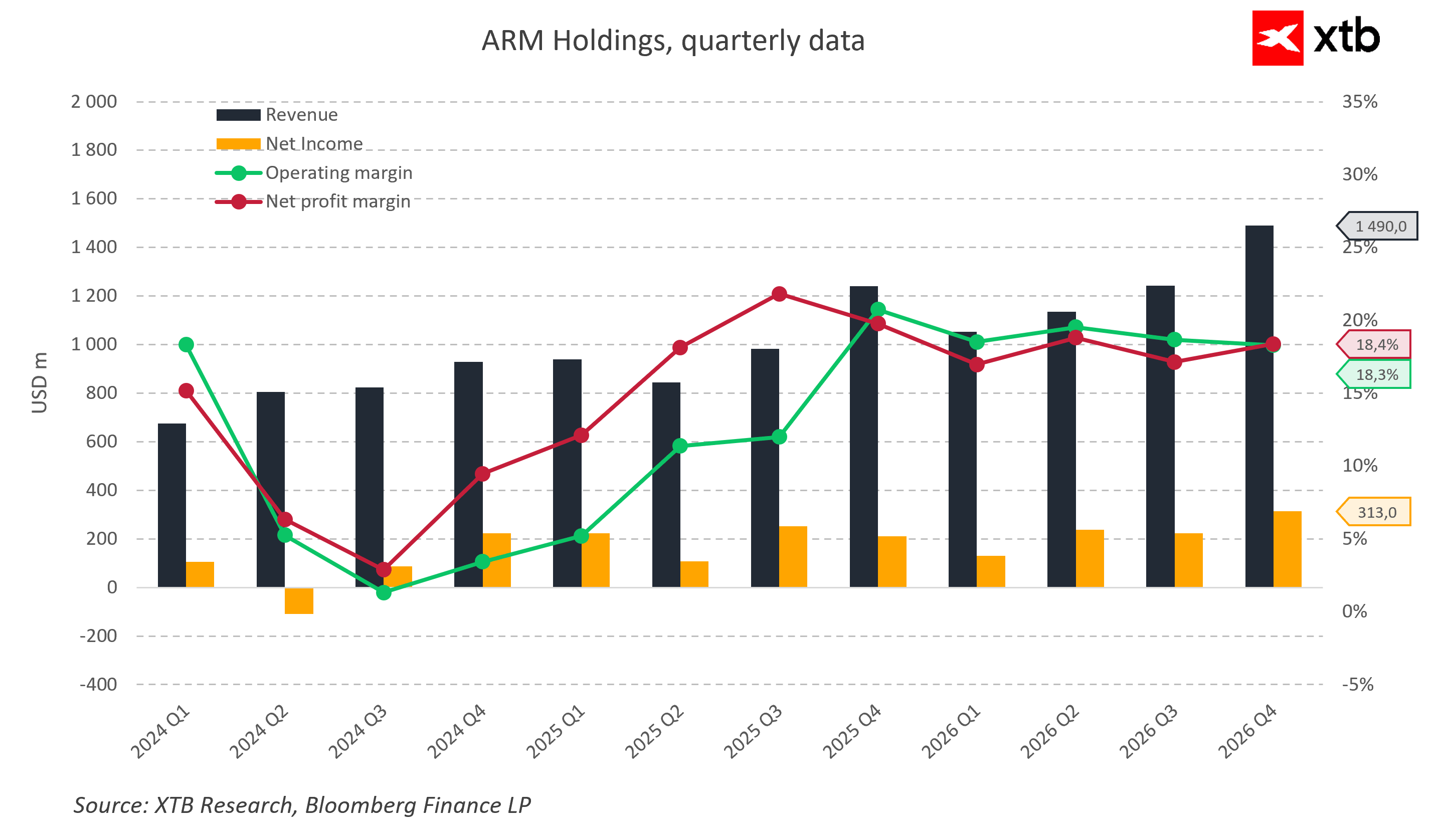
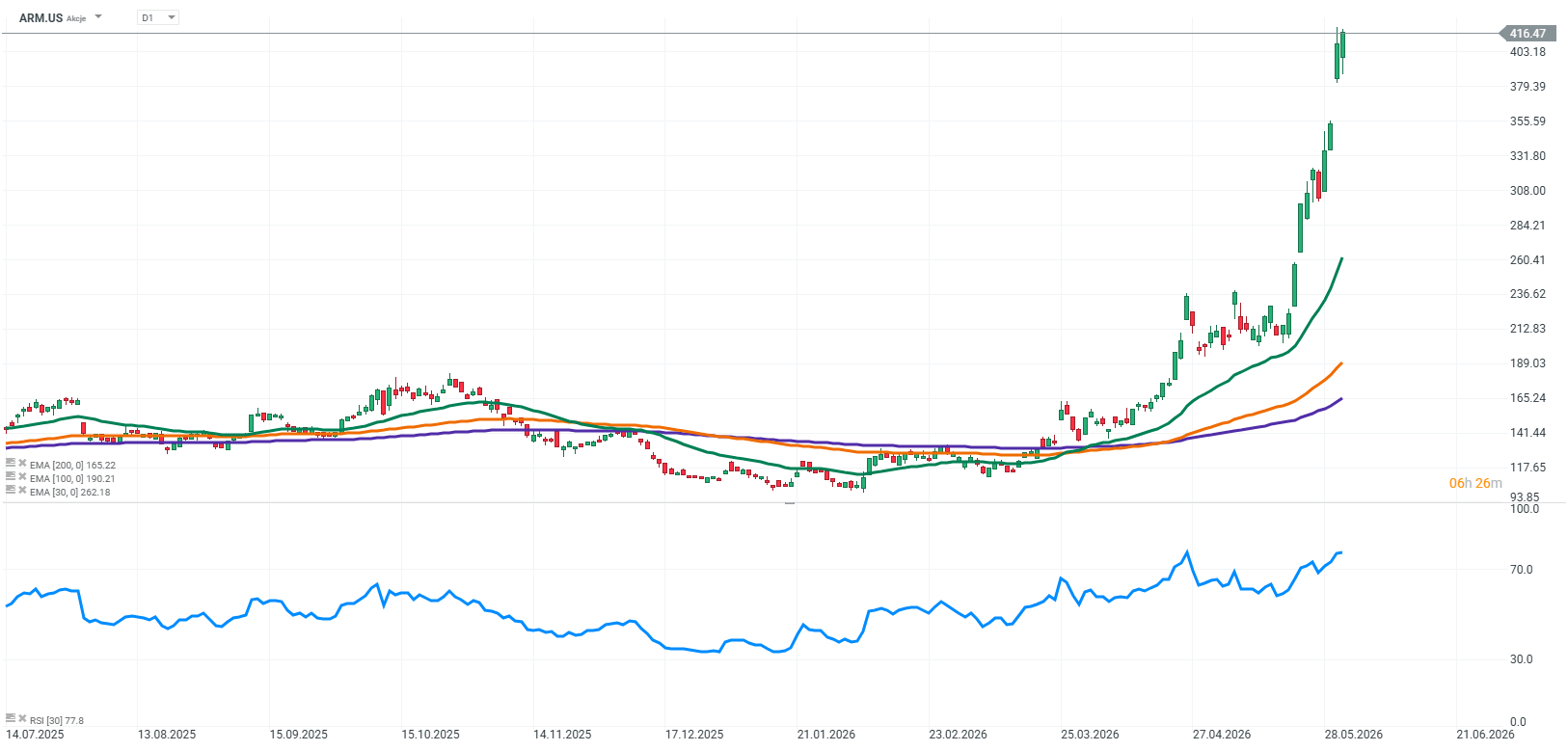
The market reaction suggests that investors are very quickly beginning to price in a profound shift in the company's business model. A business that used to be associated with high margins but stable, limited volume growth is now becoming a direct beneficiary of the entire value chain in the artificial intelligence sector. Revenue will no longer be generated solely from licenses and royalties, but from the sale of its own physical silicon. Crucial to the stock market valuation is the fact that direct sales of advanced chips carry an incomparably greater financial potential, which fully justifies higher valuation multiples in the long run.
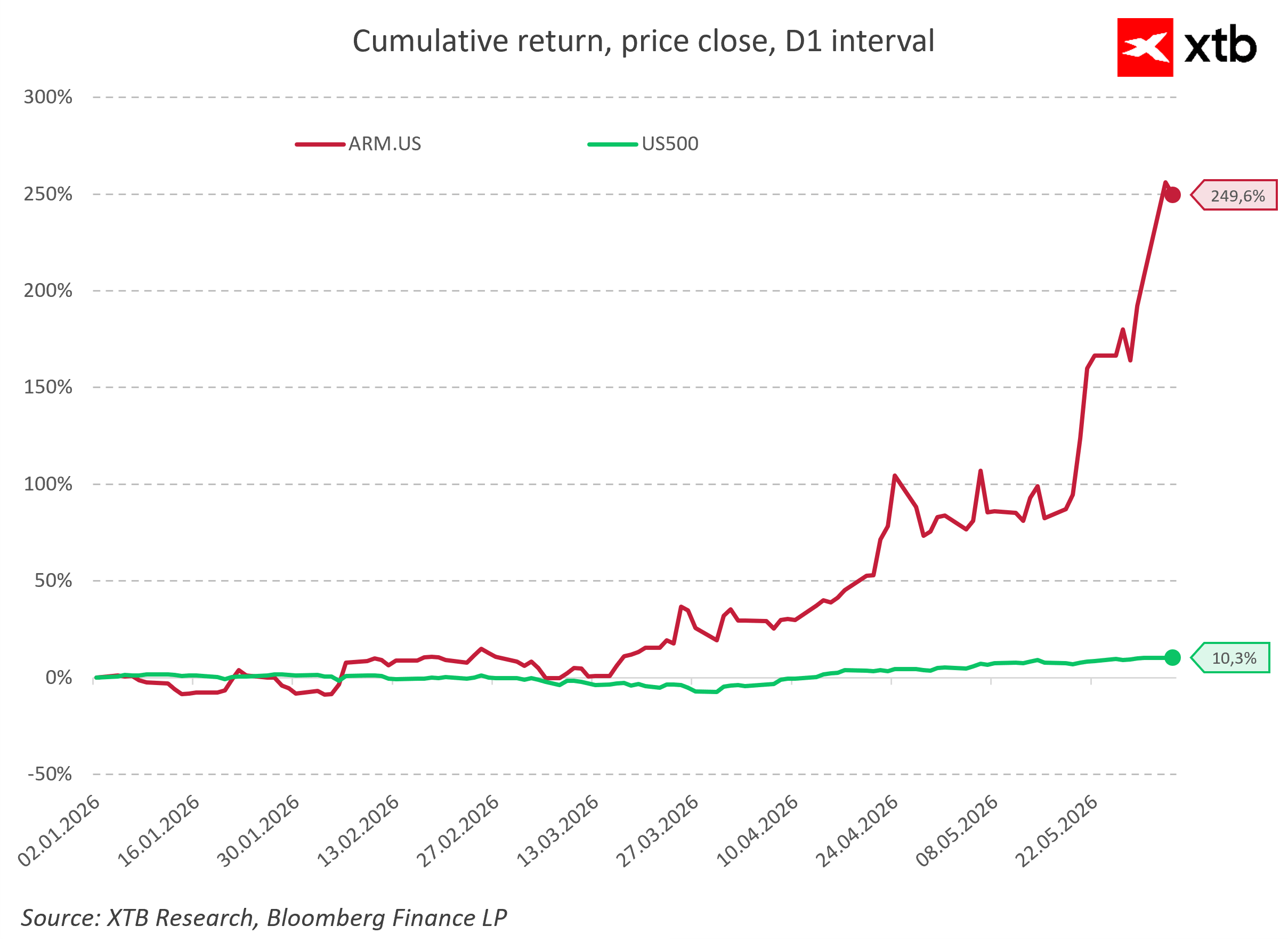
However, caution is warranted, and one must remember that the current stock market success relies heavily on promises, with forecasts being highly forward-looking in nature. The future of this segment depends on many variables, among which the most critical risks remain the pace of software adaptation, compatibility with existing systems, and the ability to efficiently scale mass production. ARM is also entering into a direct clash with giants like NVIDIA, AMD, and Intel. Furthermore, transitioning from a safe intellectual property sales model to a complex manufacturing business drastically increases operational complexity and capital requirements, and the market may need several more quarters to gain confidence that this model is stable.
The ultimate balance of rewards and risks shows that ARM is emerging as one of the most important winners of the current tech boom. The company is not only providing the foundations for other players' systems, but is actively and successfully building its own product arm. Widespread adoption of the technology by cloud market leaders and contracts with entities such as OpenAI or Meta realistically increase the chances for a rapid monetization of the entire ecosystem. The fact that financial forecasts are being revised upward so early may be a clear signal that the phase of strongest growth lies ahead. Investors should now closely follow quarterly reports, as they will ultimately determine whether the company permanently joins the top ranks of AI infrastructure providers, or whether Wall Street's expectations have turned out to be overextended.
Source: xStation5



Daily Summary: A Shallow Rebound Ahead of Earnings Season

Lumentum: Demand for AI infrastructure exceeds capacity



US OPEN: Trump de-escalates, OpenAI supports Wall Street sentiment


Morning Wrap: OpenAI Revenue Concerns Weigh on Wall Street
The content of this report has been created by XTB S.A., with its registered office in Warsaw, at Prosta 67, 00-838 Warsaw, Poland, (KRS number 0000217580) and supervised by Polish Supervision Authority ( No. DDM-M-4021-57-1/2005). This material is a marketing communication within the meaning of Art. 24 (3) of Directive 2014/65/EU of the European Parliament and of the Council of 15 May 2014 on markets in financial instruments and amending Directive 2002/92/EC and Directive 2011/61/EU (MiFID II). Marketing communication is not an investment recommendation or information recommending or suggesting an investment strategy within the meaning of Regulation (EU) No 596/2014 of the European Parliament and of the Council of 16 April 2014 on market abuse (market abuse regulation) and repealing Directive 2003/6/EC of the European Parliament and of the Council and Commission Directives 2003/124/EC, 2003/125/EC and 2004/72/EC and Commission Delegated Regulation (EU) 2016/958 of 9 March 2016 supplementing Regulation (EU) No 596/2014 of the European Parliament and of the Council with regard to regulatory technical standards for the technical arrangements for objective presentation of investment recommendations or other information recommending or suggesting an investment strategy and for disclosure of particular interests or indications of conflicts of interest or any other advice, including in the area of investment advisory, within the meaning of the Trading in Financial Instruments Act of 29 July 2005 (i.e. Journal of Laws 2019, item 875, as amended). The marketing communication is prepared with the highest diligence, objectivity, presents the facts known to the author on the date of preparation and is devoid of any evaluation elements. The marketing communication is prepared without considering the client’s needs, his individual financial situation and does not present any investment strategy in any way. The marketing communication does not constitute an offer of sale, offering, subscription, invitation to purchase, advertisement or promotion of any financial instruments. XTB S.A. is not liable for any client’s actions or omissions, in particular for the acquisition or disposal of financial instruments, undertaken on the basis of the information contained in this marketing communication. In the event that the marketing communication contains any information about any results regarding the financial instruments indicated therein, these do not constitute any guarantee or forecast regarding the future results.