



Block Inc. is a company classified as a “fintech” and one of the stars of today’s session. After the close on February 26, it published its results. The results themselves turned out to be good: profit came in close to market expectations, rising 18% year over year.
What the market reacted to most strongly, however, was the massive reduction in employment, 4,000 employees out of a workforce of 10,000. The company’s CEO speaks with pride and confidence about the success of AI initiatives at the firm and about how they allow the company to reduce headcount and, as a result, costs.
In recent quarters, people have been talking more and more—both more often and more loudly, about the threat AI poses to employment, especially for so-called “white-collar” workers. The latest layoffs at Block, a cut of nearly half despite strong results, fit perfectly into the trend of a gradual yet decisive erosion of the labor market without an apparent impact on corporate performance. Setting aside the broader labor market, however, is that really what we are seeing at Block?
All indications are that Block’s story looks quite different. Block is not the owner of just individual platforms and the financial solutions tied to them. It sells a system of mutually complementary products and solutions. Such systems typically require a lot of work and capital to develop, and their success depends on achieving the so-called “network effect,” meaning reaching a certain, more or less specific, number of users.
That is the case with Block. Platforms such as “Square” and “Cash App” needed many years to grow and to become the highly profitable, self-reinforcing machine they are today. The word “self-reinforcing” is key here. Block has already built its product and its network, so it simply no longer needs as many employees: maintaining and developing existing solutions does not require as many people as creating them in the first place. It really is that simple.
But what about the very clear declarations regarding AI and its key role in the company’s strategy? As the name suggests, these are only declarations. Block had already reduced a significant part of its workforce before, at the beginning of 2025 and in 2024, and at that time the board did not communicate anything about implementing AI.
What’s more, the company’s strategy, besides AI, also mentions a “distributed work model,” which is a euphemism for the well-known “offshoring.” For investors interested in whether the company has truly reduced its number of employees, it will be crucial to monitor whether there is an increase in liabilities for external services. That would be clear evidence that work is being shifted outside the company “at cost,” rather than being automated.
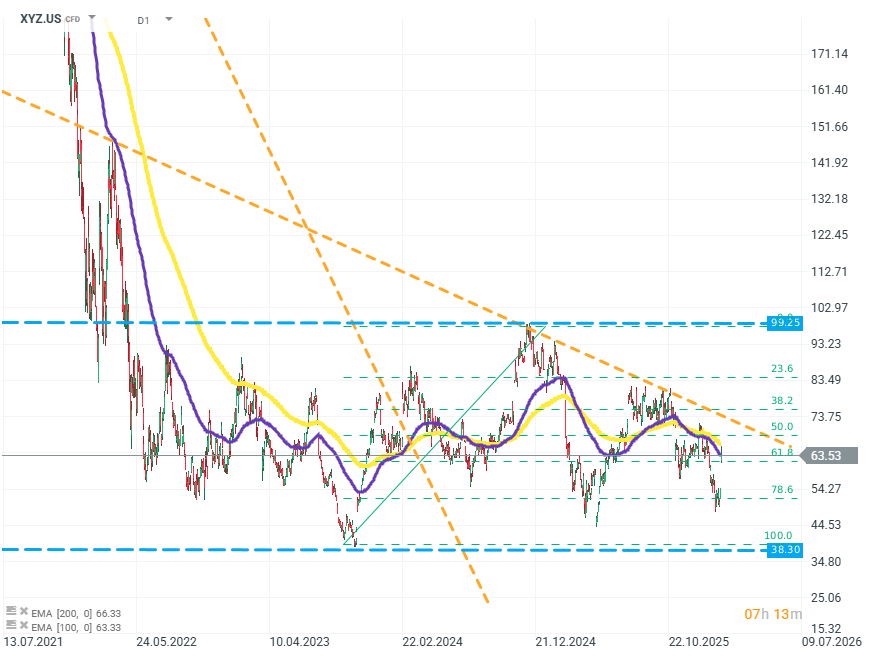
XYZ.US (D1)
Source: xStation5
Although today’s session delivered an impressive increase, the company still remains very far from its post-COVID valuation peak.



US Open: Further declines on Wall Street, Brent above 111 USD, AI correction continues (14.10.2026)


Market Wrap: "Decent" results are not enough – tech stocks fall further; oil highest since May (22.10.2026)


Tesla was supposed to burn $5 billion, but posted a positive result. Will Tesla still be a car company in a year?


Record-breaking Meta, though with a cash loss. Investors (for now) are buying Zuckerberg's plan anyway
The content of this report has been created by XTB S.A., with its registered office in Warsaw, at Prosta 67, 00-838 Warsaw, Poland, (KRS number 0000217580) and supervised by Polish Supervision Authority ( No. DDM-M-4021-57-1/2005). This material is a marketing communication within the meaning of Art. 24 (3) of Directive 2014/65/EU of the European Parliament and of the Council of 15 May 2014 on markets in financial instruments and amending Directive 2002/92/EC and Directive 2011/61/EU (MiFID II). Marketing communication is not an investment recommendation or information recommending or suggesting an investment strategy within the meaning of Regulation (EU) No 596/2014 of the European Parliament and of the Council of 16 April 2014 on market abuse (market abuse regulation) and repealing Directive 2003/6/EC of the European Parliament and of the Council and Commission Directives 2003/124/EC, 2003/125/EC and 2004/72/EC and Commission Delegated Regulation (EU) 2016/958 of 9 March 2016 supplementing Regulation (EU) No 596/2014 of the European Parliament and of the Council with regard to regulatory technical standards for the technical arrangements for objective presentation of investment recommendations or other information recommending or suggesting an investment strategy and for disclosure of particular interests or indications of conflicts of interest or any other advice, including in the area of investment advisory, within the meaning of the Trading in Financial Instruments Act of 29 July 2005 (i.e. Journal of Laws 2019, item 875, as amended). The marketing communication is prepared with the highest diligence, objectivity, presents the facts known to the author on the date of preparation and is devoid of any evaluation elements. The marketing communication is prepared without considering the client’s needs, his individual financial situation and does not present any investment strategy in any way. The marketing communication does not constitute an offer of sale, offering, subscription, invitation to purchase, advertisement or promotion of any financial instruments. XTB S.A. is not liable for any client’s actions or omissions, in particular for the acquisition or disposal of financial instruments, undertaken on the basis of the information contained in this marketing communication. In the event that the marketing communication contains any information about any results regarding the financial instruments indicated therein, these do not constitute any guarantee or forecast regarding the future results.