



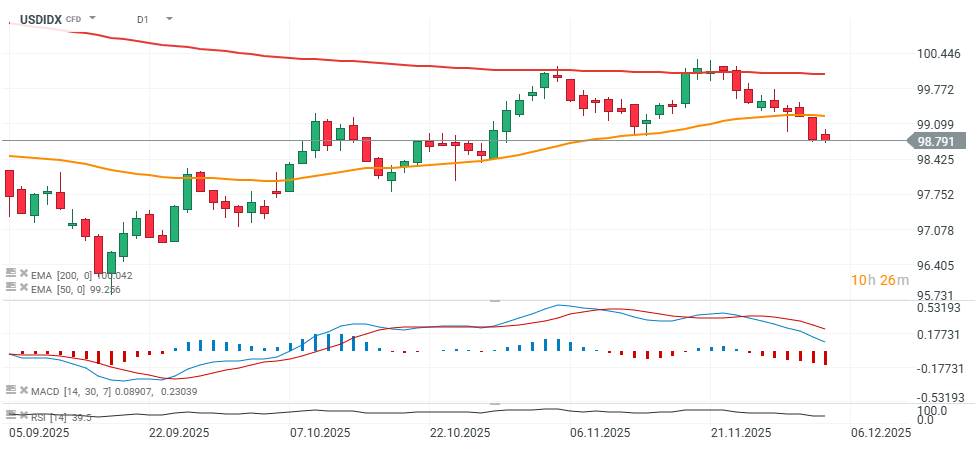
US Challenger Layoffs: 71.321k (Previous 153.074k). The USDIDX continue to slide today, but gains slightly after the Challenger report.
The November Challenger report paints a mixed picture of the U.S. labor market: moderating layoffs on the surface, but historically elevated levels beneath the headline. Despite a sharp 53% month-over-month decline, job cuts remain far above long-term norms and signal that corporate America is still bracing for economic and structural adjustments.
Job Cuts Declined in November — But Stay Historically High
-
November layoffs fell by 53% from October’s unusually high 153,074 cuts.
-
Even after the drop, November still marked the highest November total since 2022 and the 8th month this year in which layoffs exceeded year-ago levels.
-
Historically, layoffs in November rarely surpass 70,000 — this has happened only twice since 2008.
The decline is encouraging, but the broader trend remains elevated, reflecting lingering economic uncertainty and cyclical softening across key industries.
Year-to-Date Cuts Reach the Highest Since the Pandemic
-
Employers have announced 1.17 million job cuts through November — up 54% YoY.
-
This is the highest YTD tally since 2020, and only the 6th time since 1993 that cuts have surpassed 1.1 million by November.
-
Historically comparable periods occurred during recession years: 2001, 2002, 2009, and 2020.
Although the U.S. economy has avoided recession so far, the scale of layoffs resembles early recessionary dynamics, with companies acting pre-emptively to protect margins.
Industries Leading the Layoff Wave
Several sectors are undergoing significant restructuring:
• Telecommunications: +268% YoY
-
15,139 cuts in November, largely from Verizon — the worst month since early 2020.
-
YTD total: 38,035 cuts.
• Technology Remains the Top Private-Sector Job Cutter
-
12,377 cuts in November; YTD: 153,536 (+17% YoY).
-
Reflects continued cost discipline, redundancy elimination, and AI-driven restructuring.
• Retail: +139% YoY
-
Workforce reductions driven by softening consumer demand, tariff uncertainty, and shifts in shopping behavior.
• Non-profits: +409% YoY
-
Severely impacted by federal funding cuts and reduced charitable giving.
• Food Sector (Beef Processors): +26% YoY
-
Continues to adjust capacity amid changing agricultural and consumer trends.
Restructuring pressures are broad-based, impacting both cyclical industries (retail, food) and structural ones (tech, telecom, nonprofits).
Why Are Companies Cutting Jobs?
The top drivers of layoffs reveal both cyclical and structural pressures:
-
Restructuring: 20,217 cuts in November; YTD: 128,255.
-
Closings (stores, units, departments): 17,140 in November; YTD: 178,531.
-
Market/Economic Conditions: 15,755 in November; YTD: 245,086.
-
Artificial Intelligence:
-
6,280 cuts in November.
-
54,694 cuts YTD attributed directly to AI automation — a trend accelerating since 2023.
-
-
DOGE (Department of Government Efficiency):
-
293,753 cuts YTD — the single largest reason overall.
-
Additional 20,976 cuts from indirect funding losses (“Downstream Impact”).
-
A notable share of layoffs is being driven by policy-driven and technology-driven factors rather than pure economic weakness, suggesting deeper shifts in workforce composition.
Hiring Plans Hit the Lowest Level in Over a Decade
-
Companies announced 497,151 planned hires through November, down 35% YoY.
-
This is the weakest hiring outlook since 2010.
-
Seasonal hiring also fell to the lowest level since tracking began in 2012, with no new November seasonal hiring announcements.
Companies are not only reducing headcount — they are slowing future hiring as well. This combination often precedes broader labor-market softening.
Source: xStation5



US CPI above expectations!🔥📈


Dollar in Limbo Ahead of CPI 🚨

Morning wrap 🗽 Wall Street looks to rebound ahead of US CPI as ASML results weigh on sentiment (14.10.2026)



Economic Calendar - Start of Wall Street Earnings Season, Hawkish RBA, and Middle East Tensions (13.10.2026)
The content of this report has been created by XTB S.A., with its registered office in Warsaw, at Prosta 67, 00-838 Warsaw, Poland, (KRS number 0000217580) and supervised by Polish Supervision Authority ( No. DDM-M-4021-57-1/2005). This material is a marketing communication within the meaning of Art. 24 (3) of Directive 2014/65/EU of the European Parliament and of the Council of 15 May 2014 on markets in financial instruments and amending Directive 2002/92/EC and Directive 2011/61/EU (MiFID II). Marketing communication is not an investment recommendation or information recommending or suggesting an investment strategy within the meaning of Regulation (EU) No 596/2014 of the European Parliament and of the Council of 16 April 2014 on market abuse (market abuse regulation) and repealing Directive 2003/6/EC of the European Parliament and of the Council and Commission Directives 2003/124/EC, 2003/125/EC and 2004/72/EC and Commission Delegated Regulation (EU) 2016/958 of 9 March 2016 supplementing Regulation (EU) No 596/2014 of the European Parliament and of the Council with regard to regulatory technical standards for the technical arrangements for objective presentation of investment recommendations or other information recommending or suggesting an investment strategy and for disclosure of particular interests or indications of conflicts of interest or any other advice, including in the area of investment advisory, within the meaning of the Trading in Financial Instruments Act of 29 July 2005 (i.e. Journal of Laws 2019, item 875, as amended). The marketing communication is prepared with the highest diligence, objectivity, presents the facts known to the author on the date of preparation and is devoid of any evaluation elements. The marketing communication is prepared without considering the client’s needs, his individual financial situation and does not present any investment strategy in any way. The marketing communication does not constitute an offer of sale, offering, subscription, invitation to purchase, advertisement or promotion of any financial instruments. XTB S.A. is not liable for any client’s actions or omissions, in particular for the acquisition or disposal of financial instruments, undertaken on the basis of the information contained in this marketing communication. In the event that the marketing communication contains any information about any results regarding the financial instruments indicated therein, these do not constitute any guarantee or forecast regarding the future results.