



Oil prices rose at the market open on this last Monday of April, fueled by ongoing tensions in the Middle East and despite questionable reports released by Axios. The Brent July contract is currently holding above $100 per barrel, while the June contract is trading near $108 USD, approaching record closing levels seen in recent weeks. Notably, the further end of the forward curve is shifting upward, as evidenced by deferred contracts. The August contract is already trading near local peaks.
Failed Weekend Negotiations
Peace talks between the U.S. and Iran in Islamabad ended without an agreement. Donald Trump recalled negotiators, citing a lack of willingness to engage from the Iranian side. Conversely, the Iranian Prime Minister expressed condolences to Trump regarding last Saturday assassination attempt, while Foreign Minister Aragchi met with high-ranking officials in Oman to discuss matters concerning the Strait of Hormuz.
Iran’s Plan: Open Hormuz, Delay Nuclear Talks
According to Axios, Iran via intermediaries in Pakistan, submitted a proposal to the U.S. regarding an agreement to reopen the Strait of Hormuz, while postponing negotiations on nuclear issues to a later date.
The proposal suggests extending and potentially formalizing a ceasefire and lifting the maritime blockade. Meanwhile, negotiations regarding uranium enrichment and the broader nuclear package would be explicitly decoupled and pushed back, a major sticking point for Washington. It was nuclear concerns that initially led to the series of bombings last year and the start of the current war, which has been ongoing since late February (though a ceasefire has been in place for 20 days).
The market interprets this as a signal that Tehran is prioritizing physical access to oil export routes. For the United States, this would be only a partial victory, as the core issue of potential nuclear weapons research would remain unresolved. On the other hand, the world could see a return to relative normalcy with the resumption of supply from the Persian Gulf, though the exact terms for restoring traffic in the Strait of Hormuz remain unclear.
Credibility of Axios Reports
Axios relies heavily on anonymous sources within the U.S. administration and the region, which serves as both its strength (insider access) and its primary point of criticism. Some observers and media analysts accuse Axios of over-relying on unnamed sources, prioritizing speed over verification, and a tendency to publish rumors that are difficult to confirm independently, potentially undermining its credibility among more conservative audiences.
Conversely, independent ratings, such as Ad Fontes Media, classify Axios as a generally reliable source that is not necessarily biased in favor of President Trump. Nonetheless, regarding Iran, many Axios reports were subsequently denied by high-ranking Iranian officials.
Trump Claims Iran is Running Out of Storage
In a recent interview with Fox News, Trump presented an alarmist scenario: he claims Iran has "about three days" before its oil infrastructure begins to "explode from within." He argues that due to the blockade, Iran cannot load oil onto tankers and its onshore tanks are nearly full. (Their capacity is estimated at ~120 million barrels, meaning that at current Iranian production levels, they would fill up in just over a month).
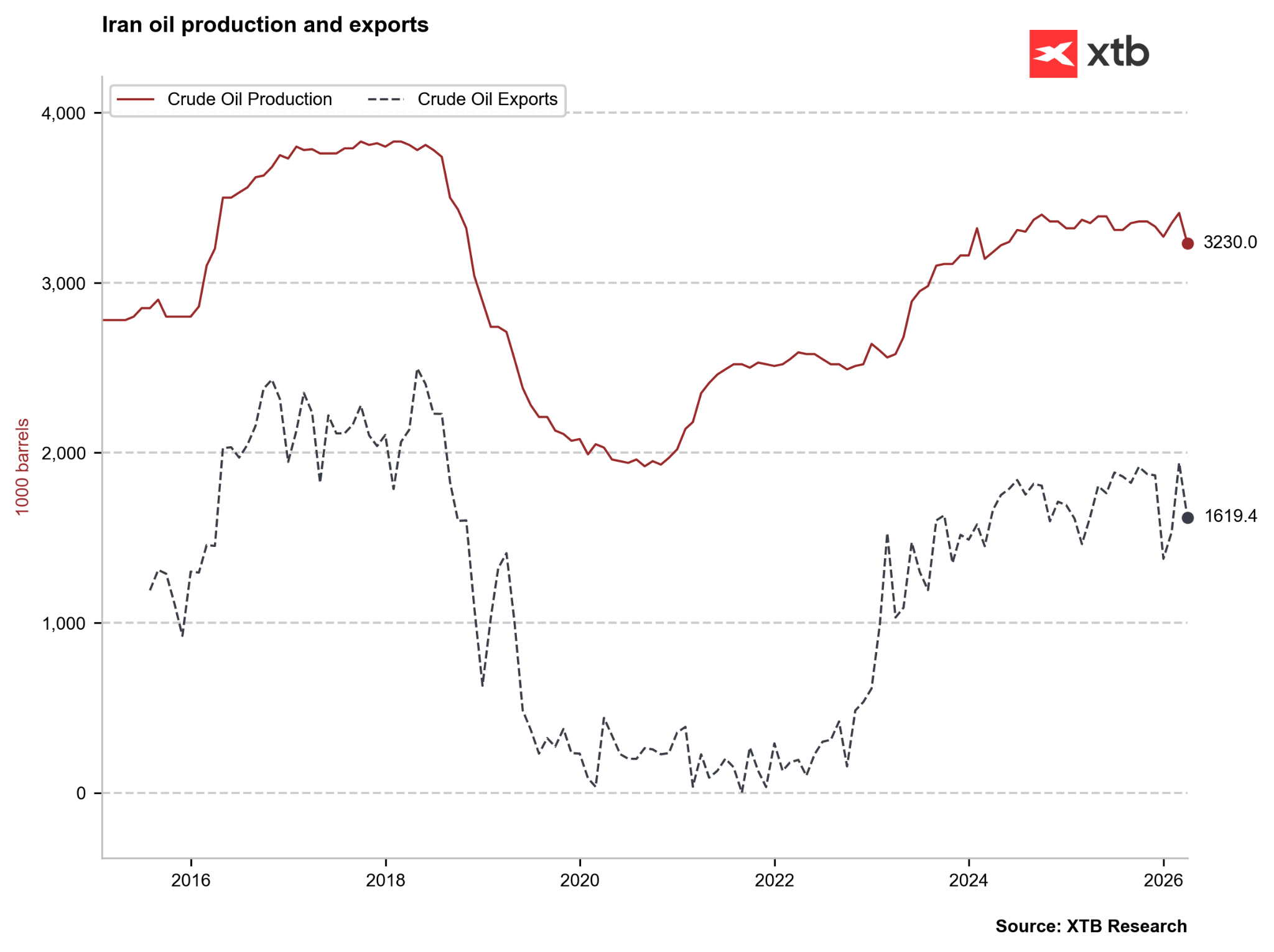 Trump’s first presidency saw Iranian production drop from ~3.9 mbd to just 2 mbd. A lack of sanction enforcement during the Biden presidency led to a production rebound; since 2024, it has oscillated near 3.3–3.4 mbd. Exports during Trump's first term dropped nearly to zero. However, Iran maintains some transit capabilities via the Caspian Sea (using swaps), meaning exports are unlikely to hit absolute zero. Source: Bloomberg Finance LP
The same material cites analyses from the AEI (Critical Threats Project) and Energy Aspects, suggesting Iran is nearing its storage limit, which would force the shutting in of oil fields. A similar drop in production occurred during the first Trump presidency. Other estimates, such as those reported by the New York Times and CNN commentators, suggest a longer horizon: from "two weeks or more" to "two or three months" of sustained production before storage becomes a critical constraint. This indicates that Trump is significantly amplifying his rhetoric relative to the analytical consensus.
Prices: August Contracts at New Local Highs
The spot price for Brent crude is trading around $106–$108 USD, near the maximum closing levels of the past few weeks. On the xStation platform, the July contract is currently the most liquid, with a volume of nearly 80,000 positions, trading slightly below $102. Meanwhile, the August contract is reaching new local highs—levels unseen in recent weeks. This suggests the market believes oil market tensions will persist. August Brent is trading just above $96, though a test of the $100 level remains possible.
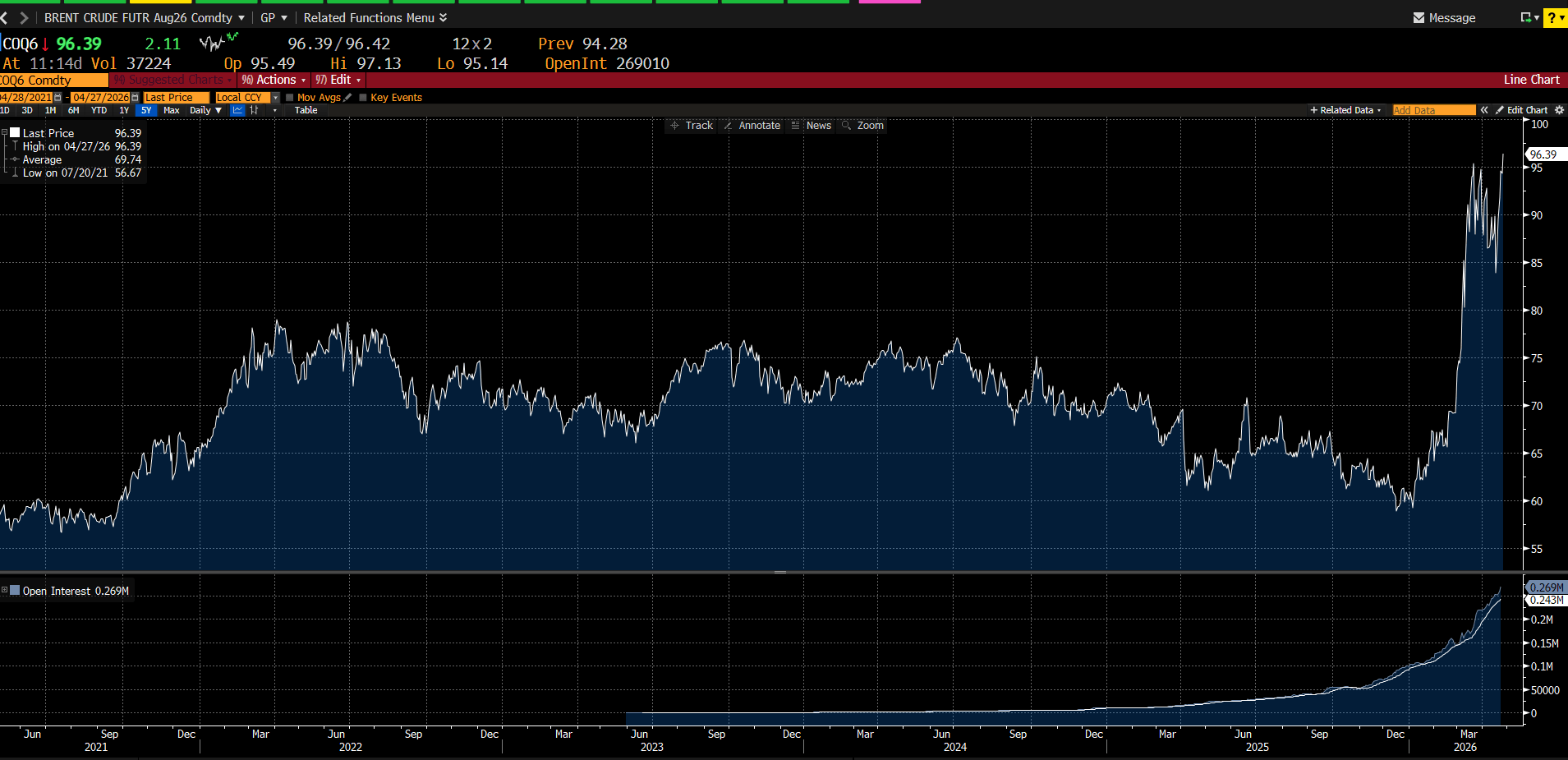 August Brent Crude contract on the ICE exchange. Source: Bloomberg Finance LP
The market remains in significant backwardation, with front-end and spot prices trading markedly higher. Recently, the spread between physical oil (Dated Brent) and the front-month contract was as high as $15; it has since compressed to below $10, hitting levels of $6–$7. This does not mean the market is no longer tight; rather, it reflects a rise in the long end of the curve and some demand destruction.
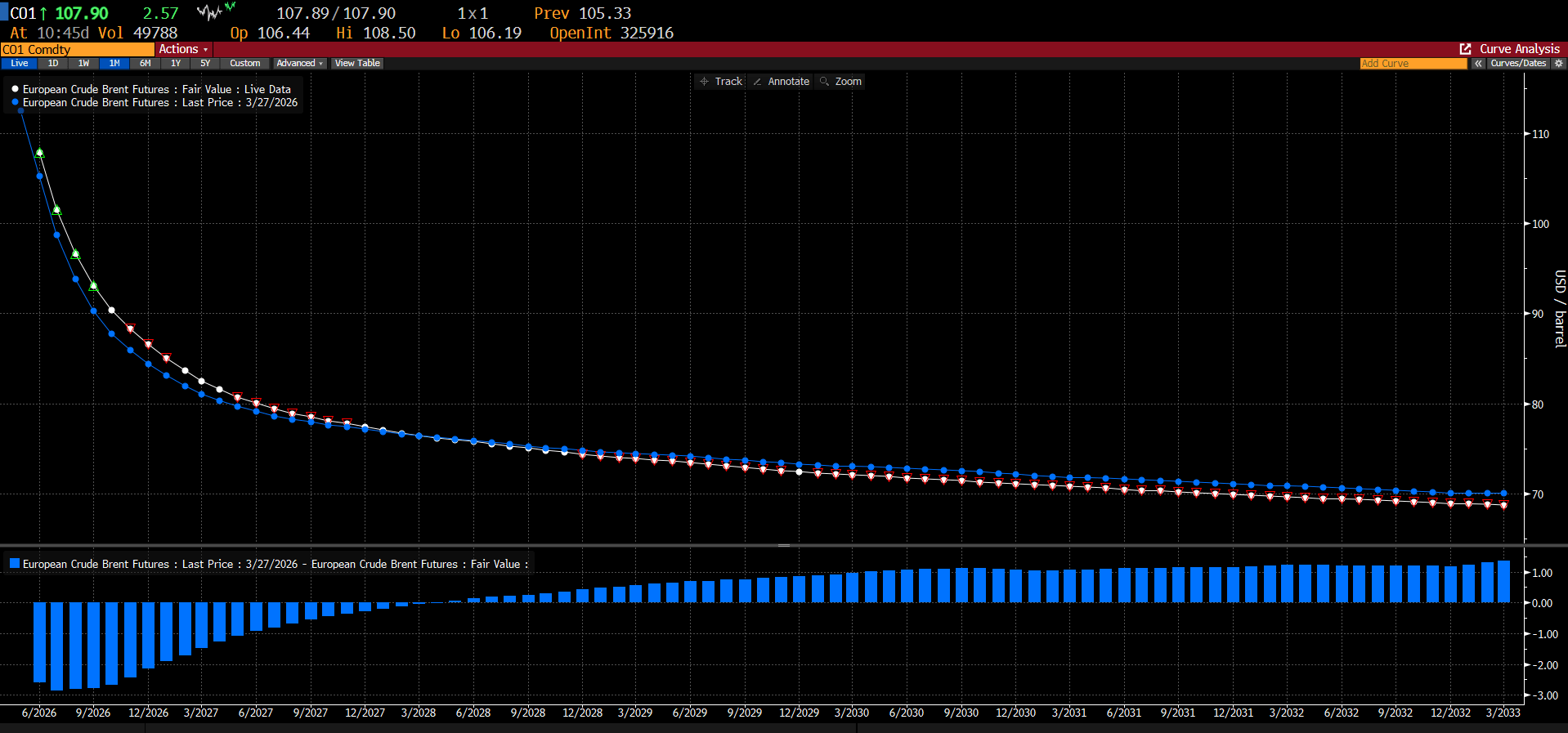 The forward curve is currently elevated compared to one month ago. Source: Bloomberg Finance LP
Further Market Implications
The market is shrouded in uncertainty. Polymarket currently estimates the chances of a permanent peace between Iran and the U.S. at less than 33% by May 31, and below 50% by June 30. Two weeks ago, these odds were significantly higher. Goldman Sachs has raised its oil price forecast to $90 in Q4 2026, while the December contract currently trades at $86. The futures market only shows stability toward the middle of next year, with quotes hovering near $75–$80.
Based on the current fundamental outlook, further price increases can be expected, particularly in deferred contracts; therefore, it is vital to monitor the situation during each rollover. Conversely, if peace is achieved sooner, prices could see a rapid 10–20% drop, followed by a fundamental re-evaluation that would likely lead to a subsequent climb. These scenarios do not account for major demand destruction; however, a drop in demand similar to the COVID-19 pandemic is unlikely. Nevertheless, for the market to balance under current constraints, demand would need to fall by at least 5 million barrels per day.
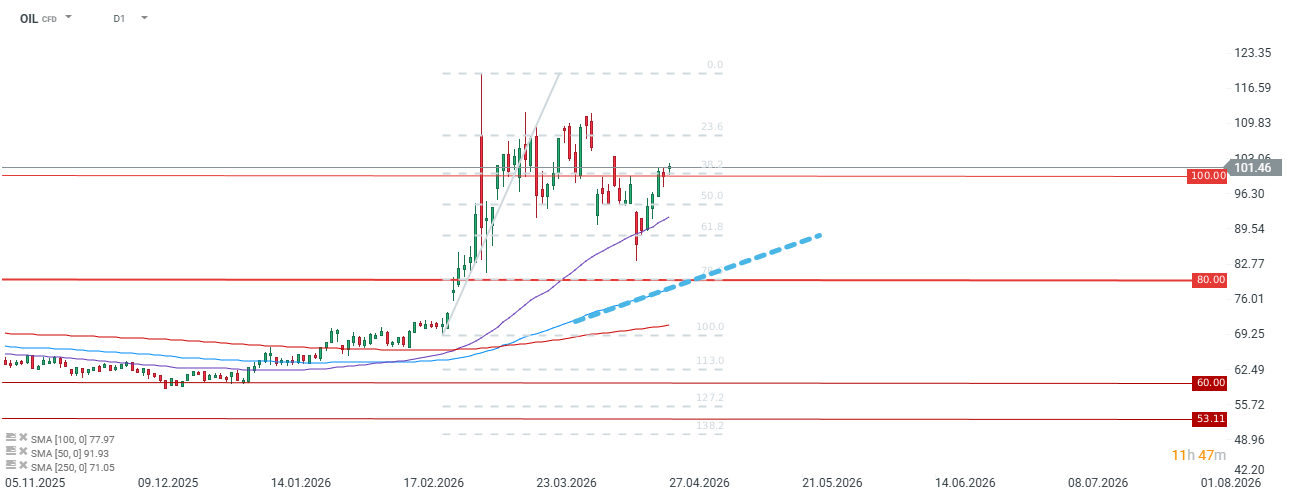 Brent is trading at its highest since April 13. A key resistance zone sits at $105. In the event of a correction, the first target is the $95 area, followed by the 50-period moving average near $92. Source: xStation5



Morning Briefing: Warsh's silence on interest rates. AI debt fears cooled sentiment, but a rebound is visible


Daily Summary: Rising inflation weighs on markets, semiconductors suffer most (14.10.2026)


US Open: CPI reading weighs on American indices (14.10.2026)
US inflation concerns rise
The content of this report has been created by XTB S.A., with its registered office in Warsaw, at Prosta 67, 00-838 Warsaw, Poland, (KRS number 0000217580) and supervised by Polish Supervision Authority ( No. DDM-M-4021-57-1/2005). This material is a marketing communication within the meaning of Art. 24 (3) of Directive 2014/65/EU of the European Parliament and of the Council of 15 May 2014 on markets in financial instruments and amending Directive 2002/92/EC and Directive 2011/61/EU (MiFID II). Marketing communication is not an investment recommendation or information recommending or suggesting an investment strategy within the meaning of Regulation (EU) No 596/2014 of the European Parliament and of the Council of 16 April 2014 on market abuse (market abuse regulation) and repealing Directive 2003/6/EC of the European Parliament and of the Council and Commission Directives 2003/124/EC, 2003/125/EC and 2004/72/EC and Commission Delegated Regulation (EU) 2016/958 of 9 March 2016 supplementing Regulation (EU) No 596/2014 of the European Parliament and of the Council with regard to regulatory technical standards for the technical arrangements for objective presentation of investment recommendations or other information recommending or suggesting an investment strategy and for disclosure of particular interests or indications of conflicts of interest or any other advice, including in the area of investment advisory, within the meaning of the Trading in Financial Instruments Act of 29 July 2005 (i.e. Journal of Laws 2019, item 875, as amended). The marketing communication is prepared with the highest diligence, objectivity, presents the facts known to the author on the date of preparation and is devoid of any evaluation elements. The marketing communication is prepared without considering the client’s needs, his individual financial situation and does not present any investment strategy in any way. The marketing communication does not constitute an offer of sale, offering, subscription, invitation to purchase, advertisement or promotion of any financial instruments. XTB S.A. is not liable for any client’s actions or omissions, in particular for the acquisition or disposal of financial instruments, undertaken on the basis of the information contained in this marketing communication. In the event that the marketing communication contains any information about any results regarding the financial instruments indicated therein, these do not constitute any guarantee or forecast regarding the future results.