



The EURUSD pair resumes dynamic gains after the weekend (+0.3%) and approaches the psychological level of 1.1600 for the first time in two months. The market is increasingly aggressively cutting expectations for a hawkish Fed policy, and the geopolitical premium on the dollar is melting in the face of a series of disappointing US data.
Technical Analysis: EURUSD (D1)
After a slowdown in the first half of August, EURUSD is attempting to break out of consolidation and moves above the 100- and 10-day exponential moving averages (EMA100 / dark purple; EMA10 / yellow). The pair has gained nearly 0.6% since Friday, initiating a test of the resistance set in June. The RSI is on the threshold of overbought territory (i.e., above 70; currently at 65), which may limit expansion above the psychological 1.1600 level, especially given the lack of additional macro data catalysts (Eurozone inflation isn't due until Wednesday, PMIs on Friday).
Today's session will be key. A close above 1.1600 should solidify the newly established uptrend even in the event of unlikely anti-euro surprises (significantly weaker-than-expected HICP or PMI). Conversely, if the price turns back toward Friday's close, further dollar weakness will depend on upcoming signals from the US economy, and EURUSD should remain within the 1.1550 – 1.1600 range.
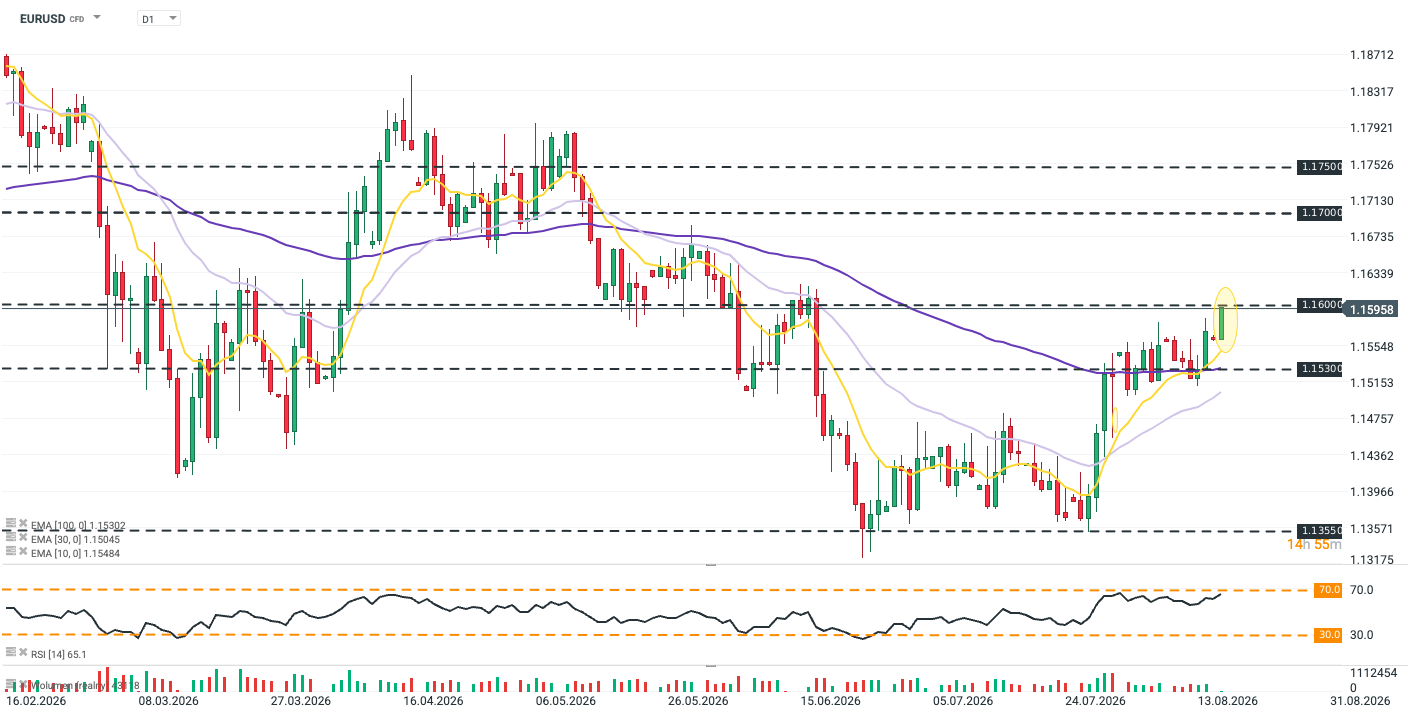
Source: xStation5
Fed Expectations Search for a New Low
The primary catalyst behind EURUSD's rise is the decline in expectations for US interest rate hikes. The past two weeks brought a series of disappointing macro data, removing arguments for Fed hawks to press for higher rates. Non-Farm Payrolls (NFP) employment unexpectedly fell in July by around 20k jobs, core inflation dropped to its lowest level since 2021, and the consumer lost steam due to elevated prices at gas stations (an unexpected 0.6% m/m decline in retail sales).
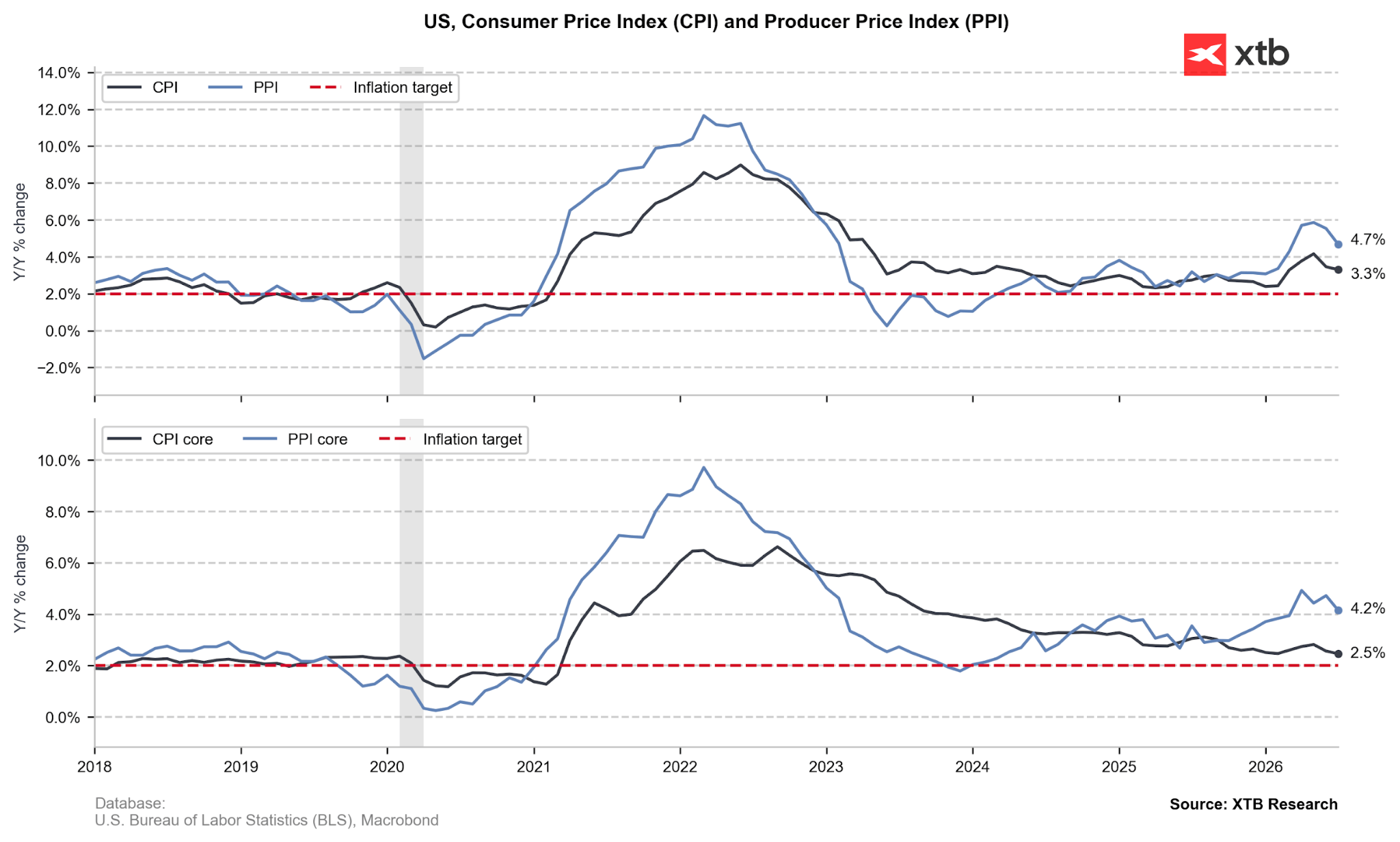
US inflation is slowing down on both the consumer (CPI) and producer (PPI) sides. Importantly, the decelerating rate of price growth also applies to sectors that are less volatile and less sensitive to oil price fluctuations (core inflation, lower panel). Source: XTB Research, Macrobond data
Following these developments, the market—which had originally done the "dirty work" for the Fed by tightening financial conditions despite unchanged interest rates (higher yields, stock market correction)—has completely turned the tables and gone on the offensive. Swap-implied odds of a rate hike before the end of 2026 dropped within a week from certainty down to 85%, while September (previously fully priced in) now stands at under 30% probability. A reshuffle also occurred in the bond market. US 10-year yields are 7 bps below their late-July peaks, and the rebounding yield spread between Germany and the US acted as a springboard for EURUSD.
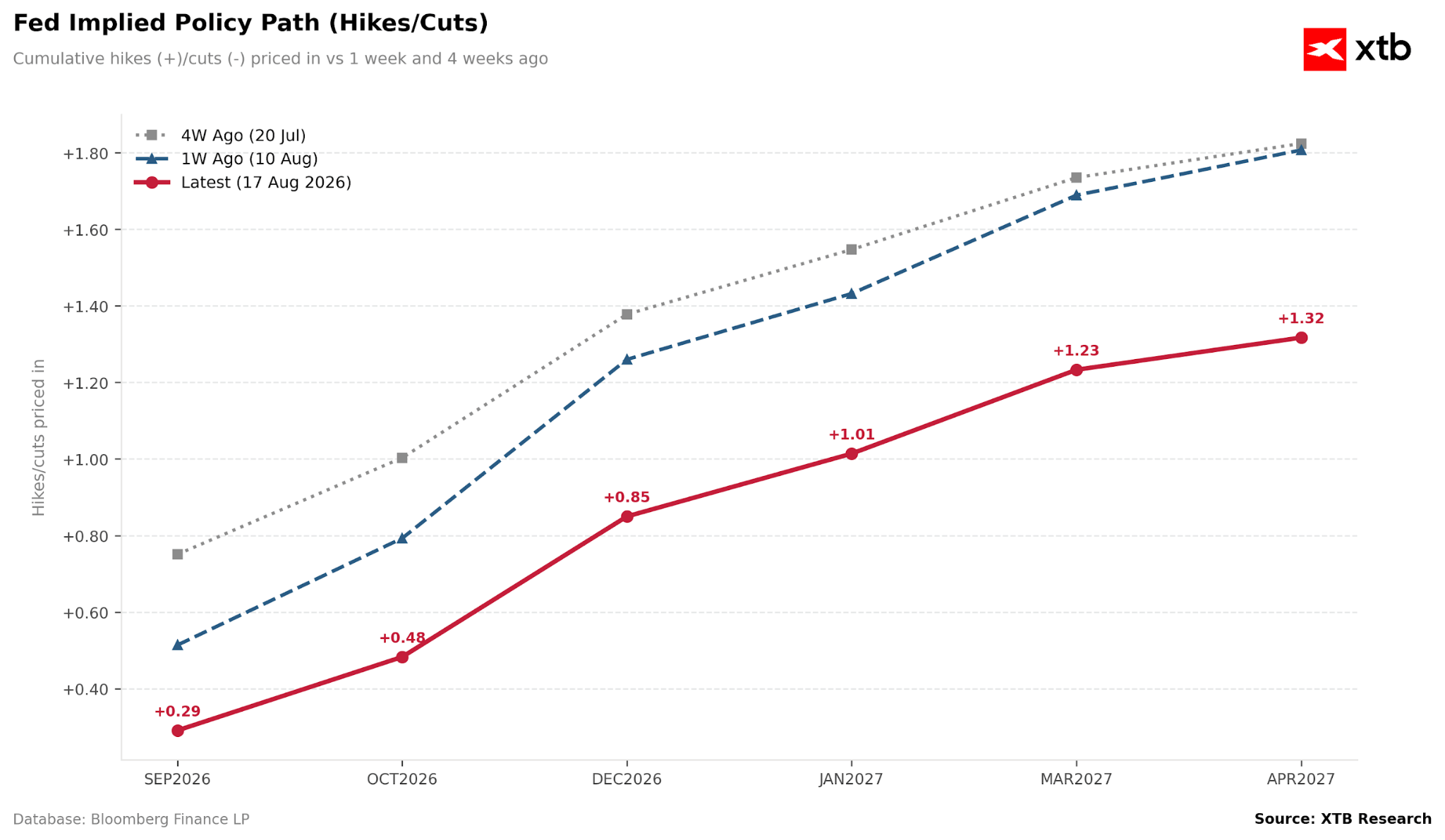
Expected US rate hike trajectory is falling (now: red, a week ago: blue, 4 weeks ago: gray). The chart shows the number of rate hikes priced in by the market for a given Fed meeting (the first full hike is now priced in only for January 2027). Source: XTB Research, Bloomberg data
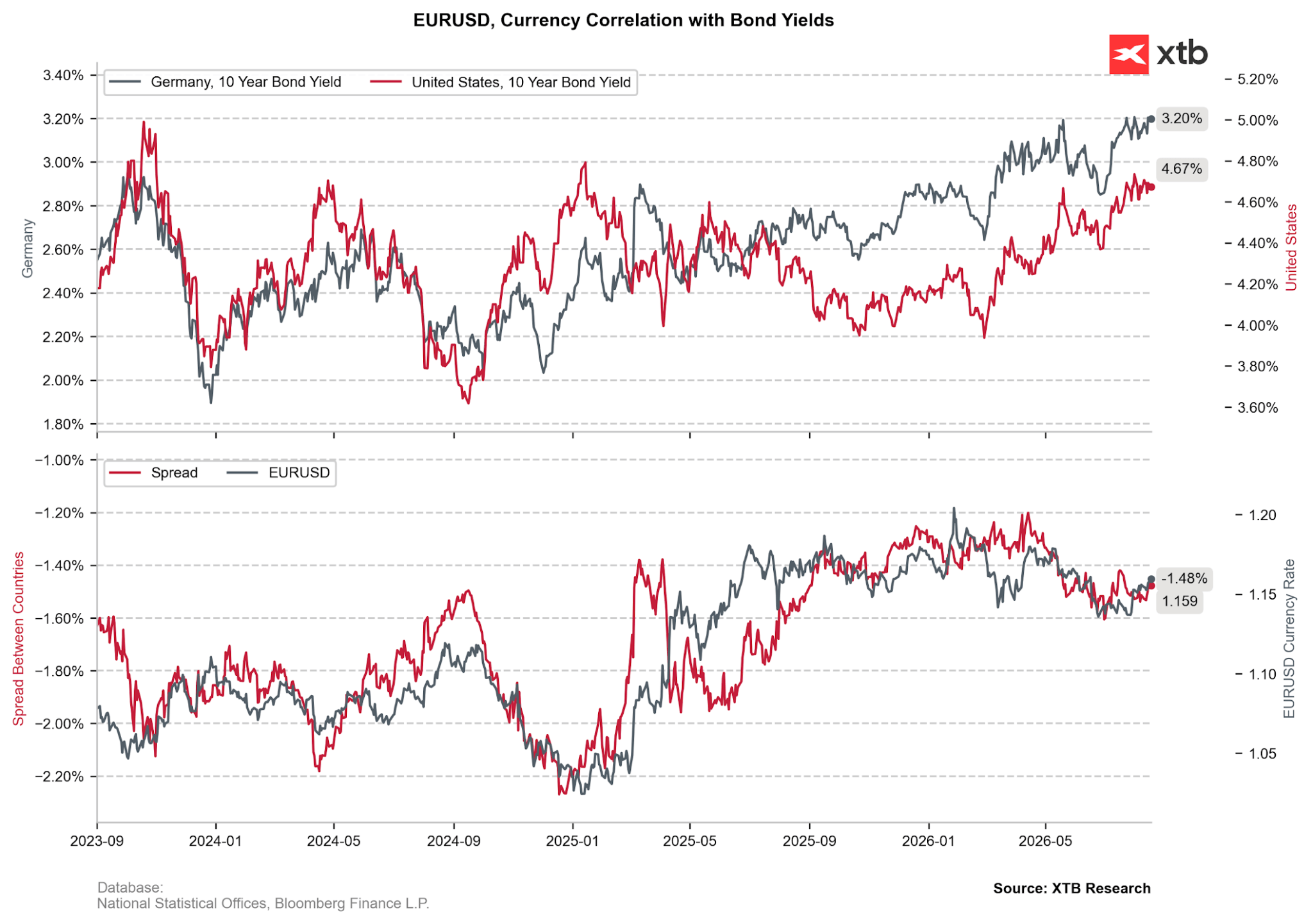
The yield spread between German and US 10-year bonds (bottom panel, red) provided support for further EURUSD gains. Source: XTB Research, Bloomberg data
Market Reduces EURUSD Bearish Positioning
Alongside spot market movements, a clear reshuffle is taking place in the derivatives market, signaling a shift in long-term investor sentiment toward the major currency pair. Although net speculative positions according to CFTC data still indicate a prevalence of shorts, the options market shows a significant decline in the premium investors pay to hedge against EURUSD declines. This is largely due to market focus shifting from oil to the Fed and domestic macro data. Furthermore, while Brent still trades near $90 per barrel, volatility in price action has declined, and the ECB—more sensitive to energy price risks (not just oil, but also natural gas)—currently has more arguments for rate hikes than the Fed.
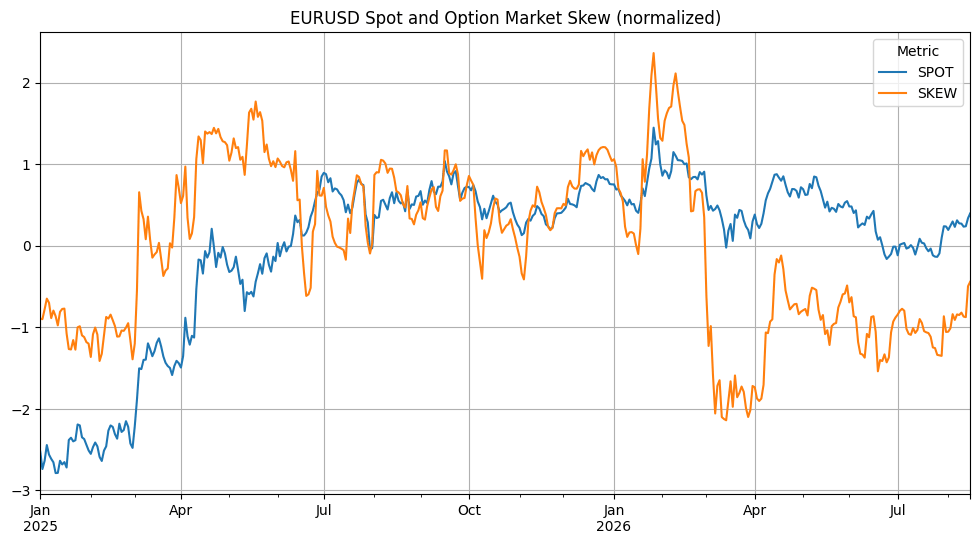
Standardized EURUSD spot rate (blue) and Real Skew (orange). Negative SKEW values indicate that the market is paying a higher premium to hedge against EURUSD downside. The Middle East war sharply pulled the indicator below zero, highlighting asymmetrical, pro-dollar geopolitical risk (even as the ECB remains more hawkish than the Fed). However, over the past week, this premium has significantly decreased (rebounding toward zero). Source: XTB Research, Bloomberg data
--
Aleksander Jablonski, XTB Quant Analyst



Daily Summary: Nasdaq and AI Stocks Rebound Ahead of Big Tech Earnings 🚀

Wall Street rebounds🚨



Market Wrap: Rebound in China and Falling Oil Prices, France Leads EU Declines



Optimism Returns to Asia❔
The content of this report has been created by XTB S.A., with its registered office in Warsaw, at Prosta 67, 00-838 Warsaw, Poland, (KRS number 0000217580) and supervised by Polish Supervision Authority ( No. DDM-M-4021-57-1/2005). This material is a marketing communication within the meaning of Art. 24 (3) of Directive 2014/65/EU of the European Parliament and of the Council of 15 May 2014 on markets in financial instruments and amending Directive 2002/92/EC and Directive 2011/61/EU (MiFID II). Marketing communication is not an investment recommendation or information recommending or suggesting an investment strategy within the meaning of Regulation (EU) No 596/2014 of the European Parliament and of the Council of 16 April 2014 on market abuse (market abuse regulation) and repealing Directive 2003/6/EC of the European Parliament and of the Council and Commission Directives 2003/124/EC, 2003/125/EC and 2004/72/EC and Commission Delegated Regulation (EU) 2016/958 of 9 March 2016 supplementing Regulation (EU) No 596/2014 of the European Parliament and of the Council with regard to regulatory technical standards for the technical arrangements for objective presentation of investment recommendations or other information recommending or suggesting an investment strategy and for disclosure of particular interests or indications of conflicts of interest or any other advice, including in the area of investment advisory, within the meaning of the Trading in Financial Instruments Act of 29 July 2005 (i.e. Journal of Laws 2019, item 875, as amended). The marketing communication is prepared with the highest diligence, objectivity, presents the facts known to the author on the date of preparation and is devoid of any evaluation elements. The marketing communication is prepared without considering the client’s needs, his individual financial situation and does not present any investment strategy in any way. The marketing communication does not constitute an offer of sale, offering, subscription, invitation to purchase, advertisement or promotion of any financial instruments. XTB S.A. is not liable for any client’s actions or omissions, in particular for the acquisition or disposal of financial instruments, undertaken on the basis of the information contained in this marketing communication. In the event that the marketing communication contains any information about any results regarding the financial instruments indicated therein, these do not constitute any guarantee or forecast regarding the future results.