



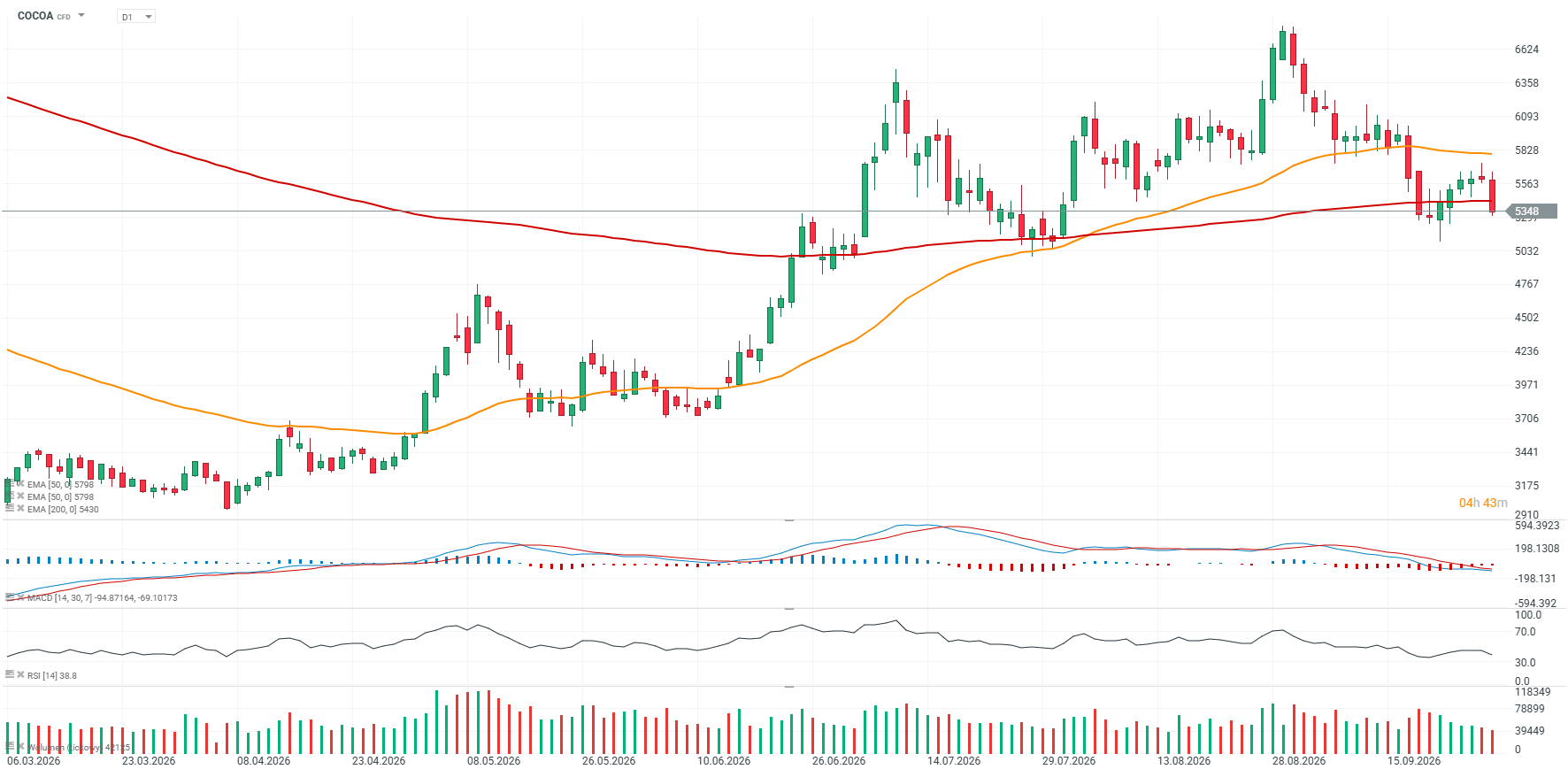
ICE cocoa futures (COCOA) are down nearly 4% and remain under pressure following the strong rebound seen in late August and early September. On the one hand, rising ICE inventories and improving supplies from Ivory Coast strengthen the bearish supply-side case, while on the other hand the market is still pricing in weather risks and quality concerns across West Africa. This creates a classic futures-market setup: near-term supply is weighing on prices, but medium-term fundamentals remain uncertain enough to prevent the market from fully removing the risk premium.
- ICE cocoa inventories have risen to their highest level in around 2.25 years, reaching 3,452,949 bags. This is clearly negative for prices, as it points to improving availability of cocoa in the exchange-traded market.
- Additional pressure comes from Ivory Coast. The country’s regulator reported that around 2.06 million metric tons of cocoa were harvested between June and the end of August, up 30% from a year earlier.
- Port-delivery data also remain strong. From the start of the international marketing year through September 27, farmers delivered around 2.18 million metric tons of cocoa, up 19.8% year on year.
- The picture is not entirely straightforward, however, as the pace of deliveries weakened in September. Between September 1 and 13, Ivory Coast deliveries were around 45.8% lower than a year earlier, showing that very strong full-season data do not necessarily imply an equally strong start to the new cycle.
- Barry Callebaut said the global cocoa market is now better supplied than during the 2023/24 El Niño-related crisis. This supports the view that the extreme supply tightness seen in previous years has eased significantly.
- Weather remains the main bullish factor. Excessive rainfall and cloudy conditions in Ivory Coast and Ghana are increasing the risk of black pod disease and may reduce bean quality.
- Early estimates for the 2026/27 season are also far from comfortable. Forecasts for Ivory Coast point to production of around 1.8 million metric tons, well below roughly 2.2 million metric tons in 2025/26.
- Ghana also remains a weak point in the market. The Cocoa Board estimates the 2026/27 crop at around 650,000 metric tons versus 750,000 previously, while more pessimistic projections point to just 450,000-550,000 metric tons.
- Some analysts have also reduced their expectations for the global surplus. StoneX cut its 2026/27 surplus forecast to 25,000 metric tons from 149,000 previously, while Transgraph Consulting expects the surplus to shrink to around 80,000 metric tons from 415,000 in 2025/26.
- Weather risk remains important over the medium term as well. A potential return of El Niño could bring warmer and drier conditions to West Africa, historically increasing the risk of weaker yields.
- Demand signals are mixed. European cocoa grindings fell 4.6% year on year in Q2 to 316,366 metric tons, pointing to softer industrial demand.
- By contrast, data from North America and Asia were much stronger. North American grindings rose 7.7% year on year to 109,659 metric tons, while Asian grindings surged 25% to 224,646 metric tons.
The market is currently caught between improving near-term supply and the risk of a weaker next season. In the short term, rising inventories and stronger deliveries have the upper hand, but further out on the curve, weather, Ghana’s production outlook, and crop quality remain risks the market cannot ignore.
 Source: xStation5


RBA turns increasingly hawkish as markets reprice November rate hike expectations ⚔️



Daily Summary: Buyers Refuse to Give In

US Natural gas extends declines 🔥📉



US OPEN: The wave of AI concerns is building again, oil returns near highs
The content of this report has been created by XTB S.A., with its registered office in Warsaw, at Prosta 67, 00-838 Warsaw, Poland, (KRS number 0000217580) and supervised by Polish Supervision Authority ( No. DDM-M-4021-57-1/2005). This material is a marketing communication within the meaning of Art. 24 (3) of Directive 2014/65/EU of the European Parliament and of the Council of 15 May 2014 on markets in financial instruments and amending Directive 2002/92/EC and Directive 2011/61/EU (MiFID II). Marketing communication is not an investment recommendation or information recommending or suggesting an investment strategy within the meaning of Regulation (EU) No 596/2014 of the European Parliament and of the Council of 16 April 2014 on market abuse (market abuse regulation) and repealing Directive 2003/6/EC of the European Parliament and of the Council and Commission Directives 2003/124/EC, 2003/125/EC and 2004/72/EC and Commission Delegated Regulation (EU) 2016/958 of 9 March 2016 supplementing Regulation (EU) No 596/2014 of the European Parliament and of the Council with regard to regulatory technical standards for the technical arrangements for objective presentation of investment recommendations or other information recommending or suggesting an investment strategy and for disclosure of particular interests or indications of conflicts of interest or any other advice, including in the area of investment advisory, within the meaning of the Trading in Financial Instruments Act of 29 July 2005 (i.e. Journal of Laws 2019, item 875, as amended). The marketing communication is prepared with the highest diligence, objectivity, presents the facts known to the author on the date of preparation and is devoid of any evaluation elements. The marketing communication is prepared without considering the client’s needs, his individual financial situation and does not present any investment strategy in any way. The marketing communication does not constitute an offer of sale, offering, subscription, invitation to purchase, advertisement or promotion of any financial instruments. XTB S.A. is not liable for any client’s actions or omissions, in particular for the acquisition or disposal of financial instruments, undertaken on the basis of the information contained in this marketing communication. In the event that the marketing communication contains any information about any results regarding the financial instruments indicated therein, these do not constitute any guarantee or forecast regarding the future results.