



Markets are currently focusing more on the losses resulting from the ongoing conflict in the Persian Gulf. This instinct is entirely understandable, wars, ultimately, are costly negative-sum undertakings. Investors must price in losses to budgets, risks to growth, inflation, etc.
The market participants that can generally only benefit from such a major escalation of tensions are defense companies. This time is no different.
The U.S. and Israeli campaign in Iran remains, for now, primarily an air campaign. According to official data, the U.S. conducted, up to the ceasefire, more than 10,000 combat missions and struck over 13,000 targets in Iran.
Ammunition is currently one of the most important bottlenecks in the defense industry, and the U.S. is no exception. According to analyses by, among others, CNN and CSIS, during Operation “Epic Fury” the U.S. used in Iran:
- more than 1,000 BGM-109 “Tomahawk” missiles,
- more than 1,000 “JASSM” missiles,
- approx. 60 “PrSM” missiles,
- nearly 250 SM-3 missiles,
- more than 200 SM-6 missiles,
- more than 200 “THAAD” interceptors,
- more than 1,000 PAC-3 “Patriot” missiles.
This means that among the most advanced types of munitions, mainly long-range systems, the U.S. has now depleted roughly 30–60% of its pre-war stockpiles. However, this is not the Pentagon’s biggest problem. The problem is that these munitions are not only extremely expensive, but their production is also limited to only a few dozen units per year. With current production capacity, the U.S. will need roughly four years to rebuild stockpiles.
This in no way means the U.S. is becoming “defenseless” or even ineffective. Nor does it mean a renewed escalation in Iran is unlikely. It does, however, highlight significant challenges for the Department of Defense and enormous opportunities for weapons suppliers to U.S. forces. Who are we talking about?
Among producers of the most advanced U.S. munitions, RTX Corp. and Lockheed Martin maintain near-total dominance.
- Tomahawk, SM-3, and SM-6 are products of RTX Corp.
- JASSM, PrSM, THAAD, and PAC-3 Patriot are associated with Lockheed Martin.
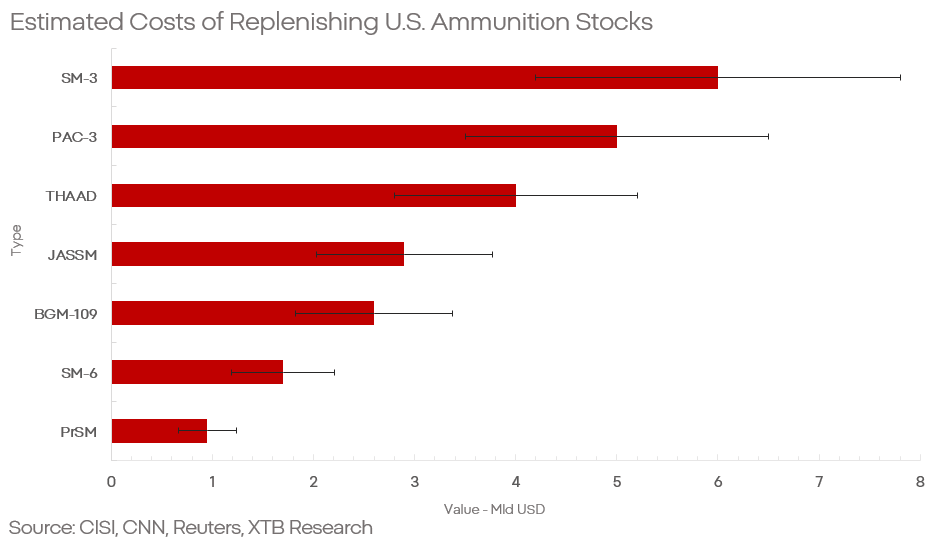
Considering only stockpile replenishment, and based on publicly available data on prices and past orders - this implies amounts of roughly $20–30 billion over aprox. four years.
Assuming a conservative $25 billion, that would translate into sales revenue of roughly $11–13 billion for RTX and roughly $13–16 billion for Lockheed Martin.
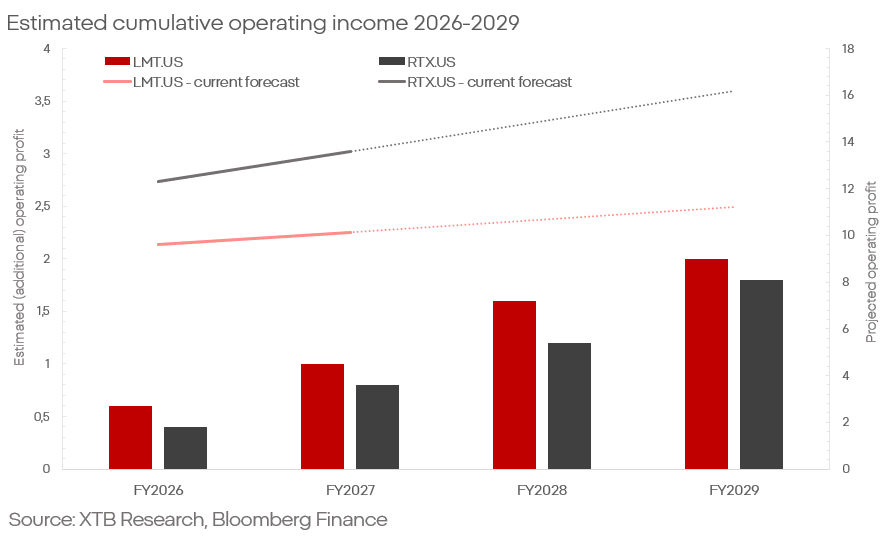
Using segment margins at these companies (12–13%), this implies operating profit of about $1.5–2.5 billion over the next four years, i.e., about $0.4–0.6 billion per year.
A high degree of caution is warranted regarding the timing of these revenues. While production of the listed munitions is currently one of the Pentagon’s most pressing bottlenecks, major investments are underway intended - at least partially, to accelerate output.
The key question to answer is: is this already in the price?
Nothing suggests it is. Both companies appear to have performed weakly in recent quarters (given the context), and the trend worsened after the latest results.
Because, based on forecasts for, among other things, the operating profit of both companies, it does not appear to have changed materially recently.
- For Lockheed, expectations for 2026 and 2027 are $9.6 billion and $10.1 billion, respectively.
- For RTX, expectations are $12.3 billion and $13.5 billion for 2025/2026.
If so, this implies a potential upside surprise of about $0.4–0.6 billion (~5%) in operating profit—an upside that the market does not currently see—at a time when both stocks are at multi-month lows.
Final remarks
Naturally, forecasts of this kind are not “absolute.” Neither RTX nor Lockheed is a company focused solely (or even primarily) on munitions—earnings forecasts can be diluted by the performance of other segments.
Moreover, there is no high precision in estimating expenditures of this type. The specifics of producing these missiles are highly classified, margins are averaged, and many operational issues can appear or disappear unexpectedly without investors or the public being informed.
Kamil Szczepański
Financial Market Analyst at XTB



Economic Calendar - Start of Wall Street Earnings Season, Hawkish RBA, and Middle East Tensions (13.10.2026)



Morning Wrap: Tech Crash in Asia and Hawkish Central Banks in the Shadow of an Oil Shock (13.10.2026)



📊Market Wrap: Europe Rebouns Despite Higher Oil and Dollar (12.10.2026)


Chart of the Day: Will the RBI's bold regulatory package rescue the rupee? (12.10.2026)
The content of this report has been created by XTB S.A., with its registered office in Warsaw, at Prosta 67, 00-838 Warsaw, Poland, (KRS number 0000217580) and supervised by Polish Supervision Authority ( No. DDM-M-4021-57-1/2005). This material is a marketing communication within the meaning of Art. 24 (3) of Directive 2014/65/EU of the European Parliament and of the Council of 15 May 2014 on markets in financial instruments and amending Directive 2002/92/EC and Directive 2011/61/EU (MiFID II). Marketing communication is not an investment recommendation or information recommending or suggesting an investment strategy within the meaning of Regulation (EU) No 596/2014 of the European Parliament and of the Council of 16 April 2014 on market abuse (market abuse regulation) and repealing Directive 2003/6/EC of the European Parliament and of the Council and Commission Directives 2003/124/EC, 2003/125/EC and 2004/72/EC and Commission Delegated Regulation (EU) 2016/958 of 9 March 2016 supplementing Regulation (EU) No 596/2014 of the European Parliament and of the Council with regard to regulatory technical standards for the technical arrangements for objective presentation of investment recommendations or other information recommending or suggesting an investment strategy and for disclosure of particular interests or indications of conflicts of interest or any other advice, including in the area of investment advisory, within the meaning of the Trading in Financial Instruments Act of 29 July 2005 (i.e. Journal of Laws 2019, item 875, as amended). The marketing communication is prepared with the highest diligence, objectivity, presents the facts known to the author on the date of preparation and is devoid of any evaluation elements. The marketing communication is prepared without considering the client’s needs, his individual financial situation and does not present any investment strategy in any way. The marketing communication does not constitute an offer of sale, offering, subscription, invitation to purchase, advertisement or promotion of any financial instruments. XTB S.A. is not liable for any client’s actions or omissions, in particular for the acquisition or disposal of financial instruments, undertaken on the basis of the information contained in this marketing communication. In the event that the marketing communication contains any information about any results regarding the financial instruments indicated therein, these do not constitute any guarantee or forecast regarding the future results.