


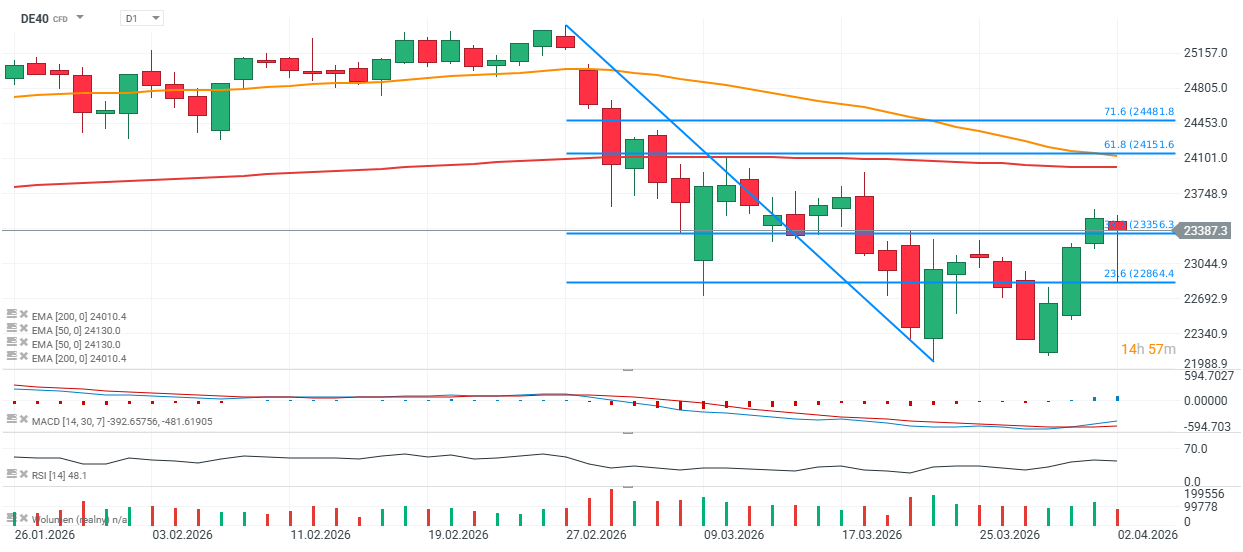
The German DAX index has declined from around 25,400 points to 22,400 points, with the DE40 futures contract closely mirroring the performance of the spot index almost one-to-one. In April, investor attention is likely to shift toward two key German names - financial heavyweight Deutsche Bank, which has recently revealed significant exposure to the technology sector and private credit lending, raising investor concerns, and BASF, the industrial and chemical giant that has been performing surprisingly well despite elevated energy prices.
Source: xStation5
Deutsche Bank (DBK.DE)
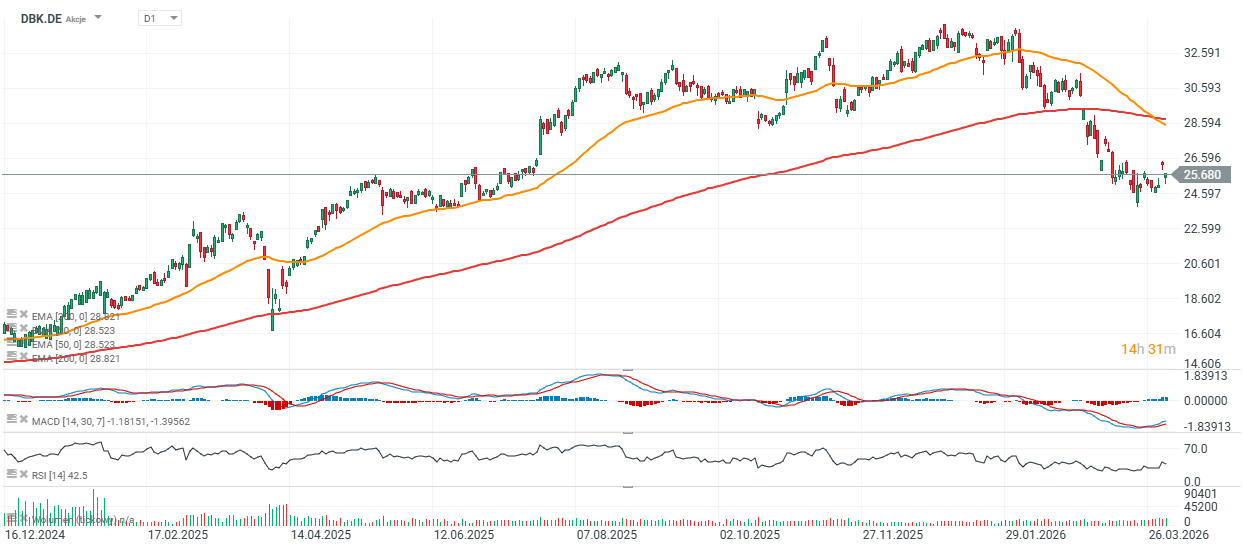
- Deutsche Bank has seen a sharp pullback from its January highs, falling from around €34 to €25. This move significantly exceeds the broader market correction and marks one of the steepest declines in recent years — close to a 30% drop.
- In April, focus will turn to the bank’s first-quarter results, scheduled for release on April 29. These figures will serve as a key test of whether Deutsche Bank can maintain the strong business momentum seen at the end of last year.
- Fundamentals remain solid for now — recent reports showed €9.7 billion in pre-tax profit, while net income doubled to €7.1 billion. Shareholder returns also remain supportive, with management announcing a €2.9 billion capital distribution plan, including €1.9 billion in dividends and €1 billion in share buybacks.
- The key question for the coming weeks is whether favorable conditions for trading and dealmaking activity will be enough to offset weaker sentiment toward the banking sector.
- The sell-off accelerated after the bank disclosed that its private credit portfolio had grown to €25.9 billion, heightening investor concerns about risks in a rapidly expanding but increasingly fragile segment.
- While Deutsche Bank emphasizes conservative underwriting standards and states it does not face significant direct risks, it acknowledges potential indirect credit risks stemming from interconnected exposures within the broader private credit ecosystem.
- At the same time, the bank’s exposure to the technology sector — including the recently underperforming software segment — has risen to €15.8 billion from €11.7 billion a year earlier, increasing sensitivity to cyclical shifts and AI-related pressures.
- Despite these warning signs, including liquidity stress in funds, loan markdowns, and tightening conditions signaled by JPMorgan — Deutsche Bank intends to continue expanding in private credit through new products, broader distribution, and integration with its private banking operations.
Source: xStation5
BASF (BAS.DE)
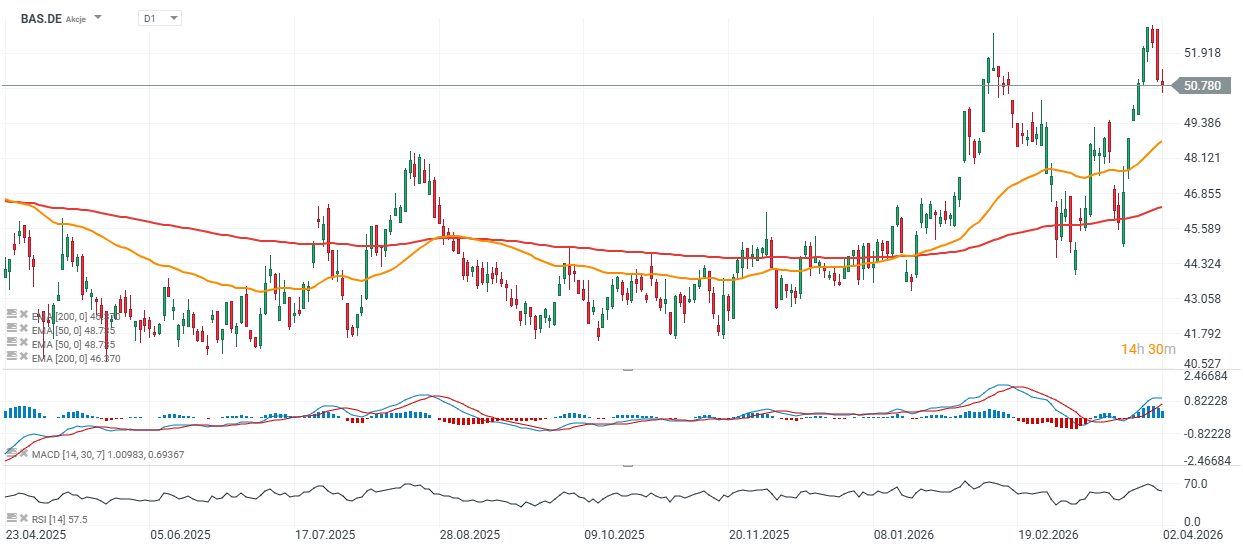
In contrast, BASF has maintained relatively strong momentum and is trading near local highs, standing out against the more volatile backdrop of the broader DAX index.
- Investors have responded positively to management’s decision to shift a significant portion of production from Germany to China, effectively reducing cost pressures in an environment of persistently high European energy prices.
- The upcoming results on April 30 will be important not only for assessing current operational performance but also for providing further insight into the company’s newly launched large-scale facility in China.
- Recent operating data showed volume growth across all segments, suggesting improving demand, although part of this effect has been offset by lower selling prices and unfavorable currency movements.
- On the bottom line, BASF is also showing improvement, with net profit increasing by €321 million to €1.6 billion. Ongoing restructuring efforts and geographic shifts are beginning to deliver tangible results.
Source: xStation5



Three Markets to Watch Next Week (09.10.2026)



Daily Summary: A Shallow Rebound Ahead of Earnings Season


Lumentum: Demand for AI infrastructure exceeds capacity


US OPEN: Trump de-escalates, OpenAI supports Wall Street sentiment
The content of this report has been created by XTB S.A., with its registered office in Warsaw, at Prosta 67, 00-838 Warsaw, Poland, (KRS number 0000217580) and supervised by Polish Supervision Authority ( No. DDM-M-4021-57-1/2005). This material is a marketing communication within the meaning of Art. 24 (3) of Directive 2014/65/EU of the European Parliament and of the Council of 15 May 2014 on markets in financial instruments and amending Directive 2002/92/EC and Directive 2011/61/EU (MiFID II). Marketing communication is not an investment recommendation or information recommending or suggesting an investment strategy within the meaning of Regulation (EU) No 596/2014 of the European Parliament and of the Council of 16 April 2014 on market abuse (market abuse regulation) and repealing Directive 2003/6/EC of the European Parliament and of the Council and Commission Directives 2003/124/EC, 2003/125/EC and 2004/72/EC and Commission Delegated Regulation (EU) 2016/958 of 9 March 2016 supplementing Regulation (EU) No 596/2014 of the European Parliament and of the Council with regard to regulatory technical standards for the technical arrangements for objective presentation of investment recommendations or other information recommending or suggesting an investment strategy and for disclosure of particular interests or indications of conflicts of interest or any other advice, including in the area of investment advisory, within the meaning of the Trading in Financial Instruments Act of 29 July 2005 (i.e. Journal of Laws 2019, item 875, as amended). The marketing communication is prepared with the highest diligence, objectivity, presents the facts known to the author on the date of preparation and is devoid of any evaluation elements. The marketing communication is prepared without considering the client’s needs, his individual financial situation and does not present any investment strategy in any way. The marketing communication does not constitute an offer of sale, offering, subscription, invitation to purchase, advertisement or promotion of any financial instruments. XTB S.A. is not liable for any client’s actions or omissions, in particular for the acquisition or disposal of financial instruments, undertaken on the basis of the information contained in this marketing communication. In the event that the marketing communication contains any information about any results regarding the financial instruments indicated therein, these do not constitute any guarantee or forecast regarding the future results.