


- Luiz Inácio Lula da Silva won Brazil's presidential election, defeating Flávio Bolsonaro in the second round.
- The Tokyo-traded Bovespa ETF fell nearly 15 percent following the unexpected election result.
- Goldman Sachs warns of a potential 10 percent rise in USDBRL under an extreme market scenario.
- Chicago soybean futures dropped to a two month low as investors anticipate stronger trade ties with China.
Luiz Inácio Lula da Silva won Sunday's second round of the presidential election in Brazil, defeating right-wing senator Flávio Bolsonaro with approx. 52% to 48% of the vote, with a margin of over 4 million votes. This is a complete reversal of voter sentiment; Lula lost the first round on October 4, becoming the first candidate since 1989 who, despite losing in the first round, ultimately won the presidency. The initial market reaction is sharp: the Bovespa index ETF traded in Tokyo fell nearly 15% in Asian trading, signaling that investors were positioned for a Bolsonaro victory.
Key Facts
- Election result: Lula wins a fourth term (though not consecutive), defeating Bolsonaro with almost all votes counted. The market priced in higher chances for Bolsonaro after the first round, so the reversal of the result in the second round surprised investors.
- Market reaction in Asia: The Tokyo ETF on Bovespa dropped by approx. 15% in thin, early trading: this is an initial signal, and the real test will come after the market opens in Brazil.
- Goldman Sachs scenario: The bank points to an extreme (non-baseline) scenario in which USDBRL could rise by as much as 10%, long-term government bond yields could jump by approx. 200 basis points, credit spreads could widen by 30–40 bps, and Brazilian equities could lose about 15%.
- Positioning as a risk factor: After the first round, markets rose, assuming a Bolsonaro victory. A large part of today's sell-off is a desire to unwind risk under positions previously taken for a Bolsonaro win, rather than a fresh assessment of Lula's policies.
- Side effect on the grain market: Soybean futures in Chicago fell to a two-month low in response to Lula's victory, which the market reads as a sign of closer relations between Brazil and China.
- Regional context: A spillover of risk to other Latin American currencies and broader EM sentiment is possible if the sell-off turns disorderly.
Market Commentary
ETFs on Brazil and Bovespa. The move seen today in Tokyo is a signal from very low volume, so it should be treated as extremely exaggerated and likely an upper bound reaction for ETFs listed in the US and Europe. However, the real test will come with the opening of the local market in Sao Paulo, where liquidity is incomparably greater. Crucial will be whether a drop around 15% holds or if fast buyers step in, hoping that the market overreacted. Goldman explicitly notes that its numbers are an extreme scenario, not a baseline forecast. It is worth emphasizing this, as headlines easily turn this nuance into a certainty.
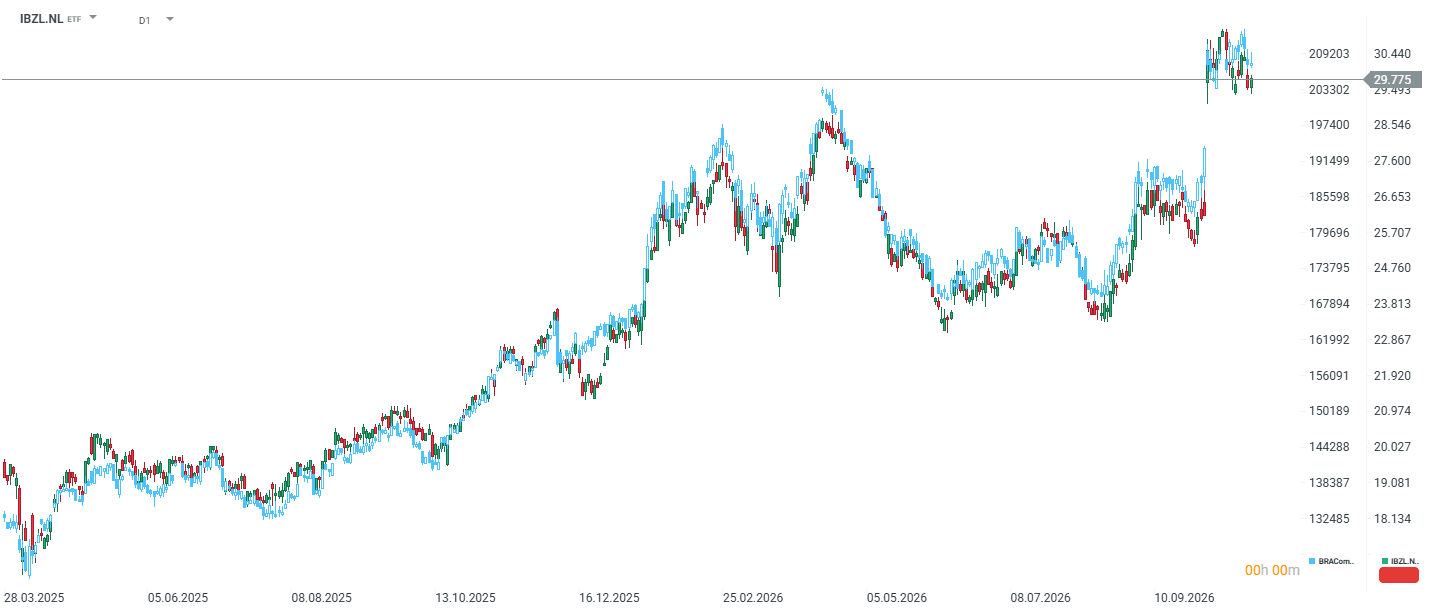 ETF on MSCI Brazil (IBZL.NL) along with the BRAComp futures contract rose significantly after the first round of elections. If both instruments were to return to levels from October 2, we face about a 10-11% drop at the opening. Source: XTB
USDBRL. The Real faces its toughest session in a long time today. A +10% scenario for the US dollar against the Real is an extreme, but even a fraction of it would mean reversing a multi-week trend of currency strengthening that the market built in anticipation of a Bolsonaro victory. For pairs with the Real, the behavior of the yield curve will also be key – if the long end indeed jumps by around 200 bps, the fiscal risk premium will return to play, a topic that will accompany the Real throughout Lula's fourth term, given his history of social spending.
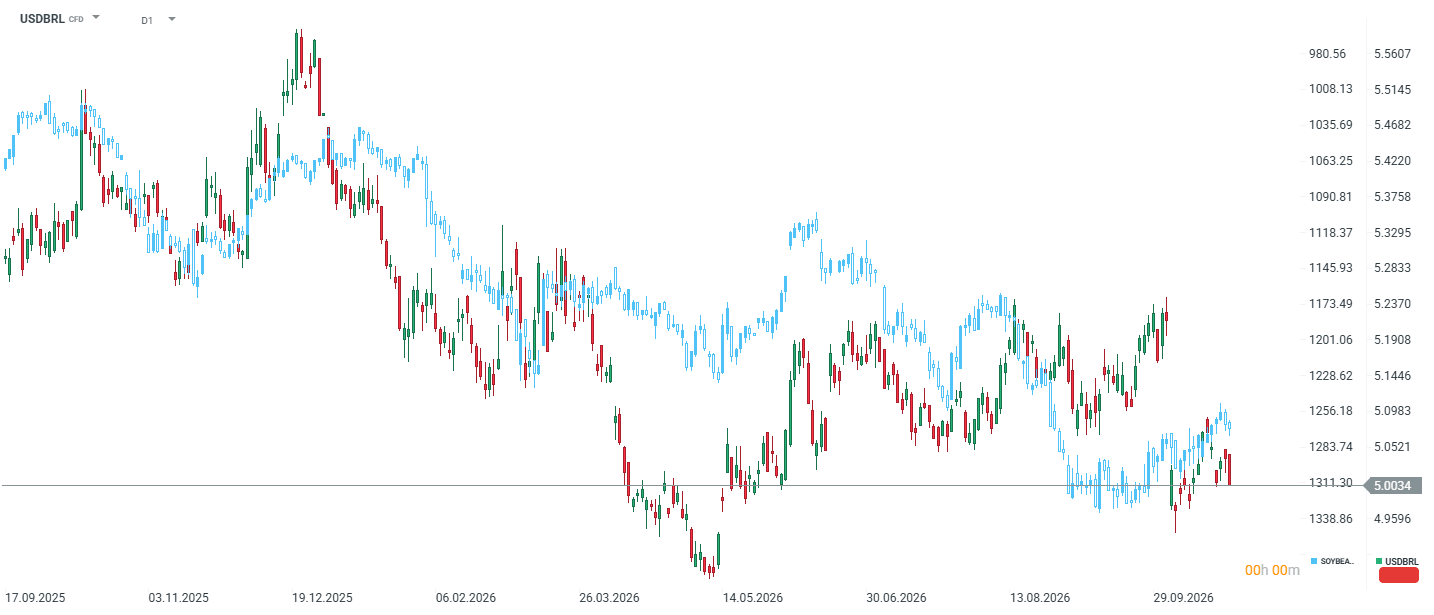 USDBRL could potentially return to around 5.2. The high correlation with soybeans indicates that soybeans could then see a drop to 1200 cents. Source: xStation5
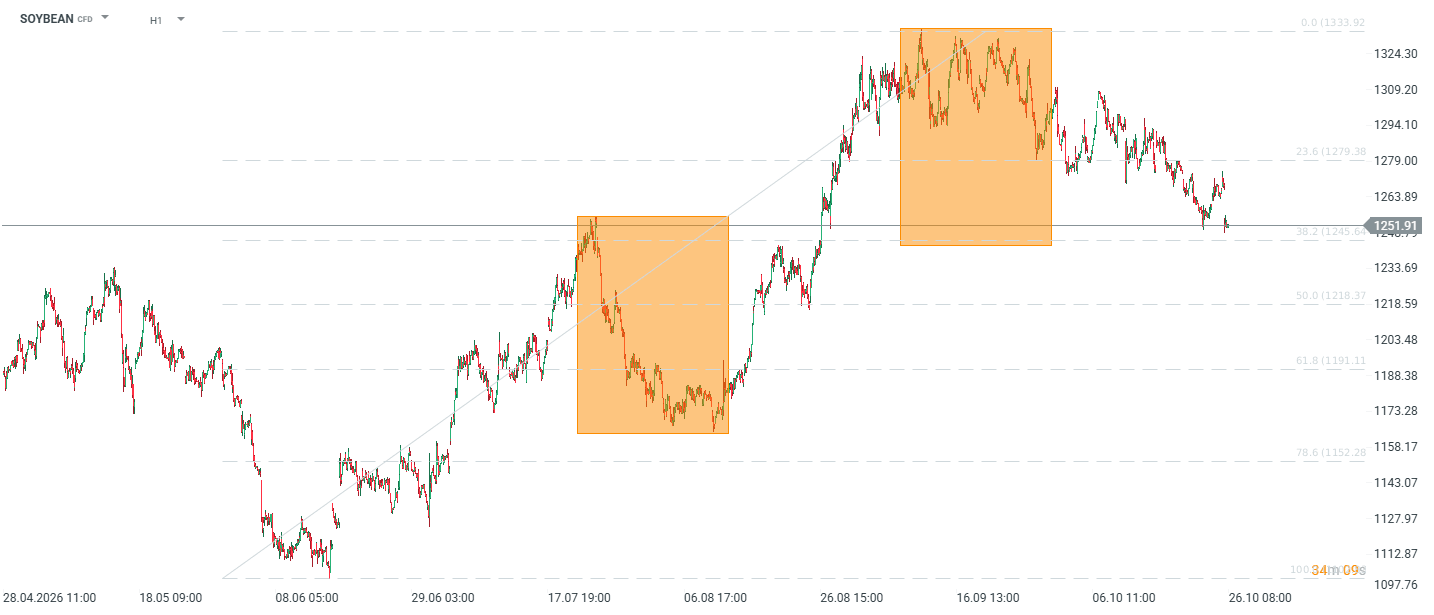
For soybeans, the market has already given an answer – Chicago contracts fell to a two-month low as investors assume Lula will deepen trade relations with China, the largest buyer of Brazilian soybeans. On one hand, this is good news for Brazilian exporters in terms of volume, but on the other hand, a weaker Real combined with a greater focus on exports to China could mean Brazil becomes an even more price-aggressive competitor for US soybeans, explaining the drop in Chicago contracts.
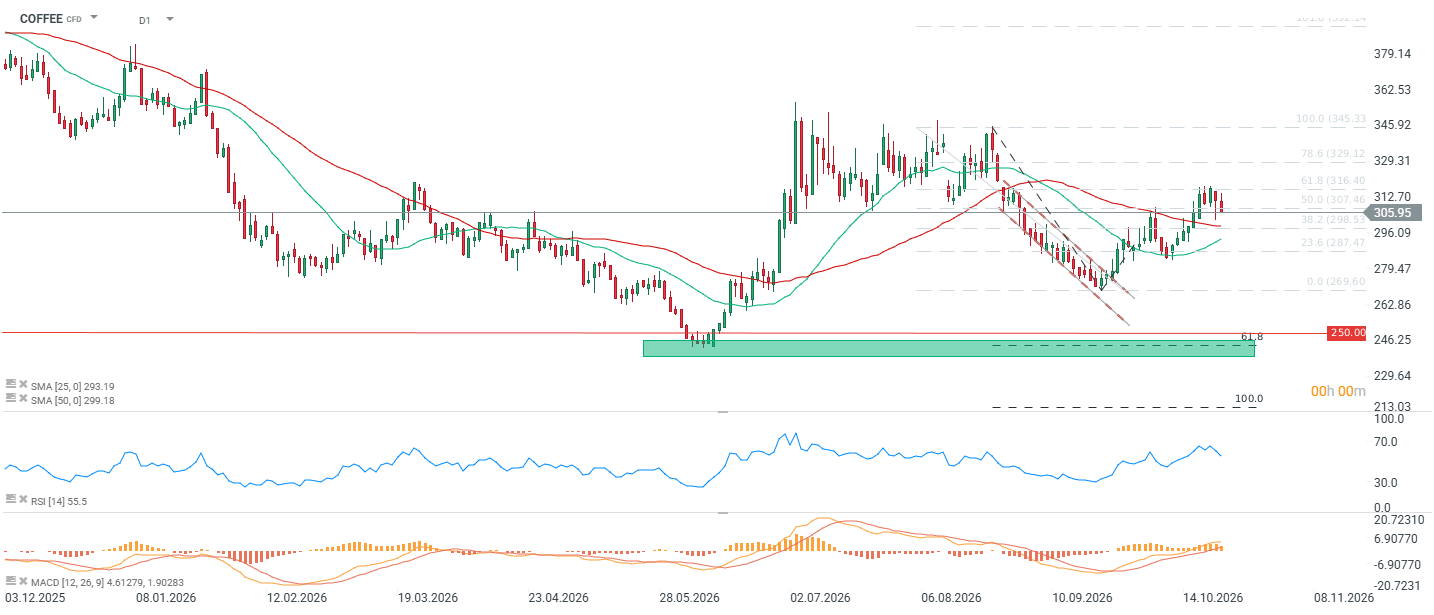
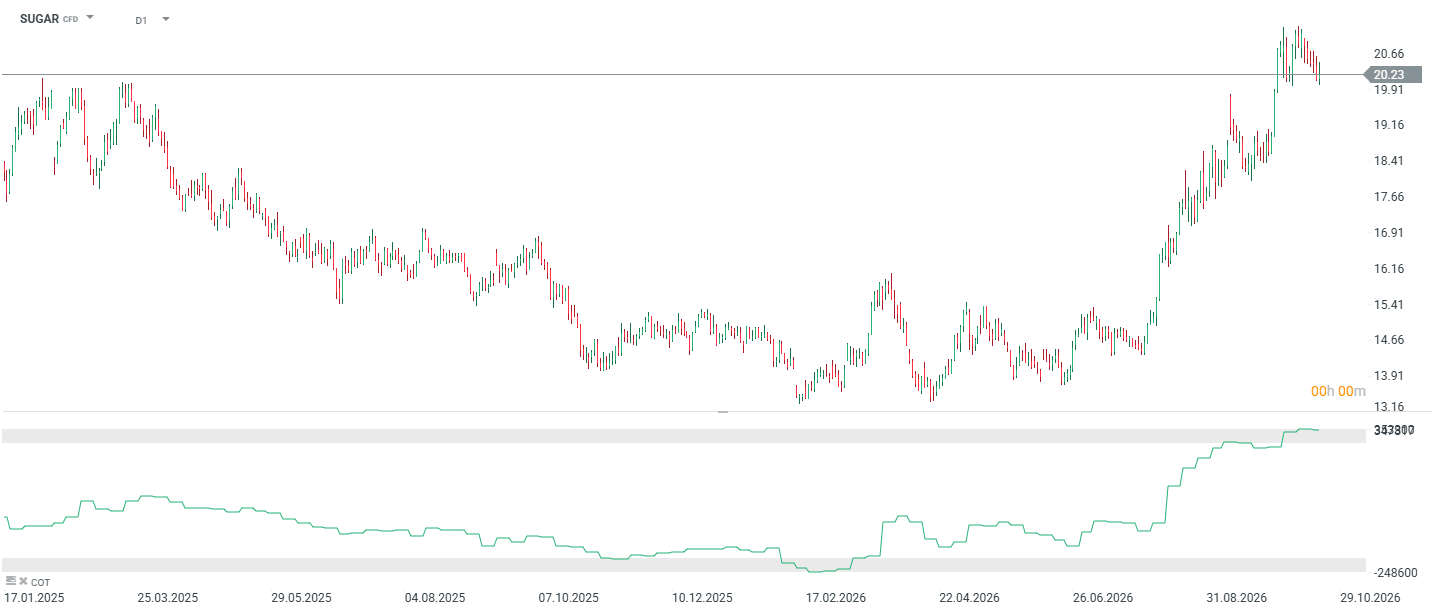
Coffee and sugar react indirectly through the currency channel. Brazil is the world's largest producer of both commodities, and a weaker Real is by definition an incentive for local producers to accelerate exports, as they receive more Reais per US dollar of revenue. Historically, such a setup—a weakening Real with unchanged supply fundamentals—acted as a drag on dollar prices of coffee and sugar due to increased selling pressure from Brazilian exporters seeking to monetize the weaker currency. However, it should be remembered that Arabica recently rose mainly due to harvest delays in Minas Gerais rather than macro factors, so the currency effect might be overshadowed by weather if rains continue to disrupt harvesting. Nevertheless, a return of coffee below 300 cents is very likely.
Sugar remains extremely overbought among speculators, but this situation is changing. There is a chance for a mild decline, though El Niño plays the main role here.
Oil and policy toward the US. This question seems most important from a broader macro portfolio perspective. Bolsonaro was undoubtedly a candidate more aligned with the Trump administration in terms of rhetoric and likely trade cooperation, so his defeat complicates the balance of power in the region at a time when Washington already has its hands full with the Middle East, Russia, and China. However, I would not expect a direct impact on the oil market. Brazil is a non-marginal and increasingly growing producer, but it is not a key supply player in the current oil crisis driven by Iran, Hormuz, and Saudi Arabia. The real risk lies elsewhere: if Lula indeed shifts Brazil closer to Beijing and further from Washington, it could affect the tone of future trade negotiations and whether Brazil will be a partner or an obstacle in US efforts to diversify supply chains away from China. This is a topic for months rather than today's session, but the market is starting to price in this uncertainty now through the lens of currency and bonds rather than oil.
Conclusion. Today's panic in Tokyo is largely an unwinding of mispositioned bets prior to the result, not an immediate new valuation of fundamentals. The real test will be the market opening in Brazil and whether investors see anything in early signals from Lula's camp that calms fiscal concerns or, on the contrary, confirms Goldman's scenario. For soybeans, coffee, and sugar, the key transmission mechanism will remain the Real's exchange rate, rather than the new president's policy directly.


Economic Calendar - German Ifo index, Middle East escalation, and Wall Street giants' earnings



🟢Morning Wrap: Lack of escalation lowers oil prices. Unexpected Lula victory hurts Brazilian stock market


Daily Summary: Oil at five-month highs, indices under pressure (23.10.2026)

BREAKING: France slows down, Germany holds on. Euro falls below 1.12
The content of this report has been created by XTB S.A., with its registered office in Warsaw, at Prosta 67, 00-838 Warsaw, Poland, (KRS number 0000217580) and supervised by Polish Supervision Authority ( No. DDM-M-4021-57-1/2005). This material is a marketing communication within the meaning of Art. 24 (3) of Directive 2014/65/EU of the European Parliament and of the Council of 15 May 2014 on markets in financial instruments and amending Directive 2002/92/EC and Directive 2011/61/EU (MiFID II). Marketing communication is not an investment recommendation or information recommending or suggesting an investment strategy within the meaning of Regulation (EU) No 596/2014 of the European Parliament and of the Council of 16 April 2014 on market abuse (market abuse regulation) and repealing Directive 2003/6/EC of the European Parliament and of the Council and Commission Directives 2003/124/EC, 2003/125/EC and 2004/72/EC and Commission Delegated Regulation (EU) 2016/958 of 9 March 2016 supplementing Regulation (EU) No 596/2014 of the European Parliament and of the Council with regard to regulatory technical standards for the technical arrangements for objective presentation of investment recommendations or other information recommending or suggesting an investment strategy and for disclosure of particular interests or indications of conflicts of interest or any other advice, including in the area of investment advisory, within the meaning of the Trading in Financial Instruments Act of 29 July 2005 (i.e. Journal of Laws 2019, item 875, as amended). The marketing communication is prepared with the highest diligence, objectivity, presents the facts known to the author on the date of preparation and is devoid of any evaluation elements. The marketing communication is prepared without considering the client’s needs, his individual financial situation and does not present any investment strategy in any way. The marketing communication does not constitute an offer of sale, offering, subscription, invitation to purchase, advertisement or promotion of any financial instruments. XTB S.A. is not liable for any client’s actions or omissions, in particular for the acquisition or disposal of financial instruments, undertaken on the basis of the information contained in this marketing communication. In the event that the marketing communication contains any information about any results regarding the financial instruments indicated therein, these do not constitute any guarantee or forecast regarding the future results.