


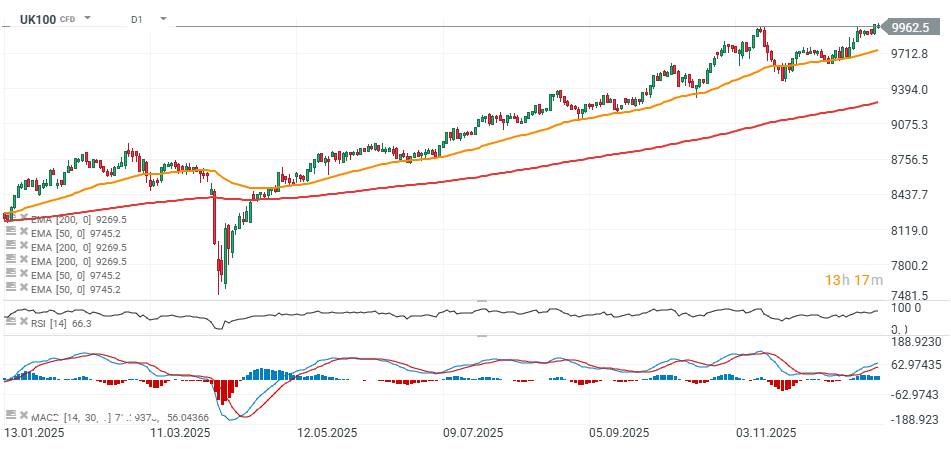
UK FTSE100 index hit historic high yesterday, driven by mining and metals sectors and aerospace & defense. London stocks are slightly lower today, with the FTSE 100 expected to give back a small portion of its strong year-to-date run after hitting fresh records on Tuesday 30 December. The rally in 2025 has been powerful. The FTSE 100 is up roughly 22% year-to-date, following a more modest appx. 5% gain in 2024.
-
Precious metal miners have been standout winners, led by Fresnillo, which is up roughly five-fold this year on the back of surging commodity prices. Fresnillo also hit a record high on Tuesday, underscoring how dominant the metals theme has been.
-
Aerospace and defence stocks have enjoyed a strong year, with Babcock and Rolls-Royce roughly doubling and BAE Systems up around 50%. The sector remains supported by broader geopolitical trends and rising defence spending.
-
UK banks have also contributed significantly to performance: LLoyds and Barclays gained almost 80% while Standard Chartered and HSBC gained 85% and 50% respectively
Will FTSE100 outperform UK mid and small stocks?
-
2026 is increasingly looking like another year where the FTSE 100 beats the FTSE 250. The large-cap index has the wind at its back, while UK-focused mid-caps face a tougher domestic backdrop.
-
The performance gap is already massive. Over the last five years, the FTSE 100 is up roughly 50%, around five times more than the FTSE 250.
-
The “UK reopening” story that helped the FTSE 250 in 2021 is gone, back then, the domestically-driven index benefited from post-lockdown momentum — but heading into 2026, there’s no similar feel-good catalyst.
-
Both indices show similar earnings growth expectations (~9%), but the risk profile isn’t equal, the FTSE 250 looks more exposed to earnings downgrades given signs of weakness in the UK economy.
-
UK consumer data is a warning signal; Barclays data suggests UK households are entering 2026 on a weaker footing, which doesn’t bode well for the more domestic FTSE 250.
-
The FTSE 100’s structure is simply more attractive right now; it leans more international and defensive (with sectors like health care), which tends to hold up better when economic momentum softens.
-
Even for mid-cap exposure, the FTSE 250 doesn’t stack up well versus Europe, the index lags European peers in expected earnings growth next year.
-
Bloomberg Intelligence expects FTSE 100 earnings momentum to stay stronger than the Stoxx 600, which strenghthens the case for large-cap UK exposure vs broader Europe.
-
Mining exposure is a major wildcard advantage for the FTSE 100, and if metals keep rallying, FTSE 100 names may benefit disproportionately. Fresnillo has already surged ~450% year-to-date, underlining how powerful this theme can be.
-
Rising global defense spending continues to favor names like BAE Systems and Rolls-Royce, adding structural support to the FTSE 100.
-
Limited room for BOE cuts is a tailwind for FTSE 100 banks. That setup tends to favor bank-heavy exposure, while it works against the FTSE 250’s heavier weighting in interest-rate-sensitive real estate.
UK100 (D1 interval)
Source: xStation5



Daily Summary: New Records on Wall Street. Markets Await the New Earnings Season

S&P 500 Hits New Record High



US Open: Wall Street Pushes Back Expectations of Another Fed Hike

US trade deficit larger than expected 🗽 US indices hit all-time high
The content of this report has been created by XTB S.A., with its registered office in Warsaw, at Prosta 67, 00-838 Warsaw, Poland, (KRS number 0000217580) and supervised by Polish Supervision Authority ( No. DDM-M-4021-57-1/2005). This material is a marketing communication within the meaning of Art. 24 (3) of Directive 2014/65/EU of the European Parliament and of the Council of 15 May 2014 on markets in financial instruments and amending Directive 2002/92/EC and Directive 2011/61/EU (MiFID II). Marketing communication is not an investment recommendation or information recommending or suggesting an investment strategy within the meaning of Regulation (EU) No 596/2014 of the European Parliament and of the Council of 16 April 2014 on market abuse (market abuse regulation) and repealing Directive 2003/6/EC of the European Parliament and of the Council and Commission Directives 2003/124/EC, 2003/125/EC and 2004/72/EC and Commission Delegated Regulation (EU) 2016/958 of 9 March 2016 supplementing Regulation (EU) No 596/2014 of the European Parliament and of the Council with regard to regulatory technical standards for the technical arrangements for objective presentation of investment recommendations or other information recommending or suggesting an investment strategy and for disclosure of particular interests or indications of conflicts of interest or any other advice, including in the area of investment advisory, within the meaning of the Trading in Financial Instruments Act of 29 July 2005 (i.e. Journal of Laws 2019, item 875, as amended). The marketing communication is prepared with the highest diligence, objectivity, presents the facts known to the author on the date of preparation and is devoid of any evaluation elements. The marketing communication is prepared without considering the client’s needs, his individual financial situation and does not present any investment strategy in any way. The marketing communication does not constitute an offer of sale, offering, subscription, invitation to purchase, advertisement or promotion of any financial instruments. XTB S.A. is not liable for any client’s actions or omissions, in particular for the acquisition or disposal of financial instruments, undertaken on the basis of the information contained in this marketing communication. In the event that the marketing communication contains any information about any results regarding the financial instruments indicated therein, these do not constitute any guarantee or forecast regarding the future results.