


Diplomatic communications, media reports, and independent analyses indicate that an escalation of the conflict between the United States and Iran is highly likely.
Iran’s geography is one of its greatest, if not its greatest, strengths. But it also creates a number of vulnerabilities. The vulnerability with the largest implications for the conflict, and the one that offers the United States the best gain-to-risk ratio, is Kharg Island.
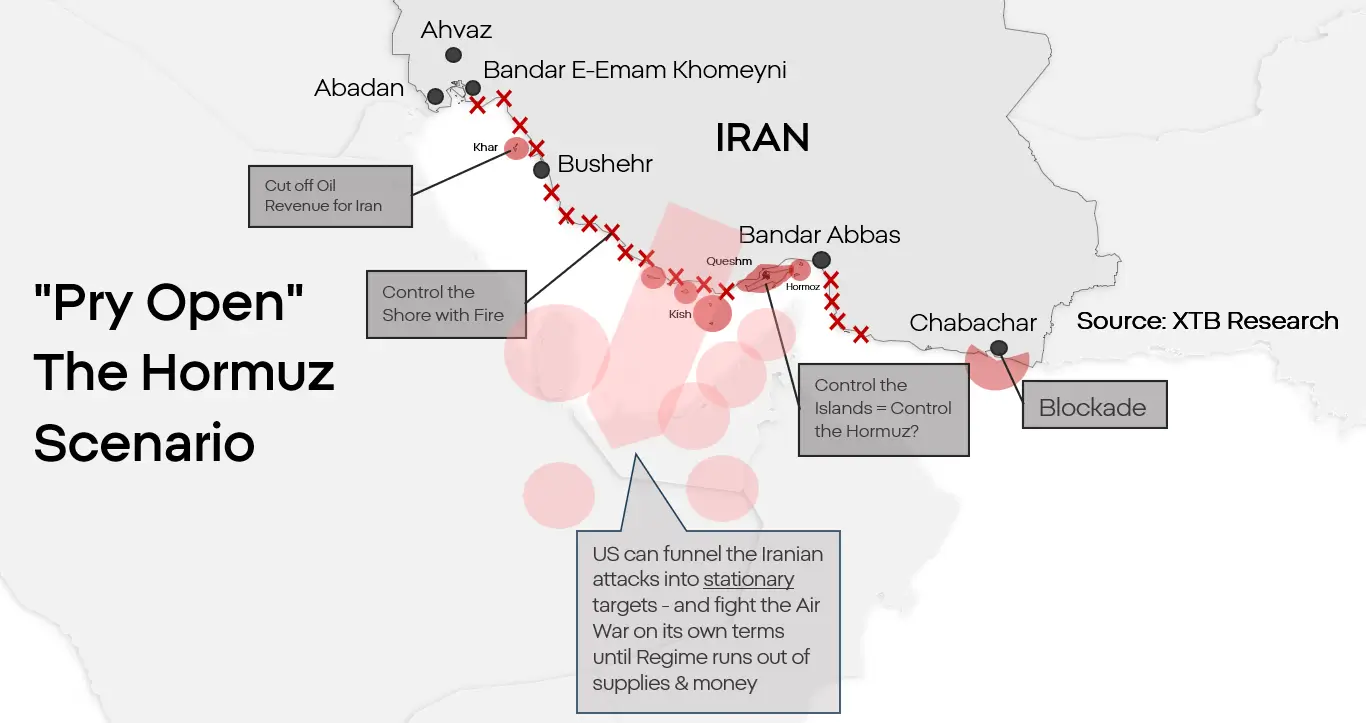
This island, located about 30 kilometers off Iran’s coast, is its Achilles’ heel. Iran’s coastline is sparsely populated and poorly organized, but this is not a matter of choice, it is a matter of constraints. Iran’s coastal waters are too shallow for the mega tankers that form the backbone of the global economy to dock in Iranian ports.
Under these conditions, Iran is forced to transport its oil to a port on an island where tankers can pick it up. The island is small, only 8 square kilometers, about 2.5 times the size of Central Park in New York City. Despite its size, it handles 90% of Iran’s oil exports.
Realistically, if the United States wanted to make Iran’s leadership understand how unfavorable their military position is, it could seize the island. Even if U.S. losses are possible, it is not possible for Iran to repel a determined U.S. amphibious landing.
This matters because oil exports are one of the last lifelines of the Iranian economy. While a wartime economy can function much longer than most suspect, it is important to remember:
- Iran is a desert; the balance of available food and water has been on the edge of a humanitarian crisis for years and is gradually worsening.
- Iran’s industry is dispersed, inefficient, and neglected; it requires inputs from abroad.
- Iran has been operating under a wartime economic regime not for a year or two, but in practice since the 1970s.
A real threat still hangs over Iran: the loss of water and power infrastructure. Here, too, Iran is powerless against U.S. air power, and the destruction of already strained infrastructure in a desert country of 90 million citizens would have apocalyptic consequences.
After such a move, the United States might no longer have anyone left to negotiate with, but that is a last resort.
Leading indicators
Despite the chaotic nature of decision-making in Washington and Tehran, there are a number of qualitative signals that suggest the likelihood of escalation is increasing.:
- It is worth remembering that the United States has not withdrawn a large portion of its military assets from the Persian Gulf region, despite ceasefire arrangements. There is a significant probability that both sides, at the moment of signing the agreement, were calculating a convenient moment to break it.
- On July 10, Trump officially called the campaign in Iran a war and asked Congress for support. This clearly points to the long-term nature of the conflict.
- U.S. attacks are no longer focused solely on IRGC facilities. There have also been many strikes on Iran’s regular military, the Artesh. This indicates that this is no longer an operation to change the government using Iranians, but a long-term campaign aimed at degrading the Islamic Republic’s ability to project power.
Effects
The math is, at least superficially, simple:
- About 25% of the supply of refined petroleum products came from the Persian Gulf region.
- The Strait of Hormuz, which is currently blocked, handled about 75% of the total volume.
- The blockade is not airtight; depending on circumstances, about 5 to 15% of the pre-war volume gets through the strait.
- This implies a reduction in global oil supply of about 16 to 18%. That would correspond fairly well to the roughly $72 per barrel level from late June and early July, an increase of about 18% compared with around $60 per barrel in December 2025.
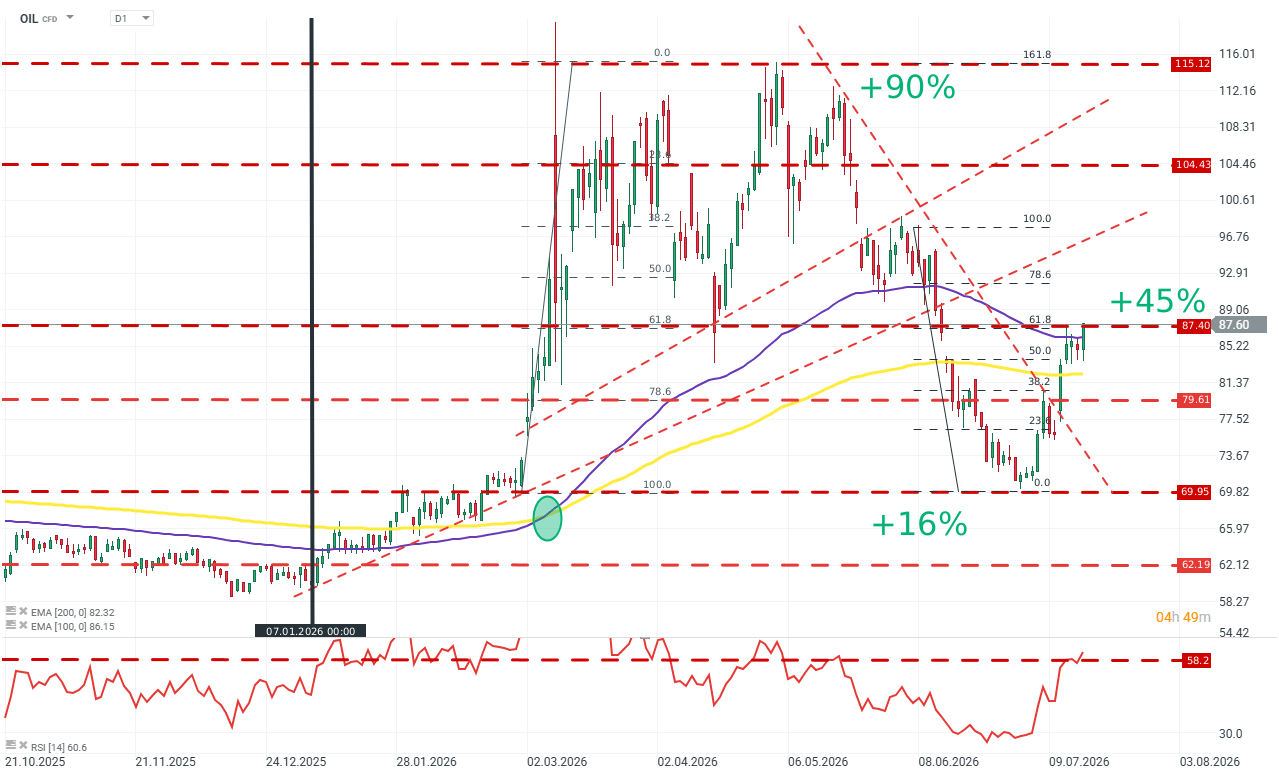
The gradual release of reserves by (mainly) the United States and China would be enough to prevent an explosion in inflation, but the problem today is different.
What the global economy lacks most is not crude oil but fuel. There are currently no gasoline and diesel inventories large enough to suppress price increases over the long term in the face of a supply shock, and worse, refining capacity in the United States and Europe is currently too limited. The undeniable proof is the so-called crack spread at the highest level in recorded history.
What does all this mean?
- The price of oil already reflects significant, but not total, escalation.
- Gasoline prices do not reflect the tightness in the refined products market.
- The decline in inflation may prove temporary, and the next wave of increases may be delayed.
Kamil Szczepański
Financial Market Analyst at XTB


Market Wrap: A 4% surge in oil prices weighs on indices (08.10.2026)


Market Wrap: Oil rises again, French fiscal concerns weigh on euro (07.10.2026)

Oil falls below $100🚨
💶Chart of the Day: EURUSD at Lowest Since May 2025 Amid French Fiscal Crisis
The content of this report has been created by XTB S.A., with its registered office in Warsaw, at Prosta 67, 00-838 Warsaw, Poland, (KRS number 0000217580) and supervised by Polish Supervision Authority ( No. DDM-M-4021-57-1/2005). This material is a marketing communication within the meaning of Art. 24 (3) of Directive 2014/65/EU of the European Parliament and of the Council of 15 May 2014 on markets in financial instruments and amending Directive 2002/92/EC and Directive 2011/61/EU (MiFID II). Marketing communication is not an investment recommendation or information recommending or suggesting an investment strategy within the meaning of Regulation (EU) No 596/2014 of the European Parliament and of the Council of 16 April 2014 on market abuse (market abuse regulation) and repealing Directive 2003/6/EC of the European Parliament and of the Council and Commission Directives 2003/124/EC, 2003/125/EC and 2004/72/EC and Commission Delegated Regulation (EU) 2016/958 of 9 March 2016 supplementing Regulation (EU) No 596/2014 of the European Parliament and of the Council with regard to regulatory technical standards for the technical arrangements for objective presentation of investment recommendations or other information recommending or suggesting an investment strategy and for disclosure of particular interests or indications of conflicts of interest or any other advice, including in the area of investment advisory, within the meaning of the Trading in Financial Instruments Act of 29 July 2005 (i.e. Journal of Laws 2019, item 875, as amended). The marketing communication is prepared with the highest diligence, objectivity, presents the facts known to the author on the date of preparation and is devoid of any evaluation elements. The marketing communication is prepared without considering the client’s needs, his individual financial situation and does not present any investment strategy in any way. The marketing communication does not constitute an offer of sale, offering, subscription, invitation to purchase, advertisement or promotion of any financial instruments. XTB S.A. is not liable for any client’s actions or omissions, in particular for the acquisition or disposal of financial instruments, undertaken on the basis of the information contained in this marketing communication. In the event that the marketing communication contains any information about any results regarding the financial instruments indicated therein, these do not constitute any guarantee or forecast regarding the future results.