



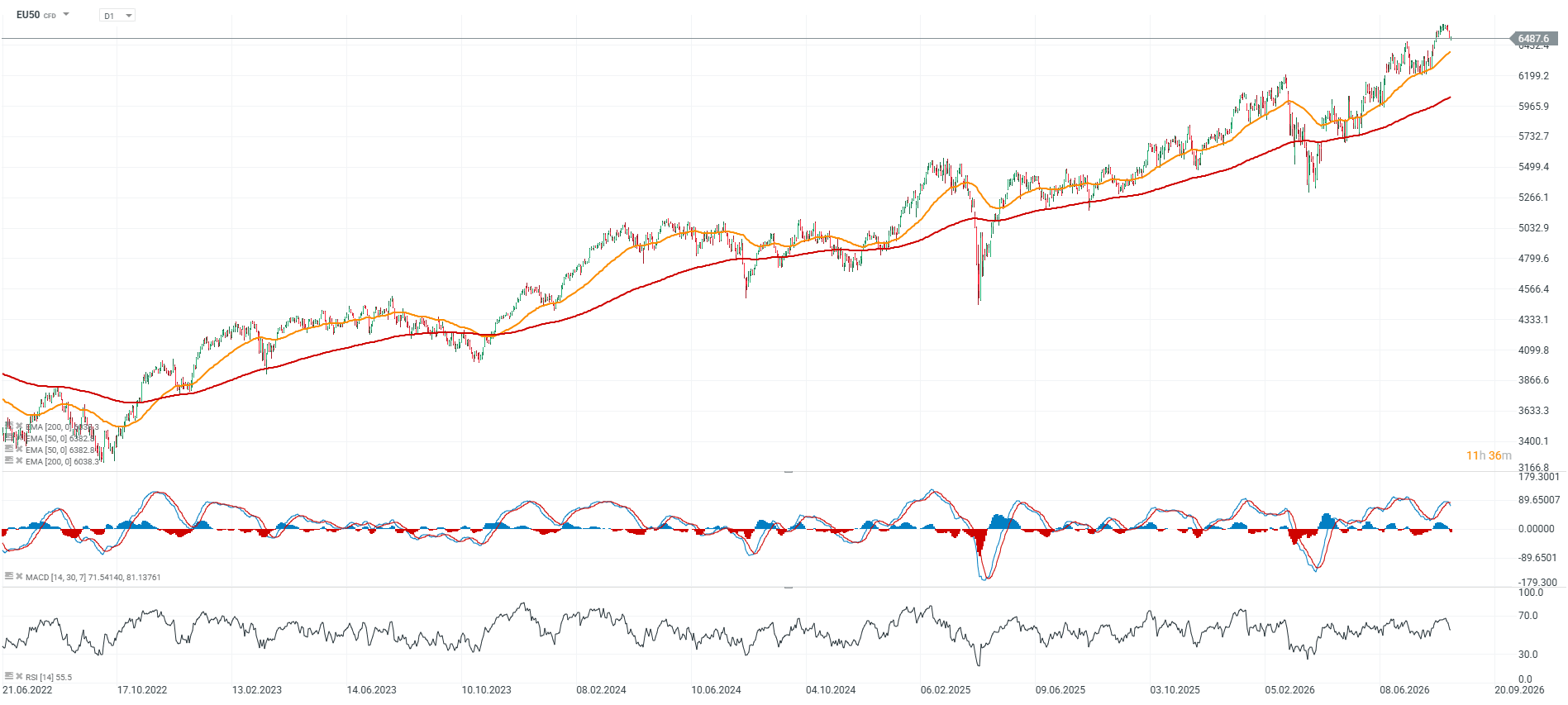
European equities are trying to stabilize after Tuesday’s sharp sell-off, but there is still little sign of a convincing rebound. The Stoxx Europe 600 remains close to a two-week low, while the Euro Stoxx 50 is trading broadly flat as investors digest the simultaneous rise in bond yields, oil prices and geopolitical tensions in the Persian Gulf. The main problem for equities is straightforward: higher risk-free rates raise the cost of capital and make stocks less attractive relative to bonds. At the same time, inflation concerns are returning, while markets are increasingly pricing in an ECB rate hike as early as September.
- The Stoxx Europe 600 is little changed and remains close to a two-week low after its steepest one-day decline in almost a month.
- The DAX is down around 0.2%, the CAC 40 is up 0.2%, while the FTSE 100 and IBEX 35 are hovering near flat.
- The yield on the 10-year German Bund has risen to 3.22%, its highest level since May 2011, increasing pressure on equity valuations.
- Growth-sensitive sectors such as technology, software and real estate remain particularly vulnerable to higher discount rates.
- ECB Chief Economist Philip Lane stressed that Eurozone inflation of around 3% remains clearly above the 2% target, while higher energy prices could reignite price pressures.
- Money markets are now close to fully pricing in a 25 bp ECB rate hike in September, a major shift from earlier expectations of an extended pause.
- Investor attention is focused on comments from Christine Lagarde and the minutes from the Fed’s July meeting, both of which could influence the next move in bonds, currencies and equities.
- Wall Street futures are trading slightly lower, while Brent crude futures (OIL) have moved above USD 92 per barrel.
- Brent crude remains close to three-week highs, while disruption to shipping through the Strait of Hormuz continues to support the energy risk premium.
EU50 chart (D1 interval)
 Source: xStation5
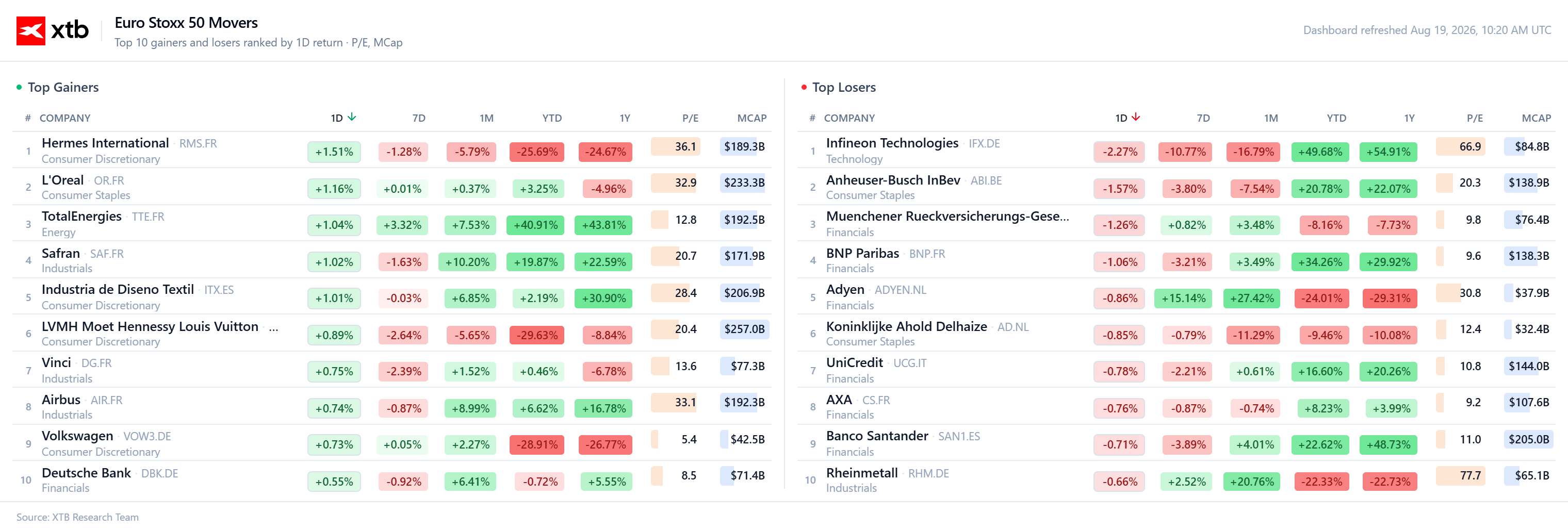
Today’s session in the Euro Stoxx 50 is showing a clear sector rotation rather than a uniform risk-on or risk-off move. On the upside, consumer and industrial names are standing out, led by Hermès (+1.5%), which can be read as a return of capital to high-quality brands after earlier weakness, although still at demanding multiples such as a P/E of around 36. L’Oréal (+1%) is also higher, but here too the market is clearly paying a premium for a defensive profile and earnings stability rather than for a cheap valuation. TotalEnergies (+1.04%) looks fundamentally different: with a P/E of 12.8x and a very strong YTD return, investors continue to reward energy exposure, particularly in an environment of elevated oil prices.
On the downside, Infineon is the weakest performer (-2.2%), even though the stock remains close to +50% YTD, suggesting profit-taking and pressure on an expensive semiconductor segment rather than a clear change in the long-term story. Weakness across banks and insurers — BNP Paribas, Munich Re, UniCredit, AXA and Santander — shows that the market is becoming more cautious toward financials after their strong performance this year. Rheinmetall is also noteworthy, down around 0.66% on the day while still more than 20% higher over one month; at a P/E of around 77, it remains one of the most demanding valuations in the index. Overall, the market is not rejecting European equities outright, but it is becoming increasingly selective on balance-sheet quality, durability of growth and valuation.
Source: XTB Research
European equities remain under pressure from bond yields
The biggest headwind for European equities remains the sharp rise in bond yields. The German 10-year Bund yield has climbed to 3.22%, its highest level since 2011, while the yield on 30-year U.S. Treasuries has moved above 5.30%.
This directly raises the discount rate applied to future cash flows, meaning companies with high growth expectations and profits further out in time are being hit hardest. At the same time, bonds are becoming increasingly competitive with equities, particularly where the equity risk premium starts to look less attractive.
Oil is complicating the ECB’s job again
Energy is the second key issue. Brent remains near USD 91.50 per barrel, while tensions in the Persian Gulf and disruption to shipping through the Strait of Hormuz increase the risk of further upside in crude prices.
This is particularly uncomfortable for the ECB because Eurozone inflation is still around 3%. Philip Lane noted that this remains too high relative to the 2% target, while more expensive oil could once again increase inflationary pressure.
As a result, the market has clearly shifted its monetary-policy expectations. Instead of assuming a prolonged period of unchanged rates, investors are now close to fully pricing in a 25 bp hike at the ECB’s September meeting.
Lagarde and the Fed minutes are key today
The next catalyst for markets may come from comments by Christine Lagarde. Investors will be looking for clues on whether the ECB is genuinely preparing the market for another rate hike despite weakening economic momentum.
At the same time, the minutes from the Fed’s July meeting will be released. Markets will focus on how concerned FOMC members were about weakening labour-market conditions even before the latest rise in long-term bond yields.
The setup for European equities therefore remains tense: higher yields are limiting valuations, oil is increasing inflation risk, and central banks may be forced to maintain a more restrictive stance than markets had expected only recently. For now, today’s stabilization looks more like a pause in the sell-off than the start of a convincing rebound.
DAX under pressure from high bond yields
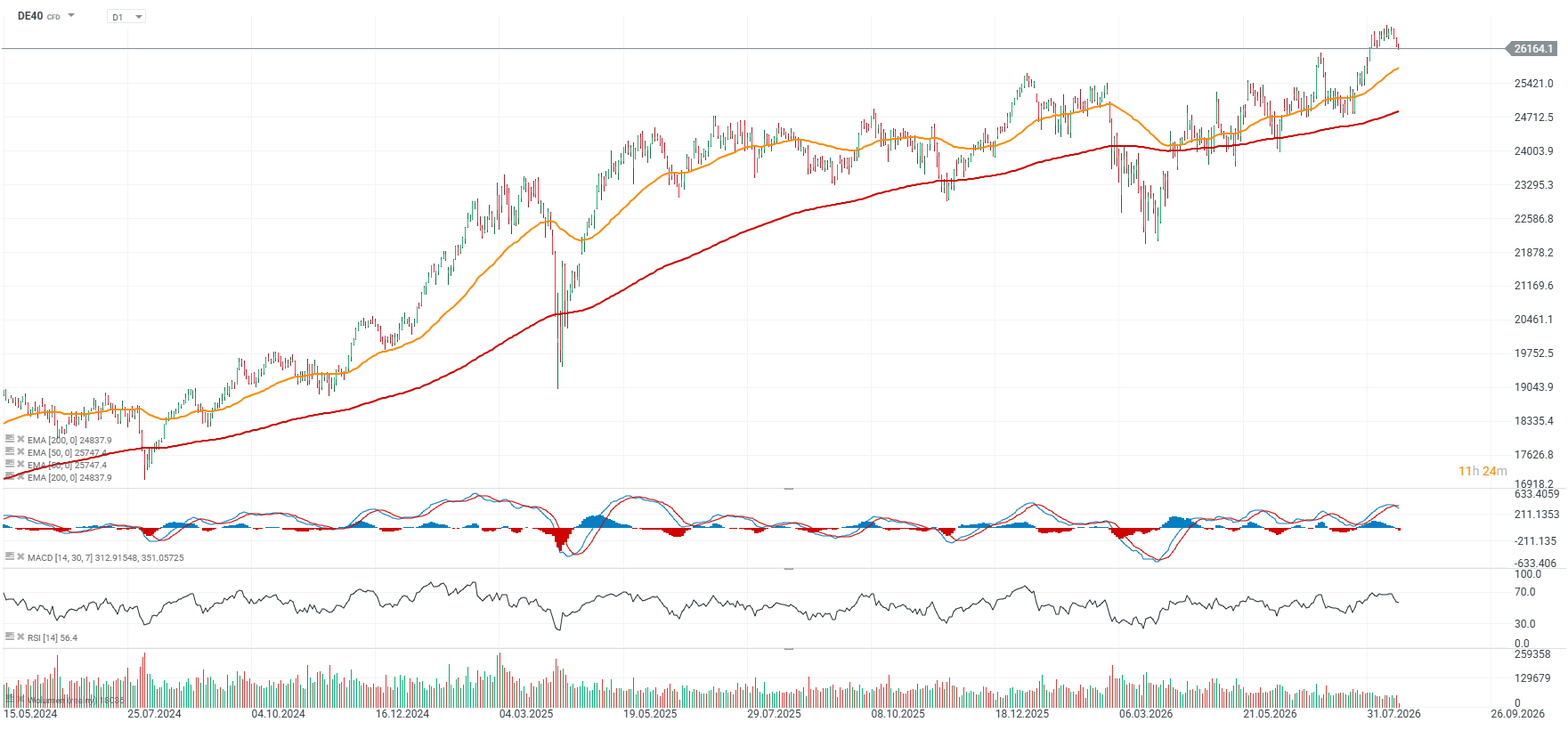
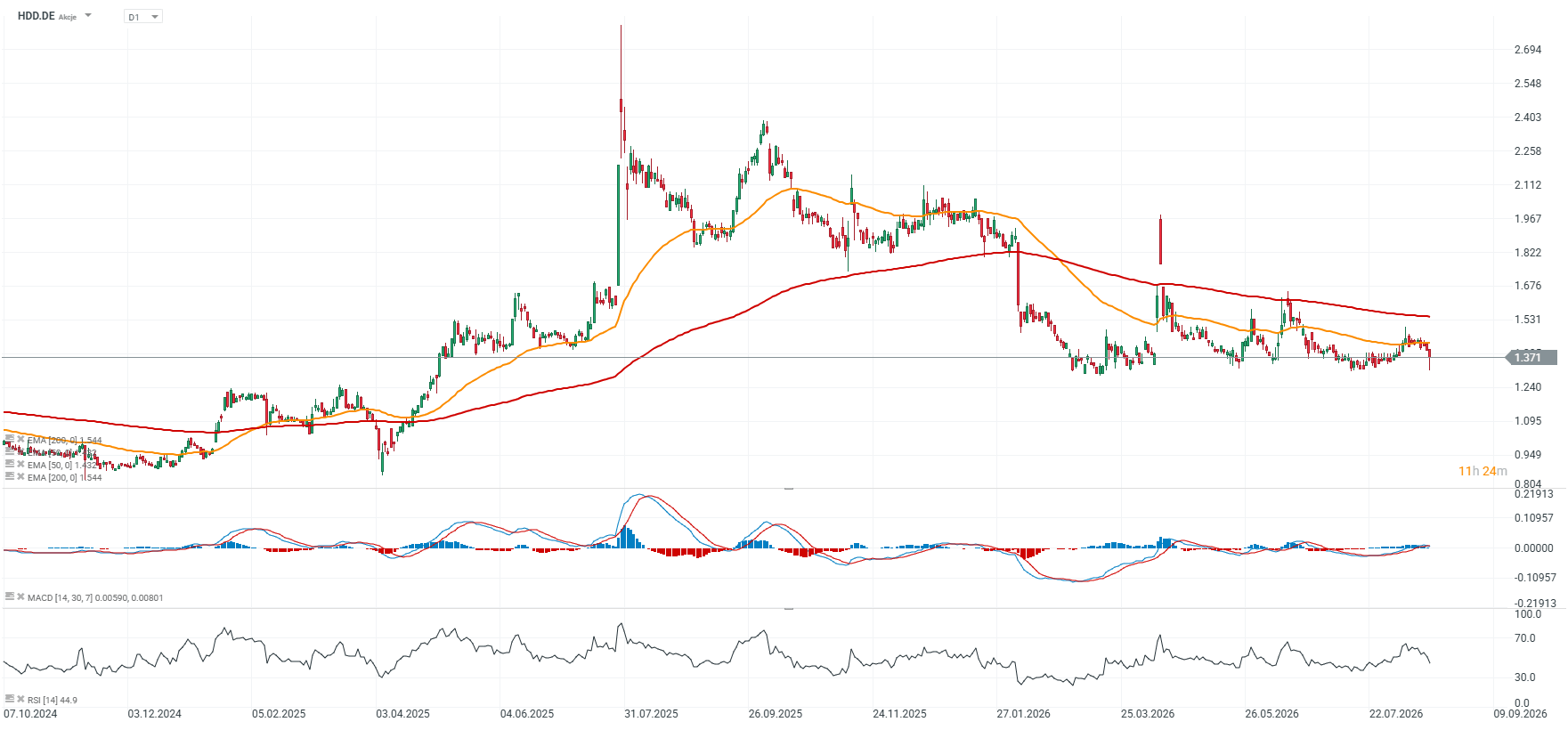
The sell-off in the global bond market has slowed somewhat, but its impact on European equities remains visible. The DAX opened Wednesday around 26,140 points, little changed, although elevated bond yields continue to be an important constraint on valuations. On Tuesday, yields on key government bonds in the U.S., Germany and Japan climbed to multi-year highs, driven by inflation concerns, high oil prices and rising debt burdens in major economies. Such an environment does not necessarily trigger a broad equity exodus, but it does limit investors’ willingness to pay high multiples for riskier assets. Pressure is also visible at the single-stock level, with Heidelberger Druck shares falling around 5.5% after a weak quarter in which the company’s net loss widened to EUR 32 million from EUR 11 million a year earlier, partly due to the expiry of a subsidy program in Italy.
Heidelberger Druck shares (HDD.DE, D1 interval)
 Source: xStation5
Heidelberger under pressure after results as sales fall by double digits
Heidelberger Druckmaschinen delivered a clearly weaker first quarter operationally. Sales fell 13% to EUR 404 million from EUR 466 million a year earlier, while adjusted EBITDA dropped to just EUR 1 million from EUR 20 million, resulting in a margin of 0.2% versus 4.4% a year earlier. The main problem was lower volume, particularly in Print & Packaging Equipment, after the expiry of Italy’s subsidy program, which the company said accounted for more than EUR 60 million of lower orders. Still, the picture is not uniformly negative: the order backlog increased to EUR 762 million from EUR 639 million at the start of the fiscal year, improving visibility for the coming quarters. Management reaffirmed its 2026/2027 outlook and still expects broadly stable sales and a meaningful improvement in EBITDA margin.
Margins were hit by volume, not by a breakdown in the business model
The most important takeaway is that the deterioration in profitability was driven mainly by lower volumes rather than by a structural decline in product margins. The company actually pointed to improved relative margins thanks to higher pricing, customs-duty refunds and a more favorable product mix. Heidelberg is also continuing its cost-cutting measures: headcount fell 2% year over year to 9,019 employees, while personnel costs declined to EUR 196 million from EUR 208 million.
Regionally, EMEA was the weakest area, with order intake down 16% and sales down 23%. Asia-Pacific performed much better, with orders up 17% and sales up 3%, driven mainly by China. This suggests that the first-quarter weakness was geographically concentrated and partly related to one-off effects rather than a broad collapse in global demand.
Cash flow remains the biggest risk
The weaker operating result had a clear impact on cash generation. Free cash flow came in at negative EUR 77 million versus negative EUR 68 million a year earlier, while operating cash flow fell to negative EUR 55 million. The company ended the quarter with a net loss of EUR 32 million, compared with a loss of EUR 11 million a year earlier.
The balance sheet also weakened. Net financial position moved from EUR 39 million of net cash to EUR 39 million of net debt, while the equity ratio declined to 24.3% from 27.2%. Heidelberg still has a meaningful liquidity buffer, however, with EUR 298 million of its EUR 436 million revolving credit facility remaining undrawn. Management expects cash outflows to ease in the coming quarters but still sees negative free cash flow for the full year because of planned investments.
The strategy still aims to improve the quality of the business
Heidelberg is not changing its strategic direction despite the weak start to the year. The acquisitions of Manroland Sheetfed and POLAR are intended to increase the share of recurring service and spare-parts revenue and strengthen the company’s position as a production-system integrator for the packaging industry.
Manroland is expected to add a mid-double-digit million-euro amount to sales already this year, while after full integration Heidelberg is targeting more than EUR 100 million in stable annual revenue and EUR 10–15 million in EBIT. At the same time, the company is expanding beyond traditional printing into areas such as defense, energy storage and e-mobility.
Fundamentally, the first quarter was weak, but the key question is whether the backlog can translate into a normalization of sales and margins in the coming periods. If it does, the current results may prove to be a local operating low. If volume recovery is delayed, however, negative free cash flow and the weaker balance sheet could become much more important for the company’s valuation.
Heidelberger Druck shares (HDD.DE, D1 interval)
 Source: xStation5


Daily Summary: SpaceX and the tech sector drive Wall Street, oil retreats sharply below $97


US OPEN: Preparations for Tesla's mega-merger with SpaceX. Diplomatic stalemate with Iran cools Wall Street's enthusiasm


RBA turns increasingly hawkish as markets reprice November rate hike expectations ⚔️


Daily Summary: Buyers Refuse to Give In
The content of this report has been created by XTB S.A., with its registered office in Warsaw, at Prosta 67, 00-838 Warsaw, Poland, (KRS number 0000217580) and supervised by Polish Supervision Authority ( No. DDM-M-4021-57-1/2005). This material is a marketing communication within the meaning of Art. 24 (3) of Directive 2014/65/EU of the European Parliament and of the Council of 15 May 2014 on markets in financial instruments and amending Directive 2002/92/EC and Directive 2011/61/EU (MiFID II). Marketing communication is not an investment recommendation or information recommending or suggesting an investment strategy within the meaning of Regulation (EU) No 596/2014 of the European Parliament and of the Council of 16 April 2014 on market abuse (market abuse regulation) and repealing Directive 2003/6/EC of the European Parliament and of the Council and Commission Directives 2003/124/EC, 2003/125/EC and 2004/72/EC and Commission Delegated Regulation (EU) 2016/958 of 9 March 2016 supplementing Regulation (EU) No 596/2014 of the European Parliament and of the Council with regard to regulatory technical standards for the technical arrangements for objective presentation of investment recommendations or other information recommending or suggesting an investment strategy and for disclosure of particular interests or indications of conflicts of interest or any other advice, including in the area of investment advisory, within the meaning of the Trading in Financial Instruments Act of 29 July 2005 (i.e. Journal of Laws 2019, item 875, as amended). The marketing communication is prepared with the highest diligence, objectivity, presents the facts known to the author on the date of preparation and is devoid of any evaluation elements. The marketing communication is prepared without considering the client’s needs, his individual financial situation and does not present any investment strategy in any way. The marketing communication does not constitute an offer of sale, offering, subscription, invitation to purchase, advertisement or promotion of any financial instruments. XTB S.A. is not liable for any client’s actions or omissions, in particular for the acquisition or disposal of financial instruments, undertaken on the basis of the information contained in this marketing communication. In the event that the marketing communication contains any information about any results regarding the financial instruments indicated therein, these do not constitute any guarantee or forecast regarding the future results.