



Major European indices are rebounding today following yesterday’s sharpest one-day fall in two weeks, with investors seeking support from strong corporate results and trying to gauge the impact of higher oil prices on monetary policy. The pan-European STOXX 600 is up by around 0.5% to 642.62 points, whilst the German DAX is gaining after SAP jumped by more than 6% thanks to better-than-expected growth in its cloud segment. The UK’s FTSE 100 is up 0.3% at 10,674.68 points, buoyed by the financial sector following news that HSBC is selling its Singapore insurance business for US$2.1 billion.
The main factor driving the market remains the escalation of tensions in the Middle East – President Trump has threatened “severe military punishment” against Iran and the Houthis following their attacks on two Saudi oil tankers in the Red Sea, raising fears of disruptions to energy supplies. Despite this rhetoric, Brent crude is, paradoxically, falling in value after an earlier sharp rise above $95 per barrel, as investors are partly taking profits following such a strong move. The dollar remains under pressure – the dollar index is down slightly, whilst the euro and the pound are gaining against it, although the yen is still heading for its steepest weekly fall since May and is hitting 40-year lows due to the structural weakness of the BOJ’s policy.
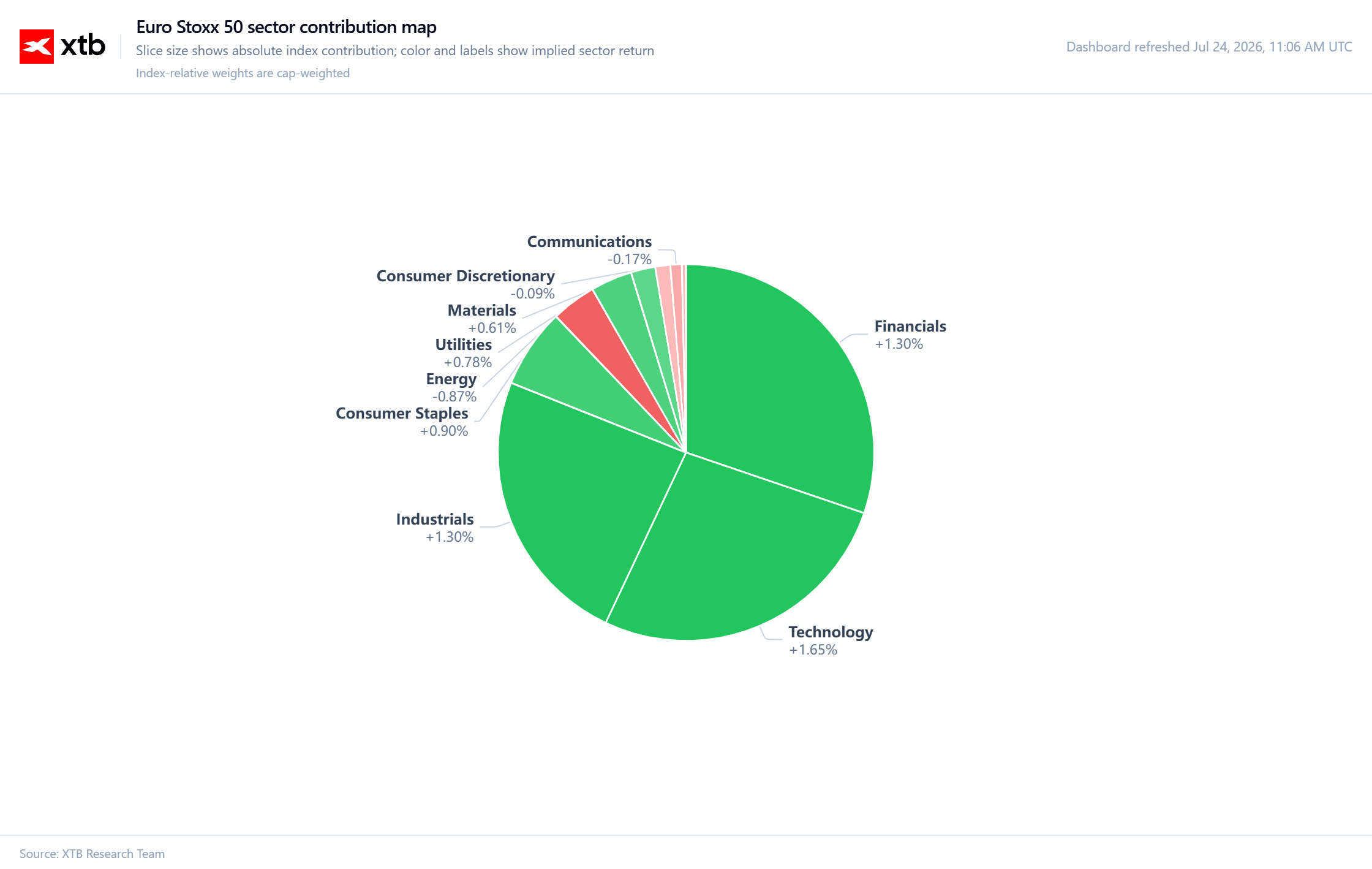
On the stock markets, the technology sector is performing best (making the largest positive contribution to the index, +1.65%), along with finance and industry (both +1.30%), whilst the energy sector is clearly dragging the market down (-0.87%), alongside weaker performances in the communications and consumer discretionary sectors. Source: XTB
Company Information
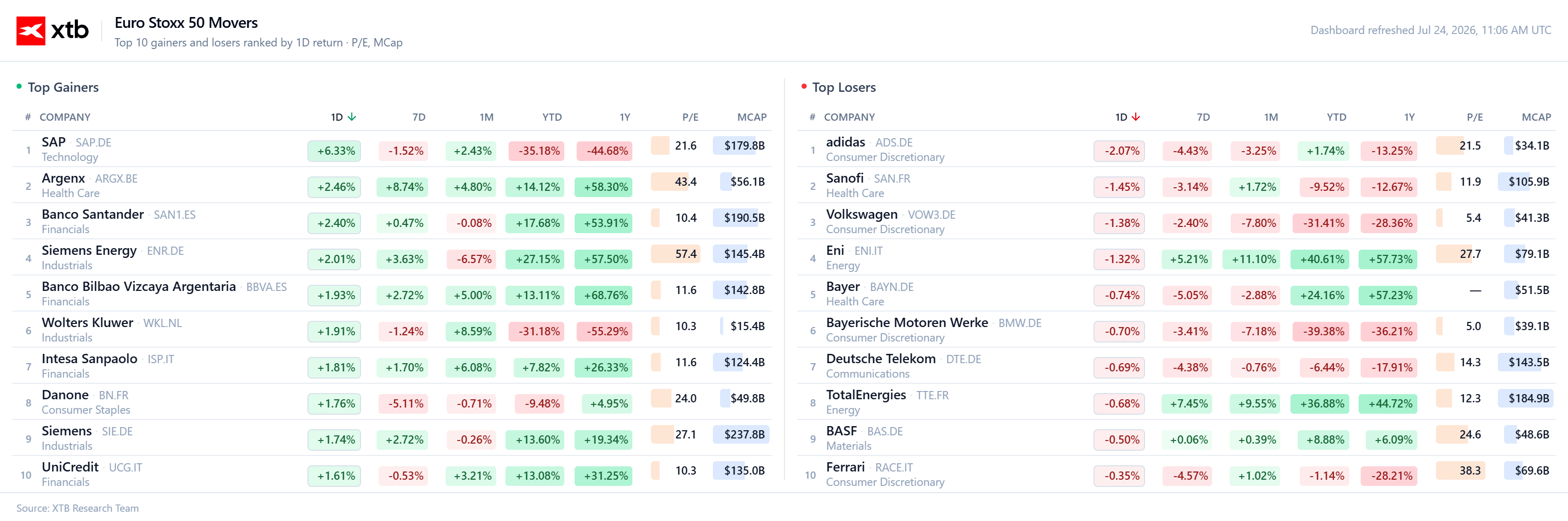
SAP (+6.33%) is the clear leader of the session after the German software giant reported growth in its cloud business that exceeded analysts’ expectations, driving the entire German DAX index higher.
HSBC (+1.2%) is rising following the announcement of the sale of its Singapore life insurance business to Allianz for 2.7 billion Singapore dollars (2.1 billion US dollars), which is in line with the bank’s strategy of focusing on its core banking operations in Asia.
3i Group (+3.1%) has hit a new high on the FTSE 100 after UBS raised its target price for the investment firm from 2,900 to 3,200 pence.
The energy sector is weighing on the market – UK-based BP (-1.6%) and Shell (-0.9%) are falling despite high oil prices, as is Finland’s Neste (-10%) following weaker quarterly results, whilst Sweden’s Securitas is down 11% after reporting a disappointing operating profit.
Adidas and Puma are down 5.2% and 1.2% respectively, after rival Deckers Outdoor (owners of the Hoka and UGG brands) announced an EPS forecast that fell short of market expectations.
Company of the Day:
Volkswagen is withdrawing its revenue growth forecast for 2026 following a 9.5 per cent fall in operating profit in the second quarter, whilst CEO Oliver Blume is pushing for a radical restructuring involving 100,000 job cuts. Volkswagen is undergoing one of the most dramatic restructurings in its history, and Friday’s Q2 2026 results confirm the German group’s mounting problems.
Poor financial results
The group’s operating profit fell by 9.5 per cent year-on-year to €3.5 billion (US$3.98 billion) in the second quarter, despite revenue totalling €82.4 billion and exceeding analysts’ forecasts. The operating margin stood at 4.2%, and the company maintained its full-year target in the range of 4.0–5.5%, which would nevertheless represent an improvement on the mere 2.8% recorded last year. The group withdrew its previous revenue growth forecast for 2026, replacing it with an expectation of a decline in sales of up to 3 per cent, and the company’s shares fell by up to 3.3 per cent following the announcement.
Radical restructuring
CEO Oliver Blume is pushing ahead with “the most comprehensive restructuring in the company’s history”, which includes a potential reduction of up to 100,000 jobs and a halving of the number of models in the portfolio. This programme overlaps with an earlier plan to cut 50,000 jobs by 2030 (of which 37,000 have already been achieved through voluntary redundancies and early retirement), and the supervisory board has already rejected a proposal to close four factories in Germany. Blume argues that, since half of the company’s overheads are personnel costs, a theoretical calculation – assuming no change in salary levels – would require the elimination of around 50,000 additional jobs worldwide.
Pressure from China and geopolitics
The main source of the problems is a sharp drop in sales in China – by more than a third over the last three months compared with the same period last year – as a result of the expansion of Chinese EV manufacturers, who are offering cheaper and more technologically advanced vehicles. Blume speaks openly of an existential threat to the company, pointing out that “Europe is under enormous economic and geopolitical pressure”, and that the automotive industry is experiencing these challenges “as if under a magnifying glass”. In response, VW is even considering producing models designed for the Chinese market on European production lines and sharing production capacity with Chinese partners, although analysts warn that this is a risky strategy. At the same time, the company has seen some recovery in North America, and the launch of budget electric models from the VW, Skoda and Cupra brands is boosting orders in Europe.



Market Wrap: ASML lifts tech sentiment, EU yields pull back



Dollar in Limbo Ahead of CPI 🚨

Economic Calendar: US CPI Inflation Data in Focus (14.10.2026)
Chart of the Day 📈 EURUSD attempts to rebound ahead of US inflation data (14.10.2026)
The content of this report has been created by XTB S.A., with its registered office in Warsaw, at Prosta 67, 00-838 Warsaw, Poland, (KRS number 0000217580) and supervised by Polish Supervision Authority ( No. DDM-M-4021-57-1/2005). This material is a marketing communication within the meaning of Art. 24 (3) of Directive 2014/65/EU of the European Parliament and of the Council of 15 May 2014 on markets in financial instruments and amending Directive 2002/92/EC and Directive 2011/61/EU (MiFID II). Marketing communication is not an investment recommendation or information recommending or suggesting an investment strategy within the meaning of Regulation (EU) No 596/2014 of the European Parliament and of the Council of 16 April 2014 on market abuse (market abuse regulation) and repealing Directive 2003/6/EC of the European Parliament and of the Council and Commission Directives 2003/124/EC, 2003/125/EC and 2004/72/EC and Commission Delegated Regulation (EU) 2016/958 of 9 March 2016 supplementing Regulation (EU) No 596/2014 of the European Parliament and of the Council with regard to regulatory technical standards for the technical arrangements for objective presentation of investment recommendations or other information recommending or suggesting an investment strategy and for disclosure of particular interests or indications of conflicts of interest or any other advice, including in the area of investment advisory, within the meaning of the Trading in Financial Instruments Act of 29 July 2005 (i.e. Journal of Laws 2019, item 875, as amended). The marketing communication is prepared with the highest diligence, objectivity, presents the facts known to the author on the date of preparation and is devoid of any evaluation elements. The marketing communication is prepared without considering the client’s needs, his individual financial situation and does not present any investment strategy in any way. The marketing communication does not constitute an offer of sale, offering, subscription, invitation to purchase, advertisement or promotion of any financial instruments. XTB S.A. is not liable for any client’s actions or omissions, in particular for the acquisition or disposal of financial instruments, undertaken on the basis of the information contained in this marketing communication. In the event that the marketing communication contains any information about any results regarding the financial instruments indicated therein, these do not constitute any guarantee or forecast regarding the future results.