



Mercedes-Benz has published its Q2 2026 results, which at first glance may look encouraging. The market seems to think so, with the share price rising by more than 2%.
Operating profit increased, net profit improved, and the key margin in the passenger car segment came in slightly better than some in the market had feared. The question is whether these results really justify optimism.
Key figures
- Mercedes’ revenue fell year on year by more than 3%, to around EUR 32.1 billion. Adjusted EBIT rose by nearly 16%, to EUR 2.3 billion.
- Net profit increased to almost EUR 1.1 billion.
- At the group level, the results can therefore be seen as decent, especially given weak demand in China and competitive pressure in the premium car market.
The problem is that the improvement did not come from a clear rebound in the core automotive business.
Mercedes-Benz results (2002 to 2025)
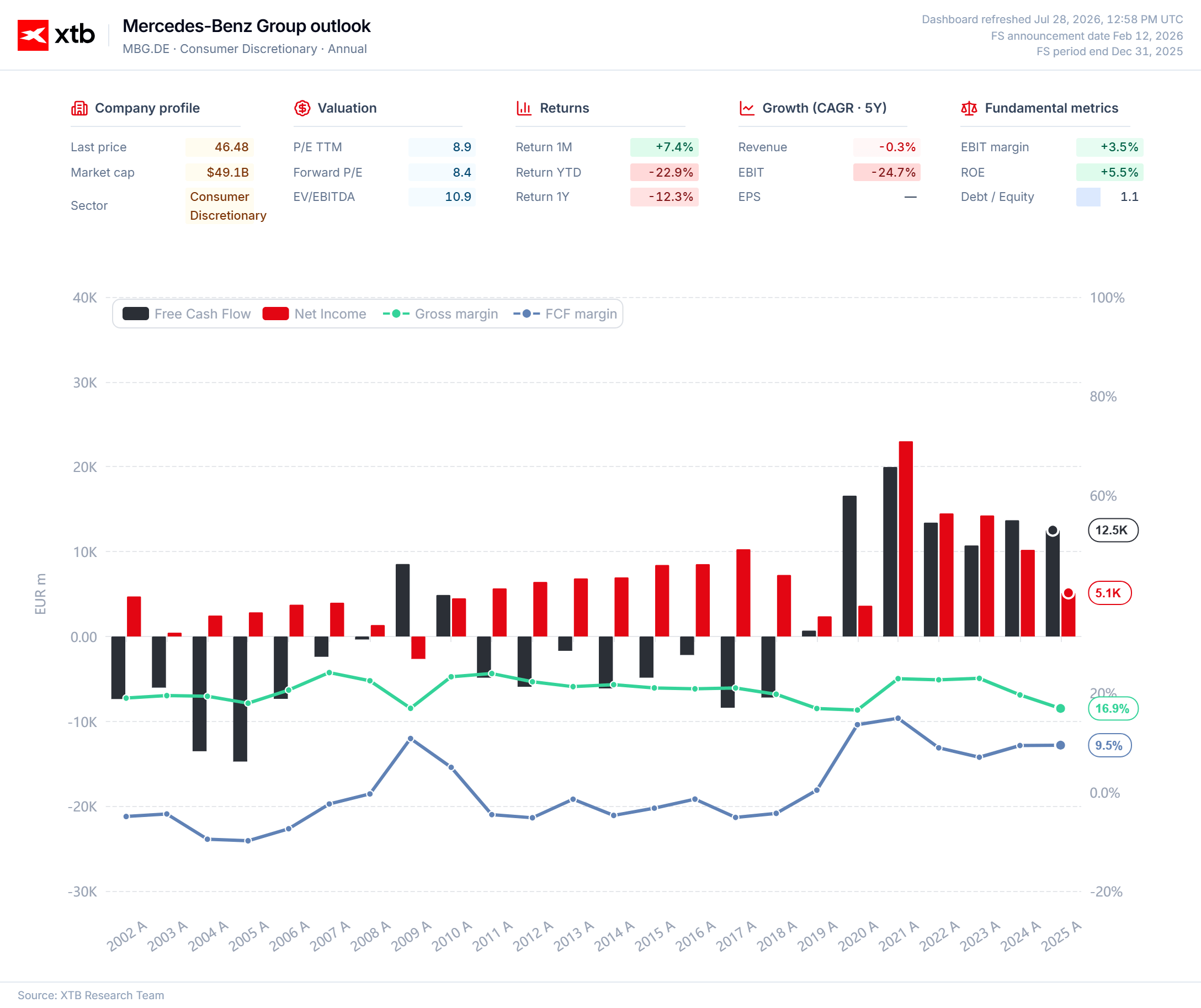
The most important segment, Mercedes-Benz Cars, delivered an adjusted margin of 4%. This is better than pessimistic expectations, but it is still terrible for a manufacturer positioning itself as premium. It is worth remembering that just a few years ago Mercedes was able to achieve double-digit profitability in this segment.
- Car sales fell by around 8%.
- The situation looked particularly weak in China, where volume dropped by about 30%.
For years, China was a source of above-average margins for German manufacturers, especially in the segment of expensive sedans and SUVs. Today, however, Mercedes has to deal with both weaker demand and growing competition from local producers.
The group result was clearly supported by a very strong quarter at Mercedes-Benz Financial Services.
- Higher profitability in the van segment, the cost-saving program, and advanced cost control made it possible to partially offset lower sales volumes.
- Mercedes is currently defending its results, already fairly weak, mainly through cost discipline rather than through growth in the core business.
- Cash flows remain an additional warning signal. Free cash flow from industrial operations fell by more than 40%, even though it was partially supported by asset sales.
Guidance
Mercedes maintained its Cars segment margin guidance at 3 to 5%, but at the same time lowered expectations for revenue and vehicle sales. Management now expects both metrics to be slightly lower than in the previous year.
Conclusion
Investor optimism is driven not by the quality of the results, but rather by the fact that the market had already priced in much worse outcomes. Mercedes avoided a deeper cut to profitability guidance and showed that it can protect earnings through cost reductions and the expansion of its financial business. However, this is not yet a report that confirms the group’s return to a path of sustainable growth. Still, the publication shows that despite a difficult situation, the company is able to slow negative trends.
MBG.DE chart analysis (D1)
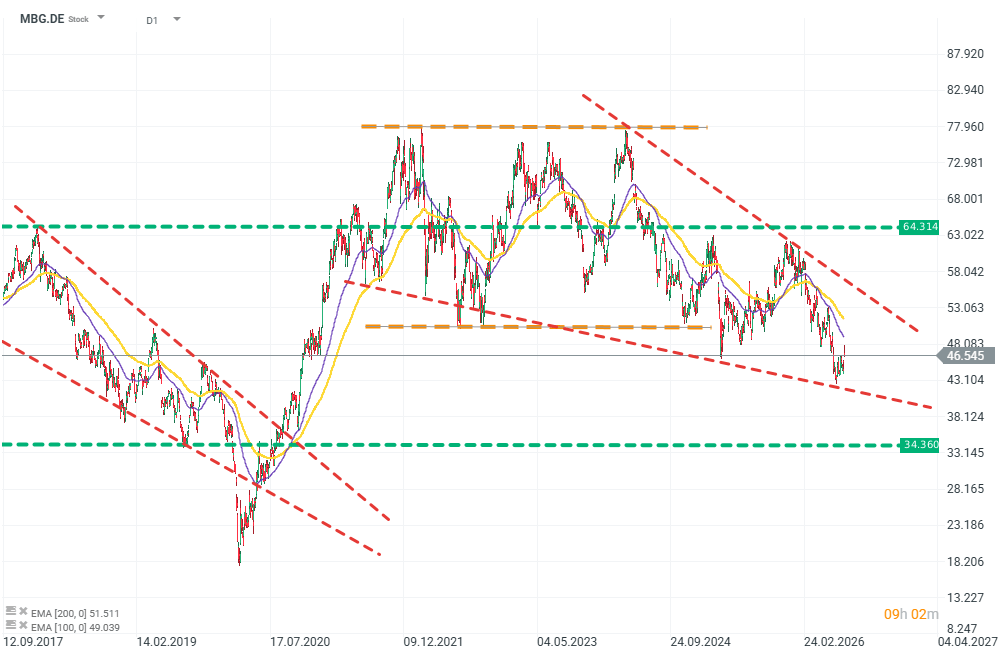
The question remains open whether this is merely a pause for breath before further erosion of the company, or a phase of consolidation and reform after which the company regains some of its former volumes and margins. Optimists might look for a chance of a repeat of the 2019 to 2020 scenario, when the company rebounded clearly after similar declines. Source: xStation5



Three markets to watch next week (23.10.2026)



Daily Summary: Oil at five-month highs, indices under pressure (23.10.2026)

US Open: Further declines on Wall Street, Brent above 111 USD, AI correction continues (14.10.2026)



Morning Wrap: AI profitability concerns spark market Sell-Off
The content of this report has been created by XTB S.A., with its registered office in Warsaw, at Prosta 67, 00-838 Warsaw, Poland, (KRS number 0000217580) and supervised by Polish Supervision Authority ( No. DDM-M-4021-57-1/2005). This material is a marketing communication within the meaning of Art. 24 (3) of Directive 2014/65/EU of the European Parliament and of the Council of 15 May 2014 on markets in financial instruments and amending Directive 2002/92/EC and Directive 2011/61/EU (MiFID II). Marketing communication is not an investment recommendation or information recommending or suggesting an investment strategy within the meaning of Regulation (EU) No 596/2014 of the European Parliament and of the Council of 16 April 2014 on market abuse (market abuse regulation) and repealing Directive 2003/6/EC of the European Parliament and of the Council and Commission Directives 2003/124/EC, 2003/125/EC and 2004/72/EC and Commission Delegated Regulation (EU) 2016/958 of 9 March 2016 supplementing Regulation (EU) No 596/2014 of the European Parliament and of the Council with regard to regulatory technical standards for the technical arrangements for objective presentation of investment recommendations or other information recommending or suggesting an investment strategy and for disclosure of particular interests or indications of conflicts of interest or any other advice, including in the area of investment advisory, within the meaning of the Trading in Financial Instruments Act of 29 July 2005 (i.e. Journal of Laws 2019, item 875, as amended). The marketing communication is prepared with the highest diligence, objectivity, presents the facts known to the author on the date of preparation and is devoid of any evaluation elements. The marketing communication is prepared without considering the client’s needs, his individual financial situation and does not present any investment strategy in any way. The marketing communication does not constitute an offer of sale, offering, subscription, invitation to purchase, advertisement or promotion of any financial instruments. XTB S.A. is not liable for any client’s actions or omissions, in particular for the acquisition or disposal of financial instruments, undertaken on the basis of the information contained in this marketing communication. In the event that the marketing communication contains any information about any results regarding the financial instruments indicated therein, these do not constitute any guarantee or forecast regarding the future results.