



Today, after the market closes, Micron Technology will release its results for the second quarter of fiscal year 2026. This event is closely watched not only by investors but also by the entire semiconductor industry and participants in the artificial intelligence sector. The Micron report has the potential to set the tone for the high-bandwidth memory segment, particularly in the context of rising demand for DRAM, NAND, and HBM in AI-powered data centers.
Expectations for Micron are extremely high. Analysts’ consensus forecasts revenue around 19.4 billion dollars, representing roughly 150 percent year-on-year growth, and earnings per share of approximately 8.7 USD. Gross margin is expected at about 69 percent, with an operating margin of 62 percent.
Market expectations
Q2 FY26 revenue: 19.4 billion USD (150% y/y)
EPS: 8.7 USD
Gross margin: 69%
Operating margin: 62%
Guidance for the next quarter
-
Q3 FY26 revenue: approximately 23.8 billion USD, gross margin above 71%, EPS around 11 USD
Analysts anticipate a record-breaking beat of consensus estimates and a strong increase in memory prices driven by AI-related demand. Projections for Q3 also reflect revenue of 23.8 billion USD, gross margin above 71 percent, and EPS around 11 USD. Such high figures highlight the exceptional nature of the current memory supercycle, fueled primarily by AI investments and constrained supply.
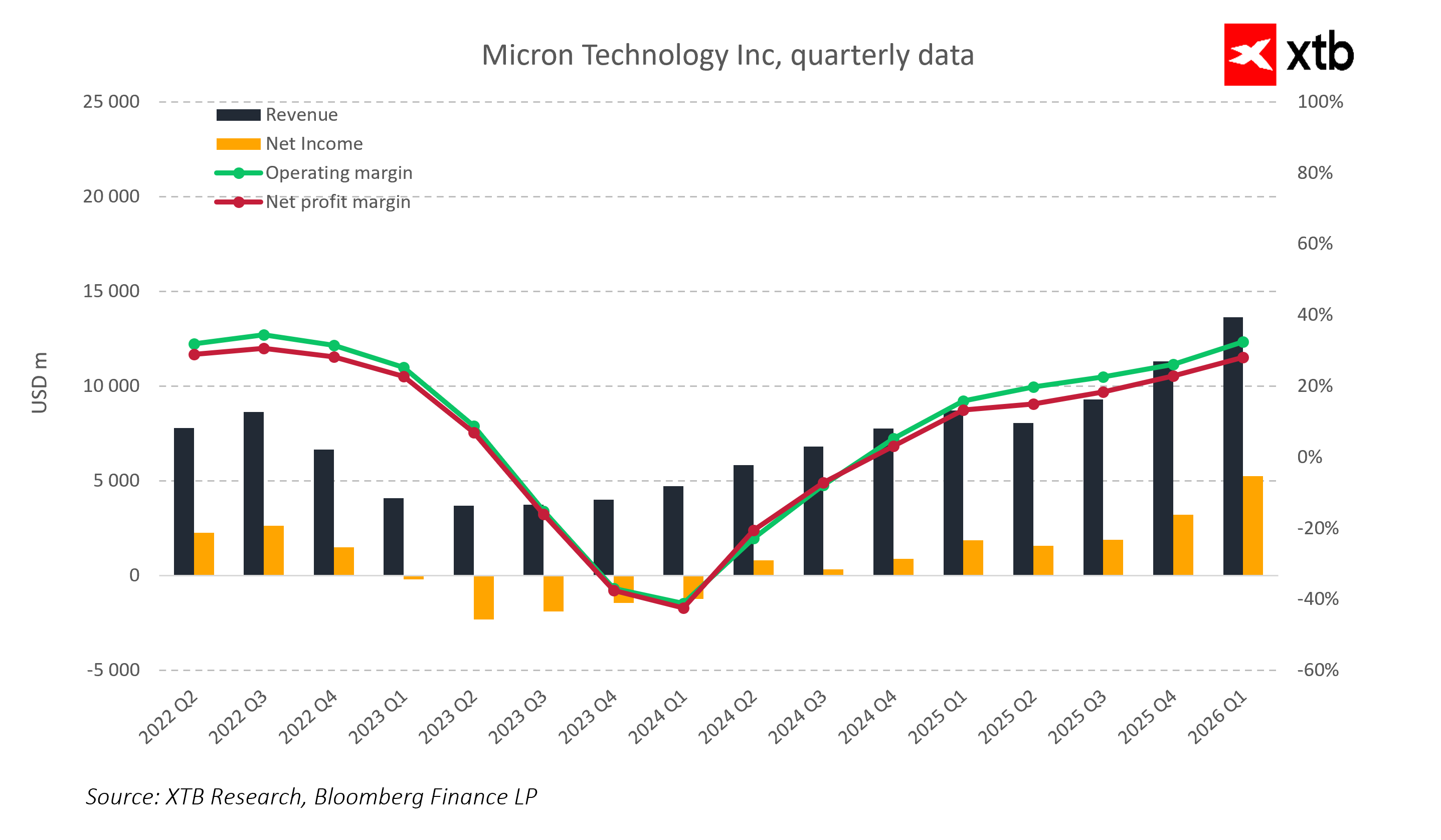
Market position and significance for the semiconductor sector
In 2026, Micron shares have already risen by around 60 percent, following an almost threefold increase in 2025. Many competitors in the semiconductor industry posted only moderate gains by comparison. Micron’s market capitalization has exceeded 500 billion dollars, surpassing companies such as Oracle and placing the firm among the world’s leading memory manufacturers.
Rising prices and strong demand for data center memory allow Micron to maintain control over revenues and margins. Its strong position in the high-bandwidth memory segment gives the company leverage in negotiations with hyperscalers and stabilizes revenue from AI server applications.
Major market players, including Amazon, Google, Microsoft, and Meta, are increasing memory investments for AI workloads and next-generation GPUs. Consequently, much of Micron’s revenue growth is driven by stable corporate and server demand.
HBM and DRAM as the foundation of the supercycle
HBM4e memory has become Micron’s core product. All production capacity for 2026 has already been contracted, with new clients joining waiting lists. Limited supply combined with growing demand keeps prices exceptionally high, and the backlog serves as a key stabilizing factor for revenue in upcoming quarters.
The DRAM segment continues to account for a significant portion of revenues. DDR5 and DDR5X server deployments are growing 20 to 25 percent year-on-year, driven by new data center construction and modernization of existing facilities. Supply discipline among the three largest manufacturers – Micron, Samsung, and SK Hynix – maintains high prices and supports gross margins exceeding 50 percent.
Although the NAND segment is regaining momentum due to enterprise SSD demand in data centers, the consumer market remains weaker. Micron emphasizes high-margin industrial applications, which helps stabilize revenues despite slower PC and smartphone markets.
Production investments and the 2027 plan
Micron continues to expand its factories in New York and has opened a facility in India, which will increase production capacity in the medium term. New HBM production lines are expected to reach full operational capacity only in 2027. In 2026, the company is fully utilizing existing capacity, allowing it to maintain high memory prices and strong margins.
The market will closely monitor how new factory investments translate into increased supply and price stabilization. Full utilization of existing plants, along with the HBM and DRAM backlog, is critical for maintaining competitive advantage and profitability.
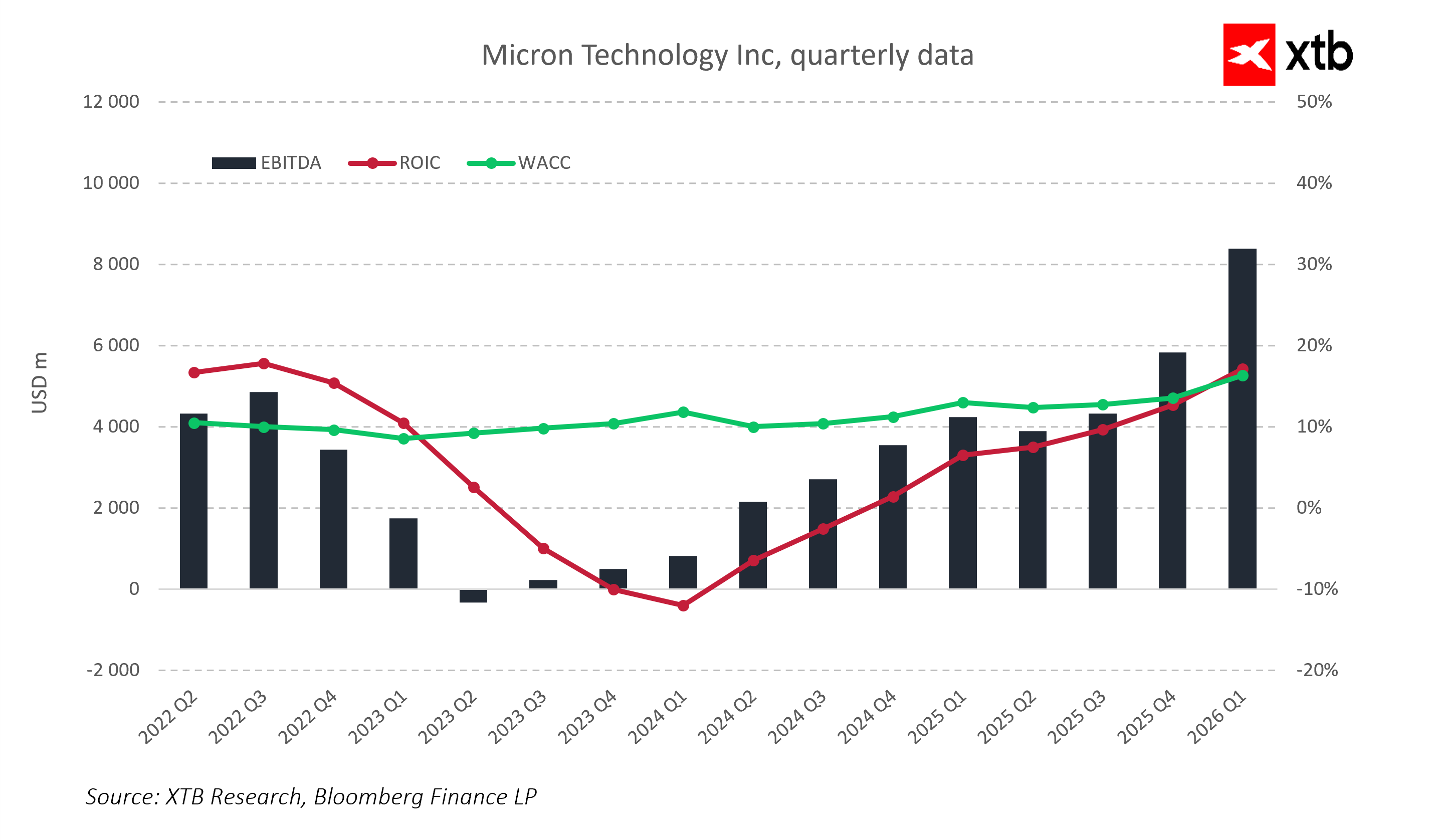
Hyperscaler demand and global factors
Demand from leading players such as Amazon, Google, and Microsoft drives HBM and DRAM sales in data centers. GPU and memory orders are closely tied to hyperscaler AI investment plans. Any slowdown in CapEx in this segment could affect Micron’s demand and margins.
The memory industry also remains sensitive to geopolitical developments. Export restrictions, government subsidies, and CHIPS Act policies influence production allocation and factory capacity. Despite these risks, Micron benefits from tax incentives and local government support, reducing cost pressure and enabling ambitious investment plans.
Market reaction scenarios
The market’s response will depend not only on Q2 results but also on management commentary regarding upcoming quarters.
In a positive scenario, a strong beat in revenue and earnings per share combined with sustained high memory prices could drive Micron’s share price higher and generate positive sentiment across the semiconductor sector.
A neutral scenario, with results in line with expectations and stable guidance, will likely lead to a moderate market reaction and be interpreted as confirmation of the ongoing growth trajectory.
A negative scenario, including revenue or EPS disappointment, slower HBM sales, and margin pressure, could trigger sector-wide declines and dampen enthusiasm for AI memory.
Ultimately, today’s report will serve as a test of the durability of the AI boom and memory demand in data centers. The results will indicate whether record Q2 performance marks the beginning of a long-term trend, with guidance for upcoming quarters being crucial to assessing the company’s growth potential and broader semiconductor market sentiment.
Key takeaways
-
Q2 revenue is estimated at approximately 19.4 billion USD, EPS around 8.7 USD, gross margin at 69 percent
-
HBM4e and high-bandwidth DRAM are the primary drivers of revenue growth and profitability improvement
-
Traditional DRAM and NAND remain revenue pillars due to growing data center demand and supply discipline
-
Investments in new factories in the US and India will increase production capacity in the coming years and may stabilize prices
-
Hyperscaler demand from companies like Amazon, Google, and Microsoft fuels Micron’s revenue and margin growth
-
Q2 results and guidance for upcoming quarters are critical to evaluating the sustainability of AI-driven memory demand
-
Publication of results may impact the entire semiconductor sector and investor decisions regarding tech ETFs and competitor stocks
-
Full utilization of existing production capacity and HBM and DRAM backlog are key for maintaining technological advantage and profitability
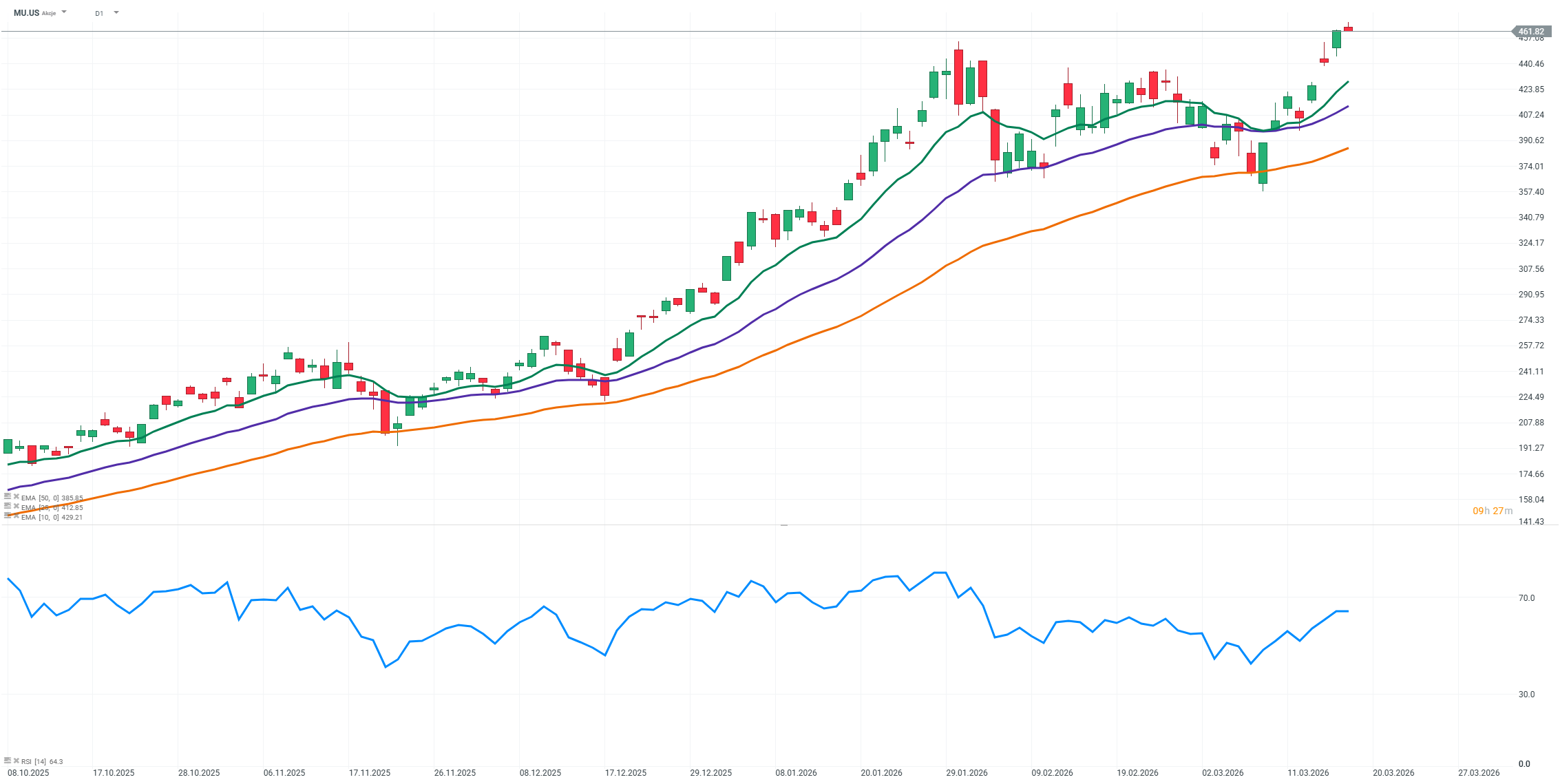
Source: xStation5


Daily summary 📈 Precious metals and stock indices rebound as Treasury yields fall


US Open: Nasdaq 100 extends losses 🚩 AI stocks under pressure, CoreWeave falls 8%



Market Wrap: Tech Sell-Off Hits Europe, Gold Shines Again


TSMC breaks records once again driven by the AI boom
The content of this report has been created by XTB S.A., with its registered office in Warsaw, at Prosta 67, 00-838 Warsaw, Poland, (KRS number 0000217580) and supervised by Polish Supervision Authority ( No. DDM-M-4021-57-1/2005). This material is a marketing communication within the meaning of Art. 24 (3) of Directive 2014/65/EU of the European Parliament and of the Council of 15 May 2014 on markets in financial instruments and amending Directive 2002/92/EC and Directive 2011/61/EU (MiFID II). Marketing communication is not an investment recommendation or information recommending or suggesting an investment strategy within the meaning of Regulation (EU) No 596/2014 of the European Parliament and of the Council of 16 April 2014 on market abuse (market abuse regulation) and repealing Directive 2003/6/EC of the European Parliament and of the Council and Commission Directives 2003/124/EC, 2003/125/EC and 2004/72/EC and Commission Delegated Regulation (EU) 2016/958 of 9 March 2016 supplementing Regulation (EU) No 596/2014 of the European Parliament and of the Council with regard to regulatory technical standards for the technical arrangements for objective presentation of investment recommendations or other information recommending or suggesting an investment strategy and for disclosure of particular interests or indications of conflicts of interest or any other advice, including in the area of investment advisory, within the meaning of the Trading in Financial Instruments Act of 29 July 2005 (i.e. Journal of Laws 2019, item 875, as amended). The marketing communication is prepared with the highest diligence, objectivity, presents the facts known to the author on the date of preparation and is devoid of any evaluation elements. The marketing communication is prepared without considering the client’s needs, his individual financial situation and does not present any investment strategy in any way. The marketing communication does not constitute an offer of sale, offering, subscription, invitation to purchase, advertisement or promotion of any financial instruments. XTB S.A. is not liable for any client’s actions or omissions, in particular for the acquisition or disposal of financial instruments, undertaken on the basis of the information contained in this marketing communication. In the event that the marketing communication contains any information about any results regarding the financial instruments indicated therein, these do not constitute any guarantee or forecast regarding the future results.