



Microsoft denied reports from The Information, which claimed the company had lowered sales growth targets and limits for selected AI products after some sales teams failed to meet their plans. The report cited sources within Azure and indicated that:
- The Carlyle Group reduced spending on Copilot Studio due to data-integration issues;
- Microsoft Foundry failed to meet assumptions tied to customer spending.
Microsoft rejected these allegations, arguing that the report mixes growth expectations with sales quotas, which — as the company emphasizes — have not been reduced. The entire situation comes amid growing market concerns that AI adoption is progressing more slowly than expected, and that only a small portion of projects move beyond the pilot phase. At the same time, tech giants are under increasing pressure to prove that massive AI investments — including Microsoft’s record-breaking 35 billion USD in capital expenditures last quarter — will translate into lasting revenue.
Despite the challenges, Microsoft continues to report solid Azure growth and expects capacity constraints to persist until mid-2026 due to strong demand. The company remains one of the primary beneficiaries of AI infrastructure, although slower implementation and reports of customer-side issues are increasing investor caution and prompting comparisons to earlier tech bubbles.
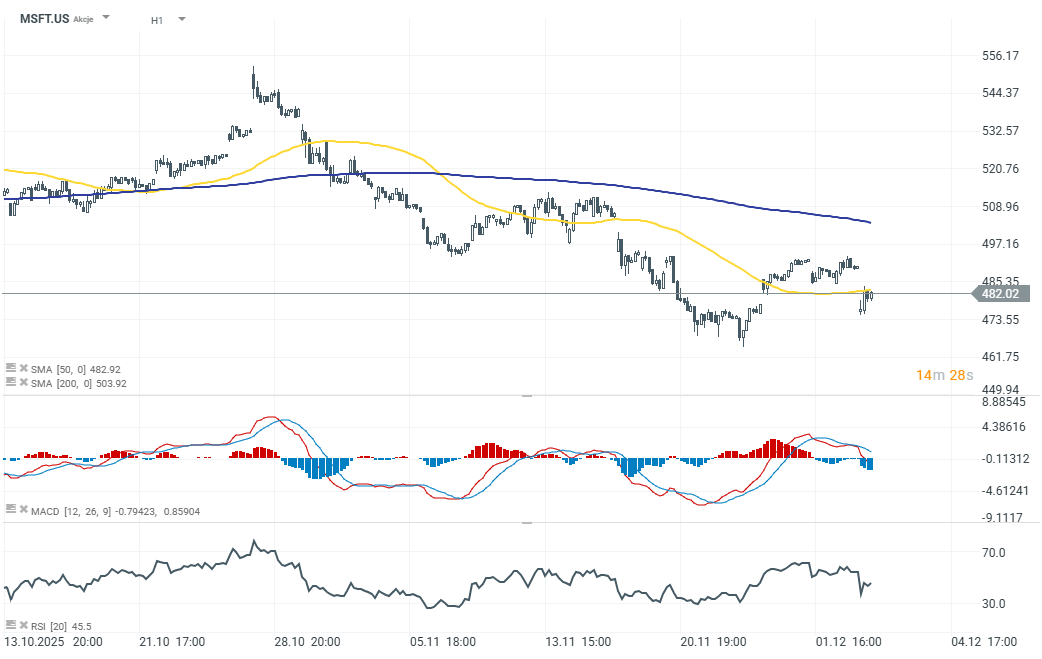
After The Information published its report, Microsoft shares initially fell nearly -3% to around 475 USD. However, they have since partially recovered to about -1.65%, trading near 481 USD.



US Open: Further declines on Wall Street, Brent above 111 USD, AI correction continues (14.10.2026)



Morning Wrap: AI profitability concerns spark market Sell-Off



Daily Summary: Valuations Under Pressure, Capital Moves Away From Technology

US OPEN: Earnings misses and rising oil push indexes lower
The content of this report has been created by XTB S.A., with its registered office in Warsaw, at Prosta 67, 00-838 Warsaw, Poland, (KRS number 0000217580) and supervised by Polish Supervision Authority ( No. DDM-M-4021-57-1/2005). This material is a marketing communication within the meaning of Art. 24 (3) of Directive 2014/65/EU of the European Parliament and of the Council of 15 May 2014 on markets in financial instruments and amending Directive 2002/92/EC and Directive 2011/61/EU (MiFID II). Marketing communication is not an investment recommendation or information recommending or suggesting an investment strategy within the meaning of Regulation (EU) No 596/2014 of the European Parliament and of the Council of 16 April 2014 on market abuse (market abuse regulation) and repealing Directive 2003/6/EC of the European Parliament and of the Council and Commission Directives 2003/124/EC, 2003/125/EC and 2004/72/EC and Commission Delegated Regulation (EU) 2016/958 of 9 March 2016 supplementing Regulation (EU) No 596/2014 of the European Parliament and of the Council with regard to regulatory technical standards for the technical arrangements for objective presentation of investment recommendations or other information recommending or suggesting an investment strategy and for disclosure of particular interests or indications of conflicts of interest or any other advice, including in the area of investment advisory, within the meaning of the Trading in Financial Instruments Act of 29 July 2005 (i.e. Journal of Laws 2019, item 875, as amended). The marketing communication is prepared with the highest diligence, objectivity, presents the facts known to the author on the date of preparation and is devoid of any evaluation elements. The marketing communication is prepared without considering the client’s needs, his individual financial situation and does not present any investment strategy in any way. The marketing communication does not constitute an offer of sale, offering, subscription, invitation to purchase, advertisement or promotion of any financial instruments. XTB S.A. is not liable for any client’s actions or omissions, in particular for the acquisition or disposal of financial instruments, undertaken on the basis of the information contained in this marketing communication. In the event that the marketing communication contains any information about any results regarding the financial instruments indicated therein, these do not constitute any guarantee or forecast regarding the future results.