



U.S. stock indices came under pressure yesterday after recently reaching record highs, while Wall Street futures are trading almost flat today. The rise in oil prices towards $100 per barrel has reignited inflation concerns and expectations of further monetary tightening by the Federal Reserve, weighing on investors' risk appetite.
- Today's economic calendar is relatively light. The main releases to watch are U.S. initial jobless claims (12:30 PM GMT) and the minutes from the European Central Bank's latest monetary policy meeting (11:30 AM GMT. Earlier this morning, Japan's Economy Watchers Survey index rose to 47, beating expectations of 46.7 and improving from the previous reading of 46.4.
-
The S&P 500 has retreated from record highs, while Brent crude ended yesterday's session near $100 per barrel and is gaining almost 2% today, climbing above $102. Oil prices are being supported by escalating tensions in the Middle East, including attacks on tankers near the Strait of Hormuz, alongside persistent disruptions to regional oil supplies.
-
The White House is reportedly considering further strikes against Iranian targets ahead of the U.S. midterm elections, despite a period of relative military calm in recent weeks. According to The Atlantic, the Pentagon has been instructed to prepare potential military options, even as the Trump administration seeks to lower fuel prices and limit the political fallout from an unpopular conflict ahead of the vote.
-
The yield on the 10-year U.S. Treasury has eased from yesterday's peak of 5.35%, its highest level since 2002. Pressure on the bond market persisted despite strong demand at a $39 billion Treasury auction. Meanwhile, Bitcoin has fallen below $83,000, reflecting a more cautious attitude towards risk assets.
-
Asian stock indices have come under pressure following yesterday's declines on Wall Street. The MSCI All Country World Index is down around 0.2%, retreating from record highs after gaining 1.5% earlier in the week. Investors are reducing their exposure to risk assets amid rising energy prices and renewed escalation in the Middle East.
-
Gold is gradually recovering after falling to $4,070 per ounce, rebounding above $4,130. Platinum and palladium are also gaining, rising 1.8% and 2.3%, respectively.
-
Markets are increasingly pricing in the possibility of another Federal Reserve interest rate hike before the end of 2026. Persistently high energy prices, rising corporate borrowing costs and substantial investment in artificial intelligence infrastructure could sustain inflationary pressures and limit the Fed's room to ease monetary policy.
-
Minutes from the Fed's September meeting confirmed that all 19 officials supported the interest rate increase. Many participants viewed the hike as a precaution against a potential resurgence in inflation, reinforcing expectations that the Fed may maintain restrictive monetary policy for longer.
-
SpaceX is reportedly in talks with banks and investors to raise approximately $40 billion to purchase Nvidia chips. The potential financing would rank among the largest transactions linked to AI infrastructure expansion, providing further evidence of sustained demand for advanced processors used in data centers.
-
Iran and Oman are holding discussions on safe navigation through the Strait of Hormuz, including geographical coordinates for transit routes and how to present their agreements internationally. Iranian Foreign Ministry spokesperson Esmail Baghaei said Tehran remains committed to restoring security in the region, adding that Iran's response to U.S. proposals will be delivered through intermediaries.
-
The United Kingdom Maritime Trade Operations (UKMTO) reported an attack on a tanker approximately 51 nautical miles north of Madinat Ash Shamal, Qatar. According to preliminary reports, the vessel was struck by multiple projectiles, with casualties reported among the crew, raising renewed concerns about maritime security and energy shipments from the Persian Gulf.
-
Washington is stepping up efforts to protect strategic technologies while expanding cooperation with the artificial intelligence industry. Following an incident involving F-35 fighter jet components reportedly shipped to China through UPS, concerns have emerged over export controls, while a U.S. administration official disclosed ongoing discussions with 20–25 AI companies and plans for FAA oversight of AI applications in aviation.
-
Rates for chartering crude oil supertankers have reached new highs, potentially increasing oil transportation costs and adding to inflationary pressures across supply chains. Tensions in the Middle East remain elevated following further attacks on strategic infrastructure, with Iran-backed Houthi rebels striking two airports in Saudi Arabia, killing three people, while clashes involving Saudi-backed forces continue in Yemen.
-
Rising energy prices are complicating the inflation outlook following the Fed's September rate hike, while investors are increasingly turning their attention to the upcoming U.S. earnings season. Markets will be looking for evidence that record investment in AI infrastructure is translating into tangible revenue and earnings growth sufficient to justify elevated equity valuations.
-
The euro remains relatively stable against the U.S. dollar, although investors are paying closer attention to France's deteriorating fiscal position. Growing concerns about public finances are increasing the risk of tensions in European bond markets and a potential confrontation with the ECB, while France's Finance Ministry has indicated that it has no plans to change its debt issuance strategy despite heightened uncertainty.
-
German imports rose by 0.9% m/m, compared with expectations for a 2.8% increase and a 5.7% decline previously (seasonally adjusted), while German exports fell by 0.8% m/m, against market expectations for a 0.9% increase and following a 0.8% decline in the previous month (seasonally adjusted). Germany's trade surplus stood at EUR 19.5 billion, compared with forecasts of EUR 19 billion and EUR 21.3 billion previously (seasonally adjusted).
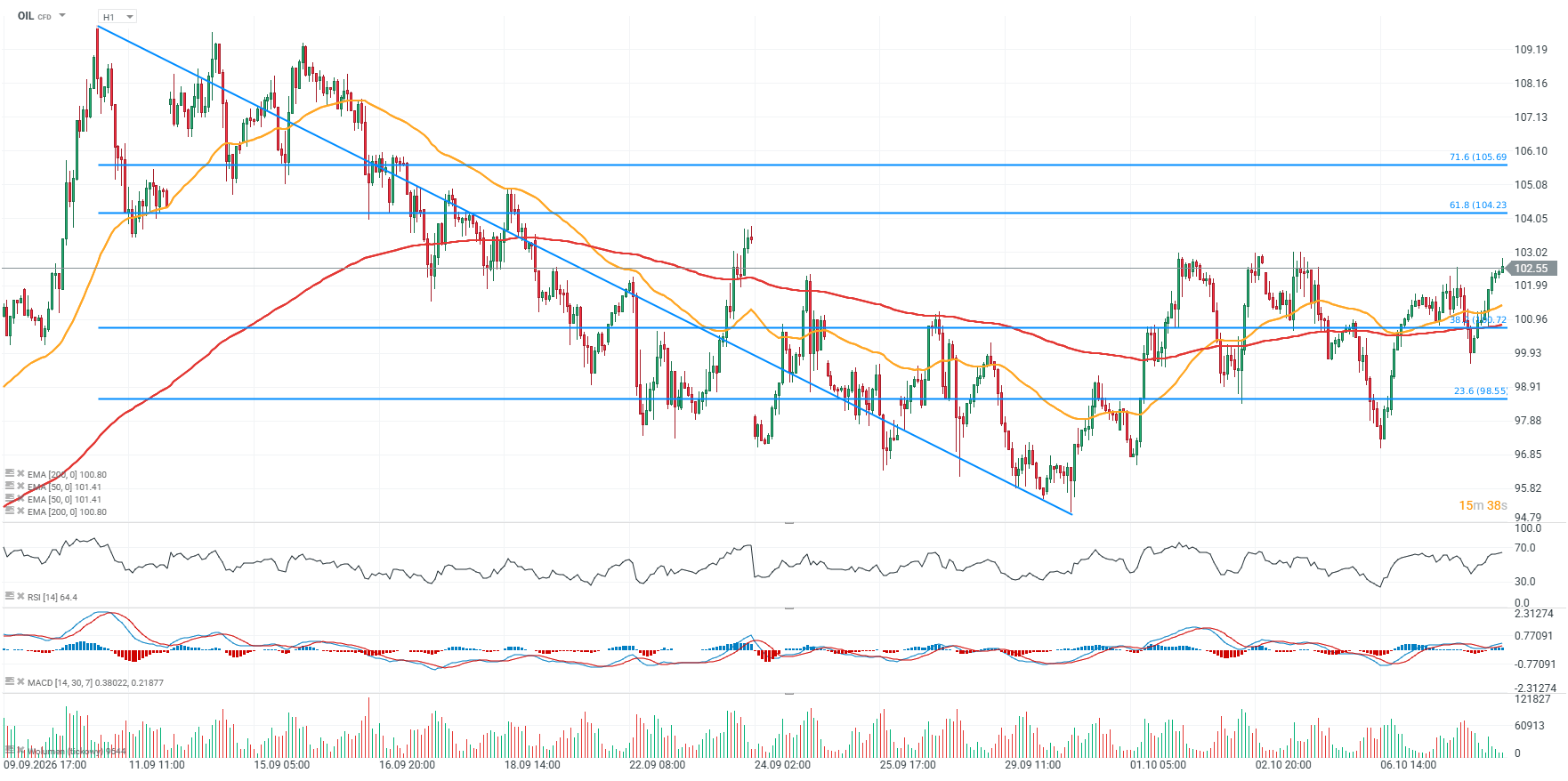
OIL chart (H1 interval)
Futures on Brent are rebounding after briefly falling to around $95, gaining approximately 8% and reaching a local high. The RSI has not yet entered overbought territory, while the MACD also suggests potential for further upside. A breakout above $103.5 could open the way towards $104.5 and $105.5, corresponding to the 61.8% and 71.6% Fibonacci retracement levels of the latest downward move. The $97–99 area remains an important support zone, reinforced by the 38.2% Fibonacci retracement level.
 Source: XTB


Daily summary: Wall Street recovers losses despite a surge in yields 🗽 Gold and silver retreat



Large decline in crude inventories 🛢️📉


📉 Gold loses 1.7%


US Open: Wall Street in the Red 🚩 Nasdaq Falls 1% From Record Highs, Constellation Brands Back at March 2020 Level
The content of this report has been created by XTB S.A., with its registered office in Warsaw, at Prosta 67, 00-838 Warsaw, Poland, (KRS number 0000217580) and supervised by Polish Supervision Authority ( No. DDM-M-4021-57-1/2005). This material is a marketing communication within the meaning of Art. 24 (3) of Directive 2014/65/EU of the European Parliament and of the Council of 15 May 2014 on markets in financial instruments and amending Directive 2002/92/EC and Directive 2011/61/EU (MiFID II). Marketing communication is not an investment recommendation or information recommending or suggesting an investment strategy within the meaning of Regulation (EU) No 596/2014 of the European Parliament and of the Council of 16 April 2014 on market abuse (market abuse regulation) and repealing Directive 2003/6/EC of the European Parliament and of the Council and Commission Directives 2003/124/EC, 2003/125/EC and 2004/72/EC and Commission Delegated Regulation (EU) 2016/958 of 9 March 2016 supplementing Regulation (EU) No 596/2014 of the European Parliament and of the Council with regard to regulatory technical standards for the technical arrangements for objective presentation of investment recommendations or other information recommending or suggesting an investment strategy and for disclosure of particular interests or indications of conflicts of interest or any other advice, including in the area of investment advisory, within the meaning of the Trading in Financial Instruments Act of 29 July 2005 (i.e. Journal of Laws 2019, item 875, as amended). The marketing communication is prepared with the highest diligence, objectivity, presents the facts known to the author on the date of preparation and is devoid of any evaluation elements. The marketing communication is prepared without considering the client’s needs, his individual financial situation and does not present any investment strategy in any way. The marketing communication does not constitute an offer of sale, offering, subscription, invitation to purchase, advertisement or promotion of any financial instruments. XTB S.A. is not liable for any client’s actions or omissions, in particular for the acquisition or disposal of financial instruments, undertaken on the basis of the information contained in this marketing communication. In the event that the marketing communication contains any information about any results regarding the financial instruments indicated therein, these do not constitute any guarantee or forecast regarding the future results.