



-
Geopolitics: Escalation in the Middle East is fuelling risk. Iran has rejected a ceasefire proposal put forward by the Iraqi Prime Minister, warning that a US strike on Tehran would lead to attacks on Tel Aviv and the closure of the Bab al-Mandeb Strait by the Houthis. US Centcom has already confirmed the 13th consecutive night of air strikes on Iranian military targets, whilst Defence Secretary Pete Hegseth has estimated the cost of a war with Iran to the US at $37.5 billion. In addition, the Houthis struck two Saudi oil tankers in the Red Sea, creating a second critical chokepoint for supply routes alongside the Strait of Hormuz.
-
Trade: Trump launches a new wave of tariffs on 60 trading partners. From Friday, the Trump administration imposed tariffs of 10–12.5 per cent on 60 economies on the pretext of insufficient efforts to combat forced labour, replacing the expiring 10 per cent global tariff under Section 122. The decision has been met with criticism from trading partners – Brazil called the tariffs “arbitrary”, Australia “unjustified”, and Japan described them as “regrettable”; however, none of the countries has announced any retaliatory measures.
-
US market reaction: sell-off driven by oil and technology. Wall Street closed Thursday’s session sharply lower – the Dow fell by over 500 points (around 1%), marking its fifth losing day out of six, whilst the S&P 500 and Nasdaq recorded their worst day since 23 June, losing 1.2% and 2.2% respectively. The market was weighed down by the performance of Tesla (-15%, its worst session since March 2025) and Alphabet (-7%, its biggest fall since May 2025) following an increase in their AI capital expenditure forecasts, which together wiped around $500 billion off market capitalisation. Futures are mixed on Friday – S&P 500 down 0.13 per cent, Nasdaq-100 down 0.44 per cent, Dow flat.
-
Asia: a red session across the board, with trading suspended in South Korea. The Nikkei 225 fell by around 2.7–2.8 per cent, the Topix by 1 per cent, and the Kospi plunged by over 5 per cent, forcing the activation of the Korean stock exchange’s ‘sidecar’ mechanism (KOSPI and KOSDAQ), which temporarily suspended algorithmic trading. The Hang Seng lost 1.33 per cent, the CSI 300 by 1.4 per cent, and the ASX 200 by 0.95 per cent – all against a backdrop of rising oil prices, tensions in the Middle East and Trump’s new tariffs. The region’s technology sector faced further pressure from declines in SK Hynix (-3.5% after reaching its ADR conversion limit), Samsung (-4%) and SoftBank (-7.5%).
-
Currencies: the yen at 40-year lows, the dollar stable. Japan’s core CPI inflation rose to 1.6% y/y in June (in line with expectations), the first increase since March, driven by rising oil prices, whilst the yen remains close to multi-year lows against the dollar (163.7–163.8). The US Treasury is pressing the BoJ for faster rate hikes, whilst Japanese Finance Minister Katayama has signalled a readiness for decisive currency intervention. On the exchange rate board, morning movements are modest: EURUSD +0.17%, GBP/USD +0.18%, USD/JPY -0.01%, USD/PLN -0.24%, EUR/PLN -0.02%.
-
Commodities: oil above $90, yields on the rise. Brent crude broke through the psychological barrier of $90 per barrel for the first time since May, gaining around 4% on Thursday, before correcting slightly on Friday morning (-1.34% on the OIL contract) in response to the Houthi attack on Saudi tankers. The yield on 10-year US bonds rose to its highest level since January 2025 (4.705%), and analysts point out that the market entered the escalation ‘poorly positioned’, which amplifies the price reaction to any negative supply-side news. Gold remains stable near the $4,040 support level (-0.05 per cent), whilst silver is up 1.14 per cent
-
Companies: Volkswagen cuts its forecasts, whilst Intel and Oracle deliver better-than-expected results. Volkswagen reported a fall in operating profit of nearly 10% year-on-year to €3.5bn (below the consensus estimate of €4.3bn) and, for the first time, forecast a decline in revenue of up to 3% in 2026, shortly after confirming plans to cut up to 100,000 jobs. On the other hand, Intel recorded its fastest revenue growth in 15 years (25% year-on-year, to $16.1 billion; shares up 9% after the close), whilst Oracle gained 3% after signing a 10-year software contract with the Pentagon worth up to $7 billion. SAP is up 3% in pre-market trading following a 27% year-on-year increase in its cloud backlog to €22.9 billion, despite a downward revision to its profit forecast for 2026 due to the costs of acquiring data for AI.
-
Cryptocurrencies and today’s trading session. Bitcoin is up slightly (+0.85%) despite generally risk-averse sentiment in the markets. The European open looks set to be mixed – the FTSE 100 is expected to open slightly lower (-0.17%), whilst the DAX and CAC 40 are set to rise (by +0.19% and +0.22% respectively), and the key themes of the day will remain developments regarding Iran, oil prices above $100 and further market reactions to Trump’s new wave of tariffs.
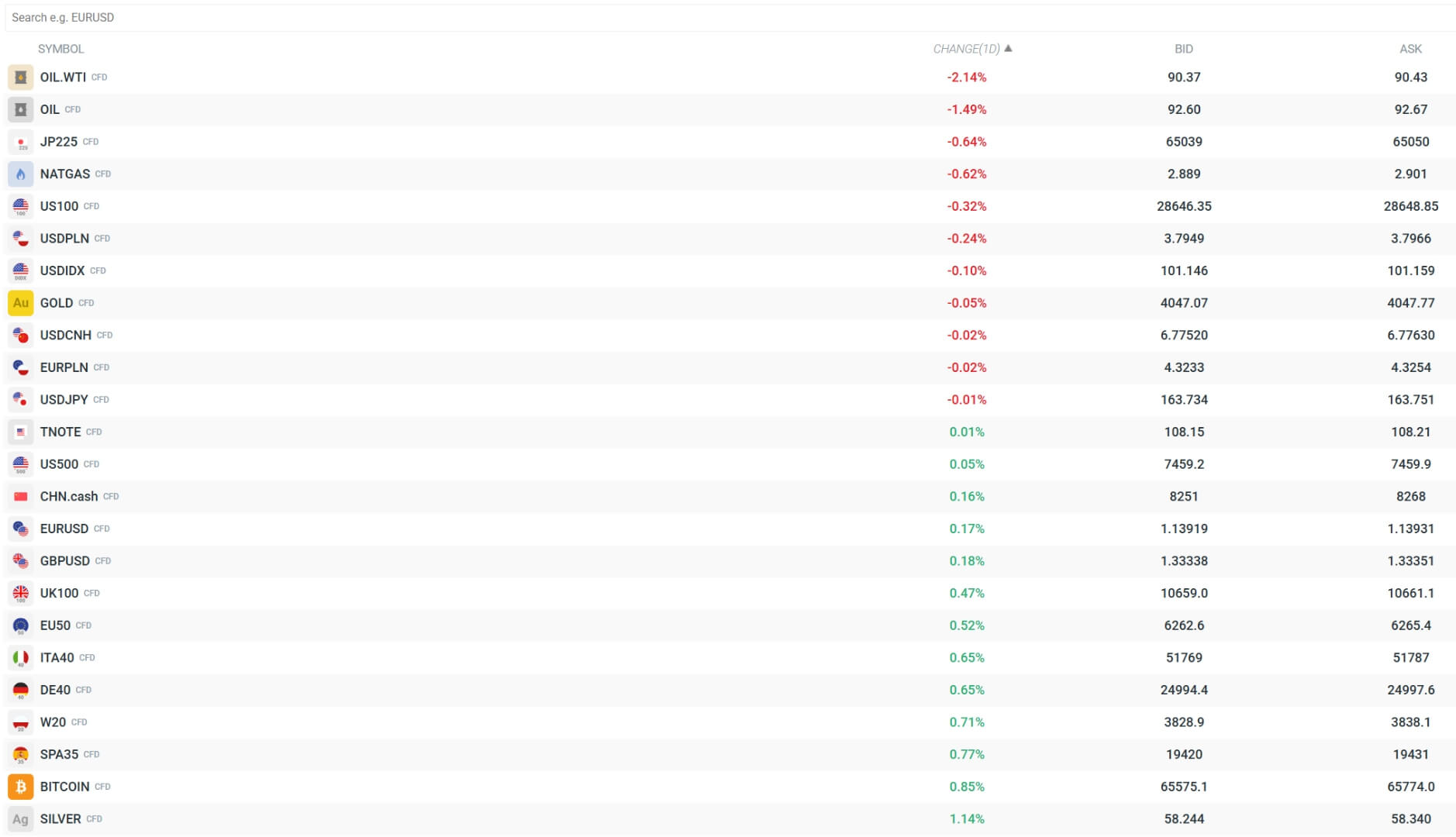
Volatility currently observed in selected instruments. Source: xStation


Daily summary 📈 Precious metals and stock indices rebound as Treasury yields fall


Oil gains as U.S. crude inventories fall

U.S. indices attempt to rebound after recent losses

US Open: Nasdaq 100 extends losses 🚩 AI stocks under pressure, CoreWeave falls 8%
The content of this report has been created by XTB S.A., with its registered office in Warsaw, at Prosta 67, 00-838 Warsaw, Poland, (KRS number 0000217580) and supervised by Polish Supervision Authority ( No. DDM-M-4021-57-1/2005). This material is a marketing communication within the meaning of Art. 24 (3) of Directive 2014/65/EU of the European Parliament and of the Council of 15 May 2014 on markets in financial instruments and amending Directive 2002/92/EC and Directive 2011/61/EU (MiFID II). Marketing communication is not an investment recommendation or information recommending or suggesting an investment strategy within the meaning of Regulation (EU) No 596/2014 of the European Parliament and of the Council of 16 April 2014 on market abuse (market abuse regulation) and repealing Directive 2003/6/EC of the European Parliament and of the Council and Commission Directives 2003/124/EC, 2003/125/EC and 2004/72/EC and Commission Delegated Regulation (EU) 2016/958 of 9 March 2016 supplementing Regulation (EU) No 596/2014 of the European Parliament and of the Council with regard to regulatory technical standards for the technical arrangements for objective presentation of investment recommendations or other information recommending or suggesting an investment strategy and for disclosure of particular interests or indications of conflicts of interest or any other advice, including in the area of investment advisory, within the meaning of the Trading in Financial Instruments Act of 29 July 2005 (i.e. Journal of Laws 2019, item 875, as amended). The marketing communication is prepared with the highest diligence, objectivity, presents the facts known to the author on the date of preparation and is devoid of any evaluation elements. The marketing communication is prepared without considering the client’s needs, his individual financial situation and does not present any investment strategy in any way. The marketing communication does not constitute an offer of sale, offering, subscription, invitation to purchase, advertisement or promotion of any financial instruments. XTB S.A. is not liable for any client’s actions or omissions, in particular for the acquisition or disposal of financial instruments, undertaken on the basis of the information contained in this marketing communication. In the event that the marketing communication contains any information about any results regarding the financial instruments indicated therein, these do not constitute any guarantee or forecast regarding the future results.