


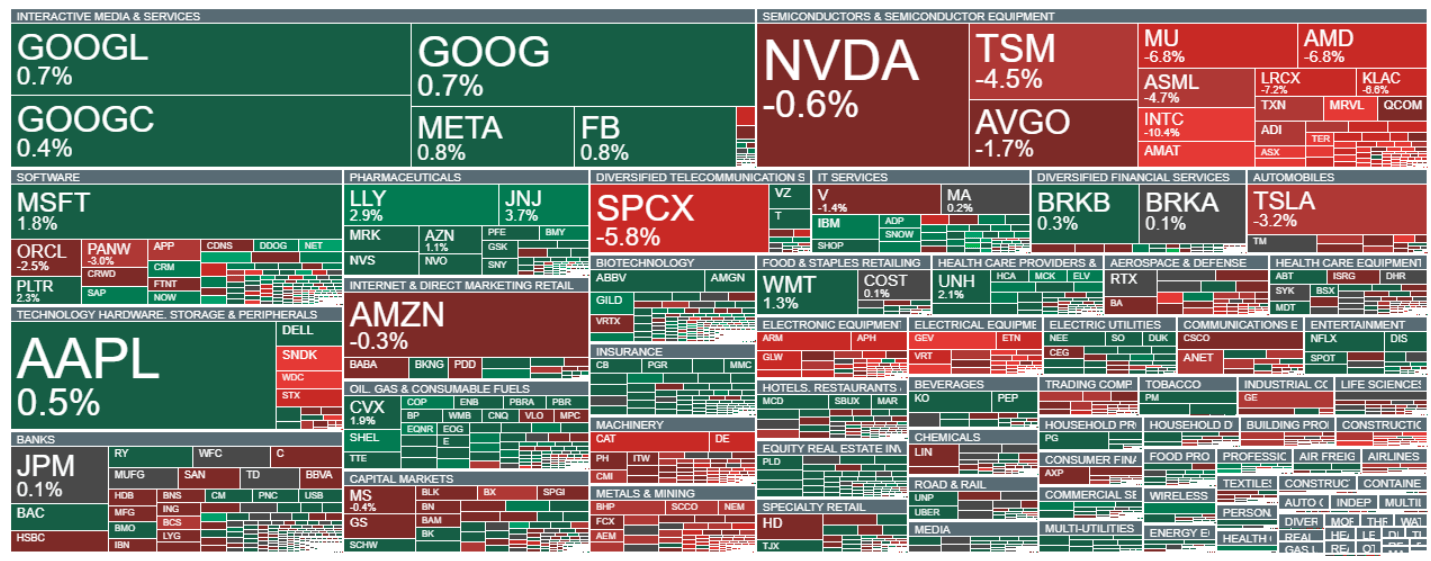
- Samsung's earnings and DeepSeek's announcement that it is developing its own AI chip are weighing on semiconductor stocks today.
- SpaceX shares are down nearly 6% following their Nasdaq debut, despite receiving positive ratings from several Wall Street banks.
- Oil prices are rebounding more than 2% to nearly $74 per barrel as tensions escalate between the US and Qatar on one side and Iran on the other, following multiple attacks on commercial vessels near Oman and the Strait of Hormuz.

- Samsung's earnings and DeepSeek's announcement that it is developing its own AI chip are weighing on semiconductor stocks today.
- SpaceX shares are down nearly 6% following their Nasdaq debut, despite receiving positive ratings from several Wall Street banks.
- Oil prices are rebounding more than 2% to nearly $74 per barrel as tensions escalate between the US and Qatar on one side and Iran on the other, following multiple attacks on commercial vessels near Oman and the Strait of Hormuz.
Memory and semiconductor stocks are dragging Wall Street lower today, sending the Nasdaq 100 down around 2%, while the Dow Jones Industrial Average loses 0.3% and the S&P 500 declines 0.5%. Shares of Micron, SanDisk, Intel, Applied Materials, and Marvell are down between 6% and 10%, with the selloff largely triggered by the market's negative reaction to Samsung's earnings. Today's weakness across the Nasdaq and semiconductor sector reflects deteriorating sentiment toward artificial intelligence, which has been the primary driver of this year's rally. At the same time, geopolitical tensions have escalated following attacks on commercial vessels near Oman and the Strait of Hormuz, increasing tensions involving Iran, the United States, and Qatar. Higher oil prices are also weighing on technology stocks.
- Nvidia shares are falling after Reuters reported that Chinese startup DeepSeek is developing its own AI chip, a move that could eventually reduce its reliance on Nvidia and Huawei processors.
- The news sparked a broad selloff across semiconductor stocks. The Philadelphia Semiconductor Index is down more than 5%, while Intel, Micron, Marvell, Western Digital, and SanDisk are all posting steep losses.
- Investors are also taking profits after the sector's powerful AI-driven rally, amid concerns that valuations have become stretched and that the upcoming earnings season could bring significantly higher volatility.
- Samsung's earnings also failed to support the sector. Although the company reported exceptionally strong profit growth, its shares declined, further weakening sentiment toward memory and semiconductor stocks.
- The market is also preparing for SK Hynix's upcoming Nasdaq listing while awaiting the release of minutes from the first Federal Reserve meeting chaired by Kevin Warsh, encouraging some investors to reduce risk exposure.
As a result, pressure on the largest AI-related companies is weighing on the broader Nasdaq, given the technology sector's dominant index weighting and the importance of Nvidia, TSMC, and other semiconductor companies within the benchmark.
Source: xStation5
US100 chart (H1 interval)
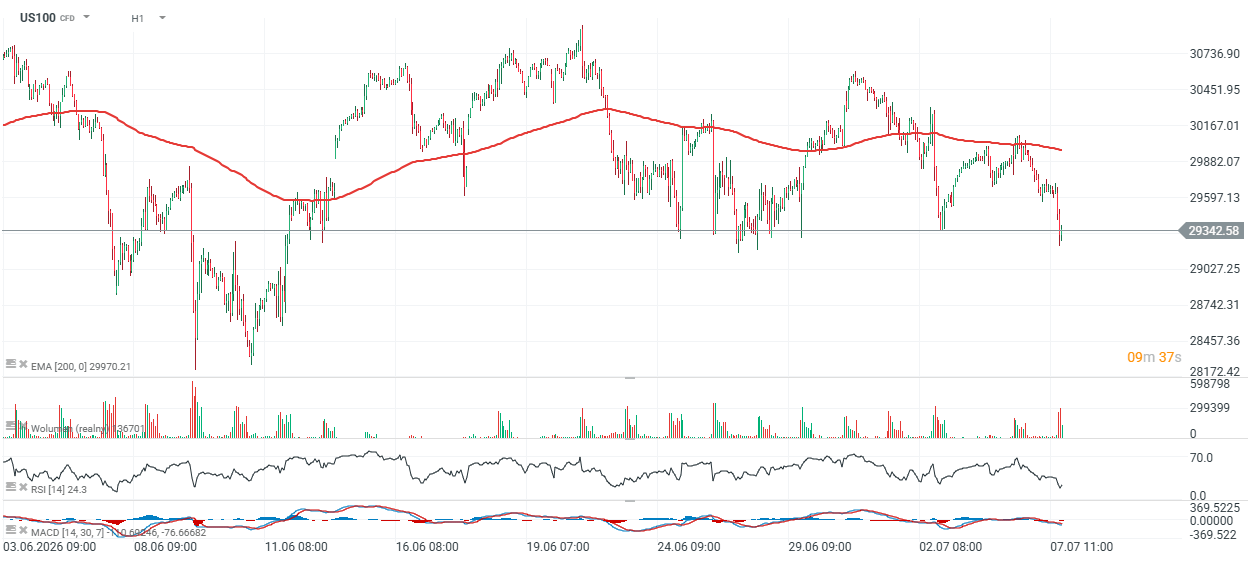
Looking at the US100 chart, we can see that the 30,450-30,800 point area has repeatedly attracted strong selling pressure. Should the index break below 29,100, the next likely downside target would be around 28,100, where previous buying interest emerged. For now, the key resistance remains the 30,000-point level.
Source: xStation5
TSMC shares (D1 interval)
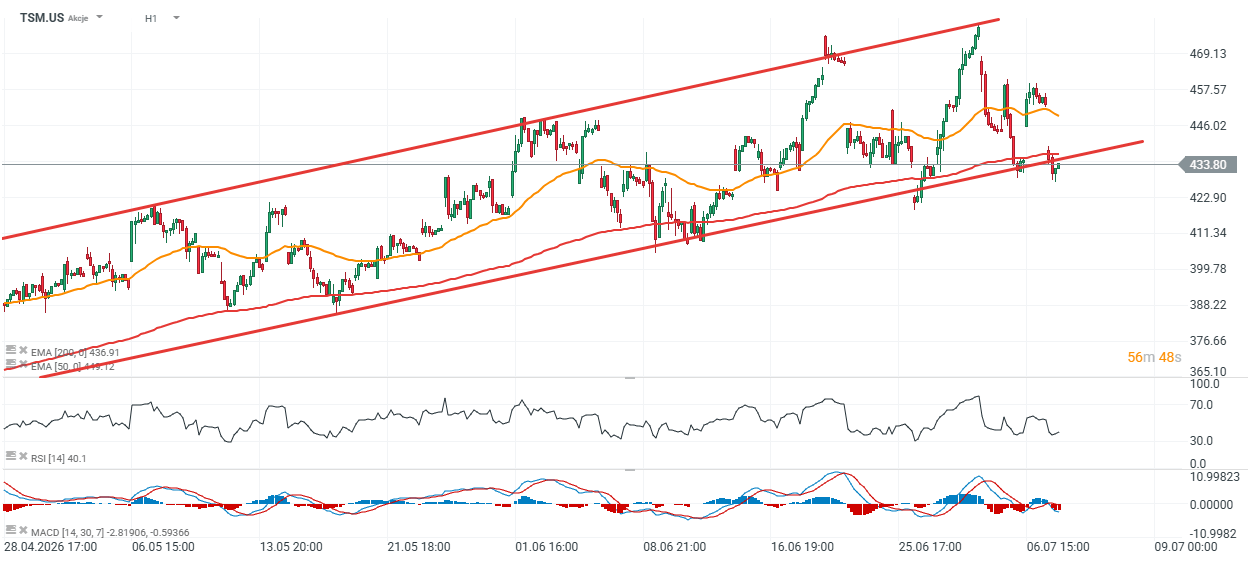
Shares of Taiwan Semiconductor (TSMC.US), the world's largest semiconductor manufacturer, have retreated nearly 10% from their recent highs and are now testing the lower boundary of their ascending price channel. Key support is located near $430 per share, while the upper boundary of the channel currently stands around $480. The nearest resistance is the 50-day EMA (orange line), currently near $450.
Source: xStation5
Why are Samsung shares falling?
Paradoxically, Samsung's earnings were not the problem. On the contrary, the company reported a 19-fold increase in operating profit, dramatically outperforming last year's results. However, equity markets look forward rather than backward. Investors concluded that even such spectacular numbers did not provide a compelling new reason to justify further expansion in AI-related valuations.
- First, expectations had already become exceptionally high. Memory manufacturers have been among this year's biggest beneficiaries of the AI investment boom, meaning that even record earnings only modestly exceeded analyst expectations. This is a classic "buy the rumor, sell the news" reaction, where excellent results become an opportunity to lock in profits.
- Second, Samsung released only preliminary earnings and did not provide detailed information on its semiconductor business or updated forward guidance. Investors were left without a clear answer to the key question: can today's AI-driven growth rates be sustained over the coming quarters?
- Sentiment was further pressured by growing doubts about the longevity of the AI investment cycle. Reports that Meta is considering commercializing excess computing capacity, combined with news that DeepSeek is developing its own AI processor, prompted investors to reassess long-term demand for the most advanced AI chips. This does not necessarily imply that demand is weakening today, but it has increased concerns that the current AI investment boom may not continue indefinitely.
Ultimately, Samsung did not disappoint on earnings. Instead, investors were disappointed that its record results failed to provide a fresh catalyst for further gains across the semiconductor sector. With valuations already elevated, even outstanding financial performance proved insufficient to attract additional buying, leaving the market increasingly sensitive to the cyclical risks facing the industry.
Samsung shares (D1 interval)
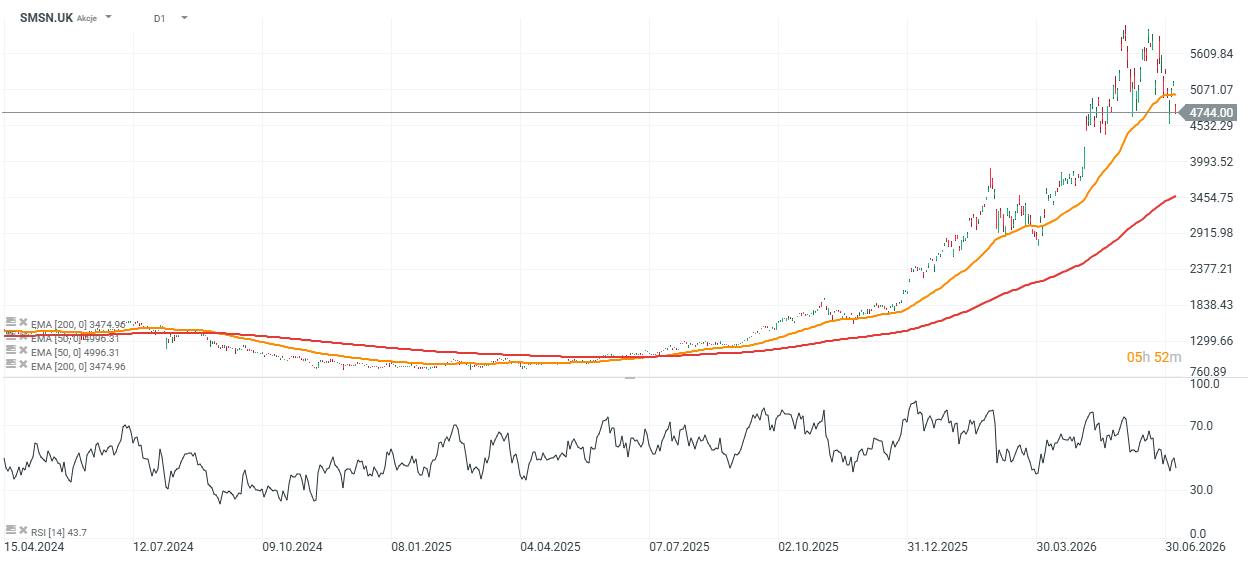
Samsung shares are currently correcting a substantial portion of their recent rally and have fallen back below the 50-day EMA (orange line), in a move resembling the March-April 2026 correction triggered by Middle East tensions. The stock is now trading approximately 25% below its all-time high.
Source: xStation5

Tesla was supposed to burn $5 billion, but posted a positive result. Will Tesla still be a car company in a year?

Record-breaking Meta, though with a cash loss. Investors (for now) are buying Zuckerberg's plan anyway


Daily Summary: SpaceX and the tech sector drive Wall Street, oil retreats sharply below $97

US OPEN: Preparations for Tesla's mega-merger with SpaceX. Diplomatic stalemate with Iran cools Wall Street's enthusiasm
The content of this report has been created by XTB S.A., with its registered office in Warsaw, at Prosta 67, 00-838 Warsaw, Poland, (KRS number 0000217580) and supervised by Polish Supervision Authority ( No. DDM-M-4021-57-1/2005). This material is a marketing communication within the meaning of Art. 24 (3) of Directive 2014/65/EU of the European Parliament and of the Council of 15 May 2014 on markets in financial instruments and amending Directive 2002/92/EC and Directive 2011/61/EU (MiFID II). Marketing communication is not an investment recommendation or information recommending or suggesting an investment strategy within the meaning of Regulation (EU) No 596/2014 of the European Parliament and of the Council of 16 April 2014 on market abuse (market abuse regulation) and repealing Directive 2003/6/EC of the European Parliament and of the Council and Commission Directives 2003/124/EC, 2003/125/EC and 2004/72/EC and Commission Delegated Regulation (EU) 2016/958 of 9 March 2016 supplementing Regulation (EU) No 596/2014 of the European Parliament and of the Council with regard to regulatory technical standards for the technical arrangements for objective presentation of investment recommendations or other information recommending or suggesting an investment strategy and for disclosure of particular interests or indications of conflicts of interest or any other advice, including in the area of investment advisory, within the meaning of the Trading in Financial Instruments Act of 29 July 2005 (i.e. Journal of Laws 2019, item 875, as amended). The marketing communication is prepared with the highest diligence, objectivity, presents the facts known to the author on the date of preparation and is devoid of any evaluation elements. The marketing communication is prepared without considering the client’s needs, his individual financial situation and does not present any investment strategy in any way. The marketing communication does not constitute an offer of sale, offering, subscription, invitation to purchase, advertisement or promotion of any financial instruments. XTB S.A. is not liable for any client’s actions or omissions, in particular for the acquisition or disposal of financial instruments, undertaken on the basis of the information contained in this marketing communication. In the event that the marketing communication contains any information about any results regarding the financial instruments indicated therein, these do not constitute any guarantee or forecast regarding the future results.