



The May NFP report has triggered a rally in the US dollar of over 0.7% against the euro, alongside significant declines in the US stock market (with the NASDAQ dropping 1.7%). The state of the US labor market has turned out significantly better than expected. In the face of persistent inflationary pressures, this should prompt the Fed to hike interest rates. The pivotal question now is not "if," but "when" – and to what extent the new Fed Chair, Kevin Warsh, will attempt to push back against monetary policy tightening.
A few words on the data
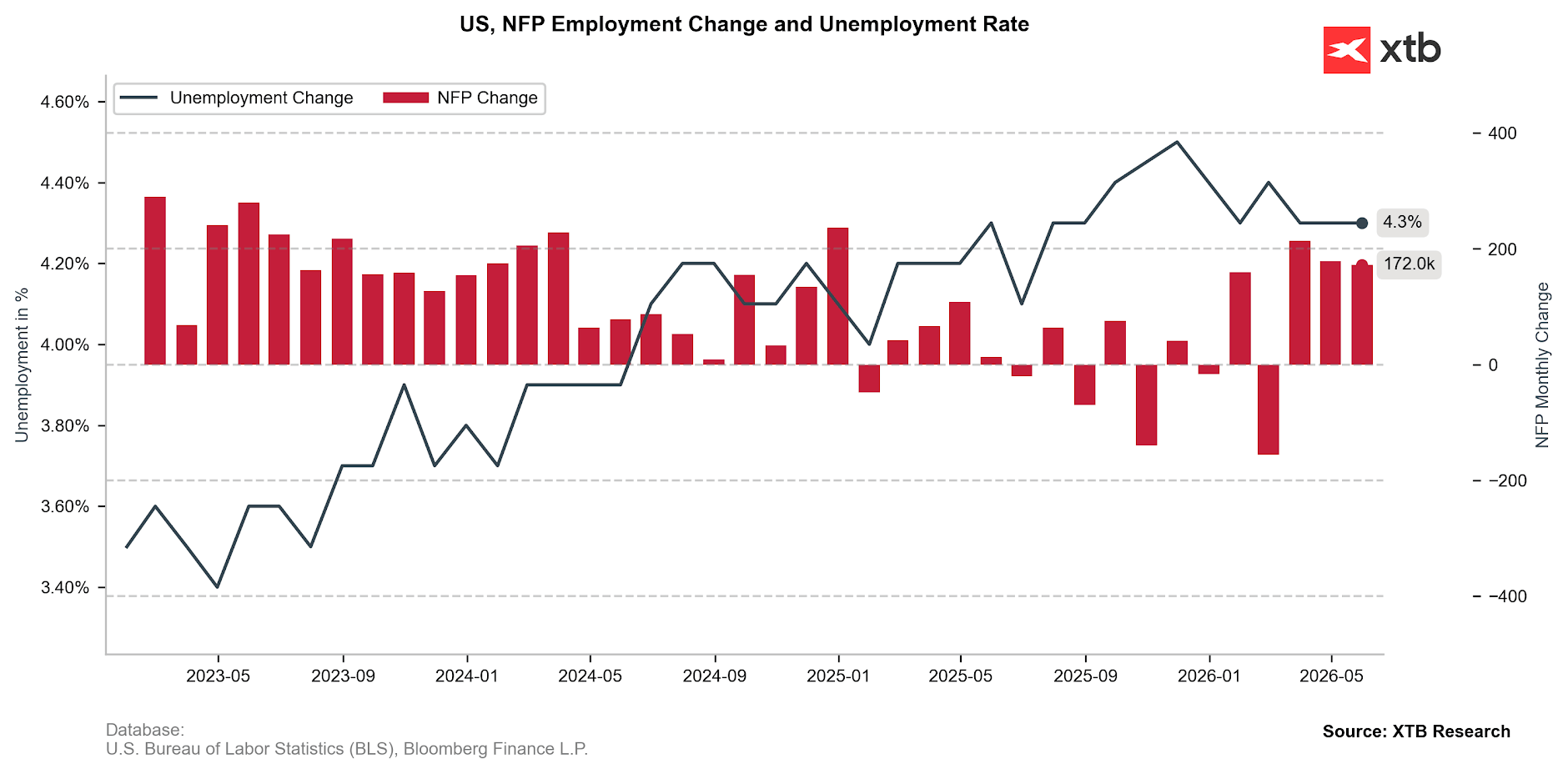
The number of non-farm payrolls in the US labor market increased by 172k. This figure not only beats the consensus estimate (86k) but vastly exceeds even the most optimistic forecasts (125k). To make matters worse for market bulls, data for the previous two months was revised upward by 93k. Given that the Bureau of Labor Statistics has accustomed us to substantial downward revisions, this comes as an exceptionally large surprise. Meanwhile, the unemployment rate remained unchanged at 4.3%.
Figure 1: Change in Non-Farm Payrolls (NFP) and the Unemployment Rate in the US (2023 - 2026)
 Source: XTB Research, 05.06.2026
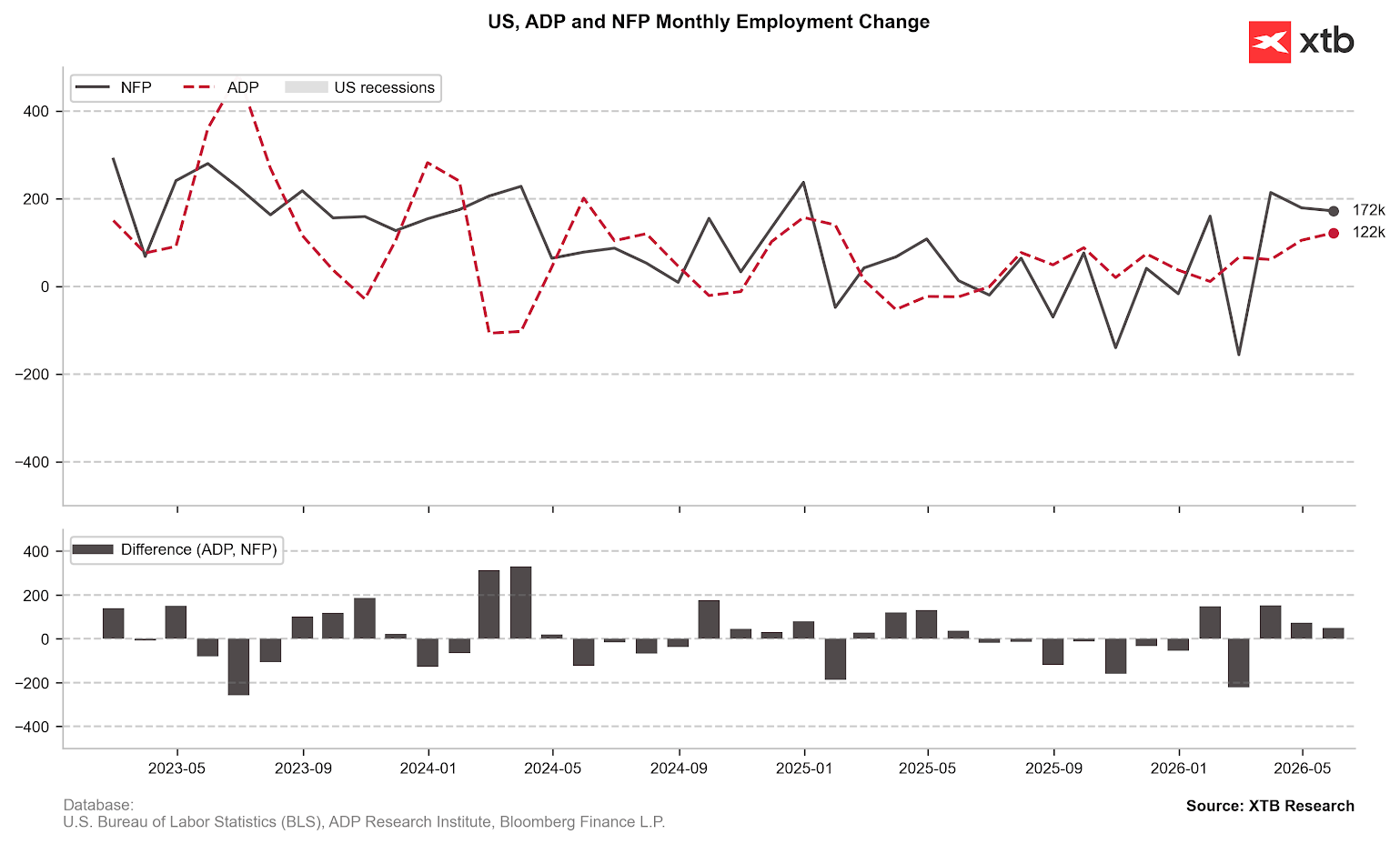
The report aligns perfectly with the broader picture painted by recent labor market data. Weekly jobless claims remained near multi-year lows, while ADP and JOLTS data both surprised to the upside – the latter particularly strongly, though it is worth noting that JOLTS data is significantly lagged compared to the rest. It is also consistent with the narrative from the latest FOMC minutes, where Fed analysts indicated that after a period of cooling, labor market conditions had "stabilized." Even then, for some policymakers, this served as an argument that the economy is not on the verge of a sudden slowdown and does not require the support of cheaper money.
Figure 2: NFP and ADP Data (2023 - 2026)
 Source: XTB Research, 05.06.2026
A 2026 rate hike fully priced in
On June 17, the FOMC will meet once again, this time chaired by its new leader. Kevin Warsh was supposed to represent the promise of long-awaited monetary easing for the markets. However, he takes over Jerome Powell's legacy at a time when discussions regarding rate cuts can be considered highly outdated.
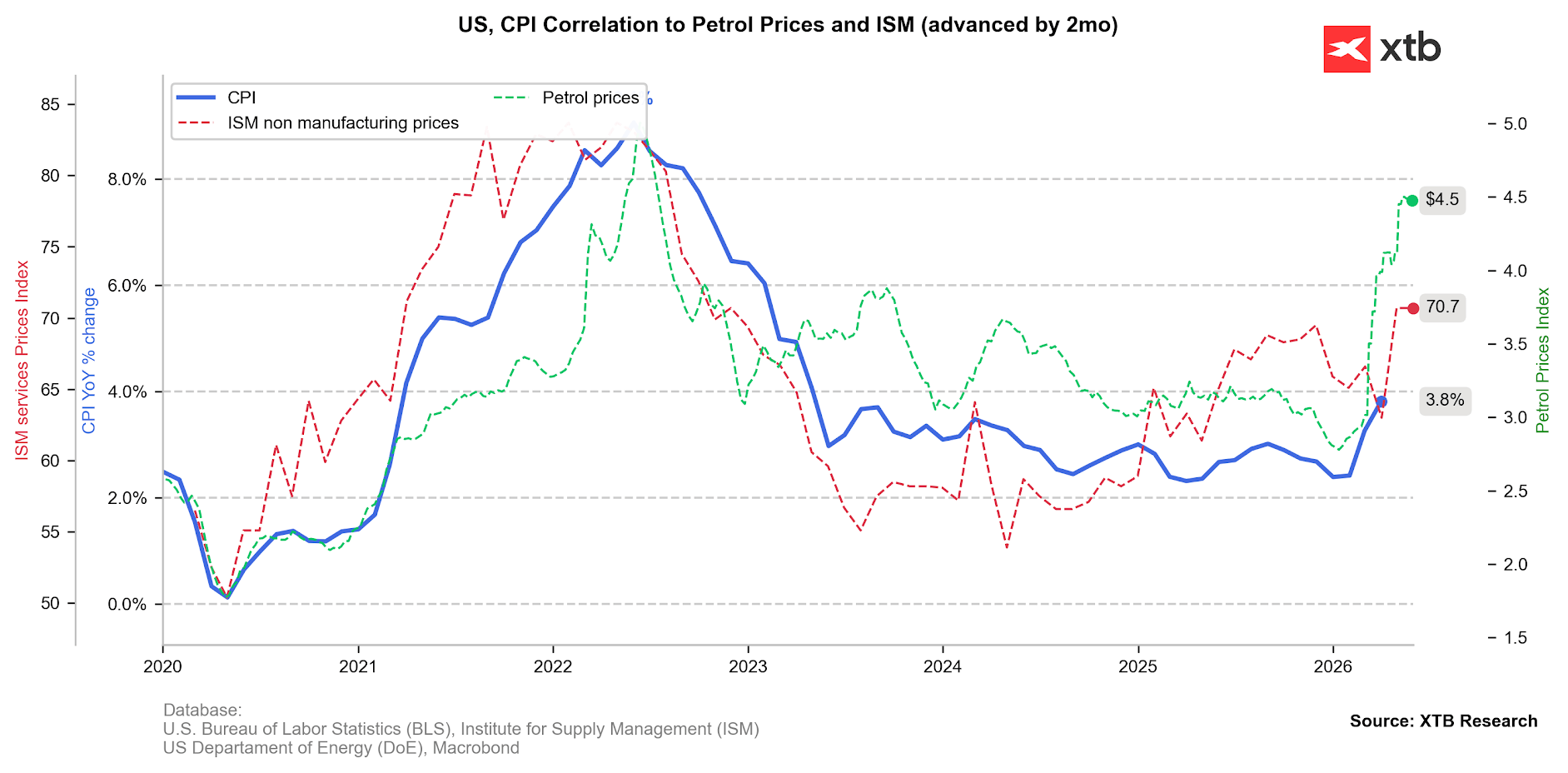
With labor market concerns fading significantly, the Fed will be able to focus almost entirely on the second part of its mandate: ensuring price stability. In light of the faster-than-expected transmission of higher energy commodity prices to other sectors of the economy, this is a critically important issue.
Figure 3: Headline CPI Inflation, ISM Services PMI Price Index, and US Gasoline Prices (2020 - 2026)
 Source: XTB Research, 05.06.2026
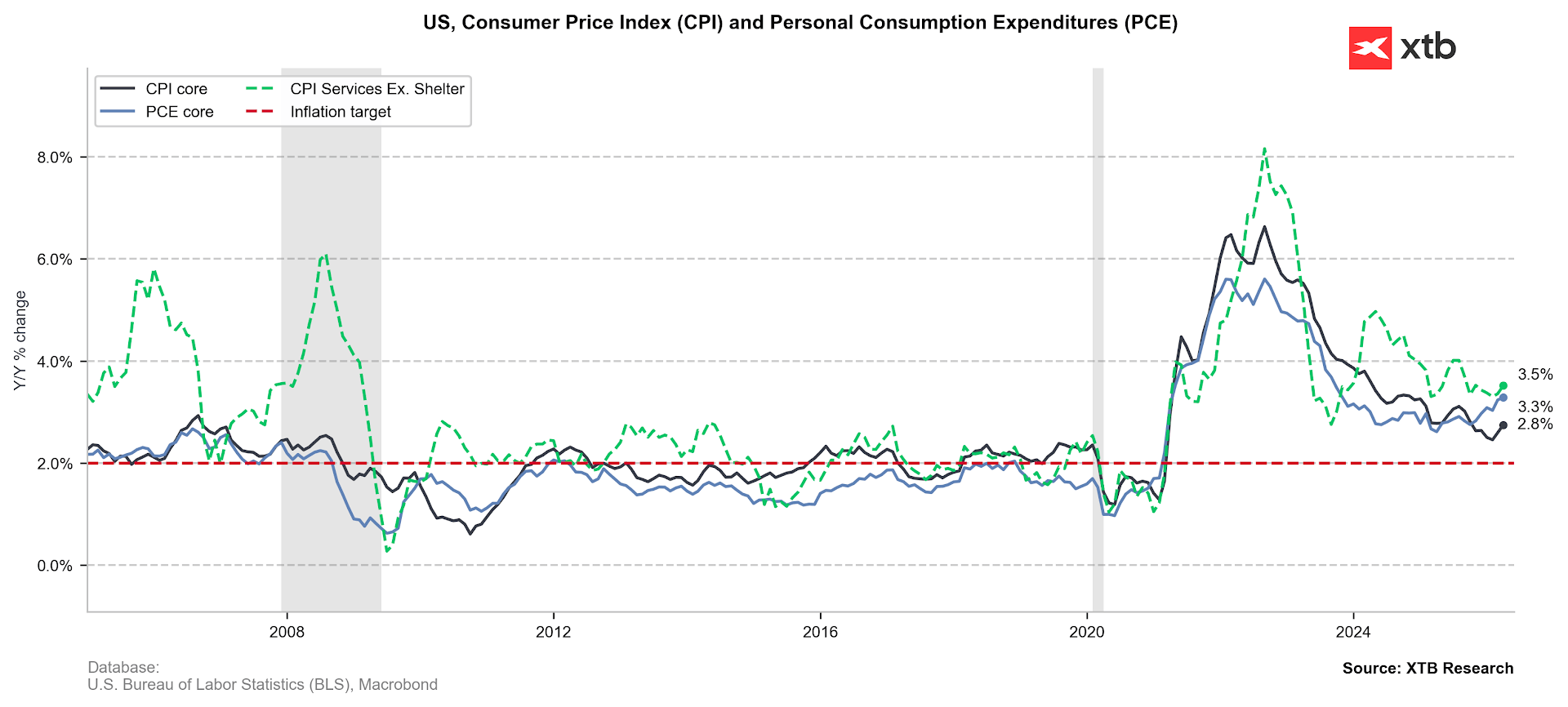
Headline CPI inflation rose to 3.8% in April. More concerning, however, is that core inflation measures have also moved significantly higher, both for CPI (2.8%) and PCE (3.3%) – the latter is published with a delay but is preferred by the Fed. At the same time, soft indicators point to further upward pressure on prices, including the price sub-index of the latest ISM PMI report, which hit a multi-year high of 70.7.
Figure 4: Core CPI and PCE Inflation in the US (2020 - 2026)
 Source: XTB Research, 05.06.2026
The dollar is well positioned
It appears that the labor market is finding its footing, and prolonged negotiations between the US and Iran (and the resulting prolonged disruption of the Strait of Hormuz) could hit US inflation harder than originally expected. Therefore, in the absence of de-escalation, the greenback should receive a three-pronged boost: from a more hawkish Fed, the US's position as a net exporter of energy commodities, and its safe-haven status, which attracts investors amidst global turmoil and should benefit from geopolitical instability.
Markets will be closely watching the divergence in rate hike pricing on both sides of the Atlantic – the US versus the Eurozone. Next week, the ECB will most likely make an upward move. Attention will center on President Lagarde’s remarks; given weak economic data and lower-than-expected inflation figures, she may temper the still rather aggressive expectations for further tightening.
Stock market under pressure
US bond yields are rising (10-year yields up by nearly 10 basis points), which is naturally unwelcome news for equity investors. There appears to be ample room for further upward revisions in rate hike expectations. If the market indeed moves in this direction, the stock market correction that many have been anticipating could easily materialize.
Key takeaway: In this context, it will also be crucial to see whether strong labor market data will call into question businesses' confidence regarding the scale of productivity growth brought by AI technology.
Since the improvement in the US labor market partly stems from job growth in the construction sector – which is enjoying a boom due to extensive data center construction – such conclusions might be somewhat premature. This issue is fundamental: excluding companies from the broader AI ecosystem, the S&P 500 is currently flat year-to-date. With them included, it is experiencing one of its most fruitful periods in decades.
—
Michał Jóźwiak, Financial Markets Analyst at XTB


Daily summary: Wall Street recovers losses despite a surge in yields 🗽 Gold and silver retreat


BREAKING: EURUSD with limited reaction to Fed Minutes from September meeting


🚩 Caterpillar shares extend decline, down 30% from record high


Webull shares down 20% amid fears over potential China ties
The content of this report has been created by XTB S.A., with its registered office in Warsaw, at Prosta 67, 00-838 Warsaw, Poland, (KRS number 0000217580) and supervised by Polish Supervision Authority ( No. DDM-M-4021-57-1/2005). This material is a marketing communication within the meaning of Art. 24 (3) of Directive 2014/65/EU of the European Parliament and of the Council of 15 May 2014 on markets in financial instruments and amending Directive 2002/92/EC and Directive 2011/61/EU (MiFID II). Marketing communication is not an investment recommendation or information recommending or suggesting an investment strategy within the meaning of Regulation (EU) No 596/2014 of the European Parliament and of the Council of 16 April 2014 on market abuse (market abuse regulation) and repealing Directive 2003/6/EC of the European Parliament and of the Council and Commission Directives 2003/124/EC, 2003/125/EC and 2004/72/EC and Commission Delegated Regulation (EU) 2016/958 of 9 March 2016 supplementing Regulation (EU) No 596/2014 of the European Parliament and of the Council with regard to regulatory technical standards for the technical arrangements for objective presentation of investment recommendations or other information recommending or suggesting an investment strategy and for disclosure of particular interests or indications of conflicts of interest or any other advice, including in the area of investment advisory, within the meaning of the Trading in Financial Instruments Act of 29 July 2005 (i.e. Journal of Laws 2019, item 875, as amended). The marketing communication is prepared with the highest diligence, objectivity, presents the facts known to the author on the date of preparation and is devoid of any evaluation elements. The marketing communication is prepared without considering the client’s needs, his individual financial situation and does not present any investment strategy in any way. The marketing communication does not constitute an offer of sale, offering, subscription, invitation to purchase, advertisement or promotion of any financial instruments. XTB S.A. is not liable for any client’s actions or omissions, in particular for the acquisition or disposal of financial instruments, undertaken on the basis of the information contained in this marketing communication. In the event that the marketing communication contains any information about any results regarding the financial instruments indicated therein, these do not constitute any guarantee or forecast regarding the future results.