



Nickel prices on the London Metal Exchange (LME) are rising for the second consecutive session but remain under pressure despite growing demand from industry and electric vehicle manufacturers. On November 25, the three-month nickel contract was trading at approximately $15,200 per tonne, while LME warehouse inventories stood at nearly 276,000 tonnes. The main challenge remains Indonesia's rapid production expansion, which continues to increase global supply faster than consumption. As a result, the effectiveness of Indonesia's proposed mining restrictions could become one of the most important drivers of nickel prices in 2027.
-
The global nickel market is expected to remain in surplus in 2027. The International Nickel Study Group (INSG) forecasts global production to increase from 3.87 million tonnes in 2026 to 4.07 million tonnes in 2027, while consumption is projected to rise from 3.85 million to 4 million tonnes. Consequently, the supply surplus could widen substantially from approximately 19,000 to 69,000 tonnes.
-
Indonesia is considering tighter nickel ore production quotas for 2027, potentially improving the global supply-demand balance. The country's 2026 RKAB quotas were previously raised to approximately 290–300 million wet metric tonnes of ore. However, the impact on prices will depend on whether these restrictions translate into lower refined nickel output, as smelters can draw on inventories or import additional ore from the Philippines.
-
The growing popularity of lithium iron phosphate (LFP) batteries is limiting the impact of electric vehicle adoption on nickel demand. Unlike NMC and NCA batteries, LFP technology does not require nickel. Consequently, rising global EV sales may not translate into a proportional increase in nickel consumption.
-
Elevated exchange inventories continue to complicate a sustained price recovery. Existing nickel stocks can satisfy industrial demand for some time, even if current production declines. For investors, a more convincing signal of improving fundamentals would be a sustained reduction in LME and SHFE inventories, particularly if accompanied by rising prices and a narrowing contango in the futures market.
What could drive nickel prices in 2027?
Indonesia currently has the greatest potential to change the nickel market's supply-demand dynamics, having emerged as the dominant center of global nickel production in recent years. The expansion of mining operations, nickel pig iron (NPI) smelters and high-pressure acid leaching (HPAL) facilities has increased metal availability for both stainless steel manufacturers and battery producers. At the same time, this expansion has put considerable pressure on higher-cost producers in Australia and other regions.
In a bullish scenario, restrictions on Indonesian mining output, improving Chinese industrial activity and declining inventories could gradually tighten the market. The surplus projected by INSG for 2027 represents just 1.7% of expected consumption, meaning even relatively modest changes in production could significantly affect the global supply-demand balance.
Conversely, persistently high Indonesian production, weaker stainless steel demand and further growth in LFP battery adoption could limit the potential for a recovery. Under these conditions, nickel prices could remain under pressure, forcing higher-cost producers to implement additional cost reductions and scale back investment.
What should investors monitor in the nickel market?
The most important indicators in the coming months will be actual nickel production in Indonesia, decisions on RKAB mining quotas, LME and SHFE inventories, and activity in China's stainless steel industry. Investors should also monitor developments in battery chemistry, particularly the share of LFP technology in the global electric vehicle market.
The LME futures curve could provide additional signals. According to November 25 quotations, the December 2027 contract was offered at approximately $15,850 per tonne, compared with around $15,200 per tonne for the three-month contract. The prevailing contango is consistent with relatively ample near-term metal availability, although the price difference between contracts also reflects financing and storage costs.
Nickel's outlook for 2027 will largely depend on whether producers slow the pace of supply expansion. Long-term industrial demand growth remains an important fundamental driver, but it does not guarantee higher prices. A meaningful reduction in production, accompanied by a sustained decline in inventories, would provide more convincing evidence that the market is approaching a lasting trend reversal.
NICKEL (1D interval)
Nickel prices have rebounded after reaching a key support zone around $15,000 per tonne, which coincides with the consolidation range established in 2025. Together with the $14,200 level, this area represents the most important support in the near term. For bulls, the next challenge will be to break above the 23.6% Fibonacci retracement of the latest downward move, potentially opening the way for a gradual recovery towards $17,000 per tonne in 2027. However, persistent oversupply and elevated inventories could limit the rebound, particularly if Indonesia's planned production restrictions prove insufficient to meaningfully tighten the global nickel market.
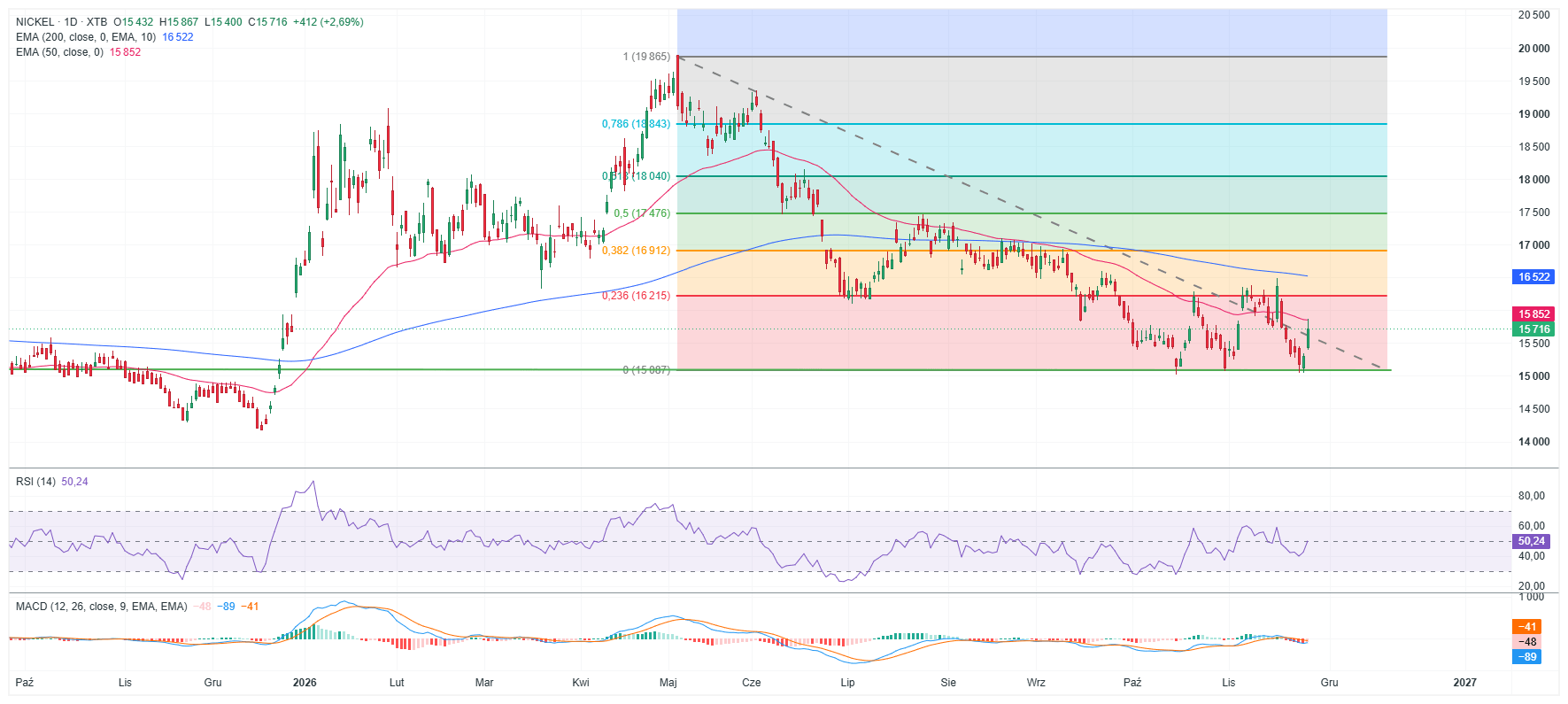 Source: XTB


🔼 OIL gains for the third consecutive session

Market Wrap: European Indices Rise 📈


📈 Gains across global stock markets


Chart of the Day: USDJPY Back Near 160. Fed and BOJ Prepare for Further Interest Rate Hikes
The content of this report has been created by XTB S.A., with its registered office in Warsaw, at Prosta 67, 00-838 Warsaw, Poland, (KRS number 0000217580) and supervised by Polish Supervision Authority ( No. DDM-M-4021-57-1/2005). This material is a marketing communication within the meaning of Art. 24 (3) of Directive 2014/65/EU of the European Parliament and of the Council of 15 May 2014 on markets in financial instruments and amending Directive 2002/92/EC and Directive 2011/61/EU (MiFID II). Marketing communication is not an investment recommendation or information recommending or suggesting an investment strategy within the meaning of Regulation (EU) No 596/2014 of the European Parliament and of the Council of 16 April 2014 on market abuse (market abuse regulation) and repealing Directive 2003/6/EC of the European Parliament and of the Council and Commission Directives 2003/124/EC, 2003/125/EC and 2004/72/EC and Commission Delegated Regulation (EU) 2016/958 of 9 March 2016 supplementing Regulation (EU) No 596/2014 of the European Parliament and of the Council with regard to regulatory technical standards for the technical arrangements for objective presentation of investment recommendations or other information recommending or suggesting an investment strategy and for disclosure of particular interests or indications of conflicts of interest or any other advice, including in the area of investment advisory, within the meaning of the Trading in Financial Instruments Act of 29 July 2005 (i.e. Journal of Laws 2019, item 875, as amended). The marketing communication is prepared with the highest diligence, objectivity, presents the facts known to the author on the date of preparation and is devoid of any evaluation elements. The marketing communication is prepared without considering the client’s needs, his individual financial situation and does not present any investment strategy in any way. The marketing communication does not constitute an offer of sale, offering, subscription, invitation to purchase, advertisement or promotion of any financial instruments. XTB S.A. is not liable for any client’s actions or omissions, in particular for the acquisition or disposal of financial instruments, undertaken on the basis of the information contained in this marketing communication. In the event that the marketing communication contains any information about any results regarding the financial instruments indicated therein, these do not constitute any guarantee or forecast regarding the future results.