


- According to reports, at least three commercial vessels were damaged, including a Qatari LNG tanker and a Saudi crude oil supertanker.
- Qatar accused Iran of carrying out the attack, calling it a serious violation of international law and a threat to the security of global energy supplies.
- At the same time, Iran said it would not resume negotiations with the U.S. if Washington continues its military threats.

- According to reports, at least three commercial vessels were damaged, including a Qatari LNG tanker and a Saudi crude oil supertanker.
- Qatar accused Iran of carrying out the attack, calling it a serious violation of international law and a threat to the security of global energy supplies.
- At the same time, Iran said it would not resume negotiations with the U.S. if Washington continues its military threats.
Brent crude (OIL) futures are up more than 2% today, climbing above $73 per barrel as geopolitical tensions flare again in the Strait of Hormuz. According to reports, at least three commercial vessels were damaged, including a Qatari LNG tanker, a Saudi crude oil supertanker, and another vessel struck by a drone.
- Qatar accused Iran of carrying out the attack, calling it a serious violation of international law and a threat to the security of global energy supplies.
- At the same time, Iran announced that it will not resume negotiations with the United States if Washington continues to issue military threats.
New tanker attacks drive oil prices higher
Oil prices are rising sharply following reports of additional attacks in one of the world's most important energy shipping routes. The U.K. Maritime Trade Operations (UKMTO) said several commercial vessels transiting the Strait of Hormuz came under attack, with at least three ships sustaining damage.
The most serious incident involved the Qatari LNG tanker Al-Rekayyat, which was struck by a projectile near the coast of Oman. A fire broke out in the engine room, raising concerns about a potential explosion. The Saudi crude oil supertanker Wedyan was also reportedly damaged, while a third vessel was hit by a drone and suffered minor structural damage. According to available information, there were no casualties or environmental spills.
Iran denies responsibility but had warned ships
Although Iran has not officially claimed responsibility for the attacks, Iranian state television reported that at least one of the tankers had ignored previous warnings from Iranian forces regarding the approved shipping route through the Strait. All three vessels were reportedly sailing along the southern route near Oman's coast, which Iran had warned against using last week.
Qatar and Gulf states condemn Iran
Qatar's Foreign Ministry described the attack as "a grave and explicit violation of international law," accusing Iran of threatening international navigation and global energy security. Doha called for an immediate halt to actions endangering maritime traffic and demanded that Iran be held accountable for any consequences resulting from the attacks.
The Secretary-General of the Gulf Cooperation Council (GCC) also condemned what he described as a "brutal" attack on the Qatari tanker, calling it a dangerous escalation that threatens regional stability. He urged the international community to take a firm stance against further attacks.
US-Iran tensions continue to escalate
Oil prices are also receiving support from worsening diplomatic relations between Washington and Tehran. Iranian Foreign Minister Abbas Araghchi said Tehran would not return to negotiations if the United States continues making military threats. Talks remain suspended during a week-long period of mourning following the death of Iran's Supreme Leader.
His comments came a day after President Donald Trump warned that unless a peace agreement is reached, the United States would "finish the job" in dealing with Iran.
Why the Strait of Hormuz matters
The Strait of Hormuz remains one of the world's most critical energy chokepoints. In peacetime, roughly 20% of global oil and natural gas trade passes through the narrow waterway, meaning that even isolated military incidents can quickly increase the geopolitical risk premium embedded in energy prices.
For now, markets are not pricing in a prolonged disruption to global energy supplies. However, the latest attacks highlight how fragile the security situation remains. Any further escalation or restrictions on shipping through the Strait of Hormuz could quickly push oil and natural gas prices even higher.
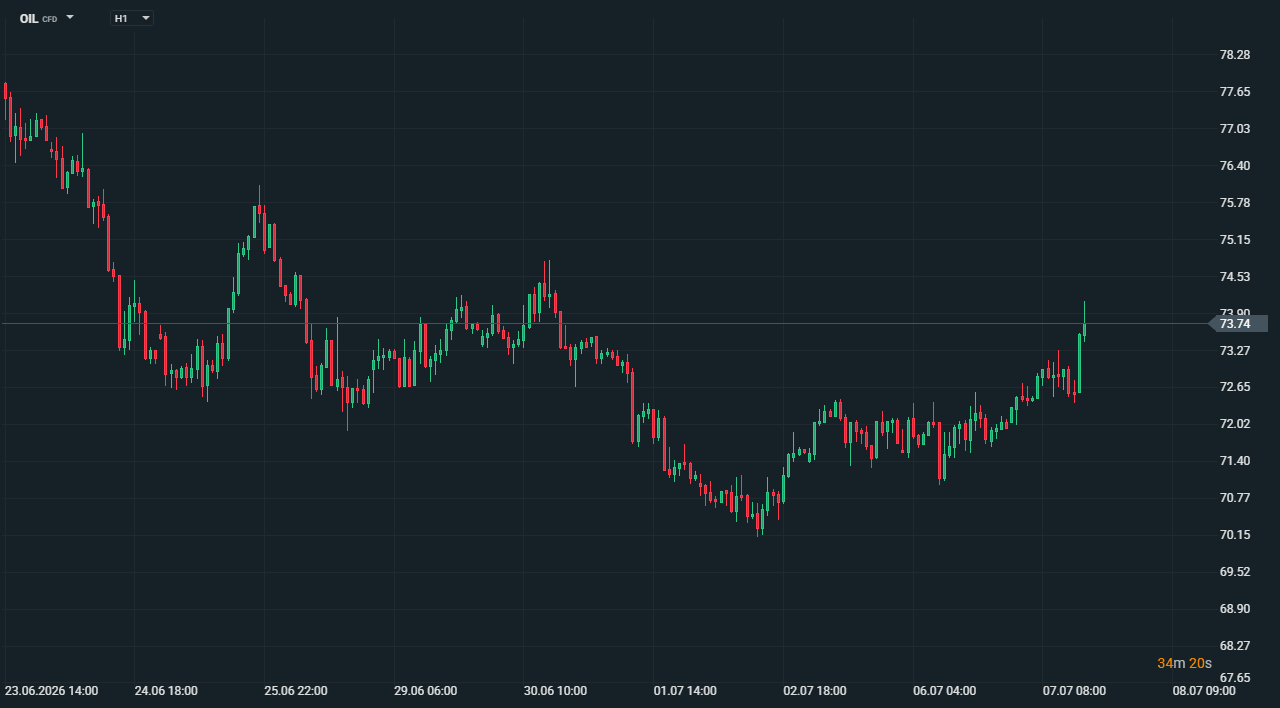
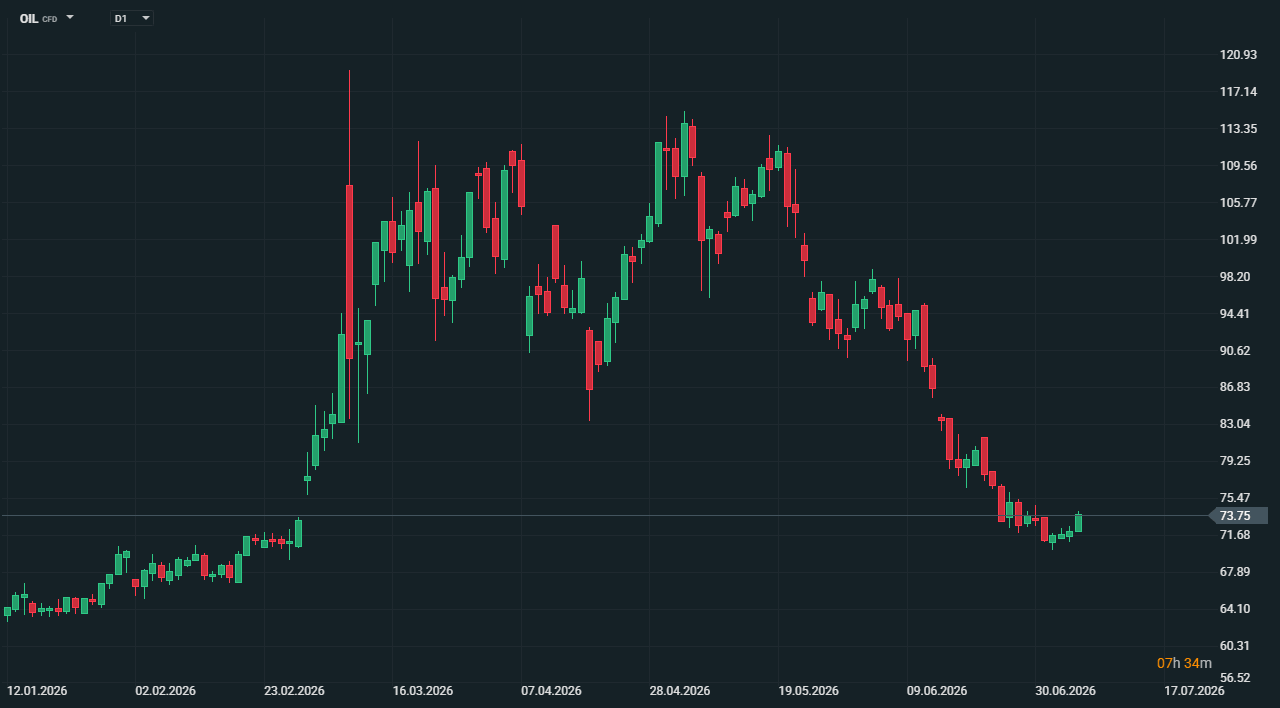
OIL charts (D1 and H1)
Brent crude is rebounding today and has reached its highest level since June 30, climbing to nearly $74 per barrel.
Source: xStation5
Source: xStation5


Daily Summary: SpaceX and the tech sector drive Wall Street, oil retreats sharply below $97

📉NATGAS loses 6% ahead of rollover


Russia is selling off gold reserves. Why, to whom, and does it matter for the market?

BREAKING: US oil inventories fall more than expected, but distillate build cools enthusiasm
The content of this report has been created by XTB S.A., with its registered office in Warsaw, at Prosta 67, 00-838 Warsaw, Poland, (KRS number 0000217580) and supervised by Polish Supervision Authority ( No. DDM-M-4021-57-1/2005). This material is a marketing communication within the meaning of Art. 24 (3) of Directive 2014/65/EU of the European Parliament and of the Council of 15 May 2014 on markets in financial instruments and amending Directive 2002/92/EC and Directive 2011/61/EU (MiFID II). Marketing communication is not an investment recommendation or information recommending or suggesting an investment strategy within the meaning of Regulation (EU) No 596/2014 of the European Parliament and of the Council of 16 April 2014 on market abuse (market abuse regulation) and repealing Directive 2003/6/EC of the European Parliament and of the Council and Commission Directives 2003/124/EC, 2003/125/EC and 2004/72/EC and Commission Delegated Regulation (EU) 2016/958 of 9 March 2016 supplementing Regulation (EU) No 596/2014 of the European Parliament and of the Council with regard to regulatory technical standards for the technical arrangements for objective presentation of investment recommendations or other information recommending or suggesting an investment strategy and for disclosure of particular interests or indications of conflicts of interest or any other advice, including in the area of investment advisory, within the meaning of the Trading in Financial Instruments Act of 29 July 2005 (i.e. Journal of Laws 2019, item 875, as amended). The marketing communication is prepared with the highest diligence, objectivity, presents the facts known to the author on the date of preparation and is devoid of any evaluation elements. The marketing communication is prepared without considering the client’s needs, his individual financial situation and does not present any investment strategy in any way. The marketing communication does not constitute an offer of sale, offering, subscription, invitation to purchase, advertisement or promotion of any financial instruments. XTB S.A. is not liable for any client’s actions or omissions, in particular for the acquisition or disposal of financial instruments, undertaken on the basis of the information contained in this marketing communication. In the event that the marketing communication contains any information about any results regarding the financial instruments indicated therein, these do not constitute any guarantee or forecast regarding the future results.