


-
Oil drops on diplomacy: Iran's weekend threats to block Hormuz were quickly defused by talks with the US. Brent crude fell below $80 per barrel.
-
Massive "dark" shipping: While official traffic decreased, unofficially up to 2-3 million barrels a day are flowing through the strait with transponders turned off.
-
Higher fuel prices in Poland from July 1: The end of the CPN shield and a VAT jump (from 8% to 23%) will push gas station prices up right at the start of the summer holidays. Cheaper crude is the only cushion.

-
Oil drops on diplomacy: Iran's weekend threats to block Hormuz were quickly defused by talks with the US. Brent crude fell below $80 per barrel.
-
Massive "dark" shipping: While official traffic decreased, unofficially up to 2-3 million barrels a day are flowing through the strait with transponders turned off.
-
Higher fuel prices in Poland from July 1: The end of the CPN shield and a VAT jump (from 8% to 23%) will push gas station prices up right at the start of the summer holidays. Cheaper crude is the only cushion.
Weekend paralysis and a diplomatic twist
The past weekend brought a sharp rise in tensions in the Middle East, which initially threatened to cut off a key global oil transport hub that, before the war, accounted for 20% of the global supply of black gold and 20% of LNG trade. In response to Saturday's Israeli attacks in Lebanon, which killed over 30 people, Tehran announced the re-blocking of the strategic Strait of Hormuz, accusing the US of condoning the violation of previous agreements. It seemed that the agreement would be completely broken due to President Trump's harsh statements on social media, but this morning, ahead of the European session, shows a return to stabilization.
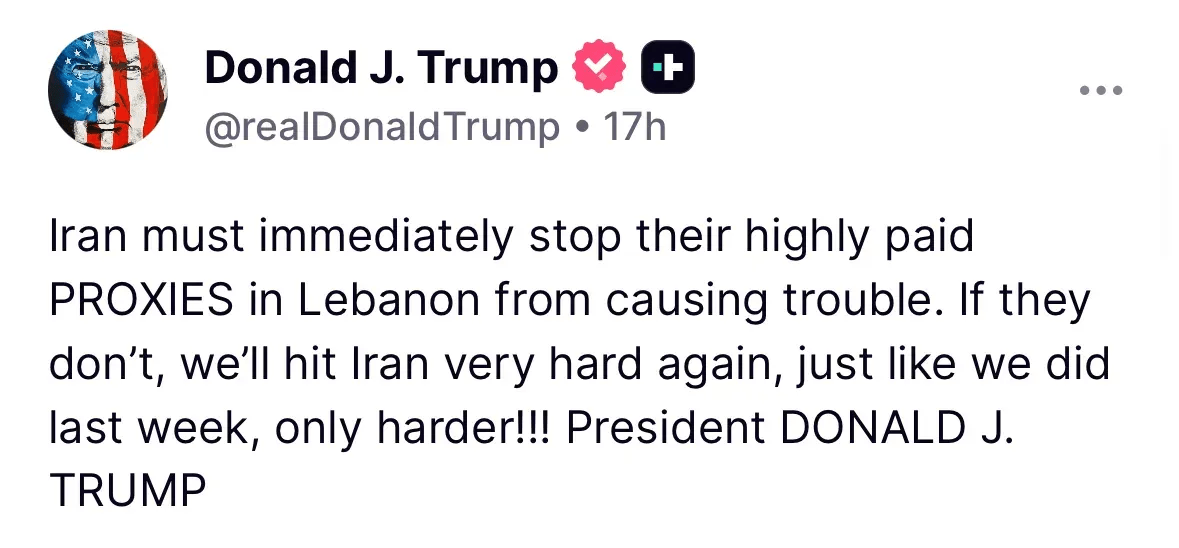 Source: Truth
Immediate mediation from Qatar and Pakistan led to another de-escalation. Talks in Bürgenstock, Switzerland, were resumed and concluded early Monday morning with the development of an official "roadmap" aimed at reaching a full peace agreement within 60 days. It is worth noting, however, that the Iranian side indicates that the initial negotiations focused primarily on Iran's frozen assets and sanctions, rather than issues concerning Lebanon. Nevertheless, the US and Iran have established a direct communication line to prevent incidents and guarantee the safe passage of commercial vessels through Hormuz, and have formed a group that is to work towards achieving lasting peace in Lebanon.
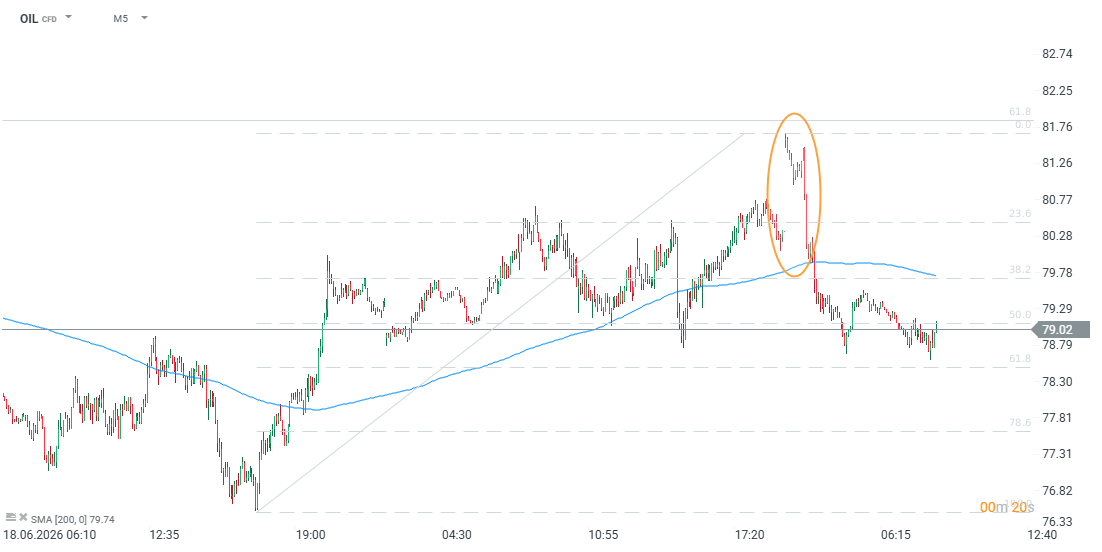
The start of today's trading, after a shortened session on Friday, was nervous. Brent oil started almost at the level of 82 USD per barrel, but prices very quickly returned to declines. Currently, Brent and WTI crude are losing about 1.5% in value, but they are still far from the local lows from last Thursday, when we were one day after the signing of the memorandum.
Two transport corridors: Traffic still heavily restricted
Despite Tehran's assurances about closing the route, millions of barrels of oil flowed continuously through the strait over the weekend, which supported the Pentagon's narrative of the ability to defend trade routes. Currently, two distinct corridors have emerged on the navigation map:
- Northern Corridor (Iranian): A route controlled by Tehran near Qeshm Island, which was used over the weekend by, among others, supertankers carrying Iraqi and Kuwaiti oil heading towards India.
- Southern Corridor (Oman): A route designated by the Joint Maritime Information Center (JMIC), running along the coast of Oman. Although navigation in this area does not require coordination with US forces, the JMIC advised ships to move with transponders (AIS system) turned on and full lighting both day and night.
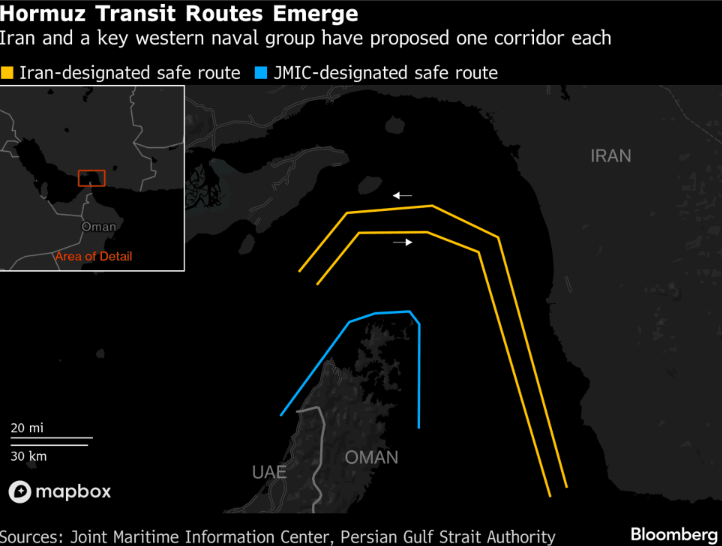 Source: Bloomberg Finance LP
Although transport was not physically completely blocked, the real volume of traffic on this key route dropped drastically, and on Sunday evening there was almost total paralysis in the strait. While in the previous days immediately after the conclusion of the preliminary agreement traffic was the highest since the beginning of the conflict, after the weekend communications from Iran, only a few smaller units decided on an open voyage with location turned on. Some producers from the region decided to send tankers "in the dark" (with transponders turned off) to perform transshipment on the high seas without attracting market attention. Such a procedure has been taking place for several weeks and reached nearly 2-3 million barrels per day. Officially, a small number of ships still pass through the Strait of Hormuz. Unofficially, it could be 2-3 times more. Source: Bloomberg Finance LP
What about LNG transport?
Data from ship tracking systems also bring information about the liquefied natural gas market. LNG carriers were observed during attempts to enter the Persian Gulf, however, the collected data indicates that these units managed to pass and leave key points of the route at the end of the day on Friday, which is before Iran's official announcements about restoring the blockade of the strait. It is worth emphasizing that an attack on a unit carrying oil, i.e., fuel, is not as dangerous as it is in the case of an attack on a gas carrier.


Daily Summary: Oil at five-month highs, indices under pressure (23.10.2026)


BREAKING: France slows down, Germany holds on. Euro falls below 1.12



Daily Summary: Valuations Under Pressure, Capital Moves Away From Technology

Market Wrap: "Decent" results are not enough – tech stocks fall further; oil highest since May (22.10.2026)
The content of this report has been created by XTB S.A., with its registered office in Warsaw, at Prosta 67, 00-838 Warsaw, Poland, (KRS number 0000217580) and supervised by Polish Supervision Authority ( No. DDM-M-4021-57-1/2005). This material is a marketing communication within the meaning of Art. 24 (3) of Directive 2014/65/EU of the European Parliament and of the Council of 15 May 2014 on markets in financial instruments and amending Directive 2002/92/EC and Directive 2011/61/EU (MiFID II). Marketing communication is not an investment recommendation or information recommending or suggesting an investment strategy within the meaning of Regulation (EU) No 596/2014 of the European Parliament and of the Council of 16 April 2014 on market abuse (market abuse regulation) and repealing Directive 2003/6/EC of the European Parliament and of the Council and Commission Directives 2003/124/EC, 2003/125/EC and 2004/72/EC and Commission Delegated Regulation (EU) 2016/958 of 9 March 2016 supplementing Regulation (EU) No 596/2014 of the European Parliament and of the Council with regard to regulatory technical standards for the technical arrangements for objective presentation of investment recommendations or other information recommending or suggesting an investment strategy and for disclosure of particular interests or indications of conflicts of interest or any other advice, including in the area of investment advisory, within the meaning of the Trading in Financial Instruments Act of 29 July 2005 (i.e. Journal of Laws 2019, item 875, as amended). The marketing communication is prepared with the highest diligence, objectivity, presents the facts known to the author on the date of preparation and is devoid of any evaluation elements. The marketing communication is prepared without considering the client’s needs, his individual financial situation and does not present any investment strategy in any way. The marketing communication does not constitute an offer of sale, offering, subscription, invitation to purchase, advertisement or promotion of any financial instruments. XTB S.A. is not liable for any client’s actions or omissions, in particular for the acquisition or disposal of financial instruments, undertaken on the basis of the information contained in this marketing communication. In the event that the marketing communication contains any information about any results regarding the financial instruments indicated therein, these do not constitute any guarantee or forecast regarding the future results.