



Oil prices remain highly sensitive to developments in the Middle East, where negotiations aimed at securing shipping through the Strait of Hormuz have reached an impasse. However, the market remains responsive to any headlines suggesting a potential “deal” and an easing of restrictions on tanker traffic through the Strait. Brent is gradually giving back part of its recent surge and is trading near $87 per barrel, while WTI is around $81, following the earlier sharp increase, with the latest media reports suggesting that Oman and Iran may be close to finalizing negotiations emerging as the main catalyst. Nevertheless, the market remains in a kind of “grey zone”: oil continues to flow through the Strait, but the persistent risk of disruption keeps the geopolitical premium elevated. In our view, a continued stalemate in the Strait of Hormuz remains the base-case scenario for the coming weeks, although the risk of escalation from the US is likely to decline as the political cycle moves closer to the autumn midterm elections.
Hopes for a Hormuz Deal Cool Oil Prices
Oil prices surged yesterday, with Brent approaching $87.50 per barrel after gaining nearly 5%, as markets grew increasingly concerned about a prolonged impasse surrounding the Strait of Hormuz. The situation began to shift rapidly, however, following reports that talks between Oman and Iran had entered an “advanced stage” and that the prospects for a peaceful outcome between the US and Iran were improving. Markets therefore started to price in de-escalation, reducing some of the geopolitical premium previously embedded in crude prices.
- Oil prices fell below $88 per barrel in response to reports of progress in the negotiations.
- A potential agreement could reduce the risk of shipping disruptions in the Strait of Hormuz as well as attacks on tankers and energy infrastructure.
- The situation remains highly fluid, however – without a final agreement, the risk of a renewed increase in the geopolitical premium has not disappeared.
- The market is therefore shifting from a “neither war nor peace” scenario towards pricing in greater chances of de-escalation, which is currently putting downward pressure on oil prices.
US Strategic Oil Reserves Fall to a 40-Year Low
Geopolitics is not the only factor that could keep volatility in the oil market elevated. The US Strategic Petroleum Reserve (SPR) has fallen below 300 million barrels for the first time since 1983, leaving the United States with a significantly smaller emergency buffer than in previous decades. This is particularly important at a time when the market remains exposed to potential supply disruptions in the Middle East.
- The SPR declined by another 6.1 million barrels last week.
- Total reserves fell to just under 299 million barrels, their lowest level in more than 40 years.
- The low level of the SPR leaves less room to deploy strategic reserves in the event of a sudden disruption to global oil supplies.
- Progress in the Hormuz negotiations is currently weighing on oil prices, but depleted US strategic reserves remain an important risk factor in the event of renewed escalation.
Higher Oil Prices Complicate the Fed Outlook Ahead of Key Inflation Data
The recent rise in oil prices has once again brought US inflation risks into focus. Markets have increased expectations for a Fed rate hike in September, while the 10-year US Treasury yield has risen to 4.727%. A lasting de-escalation in the Middle East and a decline in energy prices could, however, ease some of this pressure.
- Higher energy prices could make further disinflation more difficult and therefore limit the Fed's room to pursue a more accommodative monetary policy.
- The US 10-year Treasury yield rose to around 4.73% amid growing concerns that price pressures could remain elevated.
- A decline in oil prices driven by progress in negotiations could have the opposite effect, reducing the risk of renewed acceleration in inflation.
- Wednesday's US CPI release remains the key event and could determine whether markets maintain their increased expectations for a September Fed rate hike.
Oil Futures Chart (OIL)
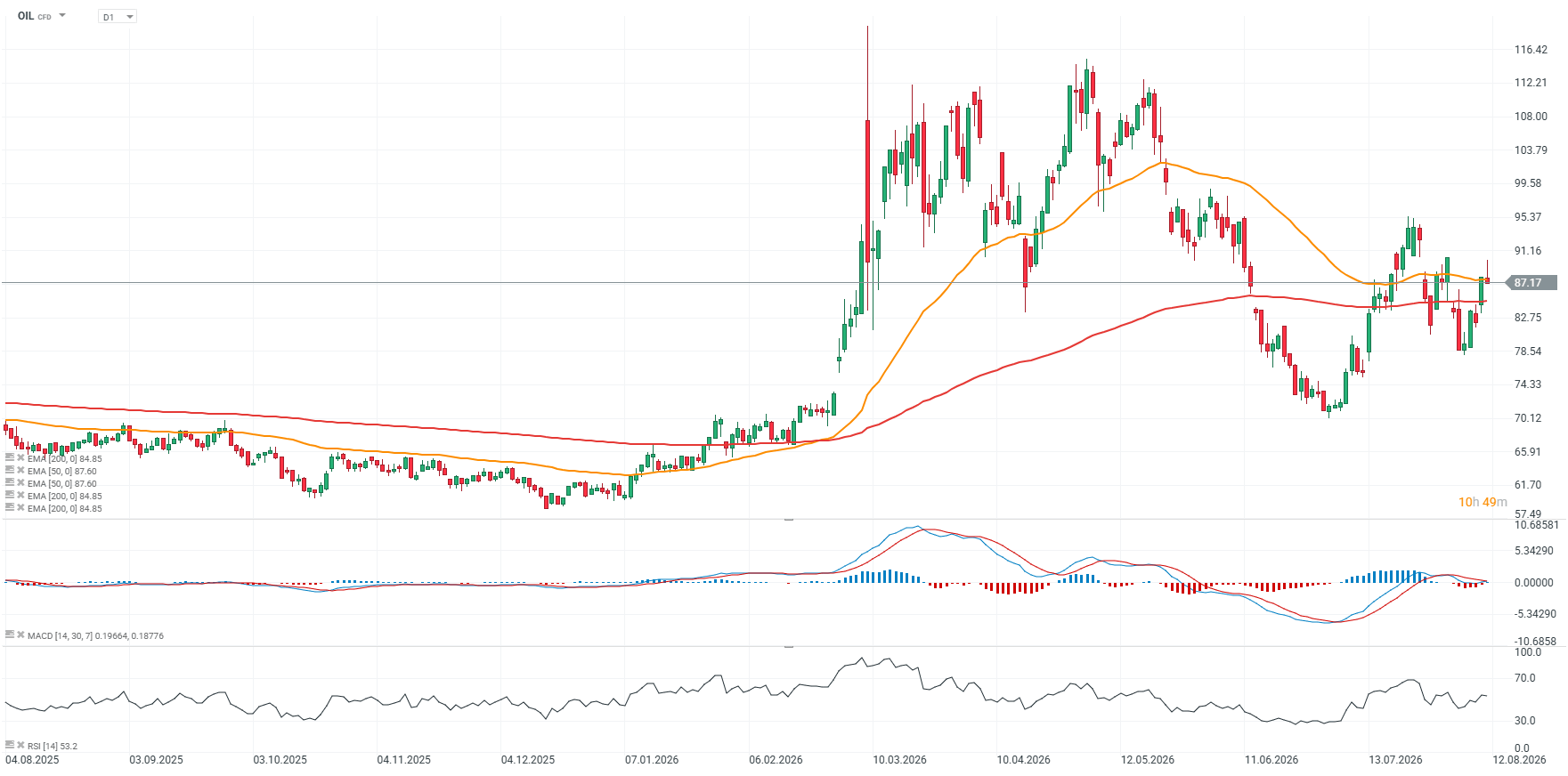
Oil prices have pulled back towards the 50-day exponential moving average (EMA50) on the daily timeframe, currently running near $87.60. A move below this level could signal a shift towards bearish momentum and open the way for a potential pullback towards $82, where previous price reactions occurred. On the upside, the area around $90 remains a potentially important psychological resistance level.
Source: xStation5


Daily Summary: Earnings Season Kicks Off on Wall Street Amid Mixed Sentiment



Market Wrap: European Stocks Rise as Banks Beat Earnings Expectations


🚩 US100 loses 0.7%



Morning Wrap: Tech Crash in Asia and Hawkish Central Banks in the Shadow of an Oil Shock (13.10.2026)
The content of this report has been created by XTB S.A., with its registered office in Warsaw, at Prosta 67, 00-838 Warsaw, Poland, (KRS number 0000217580) and supervised by Polish Supervision Authority ( No. DDM-M-4021-57-1/2005). This material is a marketing communication within the meaning of Art. 24 (3) of Directive 2014/65/EU of the European Parliament and of the Council of 15 May 2014 on markets in financial instruments and amending Directive 2002/92/EC and Directive 2011/61/EU (MiFID II). Marketing communication is not an investment recommendation or information recommending or suggesting an investment strategy within the meaning of Regulation (EU) No 596/2014 of the European Parliament and of the Council of 16 April 2014 on market abuse (market abuse regulation) and repealing Directive 2003/6/EC of the European Parliament and of the Council and Commission Directives 2003/124/EC, 2003/125/EC and 2004/72/EC and Commission Delegated Regulation (EU) 2016/958 of 9 March 2016 supplementing Regulation (EU) No 596/2014 of the European Parliament and of the Council with regard to regulatory technical standards for the technical arrangements for objective presentation of investment recommendations or other information recommending or suggesting an investment strategy and for disclosure of particular interests or indications of conflicts of interest or any other advice, including in the area of investment advisory, within the meaning of the Trading in Financial Instruments Act of 29 July 2005 (i.e. Journal of Laws 2019, item 875, as amended). The marketing communication is prepared with the highest diligence, objectivity, presents the facts known to the author on the date of preparation and is devoid of any evaluation elements. The marketing communication is prepared without considering the client’s needs, his individual financial situation and does not present any investment strategy in any way. The marketing communication does not constitute an offer of sale, offering, subscription, invitation to purchase, advertisement or promotion of any financial instruments. XTB S.A. is not liable for any client’s actions or omissions, in particular for the acquisition or disposal of financial instruments, undertaken on the basis of the information contained in this marketing communication. In the event that the marketing communication contains any information about any results regarding the financial instruments indicated therein, these do not constitute any guarantee or forecast regarding the future results.