



OpenAI, one of the leading representatives and symbols of the AI revolution, made its video-generation model, Sora, available to the general public about six months ago. The model, as many might have thought, was groundbreaking: even attentive observers were often “fooled” by the material it generated. Many saw it as the beginning of a difficult period, if not the end, for “conventional” cinema and many media industries. Yesterday, however, OpenAI announced that the time of the popular application has come to an end. What went wrong, and who could profit from it?
The details and the exact, real reasons behind OpenAI’s decision are not known. The prevailing view among journalists and many analysts in the LLM industry seems to be that the model was simply too unprofitable and/or not effective enough, and that the company is at a point where compute power and financial/human resources are needed much more elsewhere.
The financial resources in question also appear to be increasingly constrained. OpenAI is a private company, so a reliable analysis of its financials isn’t possible; however, Reuters reports that the company is offering private credit firms a return on capital of 17.5%. Such a high rate of return suggests the company may currently have serious difficulties attracting capital, which, it is worth remembering, it continues to burn at an alarming pace.
Shutting down Sora obviously signals trouble for AI-focused companies, but who might benefit from this shift in sentiment? It could be the companies most “punished” in valuations by a revolution that has not yet arrived, or firms able to identify the weaknesses of the technology.
If capital and consumers turn away from Video AI, the biggest beneficiaries could be large, traditional players that had the most to lose. The best examples here are Disney, Netflix, and Paramount.
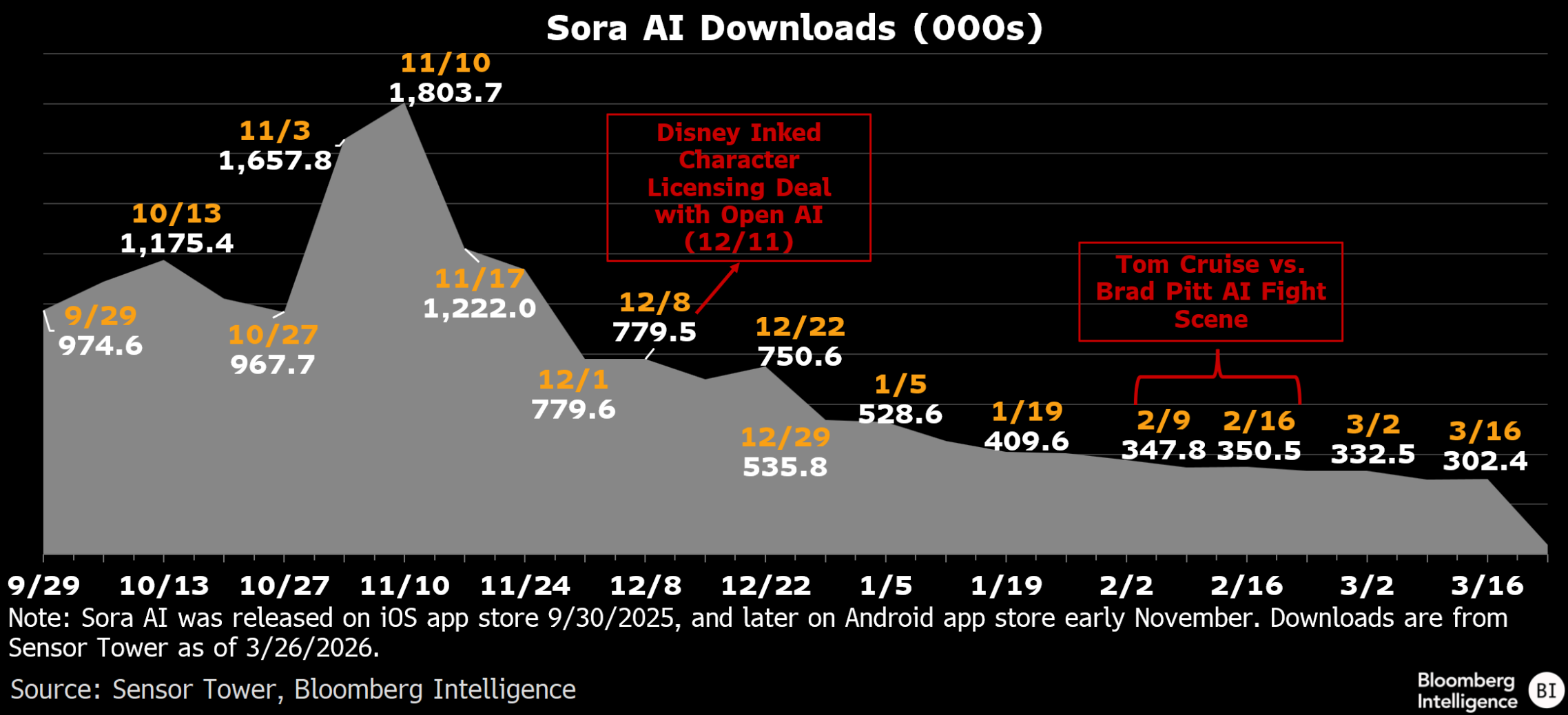
Source: Bloomberg Finance Lp.
DIS.US, PSKY.US, NFLX.US (D1)
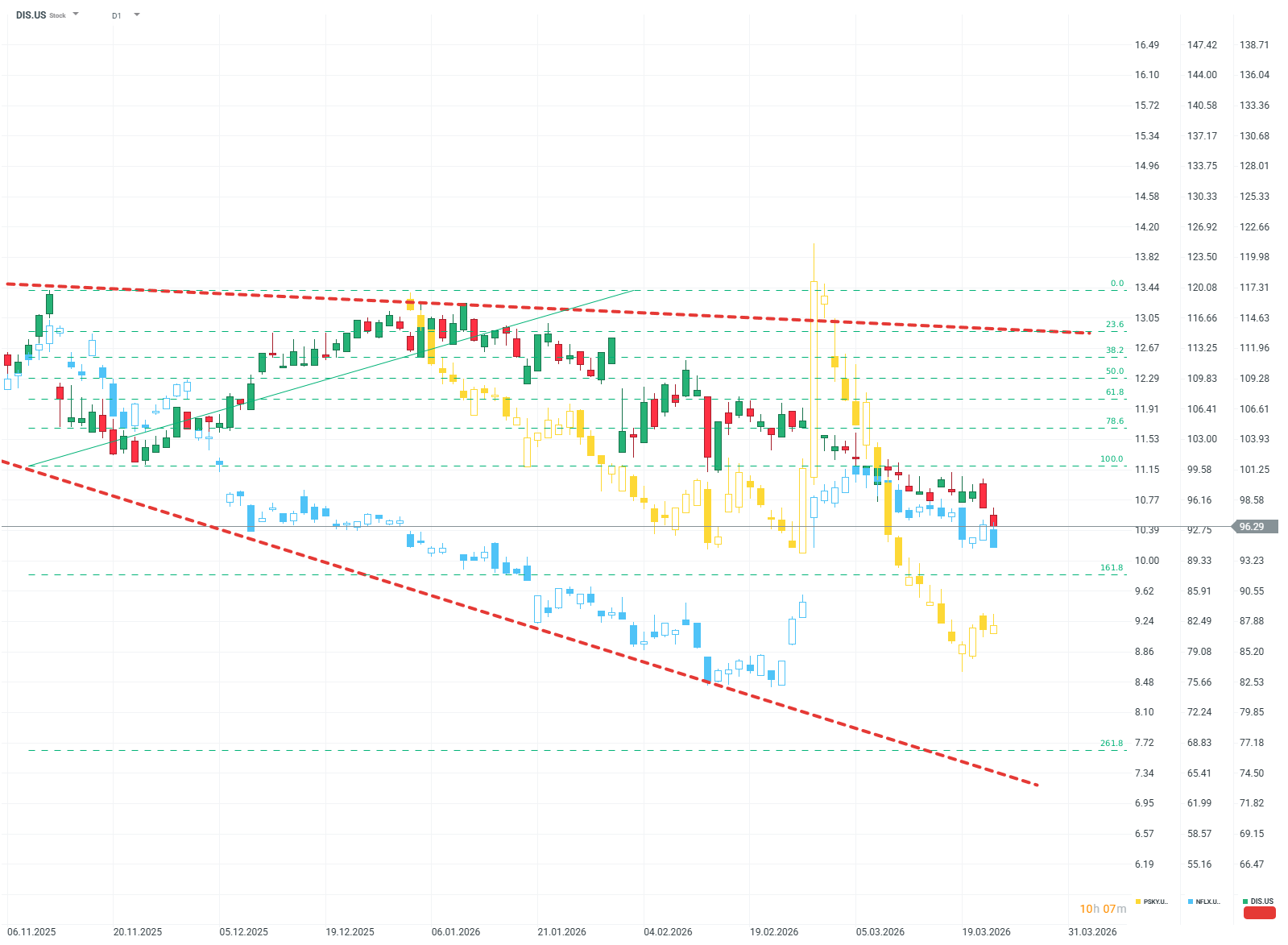
Media companies have suffered significant sell-offs amid fears about AI and the quality of their long-term strategies. After declines from recent highs in the double-digit range, a return to the upper bounds of the consolidation range may be possible. Source: xStation5.
Disney, as a global conglomerate, did not want to risk being left out of the revolution, even if it wasn’t fully convinced by it. Disney signed a cooperation agreement with OpenAI, granting it a license to its IP. By shutting down Sora, however, OpenAI is indirectly admitting that the cooperation with Disney turned out to be unproductive. Disney’s case shows that even with one of the most important assets of conventional publishers on its side, legally acquired intellectual property, a video-AI initiative can fail.
This could support the valuations of companies such as Netflix or Paramount. AI threatened the “premium” models of streaming platforms on several fronts, but the end of Sora means that the business “moat” of large distributors and producers remains insurmountable for engineers and programmers.



US Open: Further declines on Wall Street, Brent above 111 USD, AI correction continues (14.10.2026)


Market Wrap: "Decent" results are not enough – tech stocks fall further; oil highest since May (22.10.2026)


Tesla was supposed to burn $5 billion, but posted a positive result. Will Tesla still be a car company in a year?

Record-breaking Meta, though with a cash loss. Investors (for now) are buying Zuckerberg's plan anyway
The content of this report has been created by XTB S.A., with its registered office in Warsaw, at Prosta 67, 00-838 Warsaw, Poland, (KRS number 0000217580) and supervised by Polish Supervision Authority ( No. DDM-M-4021-57-1/2005). This material is a marketing communication within the meaning of Art. 24 (3) of Directive 2014/65/EU of the European Parliament and of the Council of 15 May 2014 on markets in financial instruments and amending Directive 2002/92/EC and Directive 2011/61/EU (MiFID II). Marketing communication is not an investment recommendation or information recommending or suggesting an investment strategy within the meaning of Regulation (EU) No 596/2014 of the European Parliament and of the Council of 16 April 2014 on market abuse (market abuse regulation) and repealing Directive 2003/6/EC of the European Parliament and of the Council and Commission Directives 2003/124/EC, 2003/125/EC and 2004/72/EC and Commission Delegated Regulation (EU) 2016/958 of 9 March 2016 supplementing Regulation (EU) No 596/2014 of the European Parliament and of the Council with regard to regulatory technical standards for the technical arrangements for objective presentation of investment recommendations or other information recommending or suggesting an investment strategy and for disclosure of particular interests or indications of conflicts of interest or any other advice, including in the area of investment advisory, within the meaning of the Trading in Financial Instruments Act of 29 July 2005 (i.e. Journal of Laws 2019, item 875, as amended). The marketing communication is prepared with the highest diligence, objectivity, presents the facts known to the author on the date of preparation and is devoid of any evaluation elements. The marketing communication is prepared without considering the client’s needs, his individual financial situation and does not present any investment strategy in any way. The marketing communication does not constitute an offer of sale, offering, subscription, invitation to purchase, advertisement or promotion of any financial instruments. XTB S.A. is not liable for any client’s actions or omissions, in particular for the acquisition or disposal of financial instruments, undertaken on the basis of the information contained in this marketing communication. In the event that the marketing communication contains any information about any results regarding the financial instruments indicated therein, these do not constitute any guarantee or forecast regarding the future results.