



The controversial US technology company released its results for Q2 2026. As can be seen in after hours pricing, investors are extremely pleased with the release, with the shares up about 15% ahead of the open.
Sentiment toward the company prior to the release was fairly cool. From last year’s peak, the stock had lost about 40%.
Palantir Technical Analysis (D1)
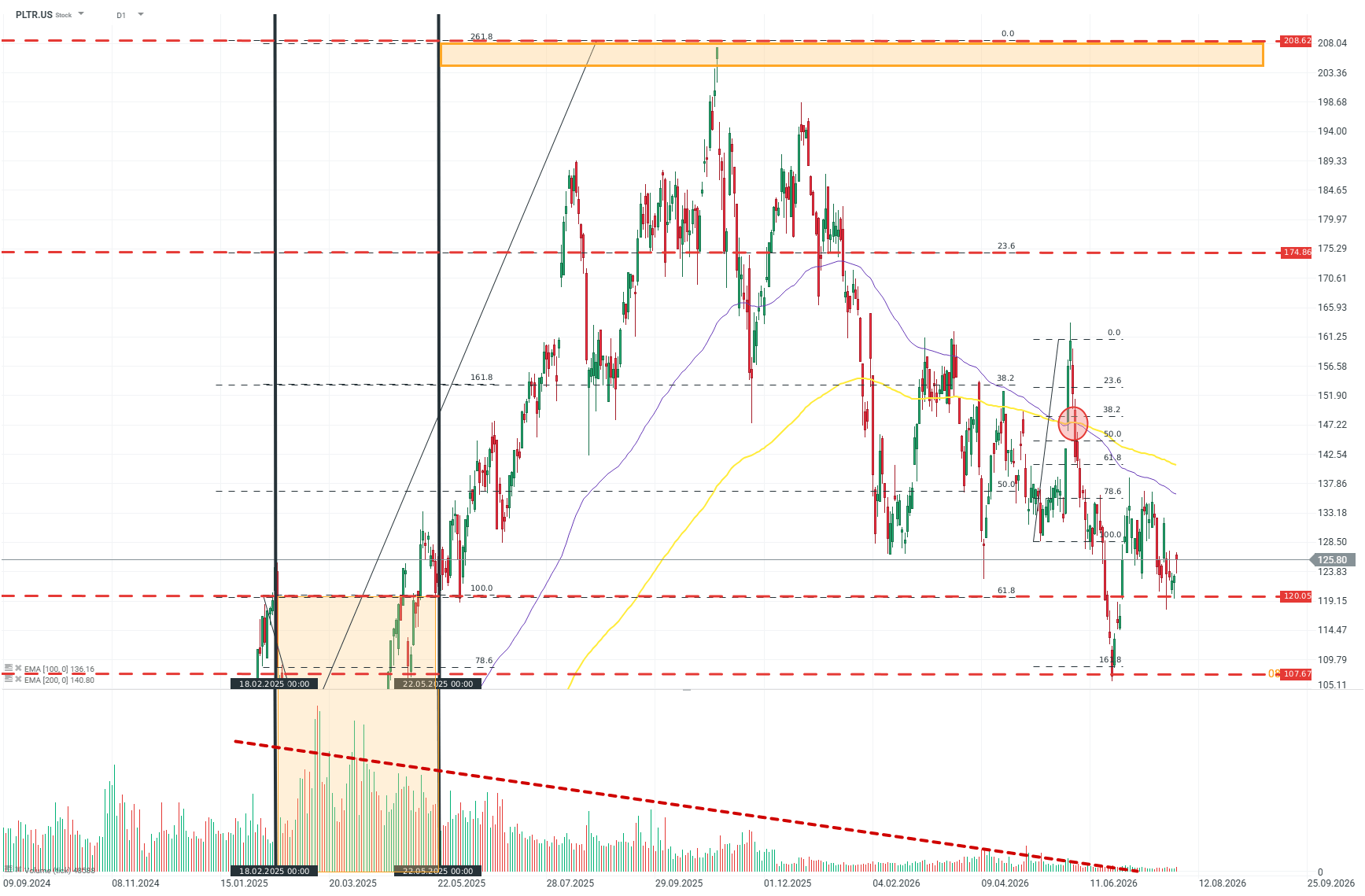
The price staged a sharp rebound from the 161.8% Fibonacci level, which currently marks a local low. The most recent correction also broke the downtrend line. If the company maintains the pace seen in premarket trading, the stock should open above the EMA200. An additional bullish signal is volume, which also indicates weakening selling pressure through declining volume. Source: xStation5
Sentiment was not helped by the company’s leaders themselves, such as Alex Karp and Peter Thiel. Management sold significant blocks of shares ahead of the earnings release, which many analysts viewed as a serious warning sign. In Palantir’s case, this signal is unusually low quality because company insiders do this fairly regularly.
This moderate, if not pessimistic, sentiment did not stop the market from expecting substantial growth from Palantir. The company once again proved that the label “hyper growth” was not popularized in connection with it without reason. Expectations were beaten decisively.
Revenue:
- Expected: USD 1.82bn (+82% YoY)
- Actual: USD 1.94bn (+94% YoY)
EPS:
- Expected: $0.34 (+213%)
- Actual: $0.41 (+256%)
This implies an adjusted operating margin of about 62%, and GAAP gross margins of 84.7%.
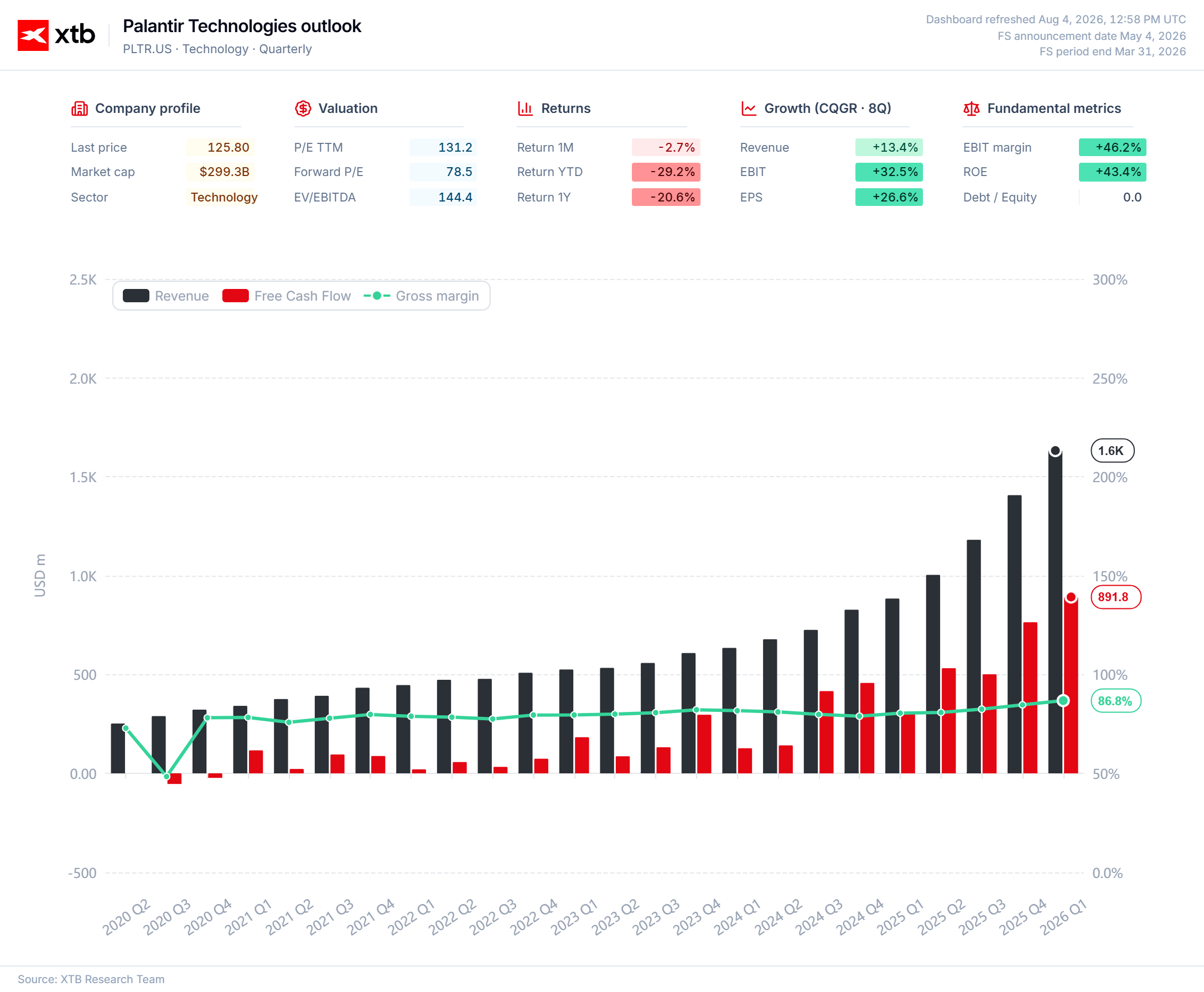
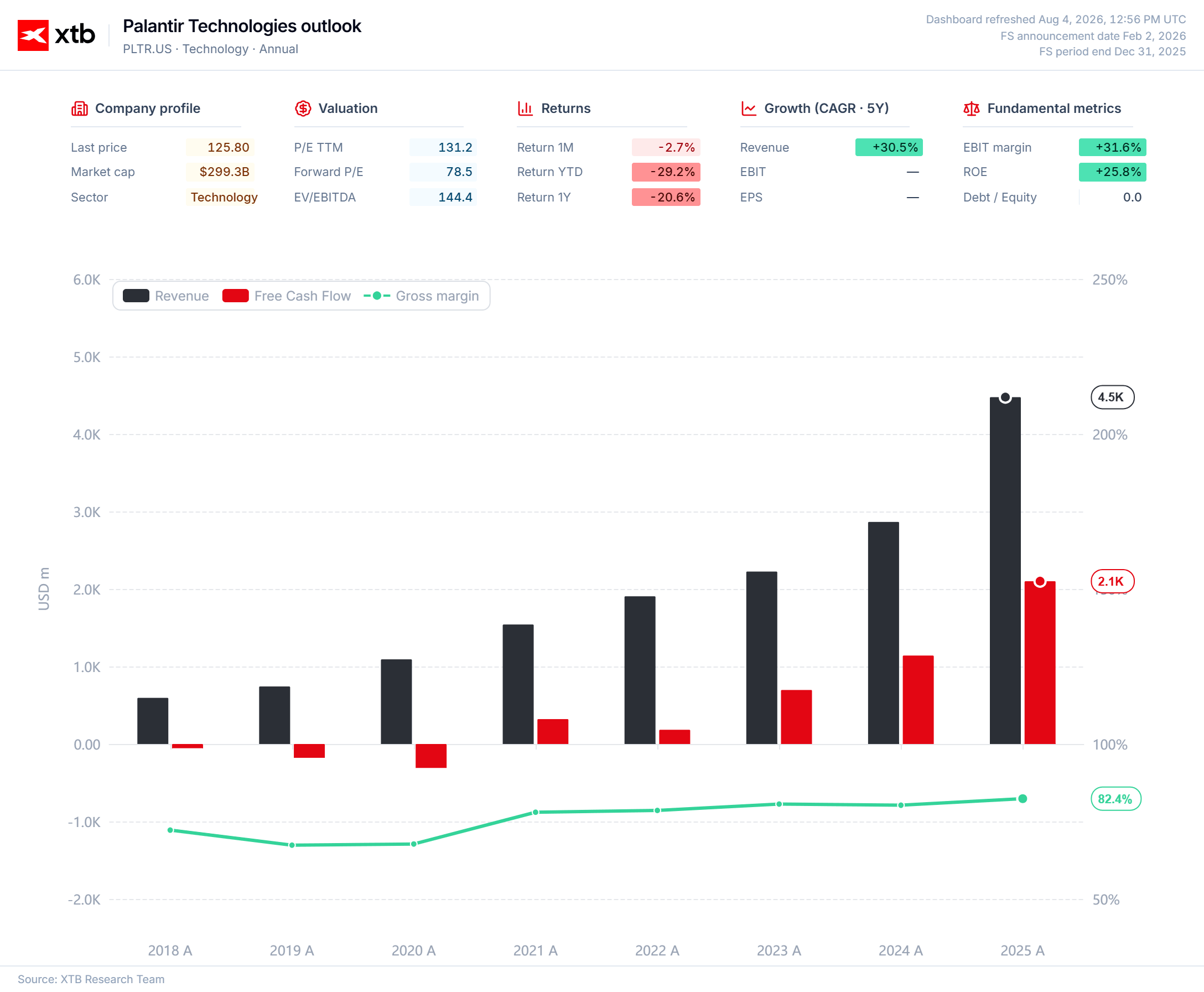
These results show why Palantir is effectively in a league of its own. Revenue and profit, however, are not the whole investment story, only the beginning.
Earnings quality
Some analysts point to inflated profit figures at Palantir. The gap between adjusted and reported results stems mainly from Palantir’s investment in SpaceX and stock based compensation.
Stock based compensation rose 66% year over year, meaning its share of revenue actually declined.
Excluding SpaceX’s contribution to EPS, adjusted EPS would be about $0.39, still implying growth above 200% and still meaningfully above market consensus.
Details and business model
To assess the quality of a business growing as quickly as Palantir, it is necessary to examine the company’s reporting much more closely than is typical for other technology firms.
- Starting with costs, the increase in costs over the first six months of the year was just over 20%. This means operating leverage remains enormous, and beating market expectations lifts the company’s terminal value.
- Another strong growth signal, and one of the “weak points” cited for example by Michael Burry, involves receivables. “RPO” rose in the first half of 2026 by more than 260% versus the same period a year earlier.
- This suggests demand for the company’s services is even more unsatisfied than management had previously indicated.
The growth in RPO does not, however, mean a lack of conversion from orders to revenue.
- A key SaaS metric, “dollar retention,” rose to a near unprecedented 157% (+700 bps).
- Revenue from existing customers rose 85%, and the top 20 customers fell as a share of revenue from 43% to 40%.
- TCV rose 49%, while duration adjusted TCV rose 129%.
The second largest support for valuations was the increase in US commercial contracts, up 153% year over year. This means:
- Palantir is becoming less dependent on relatively unpredictable and opaque government contracts, and on Europe, which is increasingly prioritizing “digital independence.”
- More importantly, Palantir’s products are no longer merely experimental, expensive, or niche solutions for the biggest and most important players. With these results, Palantir is signaling that its product is now commercial.
- The government services market is large and important, but it pales in comparison with the potential scale of expansion in the civilian market.
Guidance
The focus was not so much on the company’s highly controversial CEO, but rather on the guidance he presented.
- A show of strength was the upward revision of expectations for Q3 and for year end.
- In Q3, the company expects revenue growth to above USD 2.16bn and operating income above USD 1.29bn.
- By year end, the company is expected to achieve more than USD 8.15bn in revenue, of which USD 3.42bn is to come from the US commercial segment.
- Free cash flow is expected to be between USD 4.5bn and USD 4.7bn, implying growth of just over 100% YoY and about USD 200m above the median analyst forecast.
Outlook
At the end of each quarter, the CEO publishes a letter to shareholders. While Alex Karp’s communication can be somewhat chaotic at times, the latest publication suggests that the main obstacle to the development of the technology and AI industry is the business model adopted by OpenAI and Anthropic. In his view, the biggest limitation is the attempt to “lock” users into a single LLM model over which they have no control. Palantir addresses this by expanding integrations so that clients can use the model they want, when they want, and for whatever they want.
This is an important issue for Palantir’s business thesis. Company representatives themselves, and rather overtly, point out that OpenAI’s and Anthropic’s business model appears to be increasingly close to hitting a wall. Palantir currently offers phenomenal value added to clients and shareholders, but it does not present a qualitative program to become independent from AI lab products.
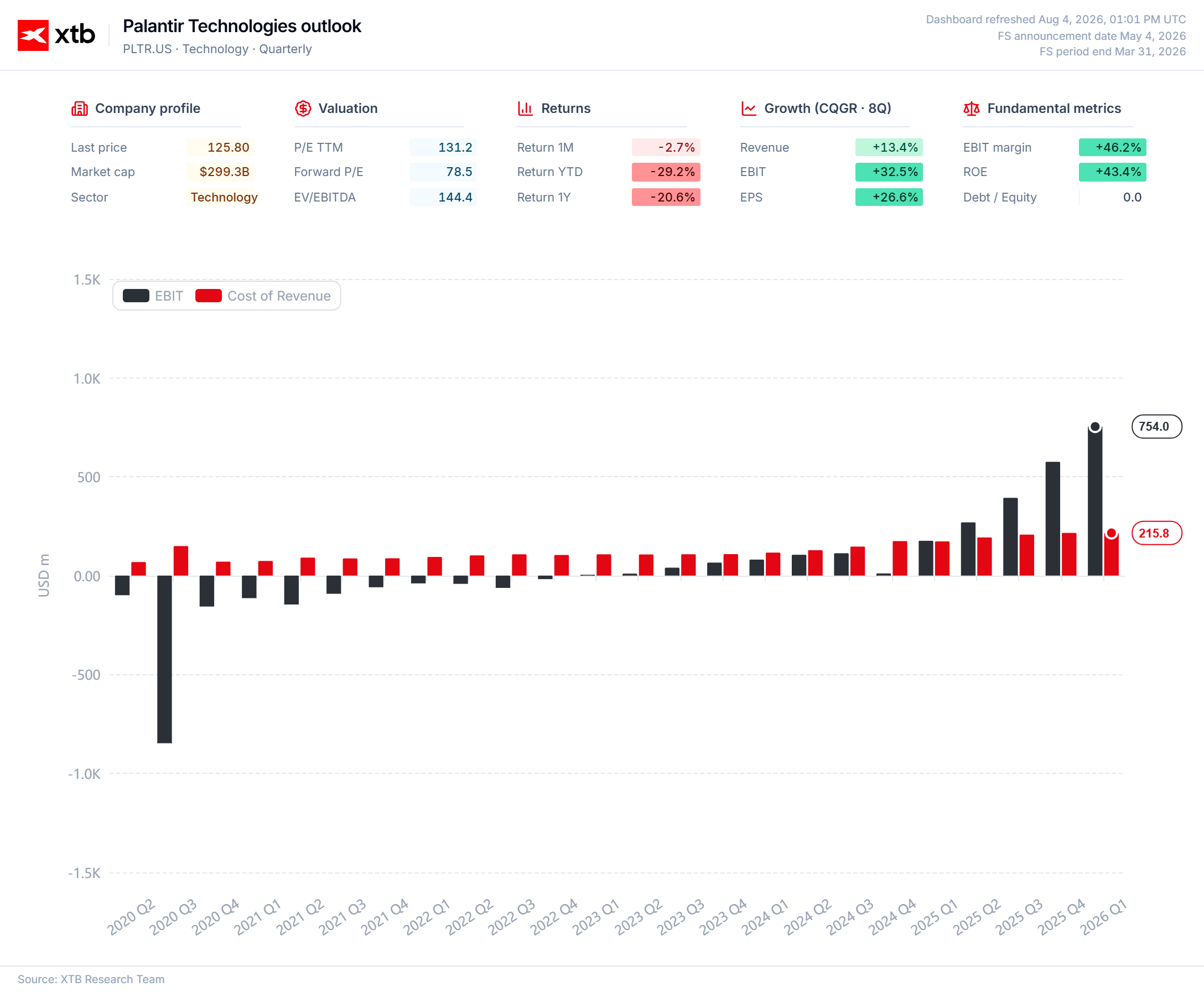
Growth as spectacular as Palantir’s is a double edged sword. For example, the current median FCF forecast indicates the company may generate USD 20bn in free cash flow and as much as USD 50bn in revenue in 2030 to 2031. That is not yet at the level of Microsoft or Nvidia, but it is already more than Meta generated before it began investing in AI.
The company currently trades at extremely high valuation multiples, about 140 P/E, about 62 P/S, and about 186 P/FCF. Does that mean investors will have to wait over 100 years for a return on investment, and the stock is absurdly expensive?
No. It means the company has no room for any mistakes or disappointments. Otherwise, the valuation may suffer disproportionate declines. This follows from the relationship between operating leverage and the company’s terminal value.
Any disappointment in the growth rate creates a “hole” in the company’s projected valuation, which, given the high multiple, becomes smaller over time.
Market consensus currently expects revenue growth to slow and stabilize at around 40 to 50% in 2027. Some valuation models imply that under such assumptions the company is not expensive over a 5 to 10 year horizon, and may still be relatively cheap, or at least fairly valued.
Kamil Szczepański
Financial Market Analyst at XTB



Market Wrap: Renewed confidence in AI drives stock market recovery (27.10.2026)


📈Daily Summary: Falling Oil Prices and Anthropic Prospectus Drive Markets


US OPEN: Anthropic filing and Iran talks support the market
Anthropic files prospectus ahead of IPO with "ANT" ticker on Nasdaq. The launch date and price remain a mystery
The content of this report has been created by XTB S.A., with its registered office in Warsaw, at Prosta 67, 00-838 Warsaw, Poland, (KRS number 0000217580) and supervised by Polish Supervision Authority ( No. DDM-M-4021-57-1/2005). This material is a marketing communication within the meaning of Art. 24 (3) of Directive 2014/65/EU of the European Parliament and of the Council of 15 May 2014 on markets in financial instruments and amending Directive 2002/92/EC and Directive 2011/61/EU (MiFID II). Marketing communication is not an investment recommendation or information recommending or suggesting an investment strategy within the meaning of Regulation (EU) No 596/2014 of the European Parliament and of the Council of 16 April 2014 on market abuse (market abuse regulation) and repealing Directive 2003/6/EC of the European Parliament and of the Council and Commission Directives 2003/124/EC, 2003/125/EC and 2004/72/EC and Commission Delegated Regulation (EU) 2016/958 of 9 March 2016 supplementing Regulation (EU) No 596/2014 of the European Parliament and of the Council with regard to regulatory technical standards for the technical arrangements for objective presentation of investment recommendations or other information recommending or suggesting an investment strategy and for disclosure of particular interests or indications of conflicts of interest or any other advice, including in the area of investment advisory, within the meaning of the Trading in Financial Instruments Act of 29 July 2005 (i.e. Journal of Laws 2019, item 875, as amended). The marketing communication is prepared with the highest diligence, objectivity, presents the facts known to the author on the date of preparation and is devoid of any evaluation elements. The marketing communication is prepared without considering the client’s needs, his individual financial situation and does not present any investment strategy in any way. The marketing communication does not constitute an offer of sale, offering, subscription, invitation to purchase, advertisement or promotion of any financial instruments. XTB S.A. is not liable for any client’s actions or omissions, in particular for the acquisition or disposal of financial instruments, undertaken on the basis of the information contained in this marketing communication. In the event that the marketing communication contains any information about any results regarding the financial instruments indicated therein, these do not constitute any guarantee or forecast regarding the future results.