



Natural gas prices on both sides of the Atlantic are recording dynamic increases, although they are driven by different fundamental dynamics. While the American market is reacting to the current heatwave, the Old Continent is struggling with mounting concerns about supply ahead of the upcoming heating season.
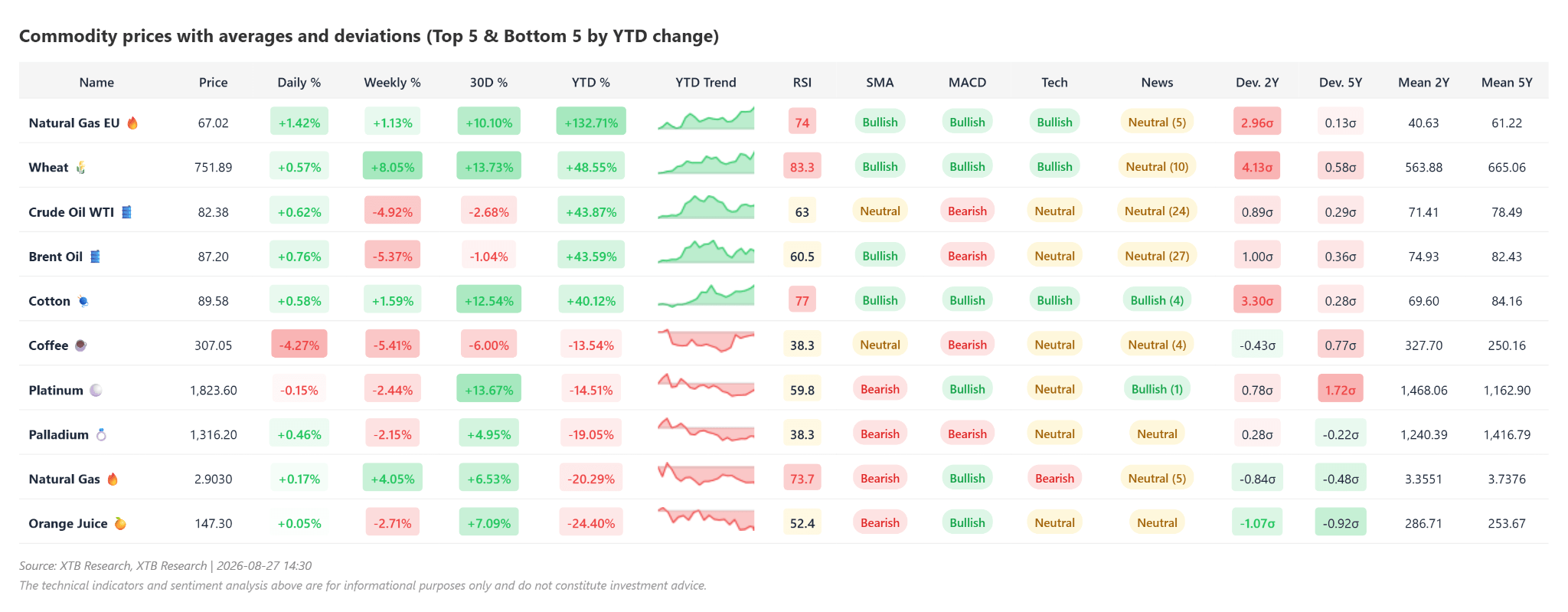 Although natural gas prices in the US and Europe remain at opposite poles when looking at returns this year, we have recently observed dynamic increases on both sides of the Atlantic. Source: XTB
Europe: supply race against time and risk of a jump to 100 EUR
The European market is under the strong influence of concerns about the winter fuel balance. Filling of gas storage in the EU is only about 63–64%, which is significantly lower not only than the 5-year average of 81%, but also below the 5-year minimum. Analysts estimate that storage can be filled to at most approx. 70% before winter, which risks their drainage to a level below 20% at the end of the season. On the other hand, it is worth remembering that the supply situation is slightly better than during the previous energy crisis in Europe. In 2021, when supply problems from Russia began, it was possible to fill storage to 77%, while in 2022, after a very weak end to the heating season (filling fell to 25%), storage was eventually filled to 95%, which was due to the fact that high filling also took place in October.
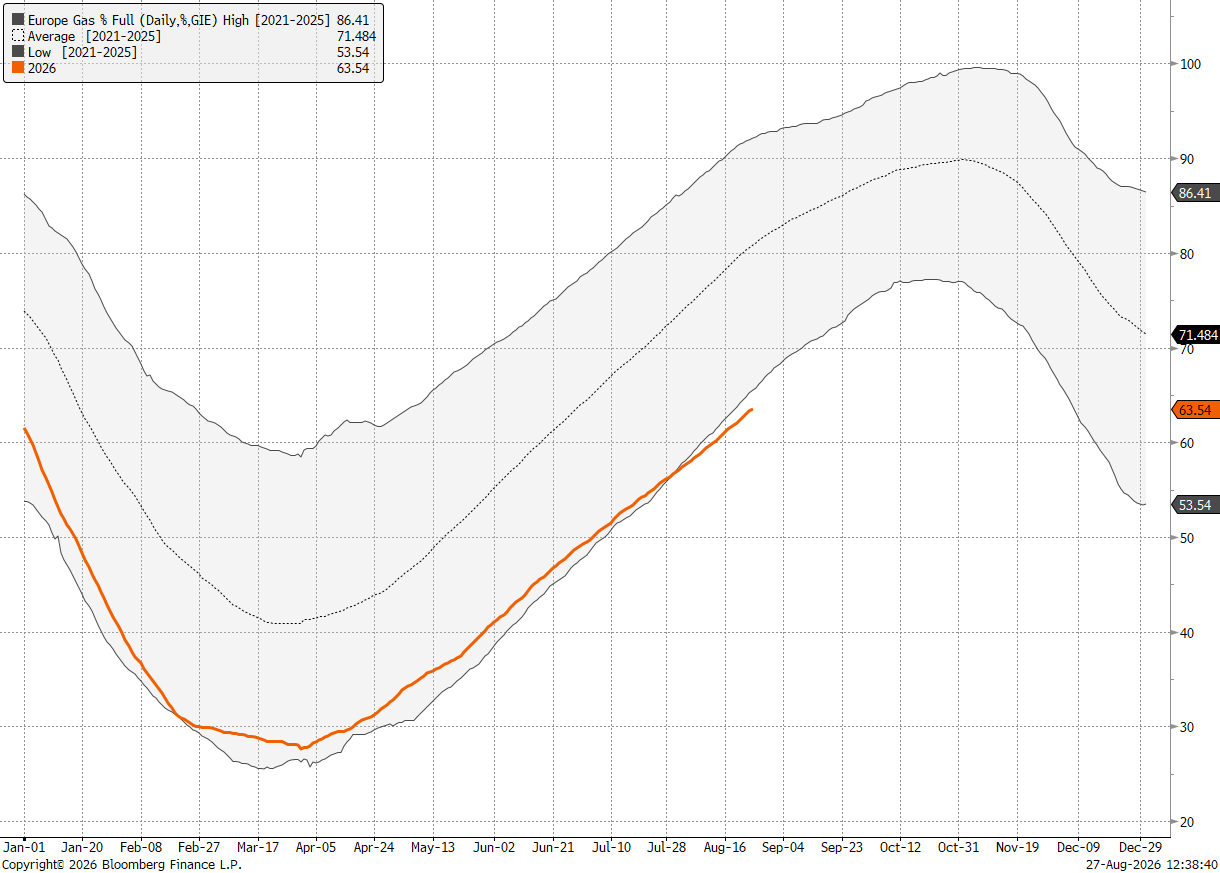 Filling of gas storage in Europe. Source: Bloomberg Finance LP
The current situation is further fueled by the tense situation in the Middle East and unfavorable weather. A drop in generation from RES (among others, due to Saharan dust limiting production from photovoltaics in Germany and southern Europe) forces higher gas consumption in the energy sector. To effectively compete with Asia for LNG cargoes from the US, prices in Europe could reach as much as 90-120 EUR/MWh this winter, which is not currently visible in the forward structure of the gas market, but at the same time the differences between winter and summer contracts for 2027 are reaching their highest levels since 2022. Excluding 2021 and 2022, however, current prices are even 20-30 EUR/MWh higher than in previous years.
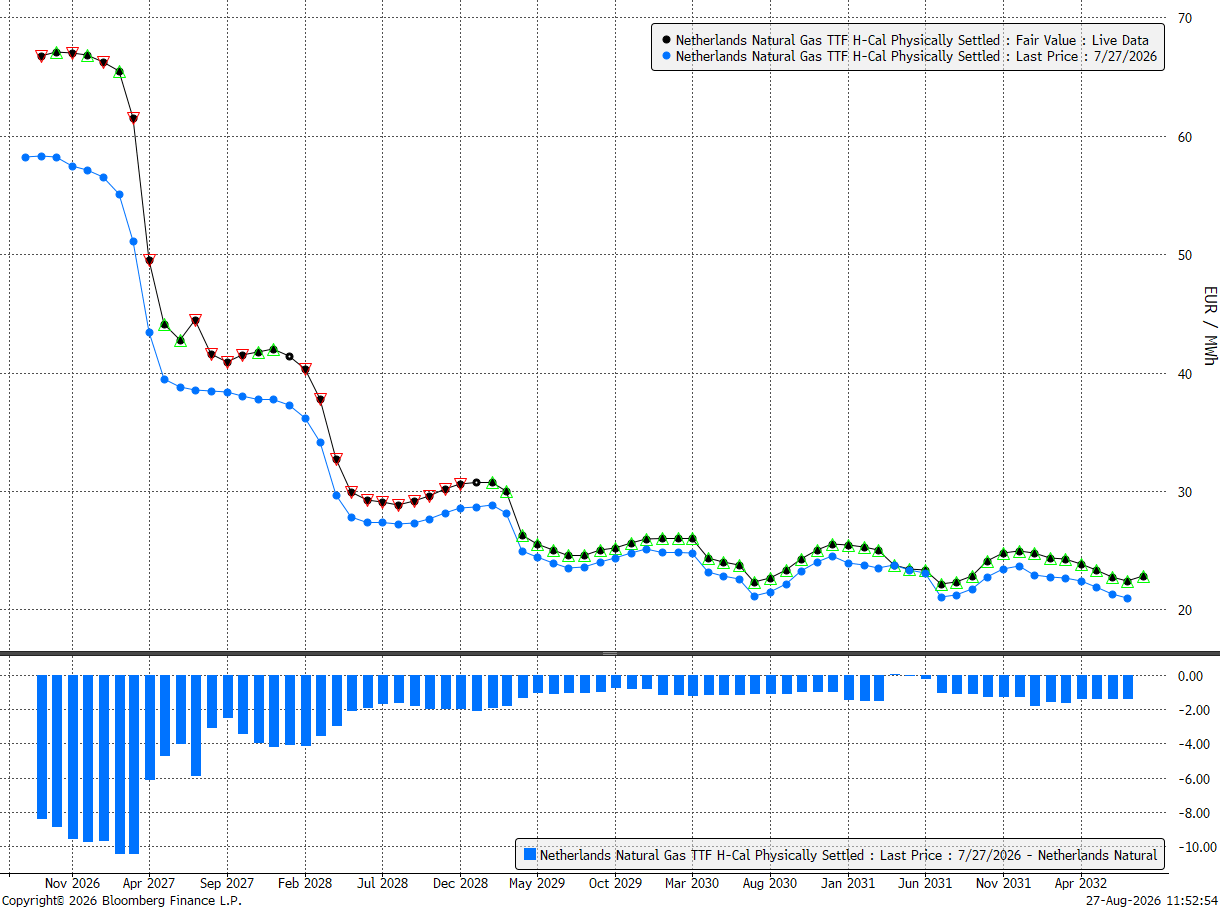 The forward structure remains in clear backwardation after the winter season. It is worth emphasizing, however, that the forward structure does not reflect concerns related to price increases to levels around 100 EUR/MWh. Source: Bloomberg Finance LP, XTB
USA: heatwave vs. record production
In the United States, high temperatures are an impulse for buyers. The Cooling Degree Days index has clearly risen, boosting power plants' demand for gas to power air conditioning and limiting the expected weekly increase in inventories to just 15 bcf (compared to the 5-year norm of 33 bcf).
The long-term growth potential of the American raw material still faces hard resistance, however. Very high production of associated gas in the Permian Basin and the expansion of transmission infrastructure (including the Hugh Brinson pipeline) maintain high inventory levels and make it difficult for prices to sustainably move above 3.00 USD/MMBtu.
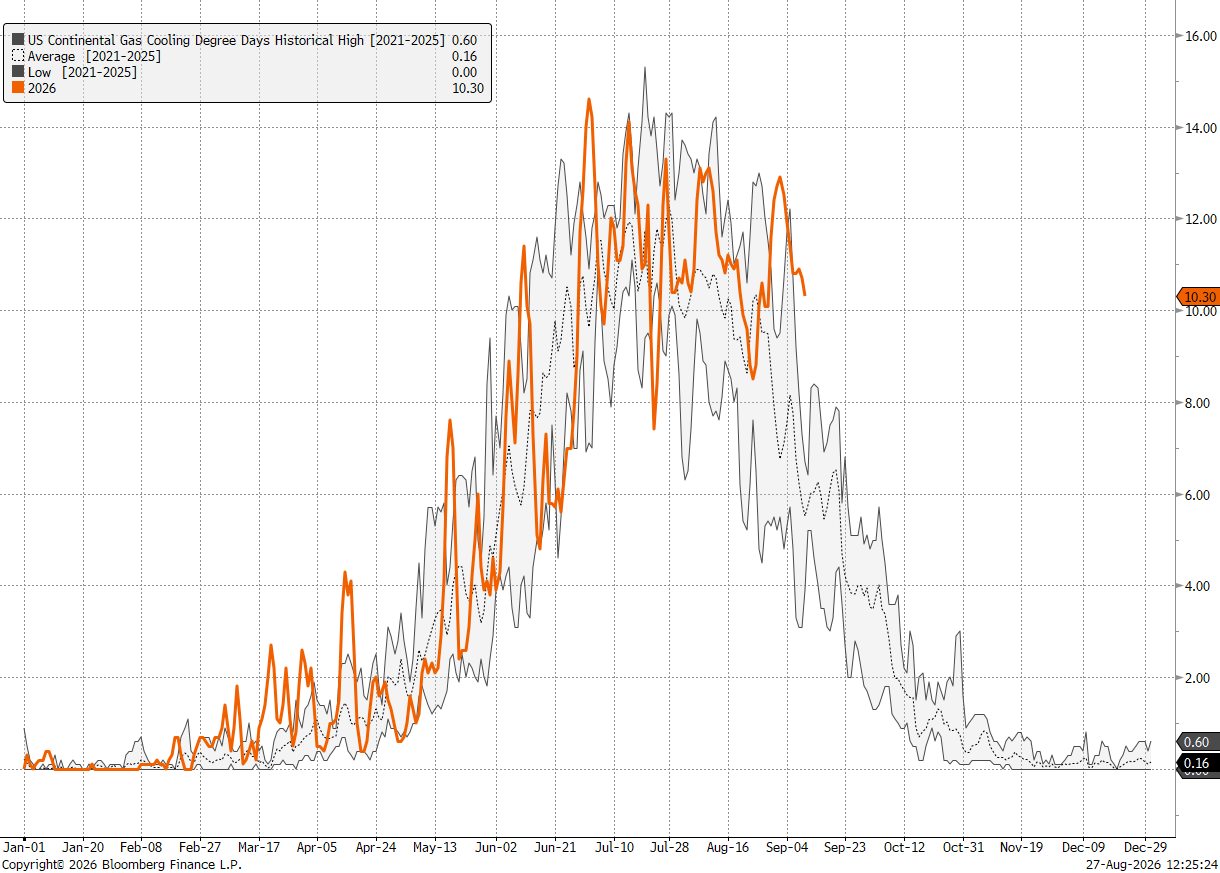 The number of cooling degree days in the USA significantly exceeds the 5-year range, which shows that at a time when temperatures should be falling, they remain at high levels. Source: Bloomberg Finance LP
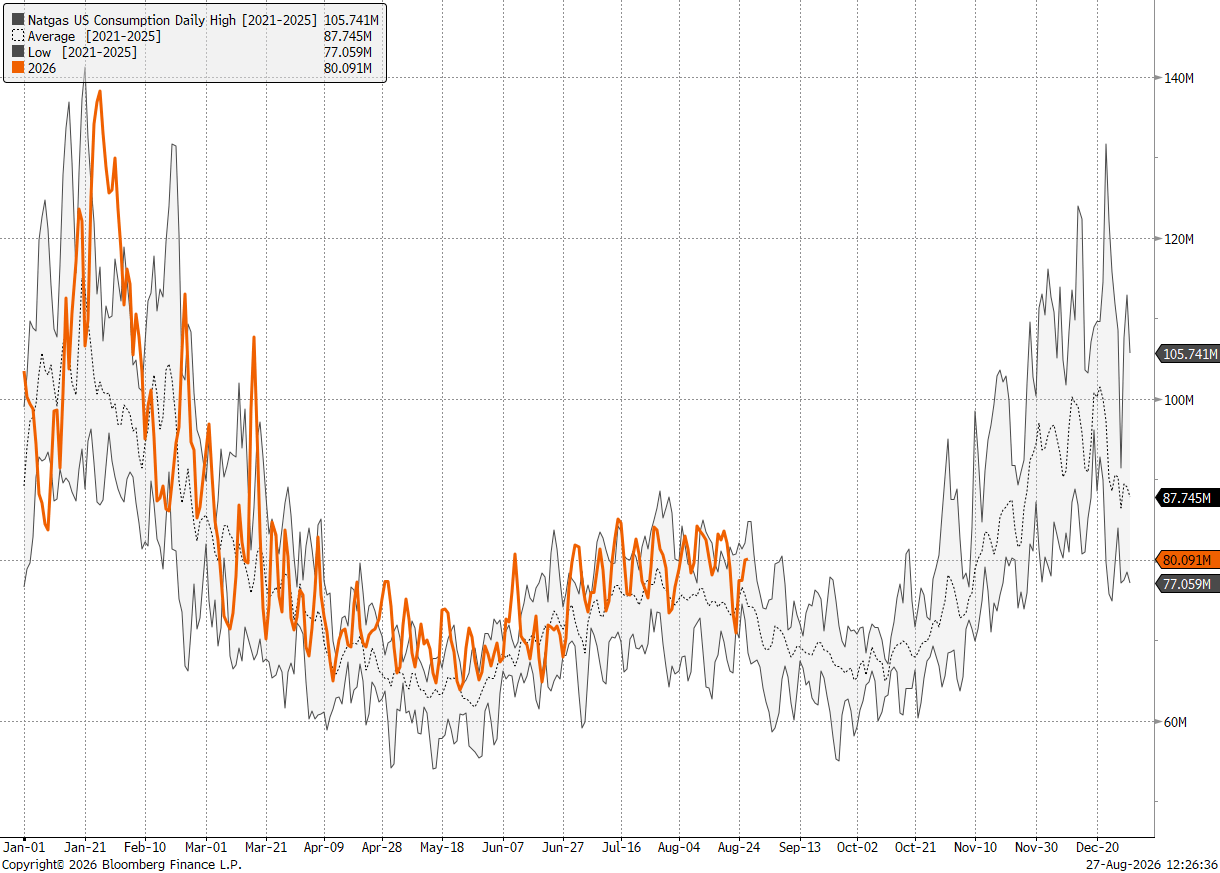 Demand for gas oscillates above the 5-year average, and the trend indicates a slow fade towards the beginning of October. Source: Bloomberg Finance LP, XTB
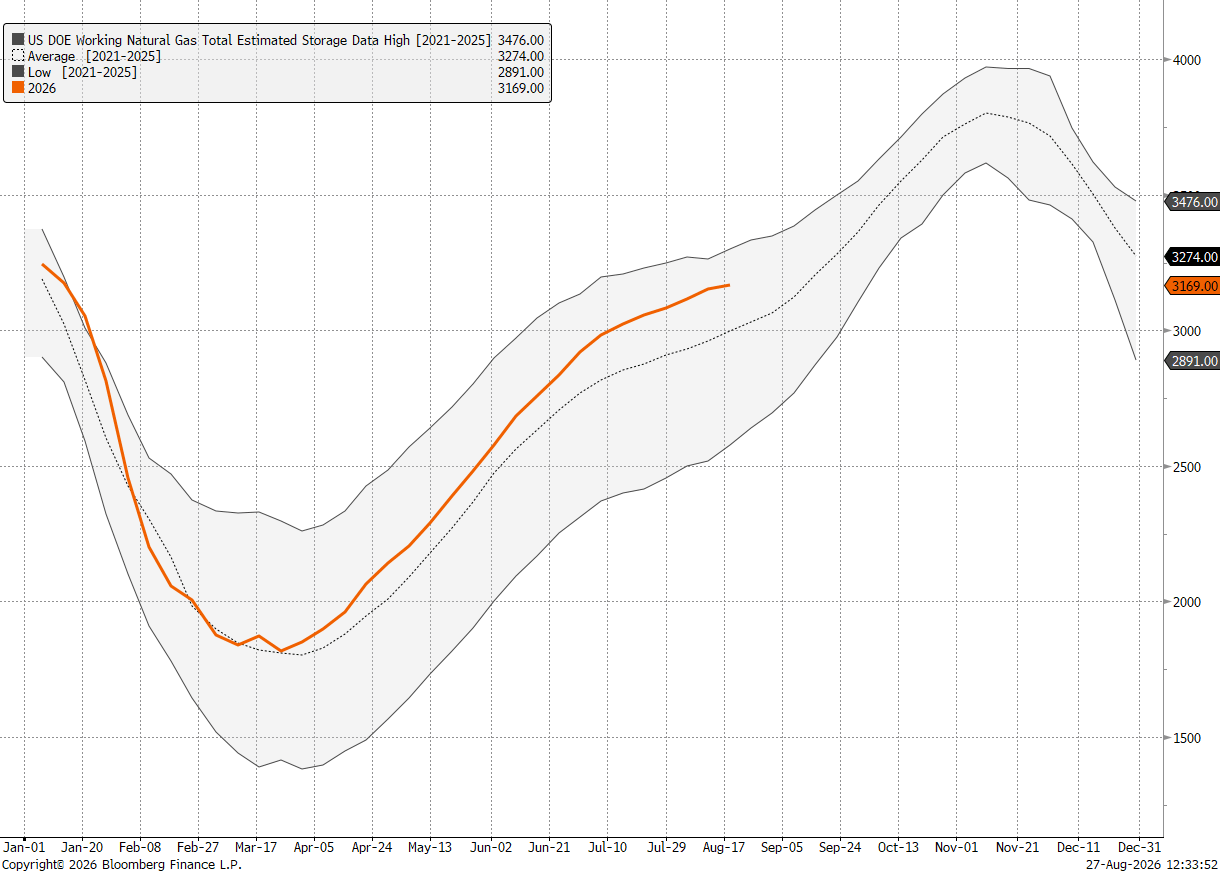 Inventories in the USA have slowed their growth slightly recently, which aids a price rebound towards 3 USD/MMBtu. Source: Bloomberg Finance LP, XTB
Futures structure: short-term fever and long-term calm
The futures curves show a clear difference between current tension and the market's long-term expectations:
- TTF (Europe): The market is in a deep structure of backwardation. Current spot valuations and for the nearest winter (approx. 65–68 EUR/MWh) drop drastically in subsequent years. Valuations for 2027–2028 go down to 30–40 EUR/MWh, and in the 2030 horizon, they tend towards 20–25 EUR/MWh. This shows that investors are paying a high premium for security "here and now," but assume a gradual stabilization of the market in the future. It is also important that a potential gas shortage problem during this winter is not perceived, although at the same time prices currently remain at levels higher than in recent years (not counting 2021 and 2022).
- Henry Hub (USA): The curve structure maintains classic seasonality. Price peaks fall on winter months (January 2027 and 2028 reaching 4.00–4.70 USD/MMBtu). At the same time, the nearest series of contracts remain suppressed by strong domestic supply. It is worth noting, however, that compared to the curve from a month ago, prices in the short term have risen, showing increased demand now, but at the same time are falling for winter (a drop from around 4.20 to 4.00 for the January contract).
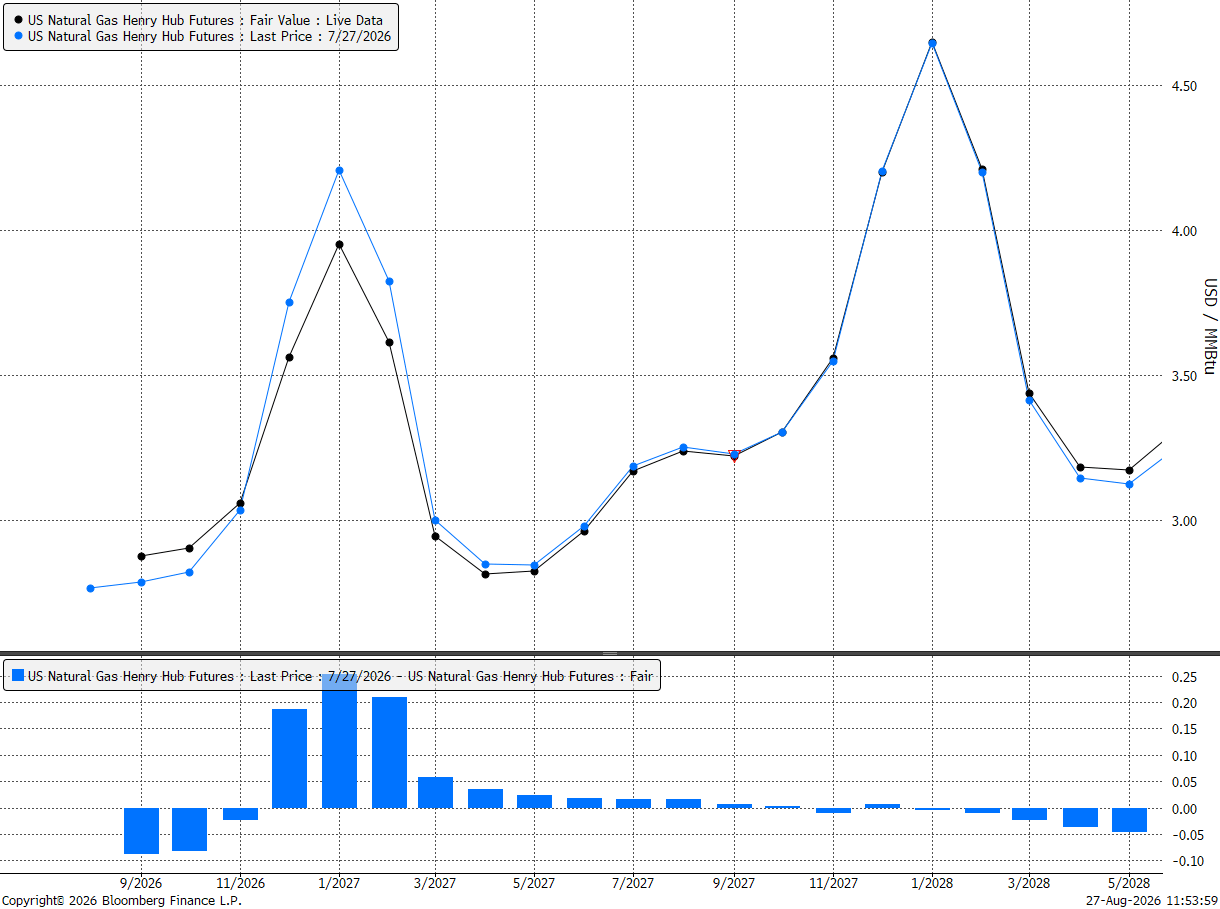 The forward structure and its change compared to the situation a month ago show currently growing demand and weakening expectations regarding high consumption during winter, which may result from expectations of lower demand due to El Niño. Source: Bloomberg Finance LP
Gas prices return to increases
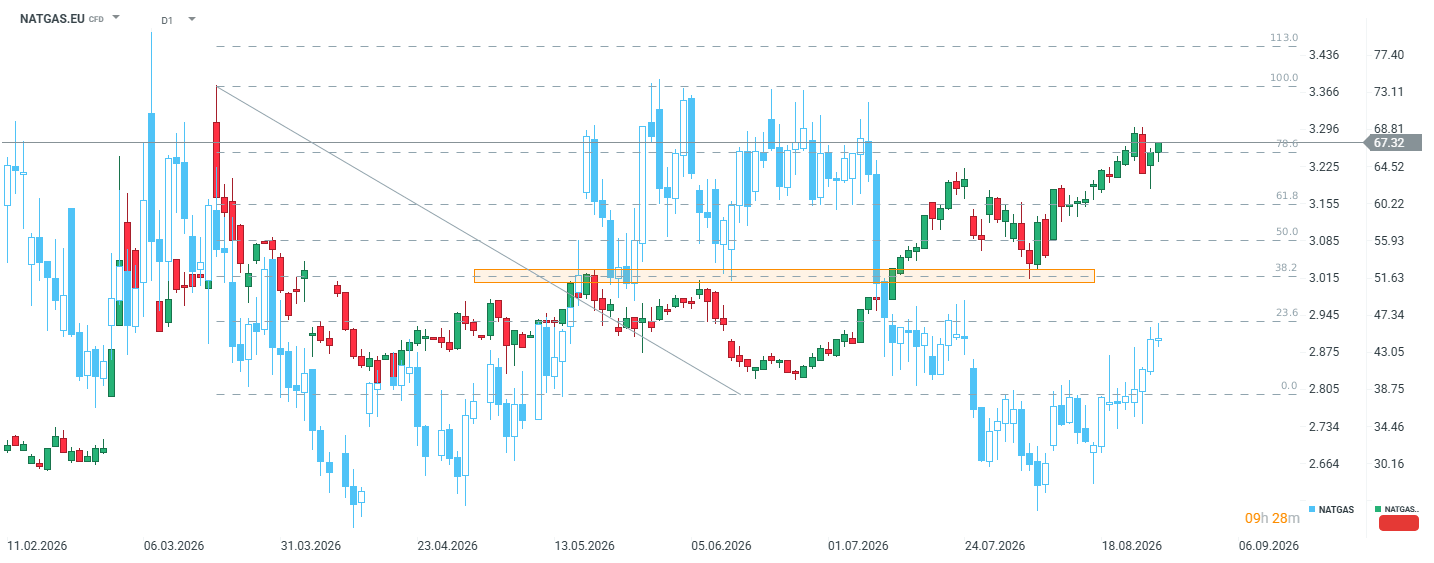
Although the fundamentals of American and European gas are different, the situation in the Middle East and LNG gas connect these two worlds, which causes increases on both sides of the ocean. Source: xStation5



Daily Summary: A Shallow Rebound Ahead of Earnings Season



Market Wrap: A 4% surge in oil prices weighs on indices (08.10.2026)


Market Wrap: Oil rises again, French fiscal concerns weigh on euro (07.10.2026)

Oil falls below $100🚨
The content of this report has been created by XTB S.A., with its registered office in Warsaw, at Prosta 67, 00-838 Warsaw, Poland, (KRS number 0000217580) and supervised by Polish Supervision Authority ( No. DDM-M-4021-57-1/2005). This material is a marketing communication within the meaning of Art. 24 (3) of Directive 2014/65/EU of the European Parliament and of the Council of 15 May 2014 on markets in financial instruments and amending Directive 2002/92/EC and Directive 2011/61/EU (MiFID II). Marketing communication is not an investment recommendation or information recommending or suggesting an investment strategy within the meaning of Regulation (EU) No 596/2014 of the European Parliament and of the Council of 16 April 2014 on market abuse (market abuse regulation) and repealing Directive 2003/6/EC of the European Parliament and of the Council and Commission Directives 2003/124/EC, 2003/125/EC and 2004/72/EC and Commission Delegated Regulation (EU) 2016/958 of 9 March 2016 supplementing Regulation (EU) No 596/2014 of the European Parliament and of the Council with regard to regulatory technical standards for the technical arrangements for objective presentation of investment recommendations or other information recommending or suggesting an investment strategy and for disclosure of particular interests or indications of conflicts of interest or any other advice, including in the area of investment advisory, within the meaning of the Trading in Financial Instruments Act of 29 July 2005 (i.e. Journal of Laws 2019, item 875, as amended). The marketing communication is prepared with the highest diligence, objectivity, presents the facts known to the author on the date of preparation and is devoid of any evaluation elements. The marketing communication is prepared without considering the client’s needs, his individual financial situation and does not present any investment strategy in any way. The marketing communication does not constitute an offer of sale, offering, subscription, invitation to purchase, advertisement or promotion of any financial instruments. XTB S.A. is not liable for any client’s actions or omissions, in particular for the acquisition or disposal of financial instruments, undertaken on the basis of the information contained in this marketing communication. In the event that the marketing communication contains any information about any results regarding the financial instruments indicated therein, these do not constitute any guarantee or forecast regarding the future results.