



The biggest disappointment: subscription growth
The key issue in the report was subscription revenue, the core of ServiceNow’s business model. It reached $3.67 billion, representing a slight beat and 22% year-over-year growth. However, investors were expecting something materially stronger. Management explained that approximately 75 basis points of growth were lost due to delays in closing several large on-premise deals in the Middle East, linked to ongoing regional conflict.
Fundamentally, this looks like a timing issue rather than a sign of weakening demand. However, in the current market environment, investors are reacting more to momentum than to nuance.
Raised guidance failed to reassure the market
Under normal circumstances, raising full-year guidance would support the stock. ServiceNow increased its full-year subscription revenue outlook to $15.74–$15.78 billion, up from $15.53–$15.57 billion previously. CFO Gina Mastantuono emphasized that the updated guidance already includes conservative assumptions around delayed deal timing in the Middle East.
This is an important signal, suggesting management does not see structural weakness in demand. However, investors interpreted the move more as an attempt to stabilize sentiment than as a strong catalyst for a turnaround.
AI narrative still ahead of monetization
From a sector perspective, the key question around ServiceNow is no longer whether it is growing, but whether it is growing fast enough to justify its positioning as a major AI beneficiary. The company has been framing itself as an “AI control tower” for enterprise clients. The issue is that the market now demands not just a compelling narrative, but tangible financial impact.
Management indicated that its AI product line is on track to exceed $1 billion in revenue in 2026, with CEO Bill McDermott suggesting that $1.5 billion could be a more realistic figure. While promising, forward-looking potential is no longer sufficient if quarterly results do not demonstrate a clear inflection point.
Fundamentals remain strong
This is where the disconnect between market reaction and operational reality becomes most visible. ServiceNow does not appear to be a business facing structural deterioration. On the contrary, the company continues to deliver strong growth, raise guidance, execute aggressive share buybacks, and close strategic acquisitions.
The company repurchased roughly 20 million shares during the quarter—more than double the total for all of 2025. It also completed the $7.75 billion acquisition of cybersecurity firm Armis ahead of schedule. These are not signs of a company under pressure, but rather of one with strong financial capacity and confidence in its long-term trajectory.
Why the reaction was so severe
The explanation lies in how ServiceNow is being valued. The company is no longer treated as a typical growth stock, but as one of the flagship AI stories in enterprise software. That raises the bar significantly. With the stock already down sharply year-to-date, the market was not looking for a “good enough” quarter, but for results that would clearly shift the narrative.
Instead, investors got a marginal beat, explanations around delayed deals, and guidance to wait for a broader strategic update at the upcoming Analyst Day. That proved insufficient, triggering a sharp sell-off that spilled over into other software names such as Salesforce, Oracle, and Adobe.
A crisis of patience, not a crisis of business
This reaction can be seen primarily as a reset of expectations rather than a signal of deteriorating fundamentals. The market is punishing ServiceNow not for weak results, but for failing to deliver a sufficiently strong proof of AI-driven acceleration—something investors have increasingly come to expect from infrastructure and enterprise software leaders.
This distinction matters. In the short term, sentiment may remain fragile. In the longer term, the key question will be whether delayed deals return to the pipeline and whether AI meaningfully accelerates growth.
At present, this looks more like a company that disappointed on pace rather than one losing control of its business. The valuation, based on forward 12-month earnings, currently stands at around 23x and may decline toward 21x after the market open, suggesting a meaningful cooling in investor expectations.
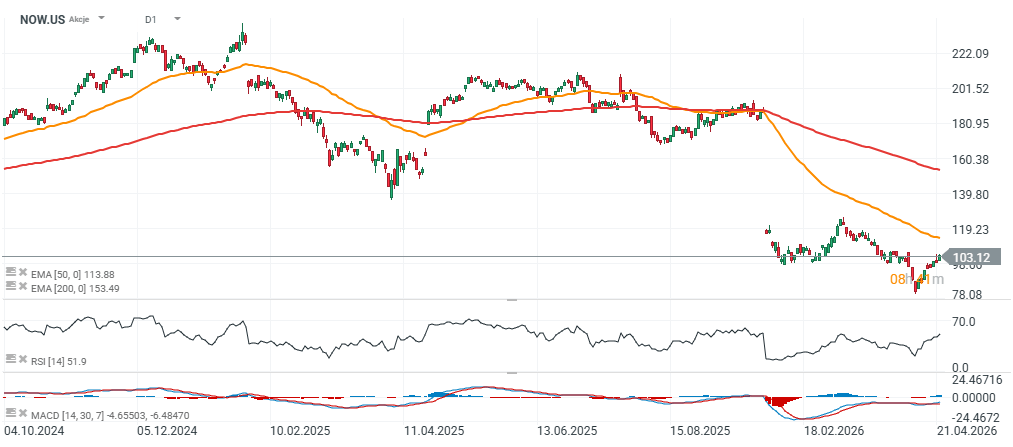
Source: xStation5


Daily summary 📈 Precious metals and stock indices rebound as Treasury yields fall


US Open: Nasdaq 100 extends losses 🚩 AI stocks under pressure, CoreWeave falls 8%



Market Wrap: Tech Sell-Off Hits Europe, Gold Shines Again


TSMC breaks records once again driven by the AI boom
The content of this report has been created by XTB S.A., with its registered office in Warsaw, at Prosta 67, 00-838 Warsaw, Poland, (KRS number 0000217580) and supervised by Polish Supervision Authority ( No. DDM-M-4021-57-1/2005). This material is a marketing communication within the meaning of Art. 24 (3) of Directive 2014/65/EU of the European Parliament and of the Council of 15 May 2014 on markets in financial instruments and amending Directive 2002/92/EC and Directive 2011/61/EU (MiFID II). Marketing communication is not an investment recommendation or information recommending or suggesting an investment strategy within the meaning of Regulation (EU) No 596/2014 of the European Parliament and of the Council of 16 April 2014 on market abuse (market abuse regulation) and repealing Directive 2003/6/EC of the European Parliament and of the Council and Commission Directives 2003/124/EC, 2003/125/EC and 2004/72/EC and Commission Delegated Regulation (EU) 2016/958 of 9 March 2016 supplementing Regulation (EU) No 596/2014 of the European Parliament and of the Council with regard to regulatory technical standards for the technical arrangements for objective presentation of investment recommendations or other information recommending or suggesting an investment strategy and for disclosure of particular interests or indications of conflicts of interest or any other advice, including in the area of investment advisory, within the meaning of the Trading in Financial Instruments Act of 29 July 2005 (i.e. Journal of Laws 2019, item 875, as amended). The marketing communication is prepared with the highest diligence, objectivity, presents the facts known to the author on the date of preparation and is devoid of any evaluation elements. The marketing communication is prepared without considering the client’s needs, his individual financial situation and does not present any investment strategy in any way. The marketing communication does not constitute an offer of sale, offering, subscription, invitation to purchase, advertisement or promotion of any financial instruments. XTB S.A. is not liable for any client’s actions or omissions, in particular for the acquisition or disposal of financial instruments, undertaken on the basis of the information contained in this marketing communication. In the event that the marketing communication contains any information about any results regarding the financial instruments indicated therein, these do not constitute any guarantee or forecast regarding the future results.