



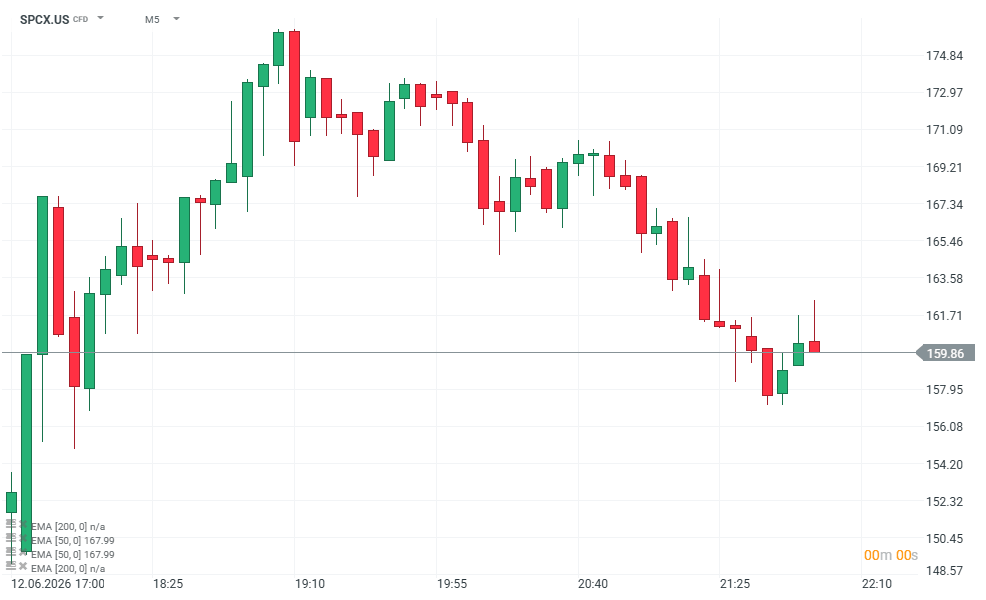
SpaceX continues its rally, gaining another 6% in premarket trading and approaching the USD 170 mark per share following its record-breaking IPO last Friday. The company’s market capitalization has already surpassed USD 2 trillion, fueling an intense debate over whether such a valuation is justified and what lies ahead for what has become the market’s hottest stock.
Will reality catch up with SpaceX?
SpaceX ended 2025 with losses exceeding USD 5 billion, while capital expenditures continue to accelerate. In the first quarter of 2026 alone, the company spent USD 10.1 billion, compared with USD 4.1 billion during the same period a year earlier. A significant portion of that spending was directed toward artificial intelligence infrastructure.
Supporters of the stock point to the company’s technological leadership and exceptionally high barriers to entry. However, valuing today what a company may potentially earn 15 or even 20 years from now inevitably introduces a substantial degree of speculation. To put the scale into perspective, for SpaceX shares to double from current levels, the company’s market capitalization would need to surpass Alphabet (Google), a scenario that appears difficult to justify given the relatively small size of SpaceX’s current business compared with the tech giant.
CFRA initiated coverage of SpaceX with a Sell rating and a USD 115 price target, implying nearly 30% downside from Friday’s closing price. According to the firm, investors are currently pricing in an extremely aggressive growth scenario while overlooking significant execution risks and the company’s massive capital requirements.
Morningstar is even more skeptical, estimating the fair value of SpaceX at just USD 63 per share, implying downside of roughly 70% from current levels.
The biggest questions revolve around the company’s ability to convert ambitious projects into tangible cash flows. SpaceX continues to present investors with long-term visions that have yet to be reflected in financial performance. Particular attention is focused on the company's plans to develop orbital data centers designed to support AI workloads.
Investors are increasingly demanding more concrete information regarding the commercialization timeline of these initiatives. Some analysts have also highlighted the limited disclosure regarding execution risks and corporate governance contained in the IPO prospectus. As the company's valuation grows, so too will expectations for transparency.
Space is difficult to value
Despite these concerns, part of the market believes the current valuation can be justified when viewed through a very long-term lens. NewStreet Research initiated coverage of SpaceX with a USD 165 price target. According to its analysts, the company should be evaluated over a 20-to-25-year horizon rather than through the framework of a typical equity cycle. Many investors enthusiastic about the "new space" sector likely share this perspective.
Ultimately, stock prices are determined by investors willing to commit capital, not by analysts issuing skeptical reports. Criticism alone is rarely sufficient to derail a strong momentum trade, particularly when many market participants acknowledge that the company's long-term potential may indeed be enormous. Current valuation levels incorporate a substantial premium for SpaceX's dominant position within the U.S. space industry. This is a market that remains exceptionally difficult to enter, requiring vast amounts of capital, technological expertise, risk tolerance, and years of execution.
Jeff Bezos recently received a painful reminder of these challenges after Blue Origin’s massive New Glenn rocket — a competitor to Falcon Heavy — reportedly exploded, likely causing delays of several months to the program. Events like these highlight just how difficult it is to replicate SpaceX's capabilities. It is equally challenging to assign a value to the company’s technological know-how, accumulated launch experience, and regulatory approvals, all of which represent significant competitive advantages. According to NewStreet, most of the key building blocks required for future success are already being developed. SpaceX bulls argue that the company remains effectively unmatched in orbital launch capabilities.
Analysts estimate that SpaceX’s technological lead over competitors could be as much as a decade. Such advantages are inherently difficult to quantify, which naturally translates into a valuation premium. Starship is expected to dramatically increase the amount of payload that can be transported into orbit compared with existing launch systems. Greater launch capacity could become the foundation for the continued expansion of the Starlink network.
Direct-to-cell satellite communications projects are heavily dependent on SpaceX’s launch capabilities. Similarly, orbital AI data centers would require a substantial increase in the amount of infrastructure that can be deployed into space. According to NewStreet, SpaceX could account for 90% to 95% of global launch capacity within the next four to five years. It remains unclear whether those estimates fully incorporate China's rapidly advancing space program, which has become an increasingly important factor in the long-term competitive landscape.
SPCX stock chart (M5)
Source: xStation5



Three markets to watch next week (23.10.2026)



Daily Summary: Oil at five-month highs, indices under pressure (23.10.2026)

US Open: Further declines on Wall Street, Brent above 111 USD, AI correction continues (14.10.2026)



Morning Wrap: AI profitability concerns spark market Sell-Off
The content of this report has been created by XTB S.A., with its registered office in Warsaw, at Prosta 67, 00-838 Warsaw, Poland, (KRS number 0000217580) and supervised by Polish Supervision Authority ( No. DDM-M-4021-57-1/2005). This material is a marketing communication within the meaning of Art. 24 (3) of Directive 2014/65/EU of the European Parliament and of the Council of 15 May 2014 on markets in financial instruments and amending Directive 2002/92/EC and Directive 2011/61/EU (MiFID II). Marketing communication is not an investment recommendation or information recommending or suggesting an investment strategy within the meaning of Regulation (EU) No 596/2014 of the European Parliament and of the Council of 16 April 2014 on market abuse (market abuse regulation) and repealing Directive 2003/6/EC of the European Parliament and of the Council and Commission Directives 2003/124/EC, 2003/125/EC and 2004/72/EC and Commission Delegated Regulation (EU) 2016/958 of 9 March 2016 supplementing Regulation (EU) No 596/2014 of the European Parliament and of the Council with regard to regulatory technical standards for the technical arrangements for objective presentation of investment recommendations or other information recommending or suggesting an investment strategy and for disclosure of particular interests or indications of conflicts of interest or any other advice, including in the area of investment advisory, within the meaning of the Trading in Financial Instruments Act of 29 July 2005 (i.e. Journal of Laws 2019, item 875, as amended). The marketing communication is prepared with the highest diligence, objectivity, presents the facts known to the author on the date of preparation and is devoid of any evaluation elements. The marketing communication is prepared without considering the client’s needs, his individual financial situation and does not present any investment strategy in any way. The marketing communication does not constitute an offer of sale, offering, subscription, invitation to purchase, advertisement or promotion of any financial instruments. XTB S.A. is not liable for any client’s actions or omissions, in particular for the acquisition or disposal of financial instruments, undertaken on the basis of the information contained in this marketing communication. In the event that the marketing communication contains any information about any results regarding the financial instruments indicated therein, these do not constitute any guarantee or forecast regarding the future results.