



Commercial shipping through the Strait of Hormuz slowed dramatically over the weekend. On Sunday, only 22 crossings were recorded—the lowest number since the signing of the preliminary agreement between the U.S. and Iran earlier this month. The immediate cause is two recent attacks on vessels, which sparked panic among crews, shipowners, and marine insurers.
The slowdown is taking place amid a rapid military escalation and tense diplomatic relations. Last Friday, the Pentagon announced strikes on multiple targets in Iran, describing them as a response to Tehran’s continued harassment of commercial shipping lanes. Iranian forces retaliated a few hours later, striking directly at Bahrain and Kuwait early Sunday morning.
Diplomacy — A Cautious Return to the Negotiating Table
Despite the escalating tensions, President Donald Trump announced Monday afternoon on Truth Social that Iran had “requested a meeting” and that high-level talks would take place Tuesday in Doha. White House spokeswoman Karoline Leavitt confirmed that envoys Steve Witkoff and Jared Kushner would attend the meeting, and that technical talks would be held in parallel on the sidelines of the negotiations.
"Iran should sign a good agreement with the United States," Leavitt said, adding that Trump "reserves the right to use military force if necessary," while noting that the president "wants the peace process to move forward."
Tehran’s reaction was—as usual—ambiguous. Even before Trump’s announcement, a senior Iranian official denied that technical talks were planned for this week. Iranian Foreign Minister Abbas Araghchi warned on Sunday that any external interference in the management of the Strait of Hormuz “will only lead to more complicated situations and delays in its reopening.” A few hours later, both sides reportedly agreed to a mutual ceasefire—a fragile truce that markets are watching with bated breath.
Oil chart: a return to pre-war levels
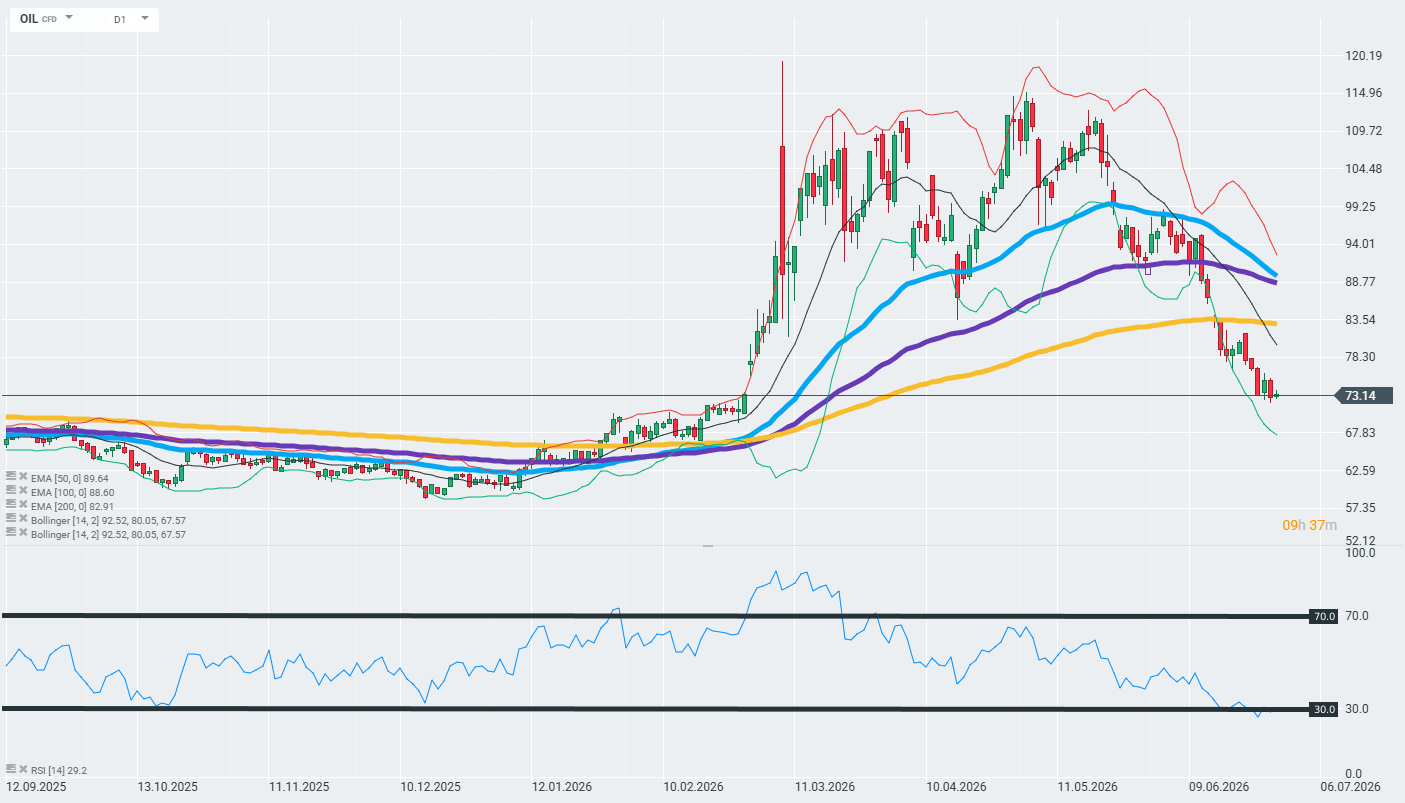
Brent crude (OIL) has fallen sharply from the highs reached during the peak of the conflict’s escalation—prices are now in the range of $72.98–73.06, virtually erasing the geopolitical risk premium that had built up since the conflict began in 2026. Key observations from the chart:
-
50-day EMA (~$89), 100-day EMA (~$88.60), and 200-day EMA (~$82.91) — all three moving averages are clearly above the current price, confirming the prevailing downtrend
-
The price has broken decisively below all three key moving averages; the 200 EMA is now acting as resistance rather than support
-
Bollinger Bands (green) show that the price is brushing against the lower band (~$67.54), suggesting that the market is oversold in the short term
-
The RSI (14) fell to 28.8 — deep in oversold territory — signaling that the sell-off may be nearing an end, but no confirmation of a trend reversal has emerged yet
The market is essentially pricing in a de-escalation scenario: if the talks in Doha are successful and the Strait is fully reopened, the geopolitical premium will evaporate. If the negotiations fall apart, traders will have to immediately restore the supply disruption premium to the price curve.


Oil gains as U.S. crude inventories fall


U.S. indices attempt to rebound after recent losses


Hot inflation data from the US🔥📈 PPI and retail sales are rising!


Nickel market panic 🚩 INSG revises forecast, surplus in 2027?
The content of this report has been created by XTB S.A., with its registered office in Warsaw, at Prosta 67, 00-838 Warsaw, Poland, (KRS number 0000217580) and supervised by Polish Supervision Authority ( No. DDM-M-4021-57-1/2005). This material is a marketing communication within the meaning of Art. 24 (3) of Directive 2014/65/EU of the European Parliament and of the Council of 15 May 2014 on markets in financial instruments and amending Directive 2002/92/EC and Directive 2011/61/EU (MiFID II). Marketing communication is not an investment recommendation or information recommending or suggesting an investment strategy within the meaning of Regulation (EU) No 596/2014 of the European Parliament and of the Council of 16 April 2014 on market abuse (market abuse regulation) and repealing Directive 2003/6/EC of the European Parliament and of the Council and Commission Directives 2003/124/EC, 2003/125/EC and 2004/72/EC and Commission Delegated Regulation (EU) 2016/958 of 9 March 2016 supplementing Regulation (EU) No 596/2014 of the European Parliament and of the Council with regard to regulatory technical standards for the technical arrangements for objective presentation of investment recommendations or other information recommending or suggesting an investment strategy and for disclosure of particular interests or indications of conflicts of interest or any other advice, including in the area of investment advisory, within the meaning of the Trading in Financial Instruments Act of 29 July 2005 (i.e. Journal of Laws 2019, item 875, as amended). The marketing communication is prepared with the highest diligence, objectivity, presents the facts known to the author on the date of preparation and is devoid of any evaluation elements. The marketing communication is prepared without considering the client’s needs, his individual financial situation and does not present any investment strategy in any way. The marketing communication does not constitute an offer of sale, offering, subscription, invitation to purchase, advertisement or promotion of any financial instruments. XTB S.A. is not liable for any client’s actions or omissions, in particular for the acquisition or disposal of financial instruments, undertaken on the basis of the information contained in this marketing communication. In the event that the marketing communication contains any information about any results regarding the financial instruments indicated therein, these do not constitute any guarantee or forecast regarding the future results.