



According to the EIA, U.S. crude oil inventories surged by 17.423 million barrels, while the market had expected a decline of 1.8 million barrels; inventories had previously increased by 2.479 million barrels.
- Gasoline inventories fell by 0.968 million barrels, compared with an expected decline of 1.1 million barrels and a 1.643 million-barrel draw in the previous report.
- Distillate inventories edged down by just 0.01 million barrels, while the consensus had pointed to a 2 million-barrel decline; inventories had previously fallen by 3.473 million barrels.
- Crude oil inventories at the Cushing hub came in at 1.611 million barrels, compared with 2.356 million barrels previously.
The biggest surprise is the massive increase of more than 17 million barrels in crude inventories versus expectations for a decline. On its own, this is a clearly bearish signal for oil prices, as it points to a significantly looser short-term balance in the U.S. market than the consensus had anticipated.
EIA sharply raises oil price forecasts as the Strait of Hormuz reshapes the market balance
The EIA has significantly raised its oil price forecasts for 2026, primarily citing persistent disruptions to shipments through the Strait of Hormuz and the rapid drawdown in global inventories. The U.S. agency now expects Brent crude to average $86.81 per barrel this year, up from its previous forecast of $81.91, while its WTI forecast has been raised from $76.26 to $80.88. The biggest revision, however, concerns the third quarter: the EIA lifted its Brent forecast by as much as $11 to an average of $85 per barrel. The oil market therefore remains in an environment where geopolitics is not merely increasing the risk premium but is having a tangible impact on the availability of physical barrels.
- The EIA expects Brent to average $86.81 per barrel in 2026 and WTI to average $80.88, both significantly above its previous forecasts.
- According to the EIA, oil flows through the Strait of Hormuz fell from 21.6 million barrels per day in the fourth quarter of last year to just 4.9 million bpd in Q2 2026.
- Global oil inventories are estimated to have declined at a rate of 4.2 million bpd in the second quarter, with the EIA expecting a further draw of around 3.8 million bpd in Q3.
- The EIA does not expect the current pressure to persist indefinitely: Brent is forecast to fall to an average of $78 per barrel in Q4 and around $69 in 2027 as shipping normalizes, production returns and inventories rebuild.
Has Hormuz moved beyond being just a geopolitical risk premium?
The most important element of the new forecast is the scale of the decline in physical oil flows through the Strait of Hormuz. According to EIA data, shipments through the route fell to 4.9 million barrels per day in the second quarter from 21.6 million bpd in the fourth quarter of last year. This is fundamentally different from a conventional geopolitical price spike driven solely by fears of a potential conflict.
The impact is visible in global inventories. The EIA estimates that inventories declined at a rate of around 4.2 million barrels per day in Q2 and expects them to continue falling by approximately 3.8 million bpd in the third quarter. With inventories being depleted at this pace, higher prices are not merely compensation for geopolitical risk; they also serve as a mechanism for balancing an increasingly tight physical market.
Brent's performance in recent weeks illustrates this dynamic particularly well. Following the signing of a memorandum between the U.S. and Iran, crude fell to around $69 per barrel on July 2. By July 23, however, renewed attacks on tankers and reduced flows through Hormuz had pushed the price as high as $105. Such a wide trading range shows that the key variable for the market is no longer political rhetoric alone, but the actual number of barrels making their way through the strait.
EIA raises its Brent forecast by $11 – but what happens in 2027?
The strongest revision can be seen in the outlook for the current quarter. The EIA now expects Brent to average $85 per barrel in Q3, as much as $11 above its previous forecast. For 2026 as a whole, Brent is expected to average $86.81, up from $81.91 previously. The WTI forecast has meanwhile been raised from $76.26 to $80.88 per barrel. This is a substantial adjustment over a relatively short period and demonstrates just how dramatically developments in the Middle East have changed previous assumptions about the global supply-demand balance.
At the same time, another potential risk has emerged: the possibility of restrictions on Saudi oil exports through the Bab el-Mandeb Strait. Saudi Arabia can redirect some shipments through alternative routes, including the Suez Canal and the SUMED pipeline, but these alternatives are longer, more expensive and have limited capacity. For the oil market, this means that shipping risks are no longer concentrated around a single strategic chokepoint.
The elevated near-term forecast does not mean that the EIA has turned structurally bullish on oil. Quite the opposite: the agency's base case assumes that the current supply shock will prove temporary. Brent is expected to average around $78 per barrel in Q4 as tanker traffic and production begin to normalize. In 2027, the average price is projected to fall further to $69.39, while WTI is expected to average $65.39 per barrel.
The main driver behind this scenario is the expected return of supply. The EIA forecasts global oil production to increase from around 100.82 million barrels per day in 2026 to as much as 109.74 million bpd in 2027. By comparison, demand next year is projected at 104.96 million bpd. If these forecasts materialize, today's deficit would be replaced by a substantial supply surplus and a rebuilding of inventories. This explains how the EIA can simultaneously raise its near-term Brent forecast to $85 while expecting prices to fall toward $69 next year.
Demand is expected to fall first, then rebound sharply
The projected demand path is also noteworthy. The EIA expects global oil consumption to average around 102.7 million barrels per day this year, down 1.2 million bpd from the previous year. Around 800,000 bpd of that decline is expected to come from non-OECD economies, where consumption is forecast to fall from 58.1 million to 57.2 million barrels per day.
In 2027, however, the EIA expects global demand to rebound strongly, rising by around 2.2 million bpd to almost 105 million barrels per day. This suggests that the agency's forecast for lower oil prices next year is not primarily based on weak demand. Instead, the key factor is supply, which is expected to grow even faster.
U.S. oil production is set to reach new highs
The United States is expected to contribute to the future increase in supply. The EIA raised its forecast for U.S. crude production in 2026 to an average of 13.8 million barrels per day from 13.78 million bpd previously.
Production is then projected to increase further to around 14.15 million bpd in 2027, compared with the previous estimate of 14.03 million bpd. The size of the revision itself is relatively modest, but the direction is important: elevated oil prices in 2026 create a favorable environment for producers, while additional supply could eventually contribute to the rebuilding of global inventories.
The EIA's latest forecast effectively describes two very different oil markets. The first is the market investors are dealing with today – constrained flows through Hormuz, rapidly declining inventories and additional risks surrounding Bab el-Mandeb. In such an environment, Brent trading in the $80–90 range is much easier to justify from a fundamental perspective.
The second scenario begins once physical flows normalize. If currently idled production does return, traffic through Hormuz recovers and global supply moves toward the levels projected by the EIA for 2027, today's price premium could disappear very quickly. As long as global inventories are declining by several million barrels per day, elevated oil prices have a clear fundamental foundation. But if Middle Eastern flows return to normal, investors' attention could quickly shift from today's geopolitical deficit toward potentially abundant supply in 2027.
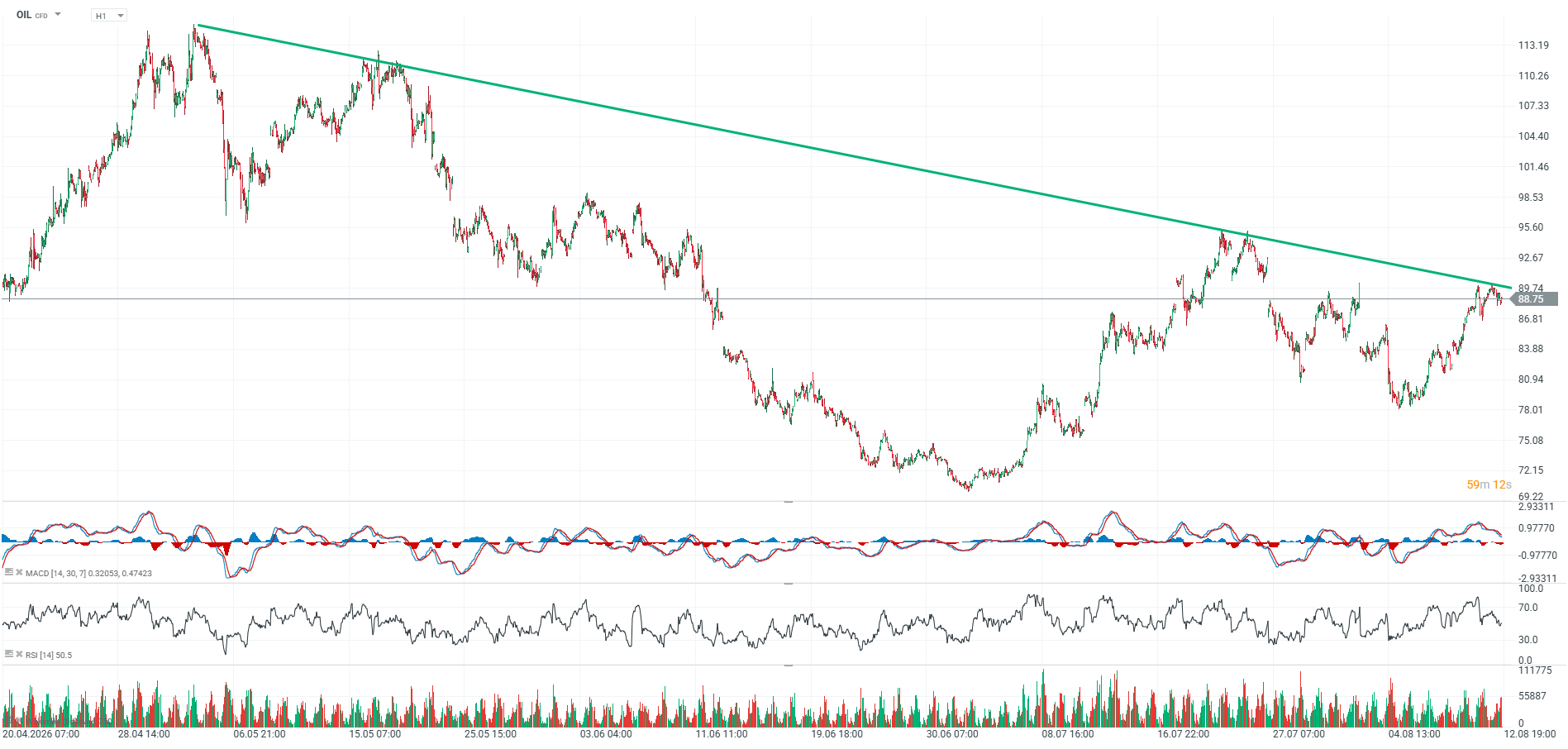
OIL (H1 interval)
Looking at oil prices on the lower, hourly timeframe, Brent has pulled back below $90 per barrel, following the path of least resistance as the medium-term trend remains downward.
 Source: xStation5



Daily Summary: Earnings Season Kicks Off on Wall Street Amid Mixed Sentiment



Market Wrap: European Stocks Rise as Banks Beat Earnings Expectations


🚩 US100 loses 0.7%



Morning Wrap: Tech Crash in Asia and Hawkish Central Banks in the Shadow of an Oil Shock (13.10.2026)
The content of this report has been created by XTB S.A., with its registered office in Warsaw, at Prosta 67, 00-838 Warsaw, Poland, (KRS number 0000217580) and supervised by Polish Supervision Authority ( No. DDM-M-4021-57-1/2005). This material is a marketing communication within the meaning of Art. 24 (3) of Directive 2014/65/EU of the European Parliament and of the Council of 15 May 2014 on markets in financial instruments and amending Directive 2002/92/EC and Directive 2011/61/EU (MiFID II). Marketing communication is not an investment recommendation or information recommending or suggesting an investment strategy within the meaning of Regulation (EU) No 596/2014 of the European Parliament and of the Council of 16 April 2014 on market abuse (market abuse regulation) and repealing Directive 2003/6/EC of the European Parliament and of the Council and Commission Directives 2003/124/EC, 2003/125/EC and 2004/72/EC and Commission Delegated Regulation (EU) 2016/958 of 9 March 2016 supplementing Regulation (EU) No 596/2014 of the European Parliament and of the Council with regard to regulatory technical standards for the technical arrangements for objective presentation of investment recommendations or other information recommending or suggesting an investment strategy and for disclosure of particular interests or indications of conflicts of interest or any other advice, including in the area of investment advisory, within the meaning of the Trading in Financial Instruments Act of 29 July 2005 (i.e. Journal of Laws 2019, item 875, as amended). The marketing communication is prepared with the highest diligence, objectivity, presents the facts known to the author on the date of preparation and is devoid of any evaluation elements. The marketing communication is prepared without considering the client’s needs, his individual financial situation and does not present any investment strategy in any way. The marketing communication does not constitute an offer of sale, offering, subscription, invitation to purchase, advertisement or promotion of any financial instruments. XTB S.A. is not liable for any client’s actions or omissions, in particular for the acquisition or disposal of financial instruments, undertaken on the basis of the information contained in this marketing communication. In the event that the marketing communication contains any information about any results regarding the financial instruments indicated therein, these do not constitute any guarantee or forecast regarding the future results.