



The start of the Q1 2026 earnings season highlights a clear divergence between the Energy and Utilities sectors within the S&P 500. In Energy, a tension persists between a supportive oil price environment and deteriorating expectations for some of the largest companies. Utilities, by contrast, remain one of the more stable segments of the market, benefiting both from their defensive characteristics and from structurally rising electricity demand.
Energy companies
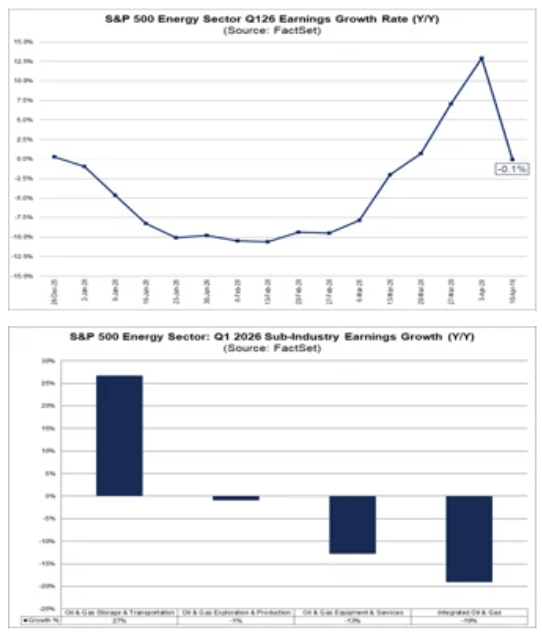
The Energy sector is currently expected to be one of the weakest in the index in terms of year-over-year earnings growth, with a projected decline of 0.1%. The sector’s outlook has been materially impacted by downward revisions for Exxon Mobil, which is now the primary contributor to the expected earnings contraction. Excluding Exxon, the sector would be posting solid earnings growth, suggesting the weakness is concentrated rather than broad-based.
- Refining, marketing, and midstream infrastructure are currently the strongest segments, benefiting from improved market conditions. In contrast, integrated oil & gas, oilfield services, and upstream companies are showing weaker performance.
- While rising oil prices support sentiment, the average price of crude for the quarter was only slightly higher than a year ago, limiting the positive impact on earnings.
- Geopolitics remains the key variable. The sustainability of elevated oil prices will depend on developments in the Middle East and their impact on supply and export infrastructure.
- At the same time, producers are maintaining capital discipline, with no meaningful shift in production or capex plans, indicating that the current price environment is not yet viewed as a structurally higher regime.
- Medium-term expectations remain strong, with the market anticipating a significant acceleration in earnings growth in the coming quarters.
The escalation of tensions in the Middle East pushed WTI crude above $100 per barrel for the first time since 2022, providing a direct boost to revenues for oil-weighted E&P companies—an effect likely to be visible in current earnings. This contrasts with gas-focused producers, where pricing remains relatively stable despite a temporary spike during Winter Storm Fern. LNG export demand in the U.S. is constrained by high utilization, while storage levels remain close to the five-year average. Despite elevated prices, the durability of the oil rally remains uncertain and largely dependent on the trajectory of the conflict. It is therefore not clear whether higher prices will translate into sustained profitability for major oil companies.
The extent of potential damage to critical infrastructure—such as oil fields, pipelines, and export terminals—will be decisive for supply dynamics and price sustainability. Although modest production growth in the U.S. is expected later this year, it is premature to characterize the current environment as a sustained high-price cycle. As a result, companies are likely to stick to existing production and capex guidance rather than aggressively revising plans upward.
Source: FactSet
Utilities companies
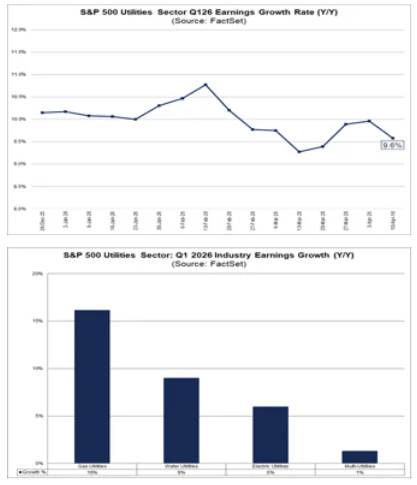
The Utilities sector enters the earnings season with one of the stronger growth profiles in the S&P 500, with expected earnings growth of 9.6% year over year. Compared to Energy, this growth is more stable and broadly distributed, with all major industry groups expected to contribute.
- Independent power producers and renewable-focused companies are performing particularly well, although meaningful contributions also come from gas, water, and electric utilities.
- In the near term, the sector benefits from its defensive characteristics, but increasingly from structural demand growth for electricity.
- A key driver is the expansion of data centers and AI-related infrastructure, which is expected to increase system load and support investment in grid capacity and generation.
- At the same time, the sector operates in a more uncertain regulatory environment, particularly in offshore wind.
- Rising political risk around offshore wind may lead to a reallocation of capital toward natural gas and LNG, implying a more pragmatic—but less “green”—energy transition.
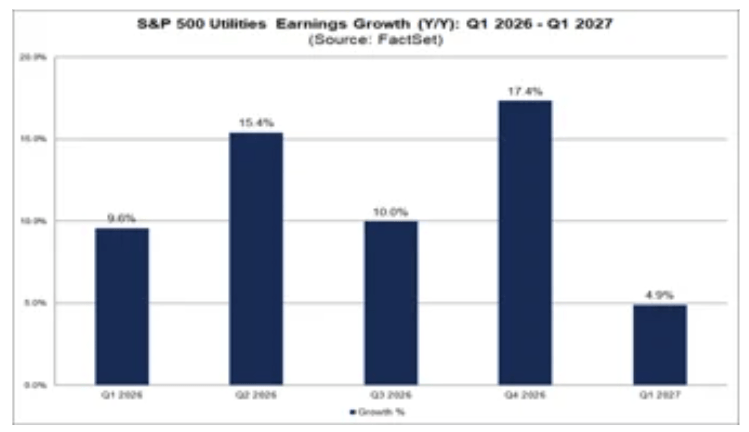
- From an investor perspective, Utilities remain one of the more predictable segments of the market, offering relatively stable earnings growth in the coming quarters.
Since the beginning of the Trump administration, offshore wind projects have faced significantly increased uncertainty. Lease sales and permitting in federal waters were halted early on, followed by stop-work orders for projects under construction. Although courts later blocked these measures, the outlook for new leasing activity remains limited in the near term. After construction resumed, projects such as Revolution Wind and Coastal Virginia Offshore Wind began delivering power, while Vineyard Wind completed turbine installation.
Regulatory uncertainty has also begun to drive capital reallocation. A $928 million agreement between the U.S. government and TotalEnergies will see the company exit offshore wind leases in exchange for reinvesting in LNG and Gulf of Mexico oil production. The Department of the Interior has since initiated discussions with other leaseholders on similar arrangements. If replicated more broadly, this could accelerate long-term investment in natural gas. Such a shift would support near- and mid-term electricity demand growth—particularly from AI infrastructure—while slowing the development of offshore wind, previously seen as a cornerstone of long-term energy transition.
Source: FactSet
The Energy sector remains primarily driven by oil prices, revisions for major companies, and geopolitical risk. Utilities, on the other hand, are increasingly becoming an exposure not only to defensiveness but also to long-term growth in electricity demand and the evolving energy mix. For the market, this distinction is critical: Energy is characterized by volatility and selectivity, while Utilities are gaining importance through predictability and the quality of their growth profile.
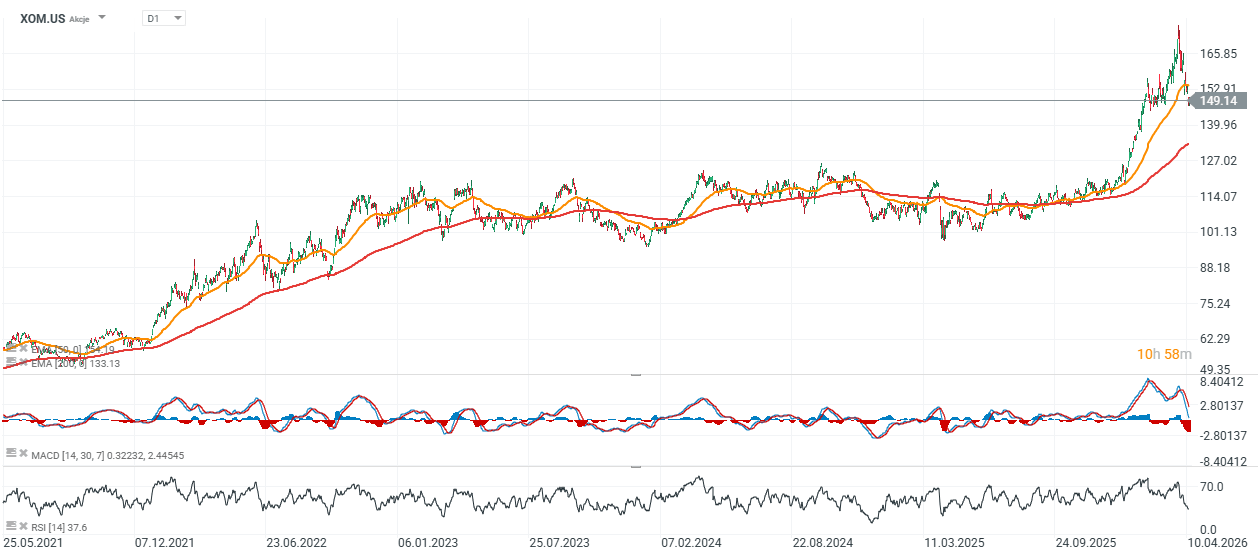
XOM.US, D1 interval
Source: xStation5



US OPEN: Anthropic filing and Iran talks support the market
Anthropic files prospectus ahead of IPO with "ANT" ticker on Nasdaq. The launch date and price remain a mystery
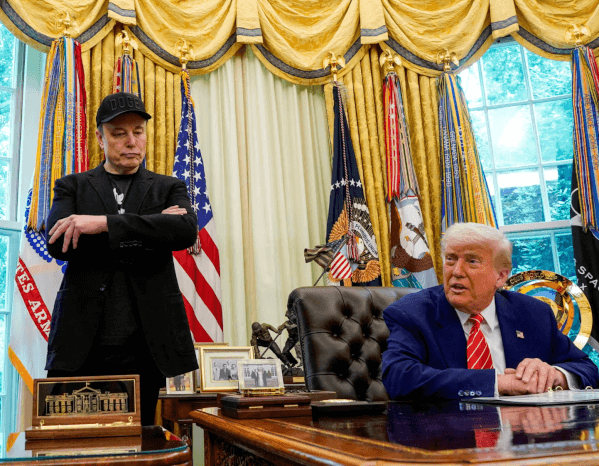


Musk Borrows $40 Billion for AI and Warns Rivals: Neocloud Providers Could Face Serious Trouble



Three markets to watch next week (23.10.2026)
The content of this report has been created by XTB S.A., with its registered office in Warsaw, at Prosta 67, 00-838 Warsaw, Poland, (KRS number 0000217580) and supervised by Polish Supervision Authority ( No. DDM-M-4021-57-1/2005). This material is a marketing communication within the meaning of Art. 24 (3) of Directive 2014/65/EU of the European Parliament and of the Council of 15 May 2014 on markets in financial instruments and amending Directive 2002/92/EC and Directive 2011/61/EU (MiFID II). Marketing communication is not an investment recommendation or information recommending or suggesting an investment strategy within the meaning of Regulation (EU) No 596/2014 of the European Parliament and of the Council of 16 April 2014 on market abuse (market abuse regulation) and repealing Directive 2003/6/EC of the European Parliament and of the Council and Commission Directives 2003/124/EC, 2003/125/EC and 2004/72/EC and Commission Delegated Regulation (EU) 2016/958 of 9 March 2016 supplementing Regulation (EU) No 596/2014 of the European Parliament and of the Council with regard to regulatory technical standards for the technical arrangements for objective presentation of investment recommendations or other information recommending or suggesting an investment strategy and for disclosure of particular interests or indications of conflicts of interest or any other advice, including in the area of investment advisory, within the meaning of the Trading in Financial Instruments Act of 29 July 2005 (i.e. Journal of Laws 2019, item 875, as amended). The marketing communication is prepared with the highest diligence, objectivity, presents the facts known to the author on the date of preparation and is devoid of any evaluation elements. The marketing communication is prepared without considering the client’s needs, his individual financial situation and does not present any investment strategy in any way. The marketing communication does not constitute an offer of sale, offering, subscription, invitation to purchase, advertisement or promotion of any financial instruments. XTB S.A. is not liable for any client’s actions or omissions, in particular for the acquisition or disposal of financial instruments, undertaken on the basis of the information contained in this marketing communication. In the event that the marketing communication contains any information about any results regarding the financial instruments indicated therein, these do not constitute any guarantee or forecast regarding the future results.